
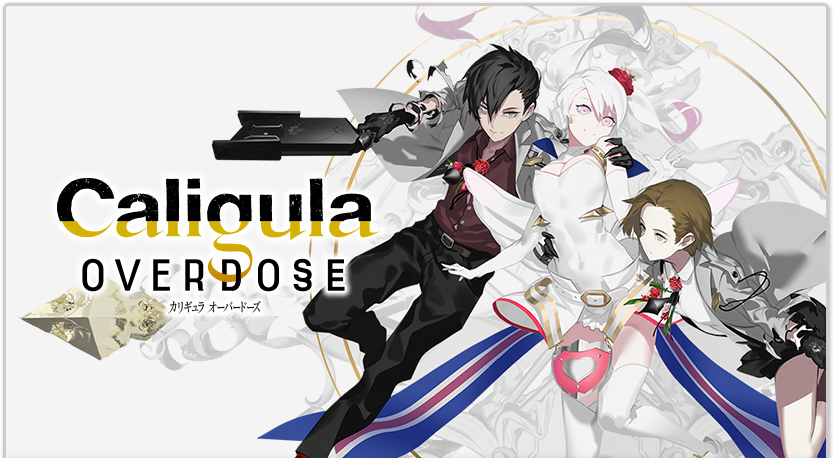
Caligula Overdose" is a PS4 title that is a remake of the PSvita RPG software "Caligula" released by Frew. The storyline is the same as the PSvita version, with the main character and his friends forming a "homecoming club" to return to reality and escape from the virtual world, but the main feature of this title is the addition of the storyline of the "Musicians of Ostinato," the nemesis of the homecoming club.
One of the key words of this work, a group that realizes that Mobius is a virtual reality and aims to "go home" to reality. The main characters belong to this group.
Ostinato (persistent repetition) musician
One of the important keywords of this work, a faction of those who sympathize with μ to create a paradise where people can escape from painful reality and give her strength through providing songs for her to sing.
They are called "rogues" (rebels) who wish to return to the real world like the homecoming group and others like them. They do not approve of their attempts to escape when they realize that Mobius is a virtual reality, and they try to stop them even by the use of force.
cathartic effect
One of the key words of this work, it is a stabilizer of runaway emotions such as anger, frustration, and hatred, which Aria stabilizes by using her own power to tune them into the form of a weapon. It is also the only power capable of opposing Digihead and Ostinato's musicians.
Basically, the hand or arm holding or wearing the weapon is blackened, and depending on the feelings, a mask, mask, or other sub ornaments are attached. Incidentally, the manifestation of the cathartic effect itself is impossible for those who are not members of the homecoming club, and the students who appear as enemies in the Musicians' route and who aspire to return to reality, whom the Musicians call "laggards," are temporarily stabilized by Aria with the Digihead's ability.
In addition, since the cathartic effects and the armament of the digi-heads are invisible to the normal inhabitants, the battle with the digi-heads and laggards is perceived as a "fight that happened" and the memory of it is erased by Aria each time. The direction at the time of appearance is basically the appearance of spines on the chest and back, followed immediately afterwards by the appearance of the armament. The thorns on the chest are decorated with different flowers for each character.
astral syndrome
It refers to the symptom of a person who has been lured to Mobius and has become a shell of a soul in the real world. The spirit is trapped in Mobius and only the body is left in the real world. Although the person can perform the minimum activities necessary for life, such as defecation and eating, he or she cannot continue living for long without the care of others.
Famous quotes, lines/scenes and scenes from "Caligula Overdose".
Another perspective not seen back home.
The most noteworthy element of this work is the story of the "Musicians of Ostinato," the antagonist of the main character and his homecoming club. The main character in this story is "Lucid," an invisible musician in a jet-black skull mask and black robe, who, along with μ, Thorn, and other musicians, fights back and forth with the homecoming club to find out why the musicians stay in Mobius and fight to protect it.
An unexpected encounter leads to a new beginning
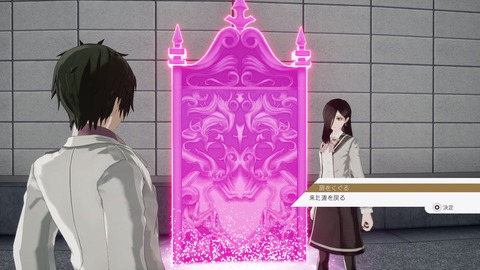
The scene of the encounter with Thorn, the mastermind and the last boss of this work, as in the Vita version, many players could not hide their surprise at the earlier-than-expected encounter with the mastermind and the last boss.
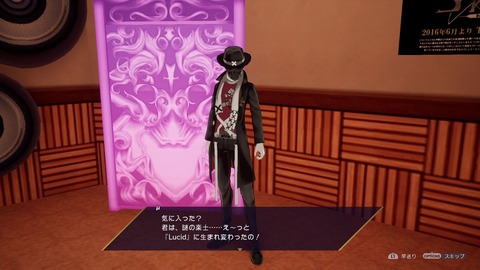
And this is the main character who became the musician of Ostinato. The jet-black coat, hat, and skull mask are somewhat reminiscent of the Grim Reaper.
Immediately after clearing the Sweet P section, I had an unexpected encounter with Thorn, the leader of Ostinato's musicians, when I went to the station square, where she asked me if I would be interested in hearing the thoughts of Ostinato's musicians, those who wish to stay in Mobius. If you choose "No," you will be taken straight into the same story as in the Vita version, where you fight as the head of the homecoming club, but if you choose "Yes," you will be able to enter the story of the musicians of Ostinato.
The protagonist is reunited with μ in the Musicians' Room, which is located just beyond the door, and she gives him the Musicians' form and power. Thorn tells him that as long as he is in that form, he will not be bothered by the fact that he is the head of the club, and that as the head of the musicians, he will give them instructions. He is also told.
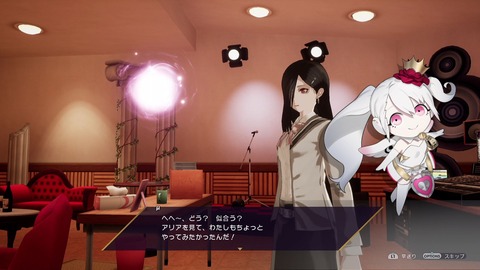
Many players may have been captivated by this adorable character.
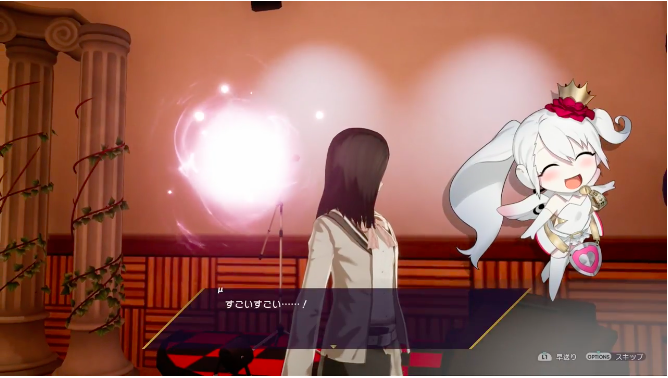
Then came the first performance of Lucid's song "Suicide Prototype," and he and Thorn were thrilled with how well it turned out. His smile was also adorable and smiling.
Then μ said that she would take the place of Aria while the main character was as Lucid, and to my surprise, she remade herself into the same deformation as Aria. I was stunned by μ's amused remark, but made no further mention of it in the form of a nail to Lucid, telling him never to hand over μ to the homecoming club. Then Lucid reminded me that in order to act as a musician, I had to give μ a tune myself, but μ sent his power to the equipment in the musician's room. Then, just as μ had taught him, Lucid sent his images and thoughts to the equipment, and the theme song, which took shape in an instant, flowed. The intense and passionate melody made Thorn gawk and say, "It's a great piece of work. ...... I guess my eyes were right. ......" and μ said, "Yeah, it's amazing, amazing! I'm going to work on my singing! I'm going to do my best to learn to sing! The birth of the mysterious musician "Lucid" remains one of the most famous scenes in the film.
The First Battle of the Jet-Black Musicians
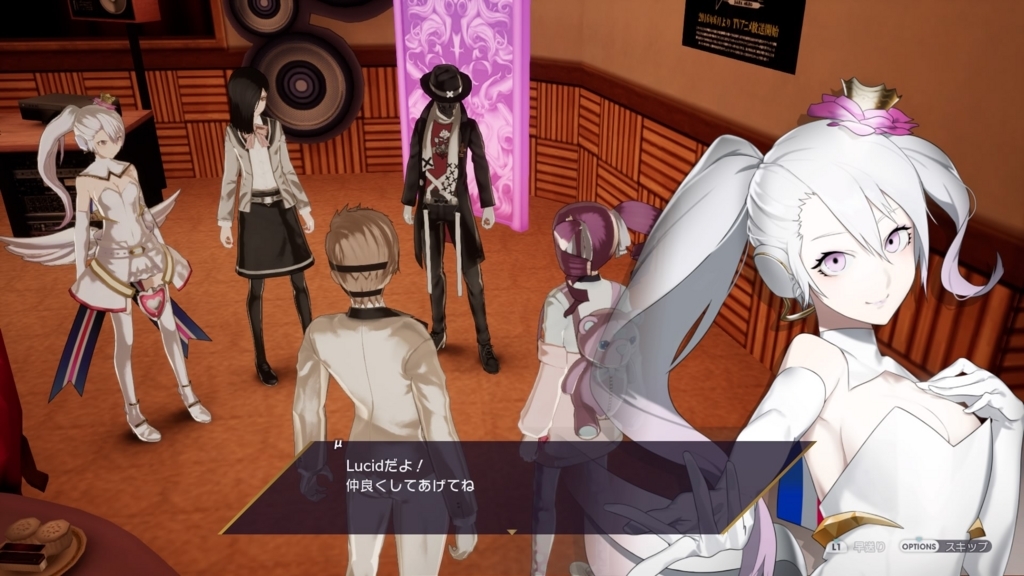
μ and Thorn introduce Lucid to Sweet P and Stork. The appearance of Lucid, with his death-like attire and invisibility, surprises not only Sweet P and Stork, but also the other musicians in the Musicians' Route story that follows.
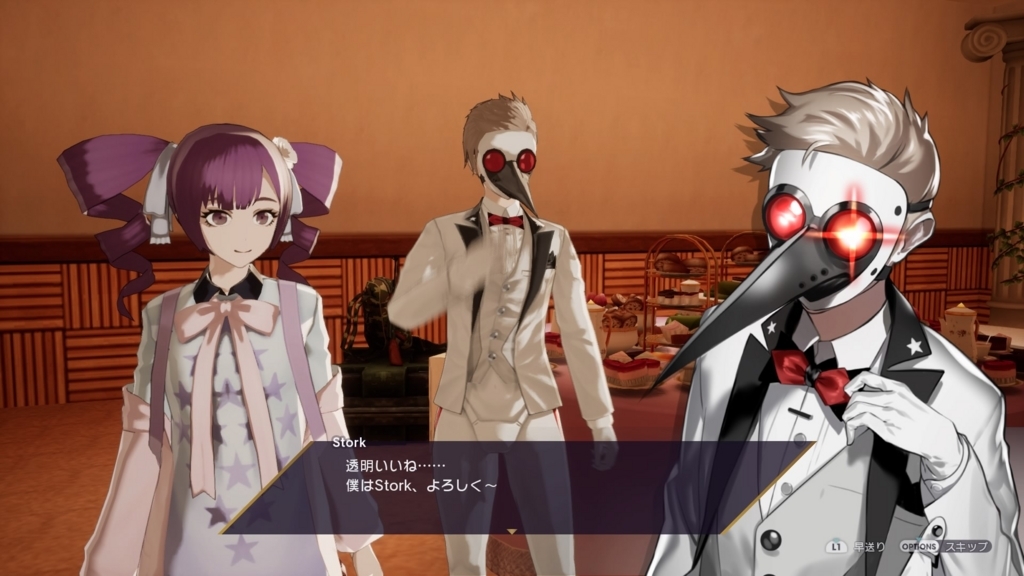
Sweet P and Stork greet Lucid; they and Ike P were the only two musicians who showed a rather friendly attitude.
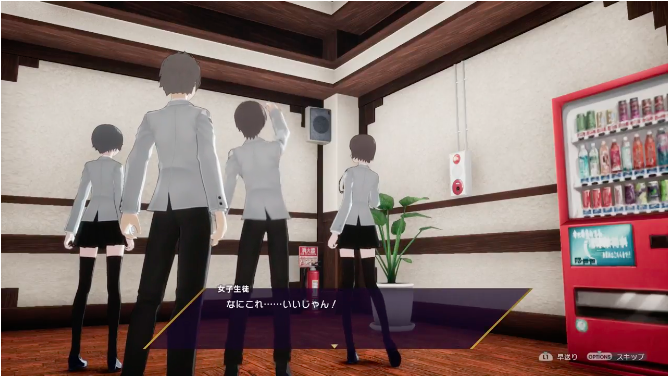
Suicide Prototype" finally sees the light of day by μ. The students, like Thorn and μ, are awed and excited by the results.
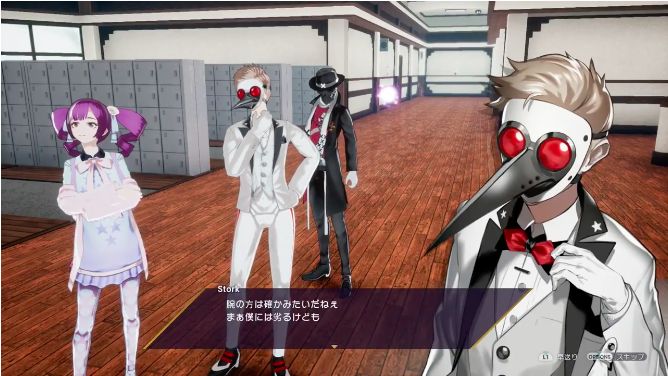
Sweet P and Stork, who were hearing Lucid's music for the first time, also acknowledged and appreciated it in their own way, but perhaps with a sense of pride as musicians, they added a dismissive remark that their own music was not up to their standards yet.
The protagonist's memorable first job as an Ostinato musician and the first battle of the homecoming club is also one of the most memorable scenes in the film for many players: after the battle with Stork, before the homecoming club heads to its next destination, the city library, while Eiji is moving on with his proposed digi-head hunting mission, The protagonist's cell phone promptly receives a message from Thorn telling him to come to the waiting room. The protagonist, seeing that all the returning members had left, became Lucid and headed for the Musicians' Room, where he found Sweet P. and Stork, who had also been summoned by Thorn. I was surprised to see Sweet P. and Stork, who had also been summoned by Thorn. Who are you? Who are you? And the invisible man? Sweet P and Stork could not hide their surprise, but after listening to μ and Thorn's explanation, they got their bearings and bailed out for now.
Later, when Lucid heads to Kichishimai High School with Sweet P, Stork, and a deformed μ, μ finally begins to play Lucid's theme song "Suicide Prototype," which he has completed as a song by infusing his own singing voice into it, over the school broadcast. The students are excited by the intensity and passion of Lucid's song, and begin to rejoice. Sweet P. and Stork, like Thorn, are impressed with the quality of Lucid's song and give it a fair amount of credit, but still dismiss it as not as good as their own. Then μ said, "Let's go ask everyone to stay in Mobius!" and Lucid, along with Sweet P and Stork, embarked on their first battle at Kichishimai High School.
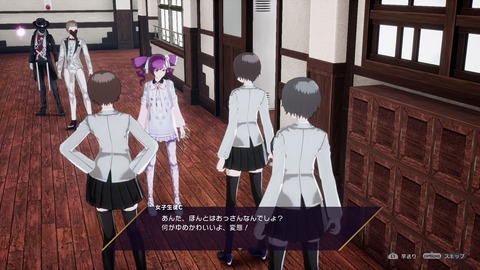
Sweet P. tried to keep the conversation quiet by finding the students who were his fans, but sadly, he was bitten by an unexpected turn of events when the students learned of his true identity at the Miyahi Hot Springs Story.

Related Articles
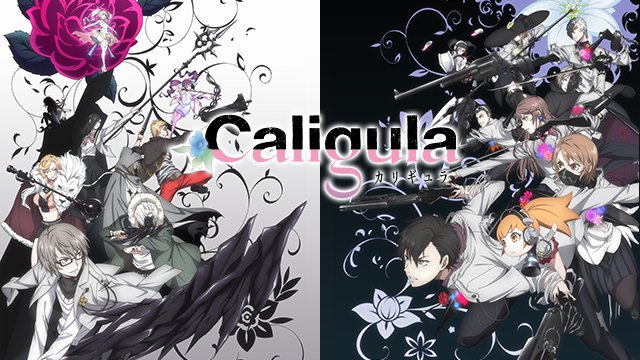
Spoiler commentary and discussion of Caligula -Caligula- (anime)
Caligula" is an anime adaptation of a juvenile RPG game released by Furyu. It depicts a group of people with a dark heart who try to escape from an idealized virtual world. The story is about the main character, Ritsu Shima, who is the official character of the game, and his attempt to return to reality from the virtual world created by μ. He confronts the musicians of Ostinato, who provide songs to μ and still cooperate with μ, and destroys the virtual world to return to reality.
Read Article
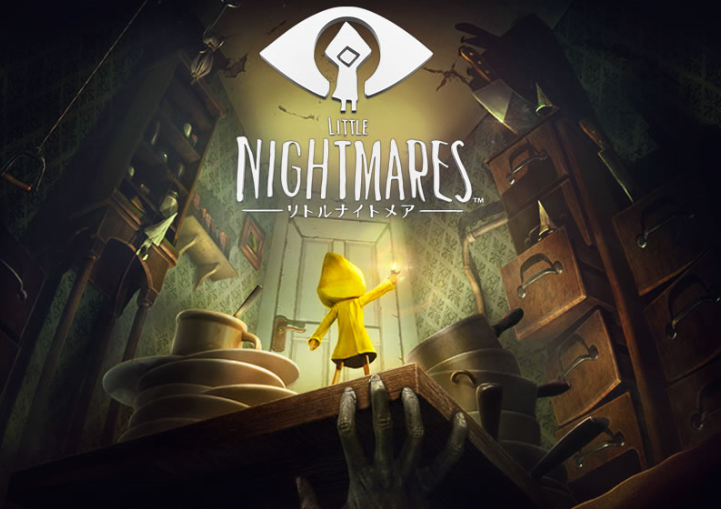
LITTLE NIGHTMARES spoiler commentary and discussion summary
LITTLE NIGHTMARES" is a suspense adventure game released by Namco Bandai Entertainment. It was developed by Tarsier Studios. The main character is Six, a young girl in a yellow raincoat who wakes up in the depths of the Mou, a huge ship called a stomach. The player controls Sixx and proceeds to escape the Mou while solving various tricks that exist in the Mou and sometimes escaping from the enemies that attack her.
Read Article
Tags
Contents
- Overview of "Caligula Overdose
- Synopsis and story of Caligula Overdose
- Return home route, top
- Prologue - Kagi P.
- Sweet P ed.
- Stork Edition
- Musicians' Route, Upper
- Yoshimai High School
- Return home route, middle
- Shonen Dole ed.
- Gardenia ed.
- Mirei, ed.
- Musicians' route, middle
- Miyahi Onsen Monogatari Edition
- City Libraries, ed.
- Return home route, bottom
- Ike P ed.
- Shadow Knife Edition
- Wicked Edition
- Musicians' route, bottom
- Theme Park Edition
- Aquarium Edition
- Landmark Tower Edition
- concluding volume (part) (e.g. of novel)
- Thorne, ed.
- A Reality Named Hope (µ version: Homecoming Route Ending)
- Beyond Betrayal (Aria version: Musicians' Route ending)
- Game System of "Caligula Overdose
- field
- Conversations with Students
- Encounter with Digihead (Lagarde)
- trauma quest
- WIRE
- stigma
- skill reel
- battle
- action option
- weapon system
- Two pistols (main character, Ike P.)
- Pistol (Shogo)
- Bow (Kotono, sweet P)
- Tekko (Koutarou)
- Great Sword (Keisuke)
- Hammer (Miho Mirei)
- Spear (Suzuna Thorn)
- Bit (Naruko)
- Nails (boy doll)
- One-handed sword (Weigen, Shadow Knife)
- Stun gun (colored voice, gardenia)
- Whip (Eiji Stork)
- Bomb (Wicked)
- DigiHead equipment
- Future Prediction (Imaginary Chain)
- overdose skill
- risk
- Characters in Caligula Overdose
- group of school pupils who are not members of any club
- protagonist
- aria
- Shogo Satake
- Izuru Minezawa
- Kotaro Tomoe
- Kensuke Hibiki / Kagi P
- Kotono Kashiwaba
- Naruko Morita
- Mifue Shinohara
- Suzuna Kagura
- Ayana Amamoto
- Eiji Biwasaka
- Ostinato Musicians
- Lucid
- μ
- Sweet P / Shizuka Nijoin
- Stork / Masahiro Sagan
- Shounen Doll / Akira Komori
- Gardenia (Gardenia jasminoide) / Yumino walnut
- Mirei Ichinose / Mirei Ichinose
- Ike P / Tomoya Koike
- Shadow Knife / Hiroki Yamada
- Thorn / Asuka Natsume
- Wicked / Marie Mizuguchi
- Other characters
- Koki Tadokoro
- Himari Minamide
- Flower Princess Rose / Lily / Iris
- Toshizo Natori
- Bifue's mother
- Worldview and terminology for Caligula Overdose
- Moebius
- Miyabishi
- landmark tower
- sea paraiso (Origanum vulgare)
- Miyabi Onsen Monogatari
- metavarces
- digital head
- The Department of Return Home (KITAKUBU)
- Ostinato (persistent repetition) musician
- cathartic effect
- astral syndrome
- Famous quotes, lines/scenes and scenes from "Caligula Overdose".
- Another perspective not seen back home.
- An unexpected encounter leads to a new beginning
- The First Battle of the Jet-Black Musicians
- The protagonist who became the true last boss.
- Theme song and insert song for "Caligula Overdose
- Theme song: Cradle
- featured songs
- Suicide Prototype
- Peter Pan syndrome
- Tokimeki☆Liberie
- Love Scope
- Originality Incident
- dilapidated
- Sadistic Queen
- Song of the Angels
- Sin
- Distorted†Happiness
- cosmo dancer
- Orbit
- Veritas
- Backstory, Trivia, and Small Stories/Episodes/Anecdotes from "Caligula Overdose".
- What is the Caligula effect?
- Mental illness suffered by the characters
- Shogo Satake: Adjustment disorder (てきおうしょうがい)
- Minezawa Weigen: Schizoid Personality Disorder
- Kotaro Tomoe: Messiah Complex
- Kikisuke Hibiki: Peter Pan Syndrome
- Kotono Kashiwaba: Cinderella Complex
- Naruko Morita: Internet addiction
- Mifue Shinohara, Ike P.: Body Dysmorphic Disorder (Body Dysmorphic Disorder)
- Suzuna Kagura: Lunchmate Syndrome
- Aya Amamoto voice: Heterophobia
- Eiji Biwasaka: Psychopath (psychopath)
- Suite P: Transvestism (cross-dressing habit)
- Stork: Stalking
- Juvenile Doll: Avoidant Personality Disorder
- Gardenia: aphonia (loss of voice)
- Mirei: narcissistic personality disorder
- Shadow Knife: Chunibyo
- Thorn: Grief
- Wicked: sociopath (antisocial personality disorder)
- New developments you can see if you are a female protagonist
- No. 1: Yuri couples go to a tea party
- No.2: Sneaking into the women's bath
- No.3: Ayako wakes up to the yuri
- Aria and Koutarou are dogs and monkeys in this film as well.
- No. 1: A grand quarrel from the very beginning of our meeting.
- No. 2: Aria, the "big head".
- No.3: A blowout at Suzuna's lunch box
- A beautiful flute that is about to awaken into the wild?
- Suzuna has a yandere attribute.
- Musicians being scratched by Naruko
- No. 1: A boy doll whose room is open to the public.
- No. 2: Mirei furious at the perverted commotion at the hot springs.
- No. 3: Ike P explodes at the disclosure of his appearance in real life.