
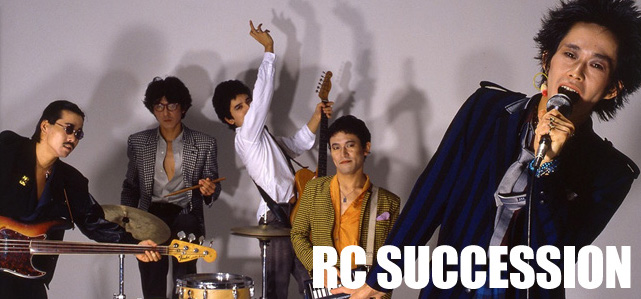
RC Succession is a Japanese rock band that debuted in 1970. Led by vocalist Kiyoshiro Imawano and guitarist Reichi Nakaiido, the band has left behind many masterpieces and classic albums. In 1991, the band went on hiatus and virtually disbanded, and with the death of Imawano on May 2, 2009, the dream of reviving RC Succession was ended forever.
Side A
Suddenly One Day (Toi et Moi)
2. seven daffodils (Toi et Moi)
3. Kose no Hibi (Rock Candy)
4. blue world (Noise Humming)
Barefoot Boy (The Tinkers)
6. it's true (Kenji Endo)
Kimi no Omokage (The Riganeys)
Side B
Hana-chan (The Liganeers)
2. come to my side (kato kazuhiko)
3. hometown mom (Little Maggie)
4. hope (four saints)
Doro Dake no Umi (RC Succession)
Kaze (Rihiko Hashida and the Schuberts) 7.
Lullaby of the Wanderer (Rihiko Hashida and the Schuberts)
*****
CD College Pops Concert Live Recording
*Same as the analog version
Live recording of the final of the "Toshiba College Pops Concert" held on August 29, 1969 at Shibuya Kokaido.
This is the first officially released sound recording for RC Succession.
The tempo of the performance is slower and more relaxed than the studio recordings that were later released.
Seishiro's voice is very elongated, and the well-harmonized chorus is very pleasing.
Around 1969, air and water pollution, destruction of nature, and other pollution problems were intensifying due to the effects of rapid economic growth. In the case of water pollution, Minamata disease killed many people, and in the case of air pollution, photochemical smog was first confirmed in Tokyo in 1970. The lyrics of "Dorodarake no Umi" (The Sea of Dirt) address these social issues. It is proof that Seishiro's radical attitude was already budding. In addition, by interjecting familiar phrases such as "Even that girl's swimsuit is pitch black" into a song about a major social issue, Seishiro was already showing his extraordinary talent for songwriting by reminding the audience that "this is not someone else's business, but our own problem.
The album includes a total of 10 artists other than RC.
Toi et moi" is a duet by a man and a woman who debuted on May 10, 1969 with "Suddenly One Day.
Rock Candies" was a trio of two men and one woman. Shinji Tanimura, who later formed Alice, was a member of this trio.
Noise Humming" was a folk group of four men.
The Tinkers" is a folk duo of two women.
Kenji Endo is a leading figure in the Japanese folk and rock world. Unfortunately, he passed away on January 13, 2017. Their debut song was "It's true," which is included here.
The Riganese" is a folk group of five men. Their debut song "Umi ha Koishiteru" is their most famous song.
Kazuhiko Kato is a member of "The Folk Crusaders," which debuted in 1967 with "Kitaitekita Yopparai. He, too, had made a great contribution to the Japanese music world, but he committed suicide by hanging himself on October 16, 2009.
Little Maggie" was a folk group of four men.
The Four Saints are a folk group of four men. Their most famous song is "Little Diary.
Rihiko Hashida and the Schuberts" was a four-member folk group formed by Rihiko Hashida, who made his debut as "The Folk Crusaders" with Kazuhiko Kato. Incidentally, the host of the show, Osamu Kitayama, was also a member of "The Folk Crusaders.
The analog version is already out of print, and a CD was released on August 8, 2007 as a limited edition, but it is also out of print now.
The CD is still available in used condition. Analog copies are very occasionally used or sold at auctions.
1970
March 5: Single "I Don't Buy Lottery Tickets"
Side A
1. do not buy lottery tickets
Side B
1. sea of mud
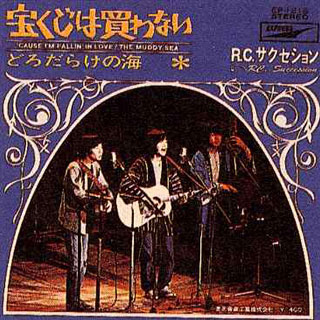
RC Succession's debut single.
The "Kimotsuwa Hanbaiichi" in the credits is a ben name of Imawano Kiyoshiro.
Since no detailed recording data was left behind, we do not know the detailed members of the backing band. According to one description, "Iseda Trio, brought by the manager at that time, was in charge of the backing band. Both sides A and B include horns, so it is likely that the "Iseda Trio" was replaced by studio musicians, considering that the trio formation "Iseda Trio" would not have been able to cope with this. In any case, no RC Succession performances are recorded except for Seishiro's vocals and the backing vocals of the other members.
The song "Takara-Kuji wa I'll Never Buy a Lottery Ticket" was written by Kiyoshiro Imawano, composed by Bandukazu Kimosawa, and arranged by RC Succession and his friends.
The lyrics are said to be inspired by "Can't Buy Me Love" by The Beatles. Seishiro here does not make the big, righteous statement that "love can't be bought with money," but rather expresses it by drawing it down to the level of the common man, "I won't buy a lottery ticket.
There are horns in this song, but they are a bit jarring.
Dorodarake no Umi" was written by Kiyoshiro Imawano, composed by Bandukazu Kimosawa, and arranged by RC Succession and his friends.
The tempo of this song is faster than the live version recorded at the "College Pops Concert Live Recording". Like "I Don't Buy Lottery Tickets," this song does not seem to need horns.
December 5: Single "Full of Tears
Side A
1. full of tears
Side B
1. singing "Yes tady wo utetta
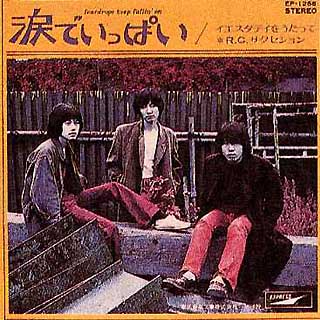
Second single.
The song "Yes Study wo Utter" was included in the album "Hard Folk Succession" released on March 21, 1982, but "Tears Filled with Tears" remained difficult to find until it was included in the omnibus album "Far East Rock Rare Tracks" released on October 11, 1989. This omnibus album is now also out of print.
In 1990, RC's album was reissued to commemorate the 20th anniversary of RC's debut, and it was included in the "RC Succession's rare 8cm CD containing three songs that will never be available again," which was given away by lottery to those who purchased the album. The three songs were "Dorodarake no Umi", "Tears in My Heart", and "Yasashisa".
The songs were included in the best album "THE RC SUCCESSION BEST ALBUM WONDERFUL DAYS 1970-80" released on June 1, 2005, and are now finally in stable supply.
Today, both "Tears Full of Life" and "Singing Yesterday" can be heard on "Early RC Succession +4" released on November 4, 2015.
Both the A and B sides are sung and performed by RC himself, with no other members of RC playing on them, thus only two acoustic guitars and a wood bass.
Tears in My Heart" was written by Kiyoshiro Imawano, composed by Bandichi Kimosawa, and arranged by RC Succession.
The absence of any extra instruments allows the audience to enjoy their exquisite chorus work on this song.
Yesterday," written by Kiyoshiro Imawano, composed by Hakuichi Kimozawa, and arranged by RC Succession, is another song performed by just the three of them.
Since only three members perform this song, you can feel their charm in every part of the song. The bluesy lead guitar of Kenchi is especially superb.
1972.
February 5: Single "Bokuno no Sensei" (My Favorite Teacher)
Side A
1. my favorite teacher
Side B
1. 3-1, Naka-ku, Kunitachi City (Please give me an answer)
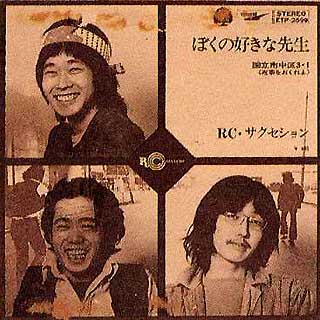
The third single released after a one-year absence.
It was released at the same time as their debut album "Early RC Succession" and became their first hit song.
For an overview of each song, see the album "Early RC Succession.
February 5: Album "Early RC Succession
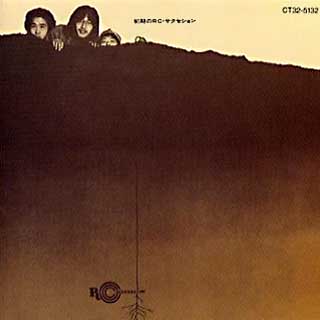
Side A
1. 2 hours 35 minutes
2. my favorite teacher
3. 3-1 Naka-ku, Kunitachi City (Give me an answer)
4. shoo
5. spring has come
6. message
Side B
1. song of king wanon i
2. the world is gold
3. i was not born to make money
4 . Freedom of Speech
5. baby don't cry no more
6. in bed
*****
CD Early RC Succession +4
01. 2 hours 35 min.
02. my favorite teacher
03. national city, naka-ku 3-1 (give me a reply)
04. shoo
05. haru ga kita kara
06. message
07. song of king wanon i
08. the world is gold
09. not born to make money
10. freedom of speech
11. baby don't cry no more
12. in my bed
13. i don't buy lottery tickets
14. sea of mud
15. full of tears
16. sing yesterday
Debut album by RC Succession.
All songs are written by Imawano Kiyoshiro, composed by Kimotsuwa Hanbunichi, and arranged by Hoguchi Yuuji. Yuuji Hoguchi was a keyboardist in the GS group "Outcast. He later achieved great success working with "Candy's". The arrangements were made without the members' permission, and the members were very unhappy when they heard the finished sound. However, the sound of the telephone call at the beginning of the song was recorded at the members' own idea.
Although unpopular with the members, the arrangements, sometimes psychedelic, sometimes avant-garde, with glimpses of experimentation in places, might now be called "acid folk.
This trend can be seen not only in the arrangements, but also in RC's chorus work and guitar work, especially in the guitars that Kenchi is seasoning in the background, and the development of many of the songs is not straightforward.
Their debut single "Takarakuji ha nai buy no ka" was released on March 5, 1970, almost two years after the release of their first single "Takarakuji ha nai buy no ka". The songs on this album were also written during that two-year period, so they felt that they were "early songs" for them. There is a theory that this is why the title of the album, "Early days" was given to the album. Although the true meaning is not clear, there is an ironic impression that seems to be typical of them.
The motif of "2 hours and 35 minutes" is based on a phone call between Seishiro and his then-girlfriend "Chiiko-san" that lasted for 2 hours and 35 minutes on June 3, 19693. It begins with the dial tone of a dial telephone (it is difficult to find a dial telephone nowadays) and ends with the sound of a pillar clock (it is also difficult to find a pillar clock nowadays) and the sound of an actual telephone conversation. The caller is Kazuo Kobayashi's sister, who actually called him late at night during the recording session, an extremely annoying technique.
Boku no Suki na Sensei" became RC's first hit song. It was modeled after "Mr. Kobayashi," the art club advisor at Hino High School, which Seishiro attended. At his high school graduation ceremony, Mr. Kobayashi told Seishiro, "If there is something you really want to do, don't get married. He remained single throughout his thirties, but when Mr. Kobayashi saw RC perform for the first time, he told him, "It's okay, you've already done enough," and he ended up marrying Ms. Ishii, whom he had been dating for a long time.
Although "3-1 Naka-ku, Kunitachi-shi" seems to be an actual address, there is no "XX-ku" address in Kunitachi-shi. However, when "3-1 Naka, Kunitachi City" is used, Toho Junior High School and Toho Senior High School are searched. This is the school that Reichi Nakai attended. Since Seishiro and Nakaiido were already in contact during this period, the song may have been written for Nakaiido. The lyrics of the song could be taken to refer to either a man or a woman.
Shoe" is a very typical Seishiro song. The guitar riff is completely rock.
At the end of "Haru ga kita kara," the song cross-fades into the single "Sannichiban de itai na mono" (The Third Most Important Thing), which was to be released on December 20 of the same year. Both "Haru ga kita kara" and "Sannichiban ni Ikaikan mono" (The Grave) are songs about Seishiro's breakup with the daughter of a tofu shop owner with whom he was dating at the time.
Message" is a 42-second song about how "even if the customers are all jerks, we always sing our best.
The song "Song of King Wanon I" is a song about the disdain for women, which would definitely be a problem nowadays. Wanon" is a coined word combining "Imawano" and "(John) Lennon. The last part of the song, "She is good at pedaling a bicycle even though she is a woman," is diverted to "Ride on the back of Nisumi-kun's bicycle," which will be included in the second album.
The song was always sung in combination with the next song, "I wasn't born to be a gold-digger.
The song "Freedom of Speech" was a prediction of the "COVERS" uproar that followed. In fact, the song was performed live at Hibiya Open-Air Concert Hall in August 1988 after the release of "COVERS," and a live version was included in "Cobra In Trouble," which was released on December 16 of the same year. It is also said that Tomokazu Miura plays the bongos in the background.
The lyrics of "Baby, Don't Cry Anymore" are straightforward, but the song has a somewhat avant-garde flavor.
The song "In the Bed" was actually written when Seishiro was sick in bed with a cold.
July 5: Single "Kimi kawaii ne
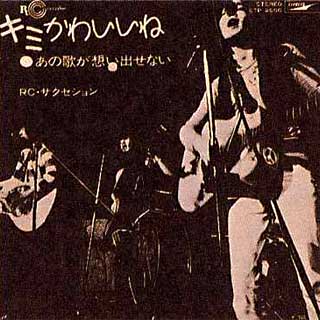
Side A
1. you're cute
Side B
1. can't remember that song
The 4th single.
Kimi kawaii ne" is a song written by Kiyoshiro Imawano, composed by Hakuichi Kimosawa, and arranged by Kenichi Toren.
The song is full of irony: "Kimi kawaii ne, but that's all there is to it, isn't it? Kiyoshiro sings in falsetto except for the chorus part. The ending, which includes a fade-out, lasts nearly 1 minute and 20 seconds, and the sound gets quieter and quieter, but it does not end completely. This is one of the little things that show the experimental attitude of the band.
Ano uta wo memoradasenai" (I can't remember that song) was written by Kiyoshiro Imawano, composed by Seiichi Takeda, and arranged by Kenchi Toren.
Seiichi Takeda was a member of "The Remainders of The Clover" and later formed Nipporini.
This song was also included in the second Kaguyahime's debut album, "Nice to meet you," and there are rumors circulating that Seishiro went to Kaguyahime to pitch the song, but this is a false rumor.
Takeda, the composer of the song, said, "When I was in Strawberry Cream (the band Takeda was in at the time), I got to know Yamada Panda (Kaguyahime's bassist), and when he heard me singing this song in Strawberry Cream at the time, he said, 'Can you let us sing it? He heard me singing this song with Strawberry Cream at the time, and asked if he could sing it with us. I think RC was singing it live at the time. So I went to Kiyoshi (Seishiro) and asked him, "Yamada Panda and the others want to sing. He said, 'If Kiyoshi (Takeda) wants to sing it, it's fine,' so they covered it.
December 5: Album "On a joyful evening".
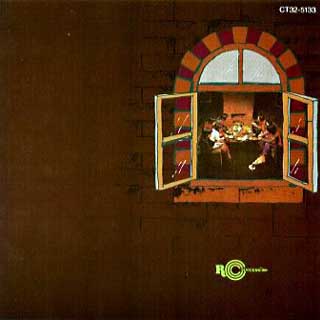
Side A
1. la la la la la la
2. congratulations emi!
3. too busy
4. bad rumor about that girl
5. even though it's September
Side B
1. sleepy
2. calm down more
3. you too, come here
4. this time last year
5. ride on the back of your bicycle, sunsumi kun
Ride on behind me on my bicycle.
*****
CD Happy Evening +4
01. la la la la la
02. congratulations emi!
03. because i was too busy
04. that girl's bad rumor
05. even though it's september
06. sleepy
07. calm down
08. come here
09. this time last year
10. ride behind me on your bicycle
11. get on the back of my bicycle
12. you're cute
13. that song i can't remember
14. the third most important thing
15. smoke
The second album was released 10 months after the debut album.
The members were dissatisfied with the arrangements on the debut album, which they did not intend to use, so they tried to self-produce this album.
Drummer Seiji Tanaka used to play drums in the backing band for Johnny's Junior. He later joined the GS bands "Junior Boys," "The Alpha," and "Rhythm 101," among others. After participating in this work "Fun Evening," he has worked with Takuro Yoshida and Zuno Keisatsu, and joined Kenji Sawada's backing band "Takashi Inoue Band.
Minoru Kuribayashi on piano, in addition to his work with Kyohei Tsutsuumi, participated in "Takuro Live '73" as Takuro Yoshida's backing band, and played keyboards on Kenji Sawada's "Dangerous Together" and on Chiharu Matsuyama's debut album "Song I Made for You".
Morihisa Shibuya on Hammond organ has worked with Fubuki Koshiji and Maki Asakawa, as well as being the musical director for the musical "Blue Bird" and producing Minako Honda's album "JUNCTION". He is also the director of this film "Fun Evening.
This album "Fun Evening" is a little less aggressive and more subdued than the debut album "Early RC Succession. The slightly scattered arrangements of the previous album have disappeared, and the performances are more cohesive.
The song "La La La La La La" was written by Kiyoshiro Imawano and composed by Kenichi Turenchi and Broadband Hitoshi Kimotsuwa.
It has the atmosphere of a party where everyone is enjoying themselves. It reminds me somewhat of John Lennon's (Plastic Ono Band) "Peace Be With You.
The song "Happy Birthday, Emi," was written and composed by Kowao Hayashi.
Vocals are shared by Kobayashi and Seishiro. The song is a casual love song, but it is also a song that makes us feel the love.
Busy Too Much" was written by Kowayo Hayashi with lyrics by Broadbandichi Kimosawa.
The lead vocalist is Kenchi Toren. The album title "Fun Evening" is taken from the first verse of this song. Listening to this song reminds me somewhat of The Blue Hearts.
Ano Musume no Akira" is a song written by Kiyoshiro Imawano with lyrics by Broadbandichi Kimosawa.
It is a hasty song and could be described as a punk song.
September ni Narenakani" was written by Kiyoshiro Imawano and composed by Hanaichi Kimozawa.
Kiyoshiro's vocals here are unique. Kobayashi's well-sung wood bass and scratchy acoustic guitar bring out the heavy and stifling late summer heat of September.
The song "Nemui" was written by Kiyoshiro Imawano with lyrics by Broadbandichi Kimosawa.
The backing chorus sounds like The Beatles. In the interlude, yawning and snoring sounds pop up in the background, while the strings sound discordant, and a clock ticks in the background.
The song "More Calm" was written by Kiyoshiro Imawano and composed by Broadbandichi Kimosawa.
Kobayashi's wood bass really sings well in this song. The song's sad but powerful performance makes the classification of "folk" and "rock" genres seem silly.
Kimi mo koide" was written by Kiyoshiro Imawano with lyrics by Hanaichi Kimosawa.
The duet between Kenchi and Kiyoshiro is backed by Kobayashi's arco bass, and the song is a slightly eerie little piece at 1:13.
The lyrics are by Imawano Kiyoshiro, and the music is by Kimozawa Wanichi.
It is very typical of Seishiro that the record he listens to while "drinking tea at a kotatsu with two people" is Otis. Of course, he was referring to Otis Redding. Three more songs about bicycles follow. The glimpse of Seishiro's later love of bicycles can already be seen here.
The lyrics to "Ride on the Back of the Bicycle of Himu-kun" were written by Imawano Kiyoshiro, and the music was composed by Hayashi Kowaso and Kenchi Toren.
The song was written by Hayashi and composed by Hayashi and Kenchi. Unfortunately, he committed suicide in August 1977.
Incidentally, although the title of the song is "HISUMI," his real name is "HISUMI" in Chinese characters.
He is also credited as the mixer of this album.
The song "Boku no Jitensha no Ushiro ni Nai" was written by Seishiro Imawano, who wrote the lyrics and music for the song.
This is the only song that does not use the pen name "Kimotsuwa Banshiichi" (肝沢幅一). I am not proud of it, but I (the author) also used to ride my bicycle down the hill to the south exit of Kunitachi and through the University Avenue. So, the scenery of this song is somewhat familiar to my eyes. But it was not a two-seater.
The bass drum-like sound of the drums was made by tapping a basketball shoe in front of the microphone. Seishiro said that he used this technique in "Ride on the Back of My Bicycle," but since there is no corresponding sound in "Ride on the Back of My Bicycle," it must have been mistaken for "Ride on the Back of My Bicycle.
December 20: Single "The Third Most Important Thing"
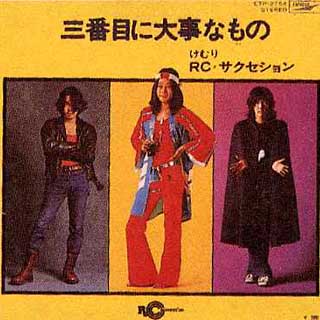
Side A
1. the third most important thing
Side B
1. smoke
The Third Most Important Thing" is a song written by Kiyoshiro Imawano, composed by Broadbandichi Kimozawa, and arranged by Kenichi Daren.
The song has a psychedelic introduction. Once the song begins, it takes on the style of an ordinary folk song, but the use of strings and other elements are still somewhat psychedelic. Like "Haru ga kita kara (Because spring has come)" and "O-grave," this song is about Seishiro's breakup with the daughter of a tofu shop owner with whom he was dating at the time.
Kemuri" is a song written by Imawano Kiyoshiro, composed by Kimozawa Hanyuichi, and arranged by Kenchi Toren.
It is a small piece of about 1 minute and 15 seconds. Kiyoshiro shows various ways of singing. When I listen to these short RC songs, I somehow feel like Tokoro George's roots.

Related Articles
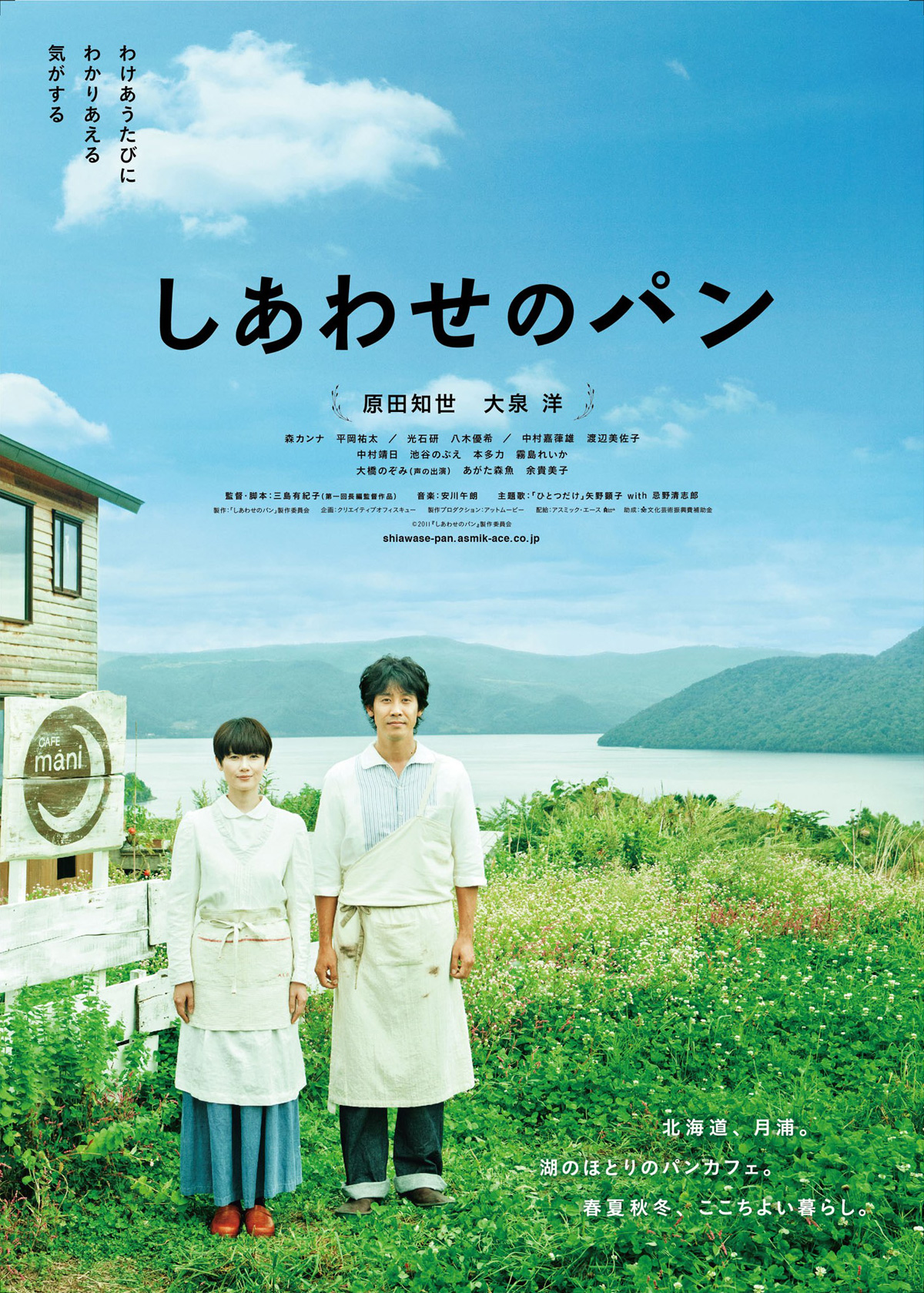
Summary of Bread of Happiness (film) spoilers and discussion
Shiawase no Pan" is a 2012 Japanese human drama film set in Hokkaido. The film was directed and written by Yukiko Mishima, and stars Tomoyo Harada and Yo Oizumi. The film depicts the interaction between Mr. and Mrs. Mizushima, who moved from Tokyo to Hokkaido to run a café, and the customers who visit them. The Mizushima's delicious food and kindness heals the customers, each of whom has their own worries and problems. Rie, the wife with emotional problems, is also healed by the nature of Hokkaido, her husband, and their friends. This is a film in which you can enjoy the beautiful nature of Hokkaido, the unique characters of their friends, the interior design of the restaurant, and the food.
Read Article
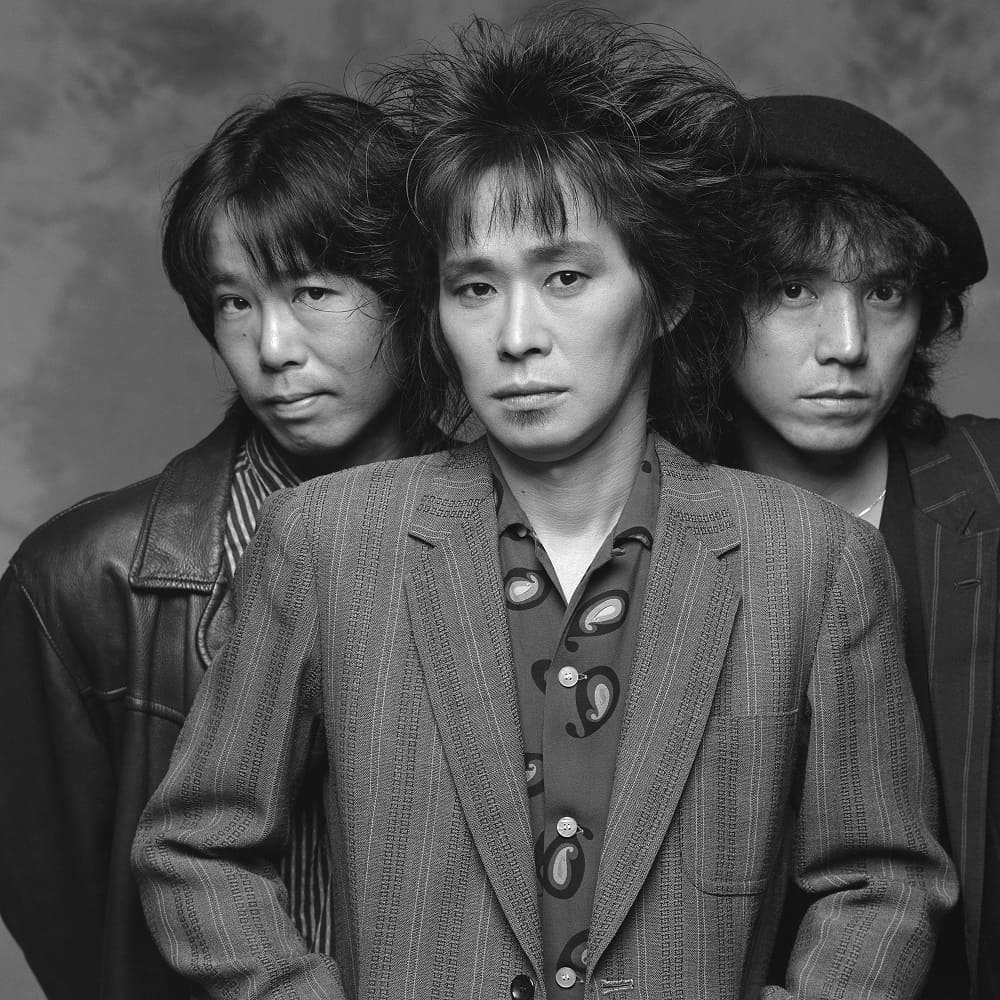
Summary of bands and units that changed their names, including RC Succession!
Here is a list of bands and units that changed their names during the course of their activities. RC Succession", of which Kiyoshiro Imawano was a member, was originally called "The Clover". Other bands and units introduced here include "RIP SLYME," which used to be called "Givinibanko.
Read Article
Tags
Contents
- RC Succession Overview
- Members of RC Succession
- Kiyoshiro Imawano
- Kazuo Kobayashi
- Reichi Nakaiido
- Kozo Araida
- Yoshiya Shibata (Yoshiya Shibata: Gee2wo)
- Former member of RC Succession
- Haren Kenchi(1968 - 1977)
- Ginji Ogawa (1979 - 1980)
- Hirofumi Kasuga (1978, 1990 - 1991)
- Brief History of RC Succession
- 1950-1967: On the Eve of Formation
- 1968-1972: From RC formation to debut
- 1973-1979: Dark Ages
- 1980-1984: To the top of the rock world
- 1985-1987: Increased solo activity
- 1988-1990: "COVERS" album, and then the end
- RC Succession Discography
- 1969.
- November 1: "College Pops Concert Live Recording" album
- 1970
- March 5: Single "I Don't Buy Lottery Tickets"
- December 5: Single "Full of Tears
- 1972.
- February 5: Single "Bokuno no Sensei" (My Favorite Teacher)
- February 5: Album "Early RC Succession
- July 5: Single "Kimi kawaii ne
- December 5: Album "On a joyful evening".
- December 20: Single "The Third Most Important Thing"
- 1976
- January 21: Single "Slow Ballad
- April 21: "Single Man" album
- October 11: Single "You'll Understand"
- 1979
- July 21: Single "Step!
- 1980
- January 21: Single "Ameagari no Yozora ni
- May 21: Single "Boss Shikeiteruze
- June 5: Album "RHAPSODY
- October 28: Single "Transistor Radio
- December 5: Album "PLEASE
- 1981
- June 1: "EPLP" album
- November 21: Album "BLUE
- 1982
- March 21: Album "HARD FOLK SUCCESSION
- April 5: Album "Yeahhhhhh.... at Budokan".
- June 23: Single "SUMMER TOUR
- October 25: Album "BEAT POPS
- December 10: Album "The Day of R&B
- December 15: Single "Tsuki ai ai tai tai
- 1983
- June 1: Single "Oh! Baby
- July 5: Album "OK
- November 7: Single "Baby! Run away."
- December 5: Album "The KING of LIVE
- 1984
- July 21: Single "Wonder
- July 21: Album "EPLP-2
- September 21: Album "The LiVE!
- November 23: Album "FEEL SO BAD
- December 21: "Mix & Mix-er" album
- 1985
- April 21: Single "All is ALRIGHT (YA BABY)
- November 21: Album "HEART ACE" (Ace of Hearts)
- December 21: Single "SKY PILOT Sky Pilot
- 1986
- April 23: Album "NAUGHTY BOY
- October 21: Album "the TEARS OF a CLOWN
- 1988
- February 25: Album "MARVY
- March 25: Single "NAUGHTY BOY
- August 15: Single "LOVE ME TENDER
- August 15: Album "COVERS
- December 16: "Cobra In Trouble" album
- 1990
- September 5: Single "I LIKE YOU
- September 27: "Baby a Go Go" album
- 1995
- September 25: Album "SOULMATES
- 2005
- October 26: Album "RHAPSODY NAKED
- 2011
- November 23: Album "singing soul ballads
- 2013
- May 3: Album "Sad Things (Official Bootleg)
- 2015
- December 16: Album "Nipporini Bonus Tracks
- 2016
- February 5: Album "PLEASE ROCK ME OUT at Hibiya Open-Air Concert Hall 1981.5.30 - 5.31
- March 30: Album "SUMMER TOUR'83 SHIBUYA KOKAIDO ~KING OF LIVE COMPLETE~".
- RC Succession's representative song
- I don't buy lottery tickets.
- My Favorite Teacher
- The reason for the cold shoulder is...
- slow ballad
- In the night sky after the rain
- welcome!
- transistor radio
- Nothing but good things can come of it.
- rock 'n' roll show
- 摩蘭坂(tamaoranzaka)
- I want to be .......
- Oh! Baby!
- Booming, loud R&R band
- Baby! Get out of here.
- freedom
- get off your arse (ass)
- Winding road by the sea
- Dedicated to Hippies
- World without Tomorrow
- Summertime Blues - Love Me Tender
- I Like You
- Overflowing hot tears
- RC Succession's backstory, trivia, small stories/episodes, anecdotes
- How Tomokazu Miura made his acting debut
- Outbursts, outbursts, etc.
- The last co-starring
- Dessert is yours.
- Have you listened to Love Me Tender?
- Dissolution of the Company
- leading a group of people singing songs about nuclear power plants