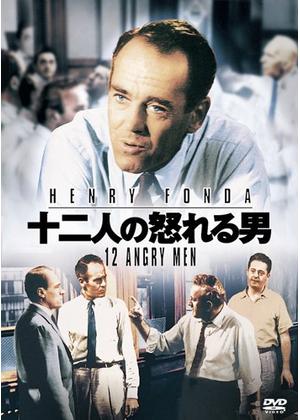
十二人の怒れる男 / 12 Angry Men

十二人の怒れる男 / 12 Angry Men

Twelve Angry Men is an American drama/suspense film released in 1957. It was released in Japan in 1959. It is based on the 1954 drama of the same name.
The story takes place in a New York courtroom where a juvenile delinquent suspected of killing his father is being deliberated. The boy's guilt is conclusively established by numerous testimonies, but only one of the 12 jurors reveals the boy's innocence in this locked-room drama.
The film is directed by Sidney Lumet, making his directorial debut, and stars Henry Fonda. The film was made in response to the strong response to the TV drama version of the same name, and Reginald Rose, the author of the TV drama version, wrote the screenplay for the film version as well. Although the film was produced on a low budget and in a small number of days, it won the Golden Bear Award at the Berlin International Film Festival and the International Catholic Film Office Award. In Japan, it was selected as one of the best foreign films in the Kinema Junpo Best Ten. It is a masterpiece that has been adapted for the stage all over the world, and is often cited as a milestone in locked-room drama. In Japan, it is also well known as the basis for the movie "12 Gentle Japanese," written by Mitani Koki.

Reviews, Ratings and Comments on 十二人の怒れる男 / 12 Angry Men

十二人の怒れる男 / 12 Angry Men
9

Suspense at its finest! So little scene development that it's easy to follow and interesting!!!

The movie "Twelve Angry Men" is an American film produced in 1957. It won the Golden Bear at the Berlin International Film Festival and was nominated for the Academy Award for Best Picture, and is known as the "milestone of the locked room drama.
The setting is a room in a New York City courthouse. There, 12 jurors discuss the case of a 17-year-old boy who is accused of killing his own father.
The case, and all the eyewitness testimony and evidence point to the boy as the murderer. No matter how they argue, the boy's guilt seems conclusive, but only Juror #8 argues for the boy's innocence. How will the argument proceed from 11 to 1?
The story is told entirely within the confines of a single courtroom, with almost only 12 jurors (although, technically, the opening scene shows the courtroom and the boy as a suspect, and someone who looks like a court official enters the room in the middle of the argument).
The story is easy to follow, unfolding all the way in one room, and yet it continues to draw you in until the very end. The viewer is drawn in by the succession of scenes in which the filmmakers find doubtful points in each of the eyewitness testimonies and evidence that had been thought to be conclusive, and verify them one by one.
The film ends with all the eyewitness testimonies and evidence pointing out suspicious points, but it ends without clearly stating the boy's guilt or innocence. This ending is also a thought-provoking development that will hold the viewer's attention until after the film is over.
And the scene where the jurors say goodbye in the last scene is also impressive. They say their names to each other and part ways. It is another masterpiece that leaves a strong impression as we are reminded here that the discussion was between strangers who had never met before and did not even know each other's names.

十二人の怒れる男 / 12 Angry Men
10

Twelve Angry Men

Low budget, representative of black and white standards.
Mostly room-to-room exchanges.
A tense drama about the trial of one boy for the murder of his parents, it is a historical masterpiece about the ideals and realities of the jury system.
The 12 men are indeed a diverse group of human beings: some are intellectuals, some grew up in slums, some are serious, some are lax. Just when you think they are leaning toward the opinion that the boy is a murderer of his parents and should be "put away quickly," one man stands up. He says, "The boy's life is at stake, so let's stop making snap judgments and have a serious discussion from the beginning. Tension flares in the empty room, and the audience is drawn into the world of the film, whether they like it or not.
In Japan, decisions are made by majority vote, but under the American jury system, if all 12 members do not agree, the case must be redone.
One man, Henry Fonda, plays the role of an intelligent and calm man, and while the film is worth seeing just for the spirited performances of the 12 great actors, the story is also excellent. The story is a tale of two or three twists and turns as the tension builds to a climax. We, the viewers, feel as if we are in that room with them and are experiencing a simulated experience.
It is a wonderful story, well directed, and performed with great spirit by talented actors. The best part of the film is Lee J. Cobb's masterful performance, especially as the angry man who cries guilty until the very end.
He has a magnificent presence that overwhelms the viewer. It is a famous scene that will remain in the history of cinema.

十二人の怒れる男 / 12 Angry Men
8

A conversation between men takes place in a small room. You can't take your eyes off the unexpected developments.

A young man is arrested on suspicion of murdering his father, and a jury trial is held to judge him. The jurors were randomly selected and had nothing to do with the case. Everyone found the young man guilty, and it seemed that the verdict would come soon. However, one juror objected. His words seemed reckless in the face of overwhelming odds. Gradually, however, the situation unfolds, and the votes for acquittal increase. What is the outcome of the men's heated debate?

The discussion among the uncles takes place in a closed room. Despite the fact that there is little in the way of artistic ability (ejikara), this is a film that keeps the viewer's eyes glued to the unexpected developments.
Why is it so interesting? It is probably because the viewer naturally becomes emotionally involved with the main character (the man who first claims his innocence). The jurors who are deciding on the guilt are not interested in the case, and some of them do not take it seriously. Some look down on the young man and swear at him. The viewer feels anger at these selfish men who can only think of themselves at an important time when a person's life is being decided (although, in normal circumstances, one can understand the feelings of the jurors on the guilty side). It is very painful to confront them and break down their arguments.
The story is very detailed as the truth emerges through the discussion, and it is really interesting to watch. Please watch it.