ゲゲゲの鬼太郎 / 墓場鬼太郎

ゲゲゲの鬼太郎 / 墓場鬼太郎

GeGeGe no Kitaro" is a Japanese manga work by cartoonist Shigeru Mizuki. Based on this work, various related works have been produced, including anime, movies, novels, dramas, video games, and stage productions. The origin of this work is "Kitaro of the Graveyard," an original picture-story show by Shigeru Mizuki.
The serialization of "Graveyard Kitaro" began in "Weekly Shonen Magazine" from issue 32 in 1965, and was renamed "Gegege no Kitaro" from issue 46 in 1967.
Kitaro, a boy who was born in a graveyard and a survivor of a ghost tribe, was picked up and raised by humans. One day, Kitaro is reunited with his father, who has taken the form of an old man with an eyeball, and leaves his human home to embark on a wandering journey. In the course of his travels, Kitaro acquires acquaintance with youkai and begins to exterminate those who misbehave.

Reviews, Ratings and Comments on ゲゲゲの鬼太郎 / 墓場鬼太郎

ゲゲゲの鬼太郎 / 墓場鬼太郎
10

The dark world view draws you in.

Gegege no Kitaro is an animated TV series featuring many yokai, originally created by Shigeru Mizuki.
Among them, the so-called "fourth season" of Kitaro's anime series broadcast from 1996 to 1997 featured a unique and unprecedented production method.
In the previous Kitaro animated series, Kitaro is a heroic figure who stands on the side of justice and exterminates evil-doing monsters.
In this fourth season, that role remains almost the same.
However, in this work, there are many scenes that emphasize that the yokai are not evil on one side or the other.

For example, in the first episode, "Yokai Mimikage Irido," humans clear a forest to cultivate a mountain, and the yokai who lived there lose their habitat.
The yokai attack humans to take revenge, but Kitaro comes and exterminates the yokai and then says, "The truth is that humans and yokai get along well with each other.
In fact, it would be best if humans and youkai could get along well with each other.
To this line, Kitaro's father, the father with the eyeballs, replies, "Well, it's a difficult problem.
The dialogue between Kitaro and his father, the father with the eyeballs, suggests that Kitaro and the other yokai wish to coexist with humans, and that it is very difficult to make this wish come true.

Thus, in the works of Kitaro's fourth season, there are many stories about the coexistence of yokai and humans.
It is not just an animation in which heroes play active roles for children, but it contains a fleeting wish to live with something beyond, something invisible, something different from ourselves.

In addition to the first episode I mentioned earlier, there are many other stories that depict this kind of interaction between yokai and humans.

Among them, episode 53, "Ghost Train to the Cemetery! features a rare episode in which Kitaro punishes a human.
This story is very popular in the original and has been animated many times.
One of the main characteristics of this episode is that it has a strong sense of horror.

The general outline of the story is that Kitaro appears by chance in front of two drunken men.
The two men, who do not believe in yokai, make fun of Kitaro, and Kitaro gets a slap on the wrist.
Kitaro gets angry and says, "I'm sorry, uncle, but I'm going to get even with you with a bump of the same size," and leaves.
The men miss the last train and get into trouble, but they happen to know that a special train is available and decide to board it.
However, there is an eerie atmosphere inside the train, and the passengers seem to be acting strangely.
The train stops at stations with creepy names such as "crematorium" and "bone jar," and the men tremble in fear.
This train scene is so realistic and full of horror elements that it will send chills down your spine even if you are an adult.
In fact, this extra train was the work of Kitaro and was a trap prepared to punish the men.
In the end, the men get their revenge with a "bump of the same size," as Kitaro said.
This is a scene that is both a thrill to watch and a horrifying scene for those of us who are human. ......

The anime is also full of other attractions, such as the times when horror writer Kyogoku Natsuhiko writes the script and voices the characters, and when Mamoru Hosoda, the director of "Summer Wars" and many other works, directs the show!
Gegege no Kitaro, loved not only by children but also by adults, is a wonderful work that offers a new image of Kitaro, a hero who is not only a so-called hero of justice, and the philosophy of Shigeru Mizuki that lies behind his heroism.

ゲゲゲの鬼太郎 / 墓場鬼太郎
8

Gegege no Kitaro (The Bearded Taro of Gegege)

Many people feel that Kitaro is a heroic character, but this is not the case.
Most of them are about exterminating yokai that do evil to humans, and sometimes they even throw people alive into hell to punish them.
There is also a long series about a man who goes to hell to reunite with his dead mother.
Other stories are drawn in accordance with the times, incorporating current events of the time.
Also, many people may think that Kitaro is strong.
No, they are not! Kitaro has not been able to exterminate the evil monsters without the help of his friends.
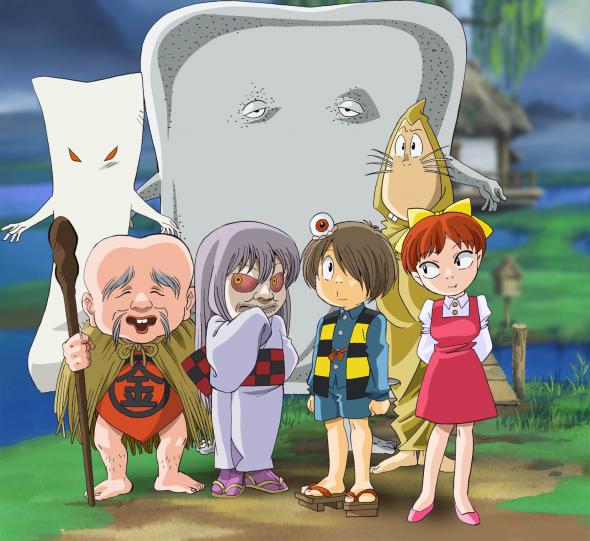
These friends are now known as Kitaro's family, and they include Grandma Sunakake, Grandpa Crying, Nurikabe, Ichikankiwomen, Nekomusume, and Nezumi Otoko, who are all helpful in many situations.
However, Nezumi Otoko is often betrayed by Kitaro, but in the end, Kitaro and his friends forgive him and he is always satisfied.
Nezumi Otoko is a beloved character.
He is especially noteworthy for the fact that he is also saved by his father, who is also an eyeball. How does he fight with his tiny body? You would think, but he helps Kitaro in unexpected ways.
And Kitaro often loses.
Every time he loses, he is cured or rather regenerated at the Yokai Hospital in Osorezan.
Or rather, he is regenerated.
I think it is because Kitaro is not the strongest character, and he is not the best, that he is still loved by people.

ゲゲゲの鬼太郎 / 墓場鬼太郎
8

If you imagine a traditional Kitaro, you will be betrayed in a good way.

This is the sixth season produced to commemorate the 50th anniversary of Gegege no Kitaro's anime adaptation.
If you imagine a traditional Kitaro, you will be betrayed in a good way. First of all, looking at the casting, the main character Kitaro is played by Miyuki Sawashiro, whose voice matches Kitaro's and adds depth to the character. Also, Masako Nozawa, famous for her role as Son Goku in Dragon Ball, plays the role of Oyaji, surprising everyone with the use of a major celebrity. Furthermore, the cat girls that have appeared throughout the series have been arranged in a modern way, giving them an isometric, cool, and beautiful impression. What? Is this really that cat girl? You are kidding, right? It is.
The characters alone are full of surprises, but the storyline is even more astonishing. In the beginning, the story begins with a modernized version of cause and effect, and then it quickly evolves into a confrontation between Japanese and Western yokai. The witch girl who meets there, like the cat girl, seems to be a consolidation of modern moe points. Once the conflict between the yokai is settled, the story returns to a cause-and-effect type of story. One of the most unique stories is the one in which Kitaro stays up all night playing a love game under the supervision of his father to understand the feelings of girls. That episode became a big topic of conversation around me.
The story is interesting, but the OP and ED are sung by Kiyoshi Hikawa, and the song "I can't see it, but it's there," which was the ED for a while, sings the characteristics of yokai in a light rhythm, and once you hear it, it will stay in your ears and make you hum along. If you think it is the same Kitaro as before, you will be surprised in many places.

ゲゲゲの鬼太郎 / 墓場鬼太郎
10

It is the best yokai anime.

The sixth series of "Gegege no Kitaro," a yokai anime that has been animated six times, is very good.
The sixth season, which celebrates the 50th anniversary of the TV broadcast, is a work that very much keeps in mind the feelings of Shigeru Mizuki, the original creator of "Gegege no Kitaro," towards yokai. I felt the history of the successive "Gegege no Kitaro" series in the opening, ending, and the story, which I thought was very good. Also, the illustrations of yokai and pictures of Sakaiminato drawn by the original author, Shigeru Mizuki, are very nice. The animated stories are also very nice and moving.
And the Gegege forest where Kitaro lives is so beautiful and enchanting. The scene in episode 4 with the fluffy gentle light dancing in the vivid green is so beautiful.
The recommended scenes in the 6th season, for example, are the battle scenes. The metal and rock-rock arranged "Gegege no Kitaro" songs that are played during the battle scenes are very enlivening and make the viewers feel really hot and cool. And the sad and sorrowful scenes will bring tears to your eyes.
The sixth season of "Gegege no Kitaro" is the best anime work that teaches us important things through the world of yokai.

ゲゲゲの鬼太郎 / 墓場鬼太郎
7

We've been waiting for you! The 6th period...Kitaro!

I've been watching Kitaro since I can remember. I am not sure if it was the manga first or the anime first, but I was familiar with it from a very young age.
The manga can be found in libraries and children's centers, and I have watched the anime often since the third season. In the third season, there is an anime original heroine, Yumeko-chan. However, I am a cat lover, and the cat girl in the original manga is the unmistakable heroine. There are other original settings in the anime that differ from the original. In the original manga, Kitaro is a "ghost tribe," but in the anime, he is a "yokai" as he is. In the original, Kitaro is weak against beautiful girls, but in the anime, he is "righteous" himself. There is also an anime that is based on the original work, and "Graveyard Kitaro," which was broadcast in the late-night hours, is the same as the original manga work.
The revived Kitaro the 6th is not a Kitaro with a sense of justice, but a "Kitaro as a monster" that is close to the original work. The anime's original heroine, Mana-chan, and a slender cat girl arranged in a modern style, are neither moe pictures nor faithful to the original work, but they do not destroy the original work and give us a good looking Kitaro.
The voice actor is the hot name of the moment, Sawashiro Miyuki. She plays the heroine Fujiko in the late-night anime Lupin III. It is common for women to voice boys, but this time they are just cool and cool. The main character, Oyaji, is played by Masako Nozawa, who has played Kitaro in the past.
The voice actors are wonderful, and Kitaro's coolness is a highlight of the show.