
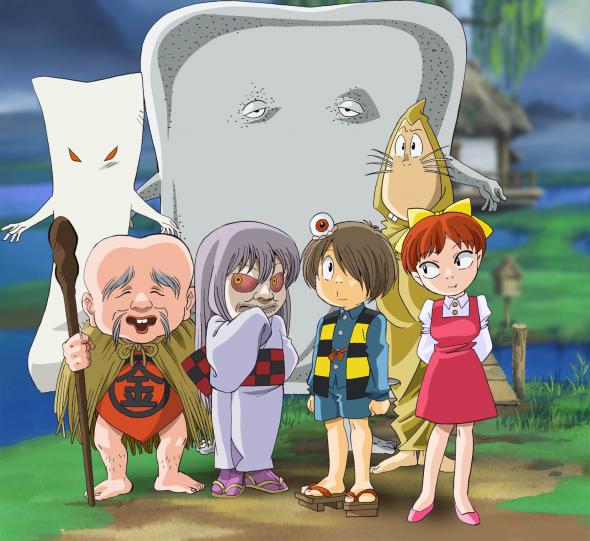

If you imagine a traditional Kitaro, you will be betrayed in a good way.
This is the sixth season produced to commemorate the 50th anniversary of Gegege no Kitaro's anime adaptation.
If you imagine a traditional Kitaro, you will be betrayed in a good way. First of all, looking at the casting, the main character Kitaro is played by Miyuki Sawashiro, whose voice matches Kitaro's and adds depth to the character. Also, Masako Nozawa, famous for her role as Son Goku in Dragon Ball, plays the role of Oyaji, surprising everyone with the use of a major celebrity. Furthermore, the cat girls that have appeared throughout the series have been arranged in a modern way, giving them an isometric, cool, and beautiful impression. What? Is this really that cat girl? You are kidding, right? It is.
The characters alone are full of surprises, but the storyline is even more astonishing. In the beginning, the story begins with a modernized version of cause and effect, and then it quickly evolves into a confrontation between Japanese and Western yokai. The witch girl who meets there, like the cat girl, seems to be a consolidation of modern moe points. Once the conflict between the yokai is settled, the story returns to a cause-and-effect type of story. One of the most unique stories is the one in which Kitaro stays up all night playing a love game under the supervision of his father to understand the feelings of girls. That episode became a big topic of conversation around me.
The story is interesting, but the OP and ED are sung by Kiyoshi Hikawa, and the song "I can't see it, but it's there," which was the ED for a while, sings the characteristics of yokai in a light rhythm, and once you hear it, it will stay in your ears and make you hum along. If you think it is the same Kitaro as before, you will be surprised in many places.