
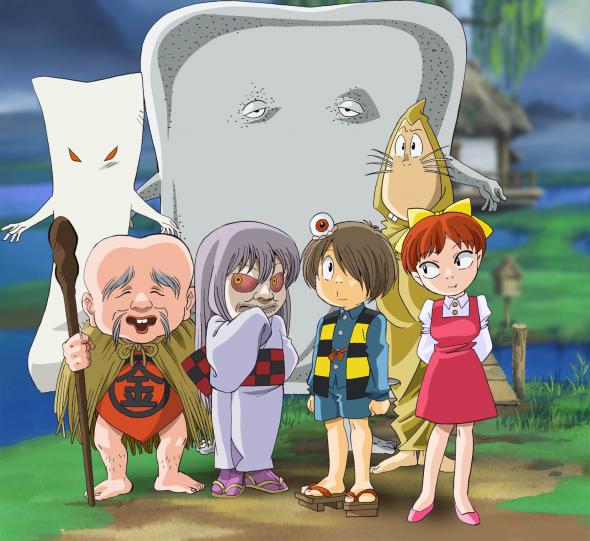

The dark world view draws you in.
Gegege no Kitaro is an animated TV series featuring many yokai, originally created by Shigeru Mizuki.
Among them, the so-called "fourth season" of Kitaro's anime series broadcast from 1996 to 1997 featured a unique and unprecedented production method.
In the previous Kitaro animated series, Kitaro is a heroic figure who stands on the side of justice and exterminates evil-doing monsters.
In this fourth season, that role remains almost the same.
However, in this work, there are many scenes that emphasize that the yokai are not evil on one side or the other.
For example, in the first episode, "Yokai Mimikage Irido," humans clear a forest to cultivate a mountain, and the yokai who lived there lose their habitat.
The yokai attack humans to take revenge, but Kitaro comes and exterminates the yokai and then says, "The truth is that humans and yokai get along well with each other.
In fact, it would be best if humans and youkai could get along well with each other.
To this line, Kitaro's father, the father with the eyeballs, replies, "Well, it's a difficult problem.
The dialogue between Kitaro and his father, the father with the eyeballs, suggests that Kitaro and the other yokai wish to coexist with humans, and that it is very difficult to make this wish come true.
Thus, in the works of Kitaro's fourth season, there are many stories about the coexistence of yokai and humans.
It is not just an animation in which heroes play active roles for children, but it contains a fleeting wish to live with something beyond, something invisible, something different from ourselves.
In addition to the first episode I mentioned earlier, there are many other stories that depict this kind of interaction between yokai and humans.
Among them, episode 53, "Ghost Train to the Cemetery! features a rare episode in which Kitaro punishes a human.
This story is very popular in the original and has been animated many times.
One of the main characteristics of this episode is that it has a strong sense of horror.
The general outline of the story is that Kitaro appears by chance in front of two drunken men.
The two men, who do not believe in yokai, make fun of Kitaro, and Kitaro gets a slap on the wrist.
Kitaro gets angry and says, "I'm sorry, uncle, but I'm going to get even with you with a bump of the same size," and leaves.
The men miss the last train and get into trouble, but they happen to know that a special train is available and decide to board it.
However, there is an eerie atmosphere inside the train, and the passengers seem to be acting strangely.
The train stops at stations with creepy names such as "crematorium" and "bone jar," and the men tremble in fear.
This train scene is so realistic and full of horror elements that it will send chills down your spine even if you are an adult.
In fact, this extra train was the work of Kitaro and was a trap prepared to punish the men.
In the end, the men get their revenge with a "bump of the same size," as Kitaro said.
This is a scene that is both a thrill to watch and a horrifying scene for those of us who are human. ......
The anime is also full of other attractions, such as the times when horror writer Kyogoku Natsuhiko writes the script and voices the characters, and when Mamoru Hosoda, the director of "Summer Wars" and many other works, directs the show!
Gegege no Kitaro, loved not only by children but also by adults, is a wonderful work that offers a new image of Kitaro, a hero who is not only a so-called hero of justice, and the philosophy of Shigeru Mizuki that lies behind his heroism.