
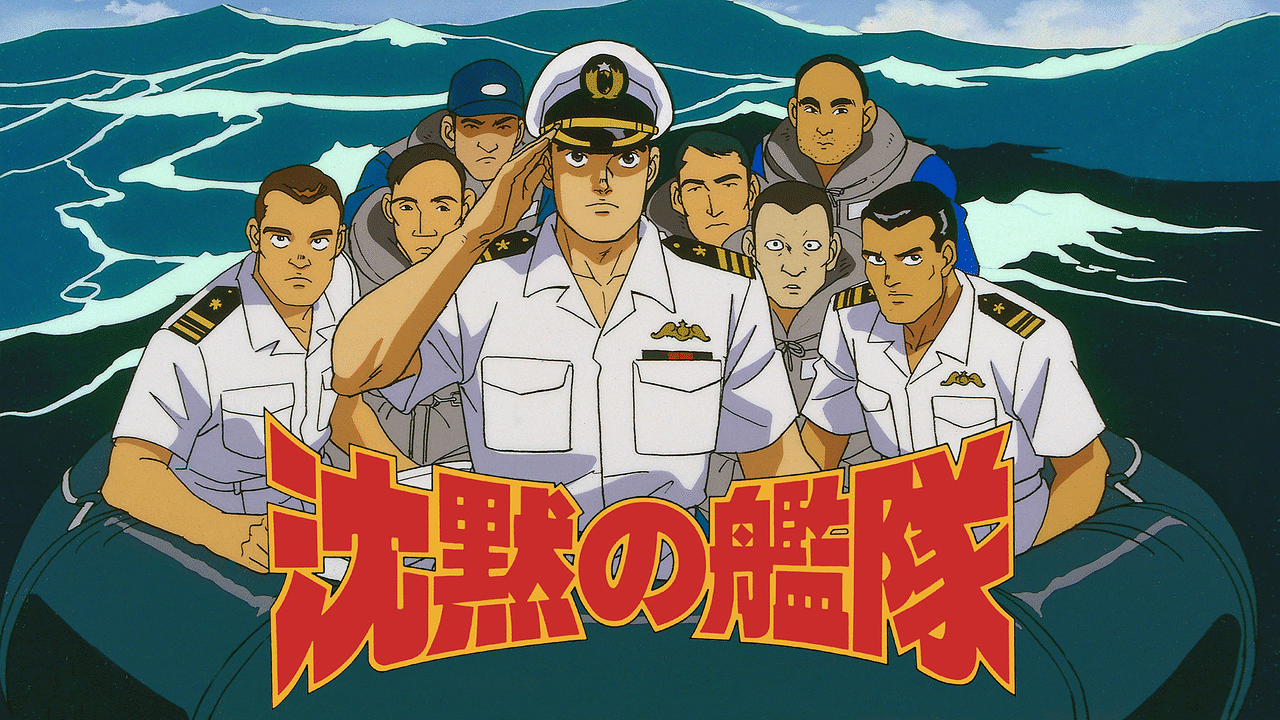
The Silent Fleet" is a radio drama, anime, and film based on a fictional war and military policy manga series by Kaiji Kawaguchi that was serialized in "Morning" magazine from 1988 to 1996. Against a backdrop of political intrigue and strained international relations due to advances in military technology, the story follows the activities of Shiro Kaieda, captain of the fictional state-of-the-art submarine Yamato, and his crew. The film was highly acclaimed for its realistic depiction and detailed storyline.

standing waves
The conventional-powered submarine "Tatsunami" in "The Silent Fleet" is a fictional submarine that plays an important role in the story. The submarine is depicted as a fictional conventional-powered submarine operated by the Japan Maritime Self-Defense Force and is involved in important events related to Kaieda and other characters.
Actual conventional-powered submarines are submarines that are not nuclear powered and use diesel engines or electric motors as their primary propulsion source. In recent years, conventionally powered submarines equipped with the Air Independent Propulsion (AIP) system have been developed, which reduces the air dependency of the diesel engines and significantly improves the submarine's diving capability.
Although the characteristics of a conventional-powered submarine limit its relatively small size and ability to dive for long periods of time, it is quiet and capable of conducting operations at close range. In the story, "TATSUNAMI" is engaged in various tactical missions and special operations, and its activities leave a strong impression on readers.
range of mountains

Yamanami before the entire crew escaped and sunk the ship on autopilot to collide with the Russian ship.
The conventionally powered submarine "Yamanami" in "The Silent Fleet" is a fictional submarine that plays an important role in the early stages of the story. This submarine belongs to the Japan Maritime Self-Defense Force, of which Kaieda was previously the captain, and is depicted as a particularly symbolic presence in the development of the story. The "Yamanami" is set up as a conventional-powered submarine of the Maritime Self-Defense Force, using diesel engines and electric motors for propulsion. In the story, the Yamanami suffers a collision with a nuclear submarine of the Soviet Union, which has a major impact on the subsequent development of the story. The accident triggers Kaieda's appointment as captain of Japan's first nuclear submarine, the Seabat, and sets the stage for a series of actions that he later takes.
separation of church and state
Kaieda's proposal in his talks with the Japanese government in Tokyo was an innovative concept of separating political and military affairs and consolidating military power in an international supranational organization. The idea was to coordinate conflicts among nations and sanction violations as they occurred. Just as the modern state system maintains domestic order by taking military power away from individuals and concentrating it in the hands of governments, the international community seeks to maintain peace by concentrating military power away from nations. President Bennett agreed with this concept, but believed that the U.S. should take the lead in realizing it. If the separation of the political and military forces is realized, the Self-Defense Forces will be freed from the problem of violating the Constitution. This marks a new phase, beginning with Prime Minister Takegami's sudden announcement that he would give command of the Self-Defense Forces to the United Nations. Kaieda, citing Japan as an example of a country that has achieved separation of church and state, argued that if separation of church and state is possible, separation of government and military is also feasible. This makes clear his intention to build an alliance with Japan.
Yamato Insurance
The "Yamato Insurance" scheme devised by Otaki is an insurance system designed to create a political structure in which the very existence of "Yamato" would benefit the international community. Under this idea, the Japanese government would insure "Yamato" through a major British insurance company, Rise. The governments that support this insurance scheme would be the underwriters of the insurance, and the United Nations would be the beneficiary. This system aims to shift to an economic structure that generates profits not through war, but through peace. This would create a new security structure in which peace is guaranteed, independent of conventional military balances and treaties. What Otaki advocates as the chairperson of the UN's Silent Fleet Executive Committee is an insurance policy based on the concept of "buying peace with money," in which at least one dollar is collected from citizens around the world to become shareholders to establish a joint stock company whose goal is the abolition of nuclear weapons and the permanent abandonment of armaments.
World Government
The World Government, a supranational organization with a permanent military, envisions that in the future all existing nations will be reorganized as part of this organization. It is envisioned that all nations will become the equivalent of a province or state under the World Government, with the current United Nations as its foundation. The establishment of this World Government is essential to achieve complete separation of political and military affairs, and its formation would mean the eradication of war from the world. War would then cease to be considered anything more than civil war or rebellion. Lee Goldwell ironically called this concept sophistry, but Bennett sees it as a new way for politics to counter war.
The Silent Fleet Project
The Silent Fleet Plan, or Silent Security Service from the Sea (SSSS), is a proposal to establish a security regime that aims to abolish nuclear weapons while providing each nation in the world with an equal nuclear retaliatory capability. The plan would make strategic nuclear submarines independent of state influence, thereby eliminating the need to have nuclear weapons on the ground and preventing a nuclear arms race. Isaac Nathan calls this approach psychological nuclear deterrence and states that it would promote nuclear disarmament in exchange for mutually assured destruction. However, U.S. President William Bennett opposed this plan as contrary to the principle of civilian control, proposing instead that the U.S. take the lead in nuclear control. The Yamato Declaration of Independence is also based on this vision of freeing nuclear forces from state control. When UN Secretary General Adams asked Kaieda about entrusting the SSSS to the US, Kaieda saw this plan as unfeasible for a land-based nation, especially the US. He believed that this plan was not feasible for a land-based nation, especially the U.S., because if one nation used nuclear weapons and the U.S. retaliated, the next target would be the U.S. itself, and the American people would not accept such a scenario. This would make it impractical for the U.S. to retaliate even if nuclear weapons were actually used.
Kaieda positions the Silent Fleet as the one entity that does not deserve retaliation for the use of nuclear weapons, and this is the main reason for their actions. He also cites the history of the U.S. use of nuclear weapons on Hiroshima and Nagasaki, and states that the reason for Bennett's nuclear missile launch against Yamato is that "this will free the U.S. from the disgrace of being the country that used nuclear weapons in actual warfare. This underscores the rationale for being free from the traditional shackles of a silent fleet.
Famous quotes, lines, scenes and scenes from "The Silent Fleet
David Ryan: "I see, you were approaching while squeezing the music. This way, our fleet can't torpedo them."

The "Yamato" (right), positioned right next to the nuclear submarine "New York" (left) and prevented from being torpedoed, while gradually lowering the volume of Mozart's music.
The "Yamato," commanded by Captain Kaieda, uses Mozart music to draw the enemy ship's attention, then gradually lowers its volume to throw the enemy ship off its senses. This precisely calculated movement allows the "Yamato" to close in on the flank of the "New York" and prevent the enemy from launching torpedoes at a distance that would normally give them an opportunity to counterattack. David Ryan said, "I see, you were approaching while squeezing the music. This way, our fleet won't be able to fire torpedoes," he roared. In this scene, the advanced quietness of the Yamato as a submarine and Kaieda's sophisticated tactics are highlighted by the incorporation of music as a tactical element. This tactical use of music symbolizes Kaieda's intelligence and creativity in not merely deceiving the enemy, but in securing a psychological advantage in battle. The use of such non-traditional methods also demonstrates that "The Armada of Silence" is not only a military strategy, but also a battle that makes use of the human spirit and wisdom.
Shiro Kaieda "We are Yamato, an independent nation. This is our declaration of independence.
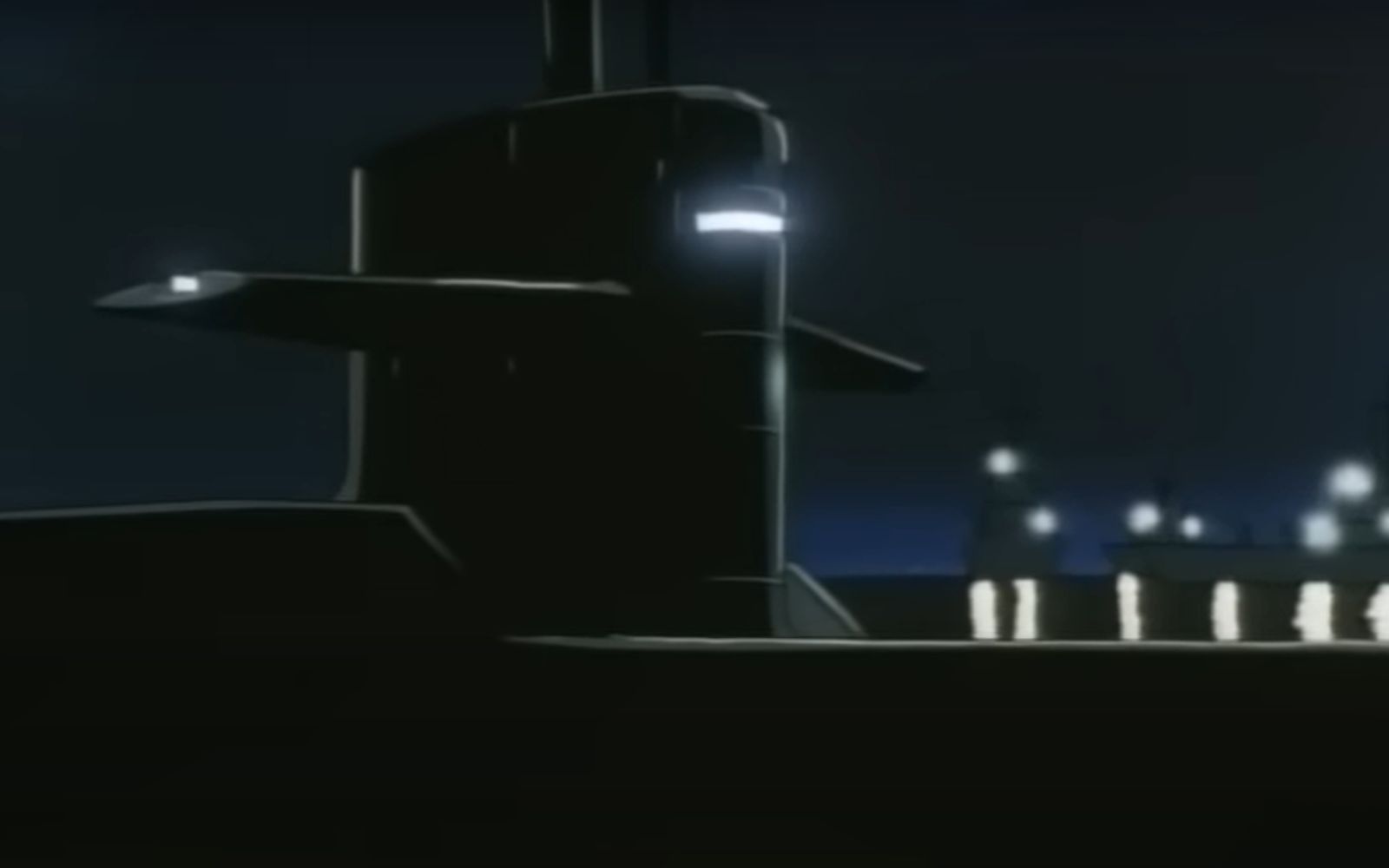
The scene where "Yamato" is surrounded by the U.S. Seventh Fleet and declares its independence.
The nuclear submarine Yamato and its captain, Kaieda, bravely proclaim to the world the establishment of their own independent fighting nation, Yamato, different from Japan, despite the extremely difficult circumstances. We are Yamato, an independent nation. This is our declaration of independence. This tense situation is an expression of Kaieda's will to establish Yamato's unique position in the international political arena, while at the same time demonstrating his determination to act on the basis of his own principles and convictions, without bowing to the pressure of the superpowers. This declaration not only declares the independence of Yamato, but also demonstrates Kaieda's ambition to seek the establishment of a new security regime against the backdrop of the international community's concern over the proliferation of military power, including nuclear weapons. This declaration is an important turning point that marks the beginning of the drama of international confrontation and cooperation that will unfold throughout the story and the adventures of "Yamato" that will accompany it.
Japanese government and "Yamato" treaty scene
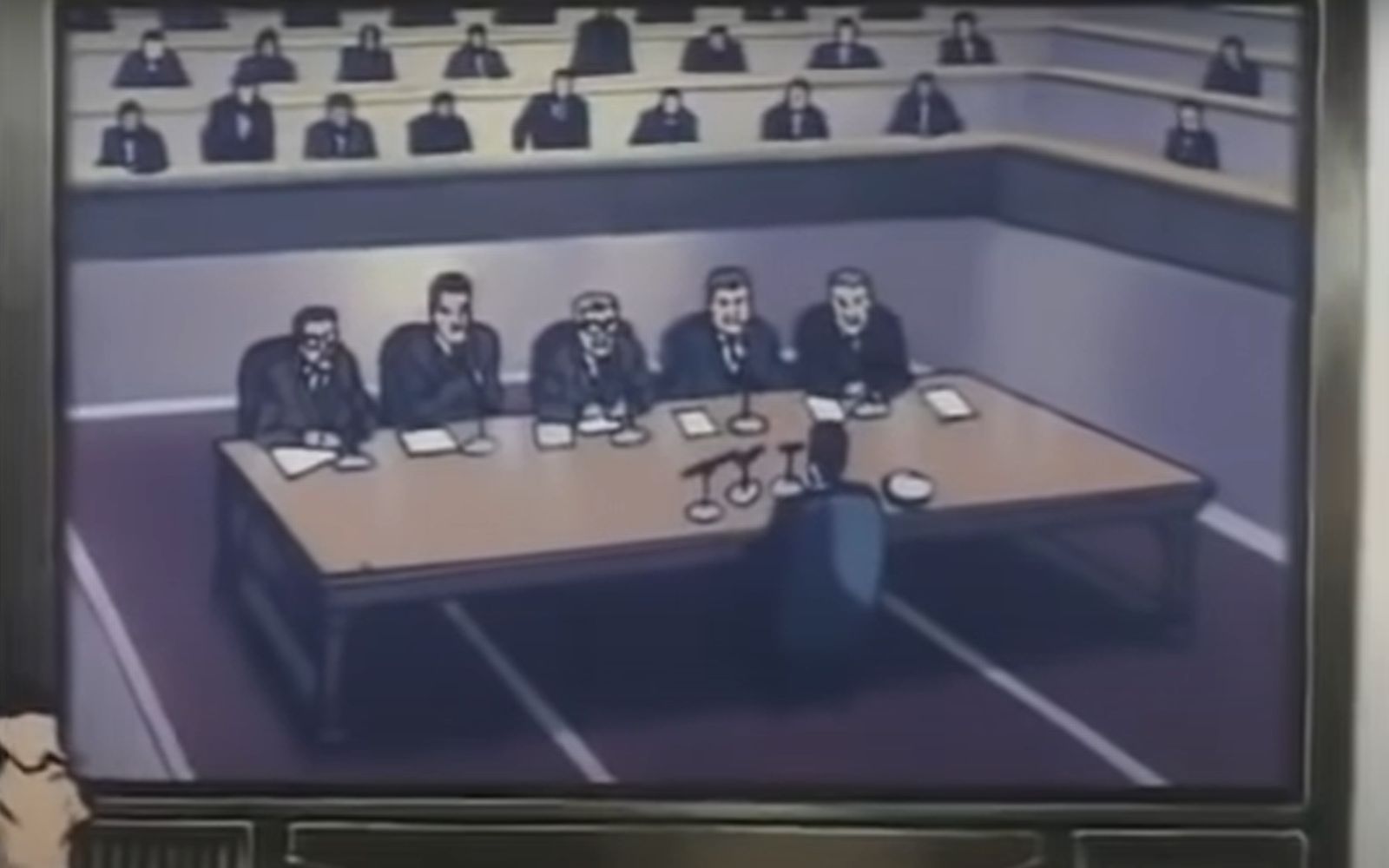
The person in the center at the back of the table is Prime Minister Takegami, representing the Japanese government, and the person in the foreground is Kaieda, representing "Yamato".
The signing of the treaty signified that the "Yamato" led by Kaieda had overcome its international isolation and had begun to establish formal international relations. The scene of the treaty signing depicts the Japanese government and representatives of Yamato sitting together at a table and signing the treaty document. This action symbolizes that the tension between the two sides has been resolved, if only temporarily, and that a new phase of mutual understanding and cooperation has begun. However, this historic moment also raises many questions and concerns. The Japanese people have been very clear: "Here and now, a treaty of friendship between Japan and Yamato has been established. But will the Japanese people and the people of the world be satisfied with this decision?" The announcer's comment conveys the news of the conclusion of the treaty, but at the same time questions the public reaction to this decision and the perspective of the international community. His words suggest more than mere news coverage, and imply a deep concern about how the treaty will be received in Japan and abroad, as well as the political and social implications going forward. This moment is a significant development in international politics, but it is also an important moment that captures the complex emotions and reactions that will result.
Tokuji Numata: "Kaieda, you answered that exclusive defense means fighting in case of invasion. But in reality, Japan's position is that whatever is done cannot be judged as aggression."

Related Articles
ジパング(かわぐちかいじ)のネタバレ解説・考察まとめ
『ジパング』とは2000年よりかわぐちかいじが『モーニング』で連載していた漫画、およびそれを原作としたアニメ作品。西暦200X年の6月、日本海上自衛隊の最新型イージス艦みらいはミッドウェー沖合にて落雷を受ける。それをきっかけに、彼等はイージス艦ごとミッドウェー海戦直前の1942年6月4日の太平洋上にタイムスリップした。オーバーテクノロジーを保有する形となった彼等は、戦前の人々や歴史の流れの中で葛藤し、各々の思想の違いによって対立していく。そして彼等の存在は、歴史を大きく変えて行くのであった。
Read Article

太陽の牙ダグラム(Fang of the Sun Dougram)のネタバレ解説・考察まとめ
『太陽の牙ダグラム』とは、テレビ東京系列で1981年10月から1983年3月まで放送されたSFロボットアニメである。地球からの圧政に苦しむ植民惑星「デロイア」が独立するまでの動乱を、戦争と政治の両面から描く。地球生まれの主人公「クリン・カシム」は数奇な運命の下、デロイア独立戦争に義勇兵として参戦する。『機動戦士ガンダム』の流れを汲んだ「リアルロボット」路線の作品であり、後に『装甲騎兵ボトムズ』や『機甲界ガリアン』を手掛ける高橋良輔のロボットアニメ初監督作品でもある。
Read Article

太陽の黙示録(かわぐちかいじ)のネタバレ解説・考察まとめ
『太陽の黙示録』とは2002年よりかわぐちかいじが『ビッグコミック』で連載していた漫画、およびそれを原作としたアニメ作品。西暦2002年の8月、マグニチュード8.8の大地震が日本を襲う。大地は東西に分裂し壊滅的な打撃を受けた日本は、やむなくアメリカと中国の南北分断統治を受け入れる。それから15年後、南北に分裂した日本は、それぞれの国の下で復興をしていた。だが、アメリカと中国の影響力が強く、かつての日本は失われてしまう。その中で日本人は様々な問題に苦悩しながらも、日本再興の為に力を尽くしていく。
Read Article
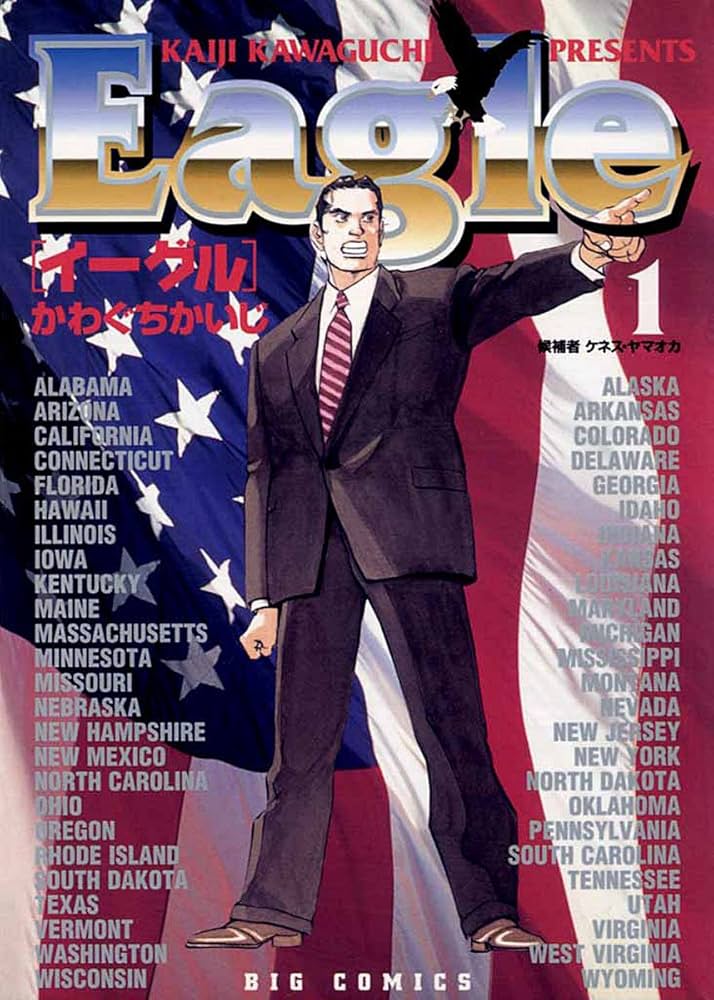
イーグル(かわぐちかいじ)のネタバレ解説・考察まとめ
『イーグル』とは、かわぐちかいじの政治漫画である。1998年から2001年まで『ビッグコミック』で連載された。新聞記者城鷹志は、唯一の肉親である母を事故で亡くす。悲しみの中、突如アメリカ大統領選挙候補者の1人ケネスから密着取材を指名された。アメリカに渡った城は、ケネスから自分の子供である事を告げられる。動揺しながらも、彼はアメリカ大統領選挙を戦うケネスの取材を行う。その取材の過程で母親が何者かに暗殺された事に気付く。事件の真相に迫りながら、アメリカの抱える政治的問題が描かれていく。
Read Article
Tags
Contents
- Overview of "The Silent Fleet
- Synopsis and story of "The Silence Fleet
- preface
- background
- Test Voyage of the "Seabat
- international conflict
- Response by the Japanese Government
- Kaieda's "Silent Fleet Plan" Proposal at the UN
- end
- Characters and characters from "The Silent Fleet
- Main Characters
- Shiro Kaieda / played by Takao Osawa
- Hiroshi Fukamachi (played by Hiroshi Tamaki)
- Nicholas J. Bennett (played by Rick Amesbury)
- Toshio Takegami (Played by Takashi Sasano)
- Japanese Government Officials
- Daigo Unabara (played by Isao Hashizume)
- Wataru Unabara (played by Yosuke Eguchi)
- Koichiro Amatsu
- Ichiro Kaido
- Hideki Kounouchi
- Jun Otaki
- Seiji Kageyama (Seiji Kageyama / performed by Yoshi Sakamukai)
- Noboru Sonezaki / Live Action: Hitomi Sonezaki (Noboru Sonezaki / Hitomi Sonezaki / acted by Yui Natsukawa)
- Keisuke Hamamoto
- Sakae Kuraike
- long river
- Yamato officials
- Eiji Yamanaka (played by Aoi Nakamura)
- Utsumi
- Takuo Mizoguchi (played by Koh Maehara)
- Maritime Self-Defense Force personnel
- Saburo Akagaki (played by Toru Tezuka)
- Susumu Tadokoro / played by Hiroshi Okochi
- Tokuji Numata (played by Yoji Tanaka)
- Kenji Hayami / Live Action: Takako Hayami (Played by Asami Mizukawa)
- Goro Watase (played by Ippei Sasaki)
- Eiichi Namba (played by Yusuke Santamaria)
- U.S. Navy personnel
- Logan Steiger (played by Aleks Ponovic)
- David Ryan (played by Jeffrey Lowe)
- Alan B. Lansing (played by Michael Gencher)
- Richard Boyce (played by Rob Flanagan)
- Terrence B. Carver
- Hendrik Doll.
- Colonel Kelly J. Nelson
- Colonel Alex P. Nagabuchi
- John Alexander Bates
- Norman King Bates.
- U.S. Government Officials
- Andy Reid
- Robert D. Baker (played by Kevin Copeland)
- Jack Turner.
- Richard Rosenberg
- Andrew Gill
- Carl Schulz
- U.S.A. and other characters
- Lee Goldwell
- Isaac Nathan.
- Mars Bennett.
- Sniper (name unknown)
- Royal Navy and government officials
- Chris Stringer
- Joseph Lowry.
- Julius Lowdon.
- William Scott
- Godfrey Lawrence.
- Cohen
- Soviet Union Navy and Russian Navy personnel
- Yuri Andropov.
- Andrei Lobkov
- Ivan Borodin
- Mikhail Sergeyevich
- Soviet Union and Russian government officials
- Mikhail Malenkov
- Yuri Gorshkov
- Victor Rozak.
- French Navy and government officials
- Jean Rouault Melville.
- Pierre Morgan
- Charles Alida.
- German and Chinese officials
- Ludwig Kiesinger
- Youwei Zhang
- news media
- Cecile Demille.
- Bob McKay
- Lucas Foss
- Murooka
- Winston Salo.
- United Nations officials
- George Adams.
- Rick Thornburg.
- Tawanda Moyo
- chabar
- Terms of "The Silent Fleet
- nuclear submarine
- Yamato
- Seawolf class nuclear submarine
- Alpha class nuclear submarine "Red Scorpion
- conventional (conventional-powered) submarine
- standing waves
- range of mountains
- separation of church and state
- Yamato Insurance
- World Government
- The Silent Fleet Project
- Famous quotes, lines, scenes and scenes from "The Silent Fleet
- David Ryan: "I see, you were approaching while squeezing the music. This way, our fleet can't torpedo them."
- Shiro Kaieda "We are Yamato, an independent nation. This is our declaration of independence.
- Japanese government and "Yamato" treaty scene
- Tokuji Numata: "Kaieda, you answered that exclusive defense means fighting in case of invasion. But in reality, Japan's position is that whatever is done cannot be judged as aggression."
- Kaieda avoids enemy torpedoes with precise judgment and instructions
- Terrence B. Carver: "This Aegis ship with the world's most powerful data system has been completely defeated. So it is no longer possible to sink the Yamato with any other ocean-going ship in the world."
- Hiroshi Fukamachi: "We have been attacking and slaughtering other countries as we please. Then let me tell you that we have to take the same risk. That is the meaning of defense!
- The Yamato dives rapidly to dodge the pressure of the torpedo explosion.
- Yamato tries to shake off the pursuit of the Sea Wolves by going through the unprecedented twin horns
- Norman King Bates "Kaieda, I knew I should have met you..."
- Backstories, trivia, and small stories/episodes and anecdotes about "The Silence Fleet
- Acoustic Torpedo Misconceptions
- Domestic and International Evaluation of "The Silent Fleet
- Media Development of "The Silent Fleet
- Takao Osawa before the release of the movie version
- Social conditions at the start of the series
- The inspiration for "Independent States in Motion
- Theme and insert songs for "The Silent Fleet
- Theme song for the anime version: Takao Raise: "Yume no Nagisa ~The Silent Service~" (The Silent Service)
- OVA version (VOYAGE2, VOYAGE3) theme song: Hiroko Kasahara "Yume no Nagisa - The Silent Service
- Radio drama theme song: CHAGE and ASKA "BIG TREE
- Theme song for live-action drama version and movie version : Ado "DIGNITY
- Insertion: Mozart, Symphony No. 40
- Insertion: Mozart, Symphony No. 41