
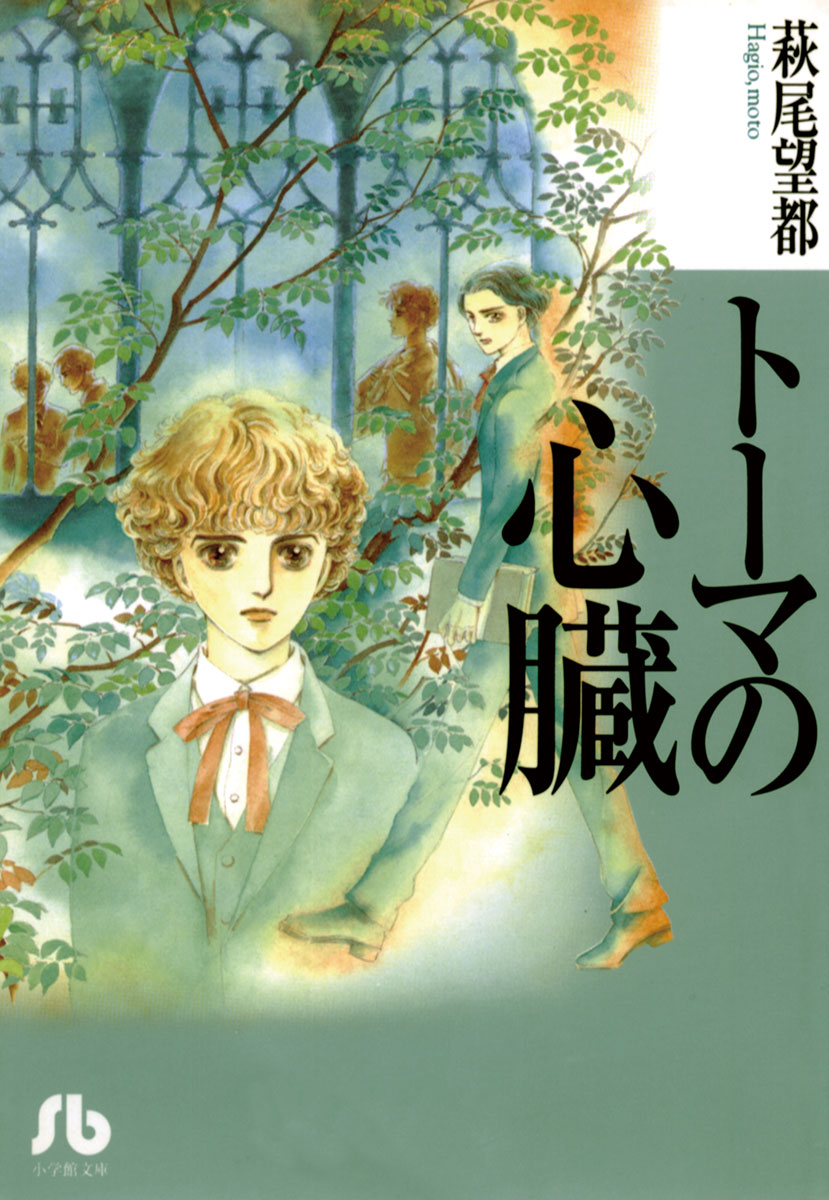
Thomas' Heart" is a girls' manga by Moto Hagio that was serialized in "Weekly Shoujo Comic" for a total of 33 issues starting in 1974, depicting the doubts and interactions of boys in a German gimnazium. It is a timeless masterpiece of girls' manga that boasts strong popularity, delicately depicting boys who are lost and find love in a closed gymnasium. On the last snowy day of that winter, a boy died. The main character, Yuri, receives a short suicide note. The story depicts the fragile and beautiful boys' faith, love, and friendship.
Thomas' will
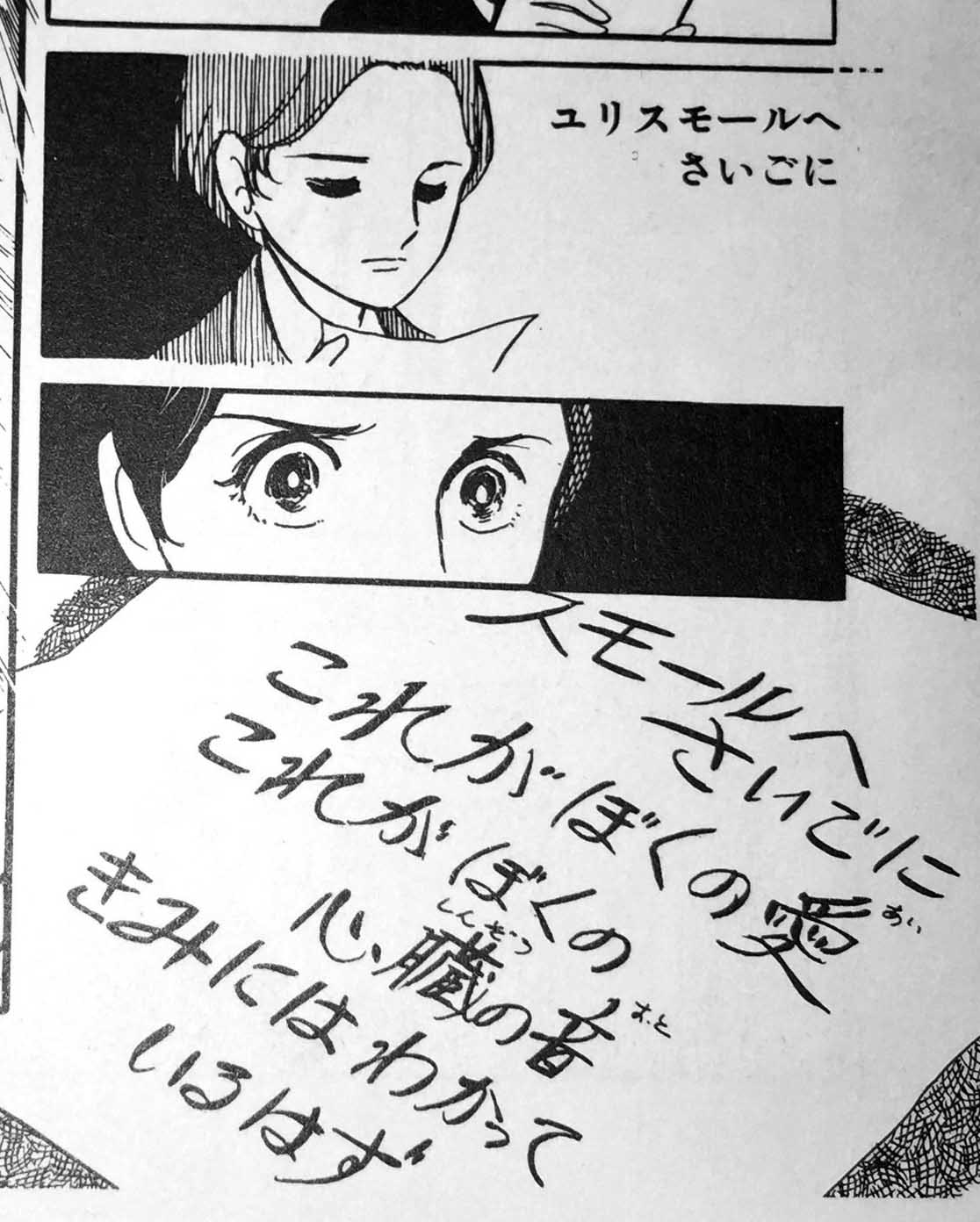
To Ulysse Moyle: "To the last, this is my love, this is the sound of my heart, and you know it."
The full text of the suicide note. The text is short, but mysterious and impressive.
Thomas' love letter
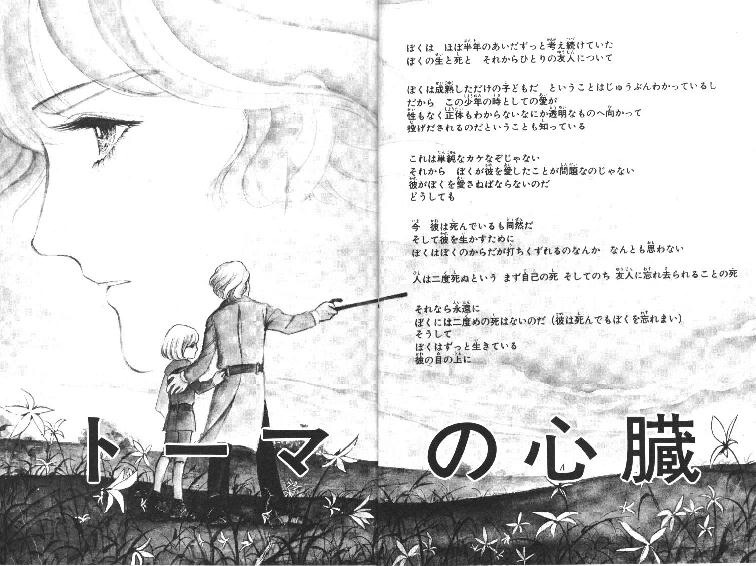
I've been thinking about it for almost six months.
About my life, my death, and my one friend.
I know very well that I am just a child who has matured.
And that's why my love as a boy's time
I know that my love as a boy's time is thrown out toward something transparent
I know that love as a boy's time
This is not a simple puzzle.
And it doesn't matter that I loved him.
He has to love me.
He has to love me.
Right now, he's as good as dead.
And to keep him alive.
I don't care if my body crumbles
They say a man dies twice, first the death of self, and later the death of being forgotten by his friends.
Then forever.
I will never die a second time (he won't forget me even if I die).
And so
I will always live
Over his eyes
The poem appears at the beginning of the work, after Thomas's death is described, but it was later found to be his love letter.
It was written in delicate script and tucked away in a difficult book titled "Renaissance and Humanism" in the library.
The first part of the poem is as above, but the love-letter in the book has a difference in *.
*toward something transparent (no sex, no identity)
It is a striking and beautiful poem.
Erik: "I'll give you one feather."
When Yuri, who knew that Thomas loved him but could do nothing about it, lamented, "I have no wings," Erik replied, "If I have wings, why not mine? I'll give you one wing... or both. You can have both wings. You don't need me. If you have wings, you can go to Toma..." He tells Yuri.
This is the scene where Yuri realizes his selfless love and understands the meaning of Toma's will, and realizes that Toma gave his wings to Yuri in exchange for his death.
Backstories, trivia, subplots/episodes, and anecdotes from "The Heart of Thomas"
Works that influenced this work
After seeing the French film "The Angel of Sorrows," the author decided to write a story about the boys in a boarding house. The movie ended in misfortune, so he decided to make the story a redemptive one. He had read Hermann Hesse and had a longing for Germany, so he set the story in Germany.
The author also says that she wanted to depict the growth of a good person who strives for perfection by juxtaposing her own childhood, when she "just wanted to be a good girl," with that of the main character.
Struggling Popular Vote
When this work was first serialized, it ranked at the bottom of the popularity polls and was in danger of being discontinued. The "Poe's Family" series, which he was working on at the same time, was so popular that there was even a proposal to have it serialized instead. He promised to draw "Poe's Family" after the serialization of this work was finished, and continued the serialization, but he gradually improved his ranking in the popularity polls and completed the series of 33 installments.
Influence of Mochito Hagio
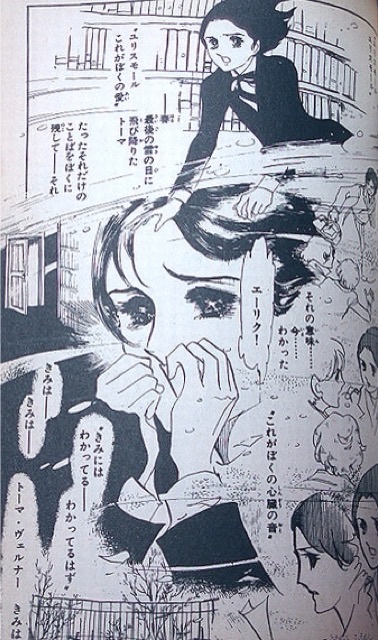
Unique screen composition. No frames and flowing lines show the reading order.
Shōjo manga were mostly aimed at girls, and the mainstream was a love story between a princess and a prince, but in the early 1970s, a revolution in shōjo manga occurred with the appearance of these women, known as the "24-nen class.
They included Moto Hagio, Keiko Takemiya, Yumiko Oshima, Ryoko Yamagishi, Yasuko Aoike, Toshie Kihara, and Mineko Yamada, all of whom were born around 1949. These women loved literature and left behind works that had never been seen before.
Their emotional and intellectual expressions, intricate frame layouts and delicate screen compositions, extreme sexual expressions, and challenges to science fiction, which had been dominated by male manga, developed a new readership.
The impetus came from a group of manga artists who gathered at the "Oizumi Salon" (Minami-Oizumi, Nerima-ku, Tokyo), where Hagio Moto and Takemiya Keiko, the authors of this work, were living together. Although their styles varied, many of their works featured boys as the main characters, and many of them are the origin of today's boys' love stories.
Hagio Mochito is not only a representative artist of the 24-year group, but also a pioneer who established a position in girls' manga, winning the first Osamu Tezuka Cultural Prize for "Cruel God Rules," becoming the first girls' manga artist to win the Medal with Purple Ribbon, and being selected as a Person of Cultural Merit.

Related Articles
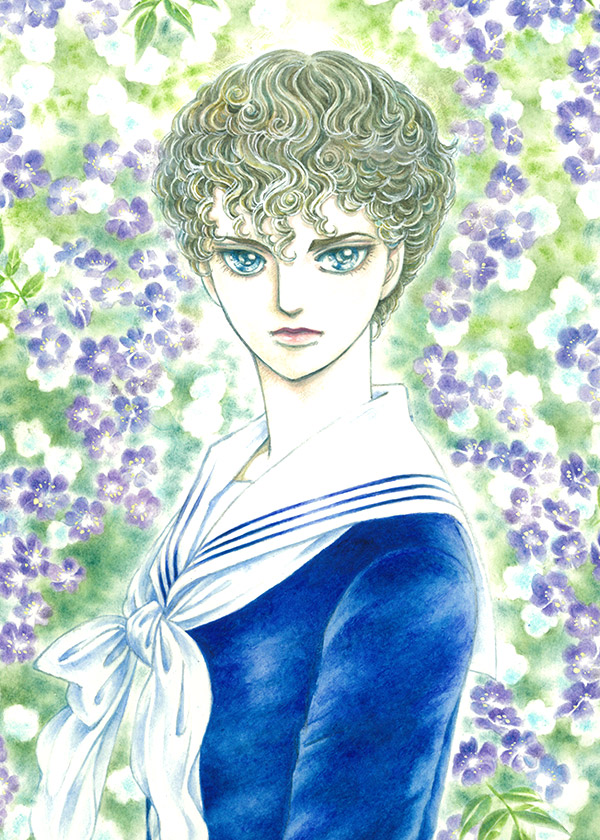
Spoiler commentary and discussion of Poe's Family (Mochito Hagio)
Poe's Clan" is a girls' manga featuring Edgar, a vampire boy, that has been published since 1972. It has a strong fan base for its aesthetic appeal and the melancholy of the vampaneras, who are not accepted by humans and must live in solitude. It was adapted for the stage in 2018 by the Takarazuka Revue, with which it has a strong affinity. It tells the story of Edgar, who wanders around the country as a boy who will never age, and survives alone while losing his friends.
Read Article
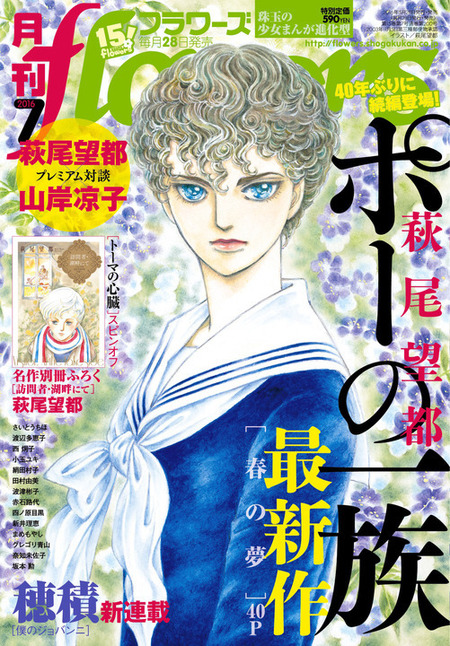
Hagio Moto's "Poe's Family": "Haru no Yume," the first sequel in 40 years, is so well-received that the magazine is going into overprint!
Since I was still young, the name "Moto Hagio" had already set him apart from other manga artists. Mr. Hagio has many excellent works, among which the "sequel" to his especially famous "Poe's Family" has recently been published in the monthly magazine "Flowers. The sales of the book far exceeded the publisher's expectations, and the book will soon be reprinted.
Read Article
Hana no 24-nen Gumi: Women Artists Who Radically Changed the Shojo Manga Industry
These female artists were active in the 1970s and took approaches that had never been taken in girls' manga before, such as BL and aesthetic expressions, which are not uncommon nowadays, content that included literary elements, and delicate illustrations. Since they were all born in 1949, they are known as the "Hana no 24-nen class. Here is a summary of the artists who are nostalgic for the author's generation.
Read Article
Tags
Contents
- Overview of "The Heart of Thomas
- Synopsis and story of "The Heart of Thomas"
- Death of Thomas
- Transfer student Erik
- Yuri's Secret
- Reunion with the devil and leftover love letters
- Thomas' will
- Characters and characters from "The Heart of Thomas"
- Schlotter Betz students
- Yuri (Yurismor Bayhan)
- Thomas Werner
- Erich Fruehlink
- Oscar Reiser
- Cyfried Gast.
- Ante Rohe.
- Bacchus
- redovi
- Jose.
- Herbert
- love
- earldom
- Airos (Aro)
- Igu (lake monster said to be living in Kyushu's Lake Ikeda)
- faculty
- Rudolf Muller
- Dr. Bush.
- Dr. Homan.
- School Doctor (Alut)
- Students' families/adults
- Marie Schwarz
- Yuri Sid Schwarz
- Maks Dodd.
- Alfonne Kimburg.
- Roger Brown
- Gustav Reiser.
- Hera (Helene Reiser)
- Sherry Bayhan.
- Yuri's father
- Yuri's grandmother
- Elisabeth Bayhan
- Bernhard Werner.
- Adèle Werner.
- Thomas' brother
- Terminology for The Heart of Thomas
- gymnasium
- gymnasium product
- Frequently used German Ruby
- Jacobian building
- Famous quotes, lines/scenes and scenes from "The Heart of Thomas"
- Thomas' will
- Thomas' love letter
- Erik: "I'll give you one feather."
- Backstories, trivia, subplots/episodes, and anecdotes from "The Heart of Thomas"
- Works that influenced this work
- Struggling Popular Vote
- Influence of Mochito Hagio