
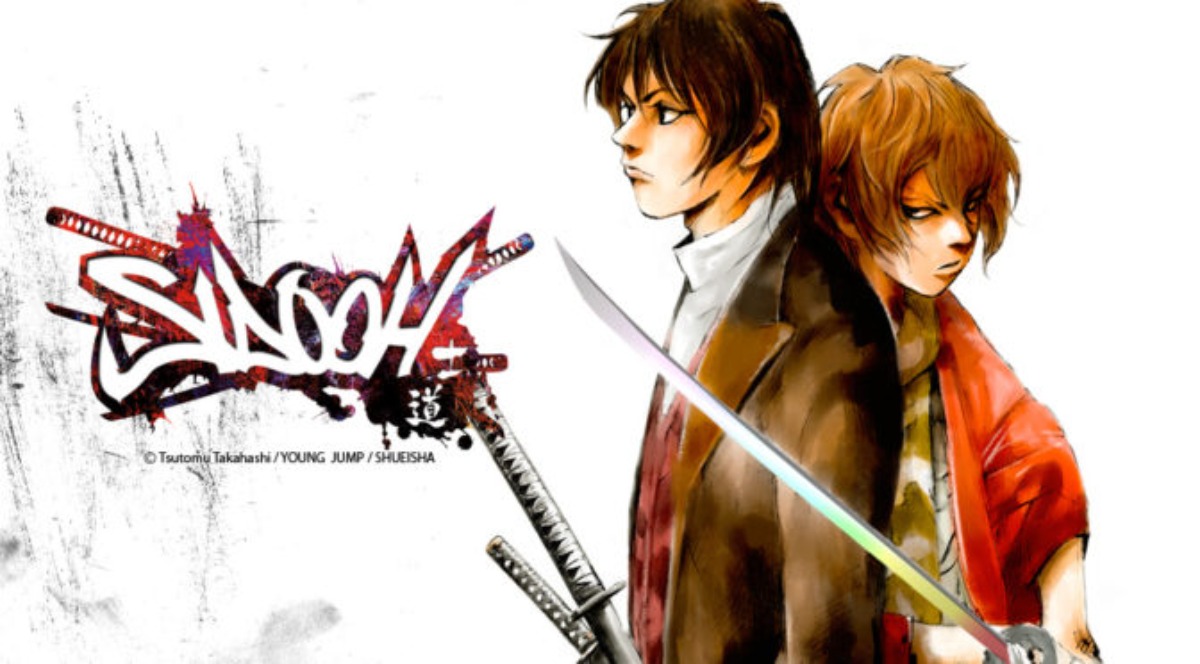
SIDOOH-Shido" is a historical manga by Tutomu Takahashi, serialized in "Weekly Young Jump" from June 2005 to November 2010. Set in the Edo period (1603-1868) just before the upheaval at the end of the Edo period, it tells the story of the Yukimura brothers, who lost their parents, and their survival as samurai while learning swordsmanship. The story depicts the brothers' growth and the ordeals they face against the backdrop of the chaos and shura of the times, deeply moving the reader.
Koharu
A female clerk at a laundry store called "Shimizu-ya" which was run by the Mito clan at the port of Yokohama. She was foolishly honest and got along well with Ino, who worked with her at Shimizu-ya. However, the Mito clan's expulsion of foreigners from Japan was exposed by a man named Ozon, and as a result, all the employees of Shimizuya were killed by the shogunate. Ino kept Koharu's hairpin as a memento of this tragedy.
park
A female clerk at a laundry called "Shimizu-ya" that was operated by the Mito clan at the port of Yokohama. When she visited the sweet store "Kashiwaya", she was captured by the Shogunate on her way out of the store. Later, unable to endure the torture of the Shogunate, she leaked information about the Mito clan's exclusion of the foreigners. Ultimately, she is slain by Tanabe.
Kengo Soma
A student at the Nisshinkan lecture hall. He lost his parents to illness and became an orphan. Later, he was rescued by a man named Kanbei and taken care of by him. He is polite and respectful to his superiors. He continues to study not only at Nisshinkan but also at a cram school run by Hayakawa. He also has deep feelings for Gentaro and develops a master-disciple relationship with him.
Kikuno Soma
She is Kengo's younger sister and is hearing impaired. She, too, lost her parents to illness and became an orphan. After that, she was taken care of by Kanbei. She also attends a cram school run by Hayakawa to learn. At first she is uncomfortable with Gentaro's rough attitude, but gradually she understands his clumsiness and becomes close to him. She promises Gentaro that she will do for him what he cannot do due to his disability. At the end of the story, she marries Gentaro and they become husband and wife. She also receives from Gentaro a dagger inscribed with the inscription, "Daigasu.
Seijiro Morita
A student at the Nisshinkan lecture hall.
Tetsumasa
He is the head of Kyoto's Yakuza clan, and is an irido dressed in Western-style clothing. He likes strong people and will spare no expense for those who are capable. If one wants to gain influence in Kyoto, the most effective way is to have Tetsumasa on one's side. He has a group of men, including Yizo Okada and Rigoro Gonda, and will sometimes invite those he likes to join him on the floor. Even after Gentaro slays 15 of the young men in his crew, he still has a deep interest in and liking for the powerful man known as Gentaro.
Toshigoro Gonda
He is a yakuza in Kyoto and a subordinate of the Tekkasho chief. He is a very large man with huge prayer beads around his neck. He seems to have quite a reputation in Kyoto, and Gentaro meets him while searching for Motokichi Hayakawa's Tsujikiri. Overconfident and overestimating his skill, he and his friends attempt to challenge Gentaro, but are eventually kicked out by Gentaro and his friends.
Sakuma Shozan
He was a warrior and thinker of the Matsushiro Clan. He had pupils such as Rugi and Yoshida Shoin. He preached the idea of a "ko-bu-ganetai" (a combination of the Emperor and his samurai) and the opening of Japan to the outside world to Keiki, but at the time Kyoto was being used as a hideout for the Emperor's expulsionists, so in 1864 he was attacked and assassinated in Sanjo Kiyamachi by Maeda Iemon, Kawakami Hikosai, and others.
Terms of "SIDOOH
Difference between "shido" and "bushido
Bushido is the determination to die without seeking reward.
Bushido" means... to be prepared to die and to live without shame.
Siberian blue robin (Luscinia cyane)

Scene of my mother's death in Korori.
In fact, cholera is a disease that has been endemic in Japan since the Edo period (1603-1868). In the past, the disease was also known in Japan as "cholera" (虎列刺), "teppo" (鉄砲) or "mikyaku" (見急) due to its symptoms of severe diarrhea and vomiting, and "korori" (虎狼痢) due to its rapid onset of death.
The cause of death of the mother of the Yukimura brothers.
Baisin Township (China)

Rugi.

Tags
Contents
- Outline of "SIDOOH
- The story of "SIDOOH
- Joined the White Lotus Corps (Biyakurentai)
- Encounters and many trials in Edo
- Activities in the Aizu Clan
- Interaction with Shinsengumi
- The Final Battle for Choshu's Transformation
- Characters in "SIDOOH
- protagonist
- Shoutaro Yukimura
- Gentaro Yukimura
- White Regiment (any of the armies that opposed the Bolsheviks during the Russian Revolution)
- Hundred Tongues
- Tasuke Samejima
- Kiyozo Asakura
- Kennosuke Ino
- Baishin Township
- Rugi
- NAGAMO (a type of duck)
- Asaji Kawakubo
- Shizuku Asakura
- Hikosaburo Yamazaki
- Kajiro Tanabe
- Kiritake Tsukumo
- Arara.
- Ullala
- person associated with the Edo shogunate
- Tokugawa Iemochi
- Ii Naosuke
- Hikogoro Hori
- Kaishu Katsu
- Michitaka Tanabe
- Tadayoshi Sakai
- Yamagata
- Shinsengumi (Mibu Roushi Gumi)
- Isami Kondo
- Toshizo Hijikata
- Soji Okita
- Hajime Saito
- Shinpachi Nagakura
- Sanosuke Harada
- Serizawa Duck (Serizawa Kamo)
- Arikawa
- Nohmi
- Persons related to the Aizu clan
- Kanbei Sagawa
- Matsudaira Katamori
- Jirobe Kimura
- Hayakawa
- Jimbo Kurasuke
- Motokichi Hayakawa
- Hideomi Uchiyama
- Choshu clan officials
- Shinsaku Takasugi
- Kogoro Katsura
- Yoshida Shoin
- Monta Inoue
- Genzui Kusaka
- Ryouemon Ishijima
- person related to the Satsuma clan
- Takamori Saigo
- Ryankina.
- Hisamitsu Shimazu
- Toshimichi Okubo
- Persons related to the Tosa Clan
- Ryoma Sakamoto
- Shintaro Nakaoka
- Izo Okada
- Seisen Osawa
- People related to the Mito Clan
- Daigo Kawabata
- Kahei Nagato
- Roushigumi
- Hachiro Kiyokawa
- Imperial Court (Chotei)
- Emperor Komei
- Hisatada Kujo
- Europe and America
- Johnson.
- Ford (car)
- Other
- Koharu
- park
- Kengo Soma
- Kikuno Soma
- Seijiro Morita
- Tetsumasa
- Toshigoro Gonda
- Sakuma Shozan
- Terms of "SIDOOH
- Difference between "shido" and "bushido
- Siberian blue robin (Luscinia cyane)
- Baisin Township (China)
- White Regiment
- group of Ronin
- Mibu Roshi Gumi
- Famous quotes, lines, scenes and scenes from "SIDOOH
- Shotaro Yukimura: "I can cut your body, but I can't cut your will."
- Shotaro Yukimura: "No matter how many roads there are, the path of the samurai is one."
- Shotaro Yukimura: "We... will defend this country even if we die."
- Gentaro Yukimura: "Brother, I will live with you. That's my shido."
- Gentaro Yukimura: "I believe in my brother. Because you are my brother."
- Seizo Asakura: "I make money with my sword. That is my shido."
- Seizo Asakura: "We will kill you before you kill us."
- Shinsaku Takasugi: "If you throw it away so easily... give it to me."
- The scene where he loses his mother in a corollary.
- The Yukimura brothers meet Seizo and beg him to be their apprentice.
- Backstory, Trivia, and Anecdotes about "SIDOOH
- The idea for this work is based on real people and historical facts
- Suspended in the middle of the season due to health problems
- Popular not only in Japan but also abroad
- Models and names of Shotaro and Gentaro
- The unit that served as the model for the White Regiment
- Author apologizes for last episode's online spoiler spreading frenzy.