
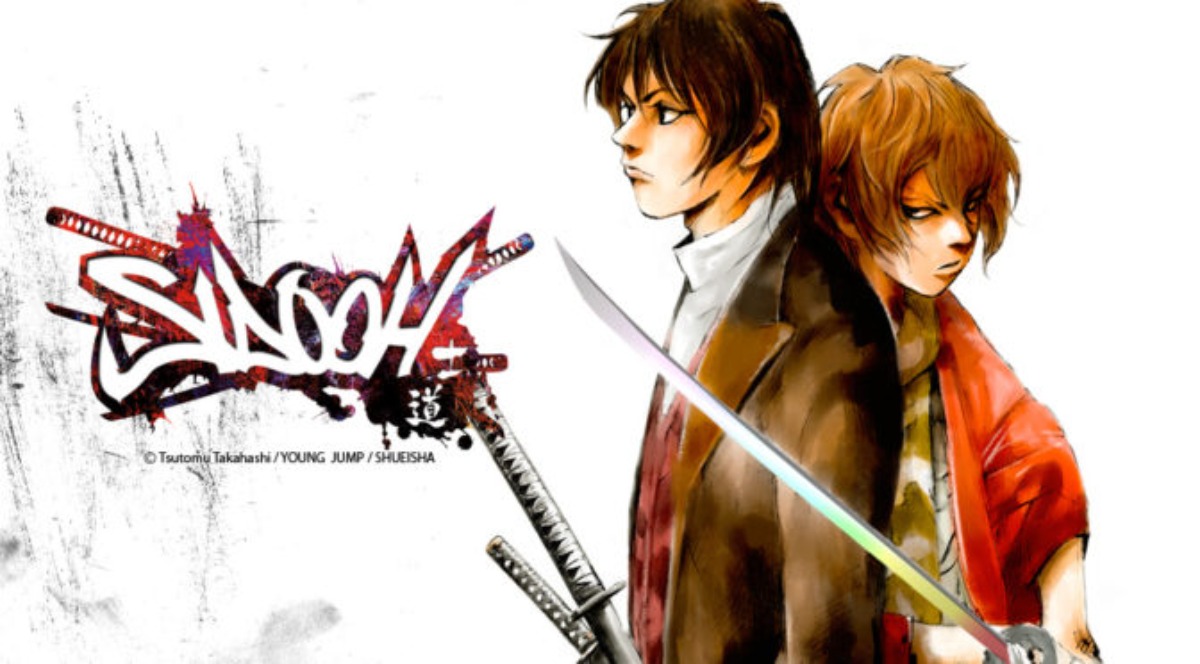
SIDOOH-Shido" is a historical manga by Tutomu Takahashi, serialized in "Weekly Young Jump" from June 2005 to November 2010. Set in the Edo period (1603-1868) just before the upheaval at the end of the Edo period, it tells the story of the Yukimura brothers, who lost their parents, and their survival as samurai while learning swordsmanship. The story depicts the brothers' growth and the ordeals they face against the backdrop of the chaos and shura of the times, deeply moving the reader.
Outline of "SIDOOH
SIDOOH" is a historical manga by Tsutomu Takahashi that was serialized in "Weekly Young Jump" from June 2005 to November 2010. The 25-volume series is set in the Edo period (1603-1867), just before the upheaval of the end of the Edo period. After their parents die, the Yukimura brothers choose to learn swordsmanship and live as samurai. The elder brother, Shotaro, and the younger brother, Gentaro, challenge the torrent of the times, becoming involved in historical figures and incidents, such as Sakamoto Ryoma and the Shinsengumi.
The story begins in Edo in 1842. Two brothers, Shotaro Yukimura and Gentaro Yukimura, pledge their determination to live alone, and the chaos of the times and the world of Shura that relentlessly befalls them are depicted. The brothers then travel from Edo to Kyoto, meeting various people along the way. Along the way, they also interact with Sakamoto Ryoma and members of the Shinsengumi, but they end up on opposite sides of the conflict. The brothers survive through the history of the end of the Tokugawa Shogunate, holding on to their own beliefs.
The story moves from Edo to Kyoto, where they witness a milestone in the history of the end of the Edo period. The brothers search for their own paths as they are involved in events such as the Sakuradamon-gai Incident, the Great Ansei Incarceration, and the assassination of Kogoro Katsura. Shoutarou becomes friends with Sakamoto Ryoma, but at the same time, he is at odds with the Shinsengumi. Gentaro is an active member of the Shinsengumi, and in the course of his activities, he also develops friendships with Okita Soji and Hijikata Toshizo. The brothers become embroiled in the turmoil of the end of the Tokugawa shogunate from their respective perspectives.
While the story is set in the turbulent end of the Edo period, it also depicts the human drama of the Yukimura brothers. The brothers love each other, but are at the mercy of the currents of the times. They grow up while experiencing encounters and partings with various people. The work is based on historical facts, and the characters and backgrounds are described in detail. Takahashi Tsutomu's drawing style is realistic and powerful, drawing the reader in. SIDOOH is a work that allows readers to not only learn about the history of the end of the Tokugawa Shogunate, but also to enjoy the touching story of the Yukimura brothers.
The work depicts the growth and adventures of the Yukimura brothers and realistically recreates the history of the end of the Tokugawa Shogunate. The work's appeal lies in Takahashi Tsutomu's detailed artwork and powerful storyline, and it won the Excellence Award in the Manga Division of the 11th Japan Media Arts Festival. Comics are published by Shueisha, and an e-book version is also available.
The story of "SIDOOH
Joined the White Lotus Corps (Biyakurentai)
The story begins with Shoutarou Yukimura (age 14) and Gentaro Yukimura (age 10), brothers from Kamiasakuni, who obeyed their mother's advice to "improve your skills" after she died of an epidemic disease called korori, and set off for Edo to take their father's sword, which he had left behind, and become stronger.
On his way to Edo from Joso-no-kuni, he meets Asakura Kiyozo, who tells Shotaro that he wants to learn swordsmanship and become stronger, and tells him to "follow me," and he is sold to an evil organization called Byakushinkyo.
The Bikyakushinkyo is a secret society led by Rugi, a great lord of Kamihisa, who sells human organs as medicine and has a large private army. Rugi is an ambitious man who wants to bring Japan under his rule and plans to overthrow the shogunate in alliance with Satcho.
After Shoutarou and Gentaro are captured by Hakushin-go, they are confined in a prison cell and literally "kept alive. The reason for this was to submit them to a killing ritual called the Byakushinsai, where they were to have a death match.
Hakushindo is a sword art taught in Hakushin-go that focuses solely on winning. In this swordsmanship, the weak must be cut down without mercy. So he faces the strongest of them all, Asaji Kawakubo.
Shoutarou risked his life to win and joined the Byakurentai, a group of assassins from Hakushin-go. The Hakurentai is a secret unit consisting of Kiyozo Asakura, Kennosuke Ino, Tasuke Samejima, Mozu, and the Yukimura brothers. They specialized in covert action and acted as pioneers in changing the world, raiding the Black Ships, Washington, and other places.
Encounters and many trials in Edo
The Yukimura brothers leave Hakushin-go and travel to Edo to test their strength and become stronger. Shortly after the Yukimura brothers arrive in Edo, a huge fire breaks out, and it is revealed that the cause is the burning of an alien ship by the Shogunate.
Ordered to shoot down the alien ships (black ships), the Hakuren-tai (White Regiment) thinks it necessary to attack from inside the black ships, so they send Hyakutan into hiding as a spy.
Meanwhile, Gentaro marvels at the technology of foreign countries and the appearance of the aliens. He is particularly interested in the guns they carry. Shoutarou reunites with Hyakutan, who works as a geisha as a spy, and gets involved in her plan. Momotei plans to infiltrate the alien ship and gather information. Shoutarou understands the danger of her plan, but he is attracted to her charms. And a kiss with her brings a new complication to their relationship.
The alien ship that Momotei has infiltrated is attacked and she is taken prisoner. In order to rescue her, Shotaro boards the alien ship with his friends from the Hakurentai. However, the alien ship catches fire due to treachery by Rugi, a spy for the shogunate. The brothers attempt to escape, risking life and death, while engaging in mortal combat with the foreign soldiers.
In the end, Shotaro fails to find Hyakutan, but the brothers survive the undersea battle and escape safely. Meanwhile, it is discovered that Hyakutani was actually rescued by an alien ship and is carrying Shotaro's child. This secret is not revealed to those around them. Shortly after their escape, the brothers are picked up by a shogun retainer named Hori Hikogoro and assigned to work in his household.
Hori was a disciple of Ino Tadataka, who devoted himself to the production of maps of Japan, and the Yukimura brothers learned and grew in the art of mapmaking.
Their daily life is also enriched through their interaction with Koharu, Hori's daughter. The brothers and Koharu grow close to each other and form a deep bond, but while their days are peaceful, the conflict between the shogunate and the expulsionists intensifies.
In the midst of this chaos, the brothers meet Daigo Kawabata, the leader of the expulsionist faction. Kawabata is a man who distrusts the Shogunate and stands by his beliefs, and the brothers, who sympathize with his ideology, find their encounter with him to be fateful.
Meanwhile, the conflict between the Shogunate and the expulsionists gradually intensifies, and Hori is forced to commit seppuku (ritual suicide) for treason. Upon his death, the brothers vow to take revenge against the Shogunate.
As they face various trials, the brothers are inspired by Hori's beliefs, but they also grow and reexamine their own beliefs.
The brothers' map-making skills gradually improve and their own personalities are reflected in their maps, while the upheavals of the times begin to affect their lives. The clash between the Shogunate and the barbarian expulsionists intensifies, and the brothers, along with Kawabata, find themselves caught in the middle of it all. Conflicted between their beliefs and reality, the Yukimura brothers struggle to find their own way.
Activities in the Aizu Clan
After the incident in Edo, the Yukimura brothers came to Aizu to study swordsmanship at the Aizu Banmeikan to further strengthen their skills and met new friends. The Yukimura brothers join their fellow samurai, who have sworn allegiance to the shogunate, and throw themselves into the arena of battle. Although initially uncomfortable in their new environment, the brothers devote themselves to daily training and combat with the pride and determination of warriors.
The Yukimura brothers grew by leaps and bounds, gradually gaining strength through rigorous training and combat. Gentaro's swordsmanship, in particular, became more sure-footed, and every time his sword was pointed at an enemy, a soulful blow was unleashed. His courage and swordsmanship earned him the respect of the warriors. Shoutarou, too, was agile and swift on the battlefield, his movements attracting widespread attention within the Aizu domain, and their courage and determination continued to influence many people. As the conflict between the shogunate and the new government intensified, the war became even more severe, and the brothers found themselves in battle again and again. Gentaro defeated many enemies with his superior swordsmanship, and his bravery was admired by warriors both inside and outside the Aizu domain. Shoutarou also moved around the battlefield with his agile movements, and his presence had a great influence in the Aizu domain.
Within the Aizu domain, Tsurutaro Kataoka crossed swords with the Yukimura brothers as a master swordsman, testing their abilities and beliefs. Later, Kataoka Tsurutaro and the brothers bonded as comrades fighting together. They also met Saigo Takamori, the leader of Satsuma, who was described as being made of love. The brothers explore deeply the meaning of battle from their different standpoints in Satsuma and Aizu.
In the course of battle, the brothers further deepen their friendship and beliefs, and become important figures in bringing courage and hope to themselves and others in the chaotic times of intensifying conflict between the Shogunate and the new government. However, the Aizu Clan gradually finds itself in a difficult position, and the war situation becomes even more severe.
Interaction with Shinsengumi
The brothers were ordered by the Aizu Clan to go to Kyoto to serve Matsudaira Yoho, the Protector of Kyoto. The brothers eventually come into contact with the Shinsengumi, an organization of the Imperialists and Exclusionists.
The Shinsengumi was a special unit of the Shogunate that was active during the upheavals of the last days of the Tokugawa Shogunate.
The relationship between the Yukimura brothers and the Shinsengumi was both adversarial and cooperative. Since the Hakurentai aimed to overthrow the shogunate, they engaged in numerous battles with the Shinsengumi. However, they sometimes fought together temporarily against Hakushin-go's treachery and Satcho's ambitions, especially Shoutarou and Hijikata Toshizo, who recognized each other's swordsmanship and fought each other on equal terms. Gentaro also studied swordsmanship under Kanbei Sagawa, while Isamu Kondo and Soji Okita played important roles for the brothers in the Shinsengumi. A friendship also developed between Gentaro and Okita, and they eventually treated each other like close friends.
Through the events in Kyoto, the brothers also interact with the Honno Exclusionist faction and different clansmen, and they gain a new understanding of their position, their mission, and the currents of the times. Meanwhile, as the conflict between the Shogunate and the Honno Exclusionist faction intensifies, the brothers begin to question their positions and beliefs.
A moment comes when they are forced to think deeply about their own beliefs and positions, rather than merely opposing each other.
As the situation at the end of the Tokugawa Shogunate becomes increasingly tense, the brothers find themselves in a position of conflict between the Shogunate and the Honno Exclusionist faction. Through the various events and choices they make on the streets of Kyoto, they reconsider their beliefs and mission in order to make a final decision.
The Final Battle for Choshu's Transformation
It begins at the moment Shoutarou takes a new step in life to marry Hyakushi. Meanwhile, Ryoma Sakamoto and Shintaro Nakaoka, both aspiring to overthrow the shogunate, fatefully meet Rugi, the ruler of Hakushin-go. At the same time, Shotaro and Gentaro receive information from Nagamo of Hakushin-go about a secret meeting between Sakamoto Ryoma and Rugi. Based on this information, the Yukimura brothers plan an attack on Omiya. This raid provided the perfect opportunity to attack Sakamoto Ryoma and Rugi, which would later lead to a major incident.
The Aizu clan, including the Yukimura brothers, learn of Ruyi's ambitions and oppose his plan. This act of rebellion is tracked by the Hakurentai, and Shotaro and Nakaoka are hunted down by them. However, Shotaro is rescued by Momotei and his friends.
On his way to Edo, Shotaro faces a fateful confrontation with Hijikata Toshizo of the Shinsengumi. During this swordfight, Hijikata explains to Shotaro the essence of bushido. In other words, it is not "the determination to die without seeking reward," but "the determination to live unashamedly with the resolve to die inside.
Meanwhile, Gentaro was defeated by Kanbei Sagawa and saved his life. Kanbei was a retainer of the Aizu domain, and his swordsmanship was top-notch. He is well-liked by those around him and has an upright character and a strong sense of humanity. This is where the quarrelsome Gen takes the opportunity to begin learning about bushido and loyalty. Through a fierce battle with Kazue Souma, Shoutarou learns that the Souma brothers were connected to Hakushin-go in the past. Despite the help of Shoutarou and others, Souma stays in Hakushin-go to seek revenge against Asaji and his own past, but is defeated by assassins.
He also attacks Omiya in order to accomplish his underhanded plan to assassinate Ryoma Sakamoto. Gentaro attempts the attack from a balloon flying over the sky, armed with a power firework and a flying palanquin. Meanwhile, Shoutarou infiltrates Omiya and finally encounters Sakamoto Ryoma and Nakaoka Shintaro. Sakamoto is holding a state-of-the-art pistol, and Shoutarou's sword stabs him. Both Sakamoto and Nakaoka were killed.
The first conquest of Choshu broke out before they had time to catch their breath, and Shotaro and his men joined the battle as members of the Aizu Clan. In the fierce battle, Shotaro won a fierce battle with Takasugi Shinsaku.
In the second conquest of Choshu, a decisive battle begins in which Hakushin-go also joins forces to fight. In this battle, Shotaro and Gentaro challenge Rugi to a fierce confrontation. They work together to exploit Rugi's weaknesses and crush his ambitions. With Rugi's death, Hakushin-go collapses and its rule comes to an end.
The Aizu forces led Hakushin-go to ruin. Gentaro and the deeply wounded Shotaro set out for Aizu. When the view eventually opens up, they see Mount Bandai (Iwaki-san), a mountain they had dreamed of. Shoutarou, who had been thinking of his family and wishing for his friend's survival, quietly closed his eyes.
Characters in "SIDOOH
protagonist
Shoutaro Yukimura

Shotaro Yukimura is from Kamihara Province and his nickname is "Sho". Following the advice of his mother, who died in Korori, to "hone his skills," he takes his father's sword and sets off with his younger brother to become stronger. On the way, he meets Asakura Seizo, who sells him and Gentaro to Hakushin-go, where they are sacrificed, but they successfully defeat Asaji and are recognized by Rugi. Thereafter, he trains as a child renren in Hakushin-go and trains as a sword fighter. Two years later, Sho grew up to be a fine man and attacked a black ship, Wassington, as a group of assassins (Hakurentai) from Baeksin-go. After the black ship is sunk, he replaces Seizo, who was betrayed and executed by Baishin-go, as the leader of the White Regiment. A year later, he found his own way of bushido and trained under Sagawa Kanpei in Edo and Aizu in order to defeat Rugi. His skills were equal to those of Hijikata Toshizo of the Shinsengumi, and when he confronted the wounded Takasugi Shinsaku, he intentionally beat him down while sustaining wounds himself. At heart, he is a gentle man who respects the courtesies of a samurai. He succeeded in his goal of defeating Rugi and destroying Hakushin-go, but after being seriously wounded, he left his last will and testament to Gentaro and died.
Gentaro Yukimura

Gentaro Yukimura, nicknamed Gen, is four years younger than Shoutarou Yukimura. He has a strong sense of humanity, although he often gets into trouble for his wild behavior. Although his swordsmanship is self-styled and not bound by "kata" (patterns), like his character, he is so skilled that he practically defeated Kogoro Katsura of the Choshu domain. In the end, he and Hijikata Toshizo fought all the way to Hakodate, but he survived and returned to Aizu, where his wife and Hyakutoku were waiting for him.
White Regiment (any of the armies that opposed the Bolsheviks during the Russian Revolution)
Hundred Tongues


Tags
Contents
- Outline of "SIDOOH
- The story of "SIDOOH
- Joined the White Lotus Corps (Biyakurentai)
- Encounters and many trials in Edo
- Activities in the Aizu Clan
- Interaction with Shinsengumi
- The Final Battle for Choshu's Transformation
- Characters in "SIDOOH
- protagonist
- Shoutaro Yukimura
- Gentaro Yukimura
- White Regiment (any of the armies that opposed the Bolsheviks during the Russian Revolution)
- Hundred Tongues
- Tasuke Samejima
- Kiyozo Asakura
- Kennosuke Ino
- Baishin Township
- Rugi
- NAGAMO (a type of duck)
- Asaji Kawakubo
- Shizuku Asakura
- Hikosaburo Yamazaki
- Kajiro Tanabe
- Kiritake Tsukumo
- Arara.
- Ullala
- person associated with the Edo shogunate
- Tokugawa Iemochi
- Ii Naosuke
- Hikogoro Hori
- Kaishu Katsu
- Michitaka Tanabe
- Tadayoshi Sakai
- Yamagata
- Shinsengumi (Mibu Roushi Gumi)
- Isami Kondo
- Toshizo Hijikata
- Soji Okita
- Hajime Saito
- Shinpachi Nagakura
- Sanosuke Harada
- Serizawa Duck (Serizawa Kamo)
- Arikawa
- Nohmi
- Persons related to the Aizu clan
- Kanbei Sagawa
- Matsudaira Katamori
- Jirobe Kimura
- Hayakawa
- Jimbo Kurasuke
- Motokichi Hayakawa
- Hideomi Uchiyama
- Choshu clan officials
- Shinsaku Takasugi
- Kogoro Katsura
- Yoshida Shoin
- Monta Inoue
- Genzui Kusaka
- Ryouemon Ishijima
- person related to the Satsuma clan
- Takamori Saigo
- Ryankina.
- Hisamitsu Shimazu
- Toshimichi Okubo
- Persons related to the Tosa Clan
- Ryoma Sakamoto
- Shintaro Nakaoka
- Izo Okada
- Seisen Osawa
- People related to the Mito Clan
- Daigo Kawabata
- Kahei Nagato
- Roushigumi
- Hachiro Kiyokawa
- Imperial Court (Chotei)
- Emperor Komei
- Hisatada Kujo
- Europe and America
- Johnson.
- Ford (car)
- Other
- Koharu
- park
- Kengo Soma
- Kikuno Soma
- Seijiro Morita
- Tetsumasa
- Toshigoro Gonda
- Sakuma Shozan
- Terms of "SIDOOH
- Difference between "shido" and "bushido
- Siberian blue robin (Luscinia cyane)
- Baisin Township (China)
- White Regiment
- group of Ronin
- Mibu Roshi Gumi
- Famous quotes, lines, scenes and scenes from "SIDOOH
- Shotaro Yukimura: "I can cut your body, but I can't cut your will."
- Shotaro Yukimura: "No matter how many roads there are, the path of the samurai is one."
- Shotaro Yukimura: "We... will defend this country even if we die."
- Gentaro Yukimura: "Brother, I will live with you. That's my shido."
- Gentaro Yukimura: "I believe in my brother. Because you are my brother."
- Seizo Asakura: "I make money with my sword. That is my shido."
- Seizo Asakura: "We will kill you before you kill us."
- Shinsaku Takasugi: "If you throw it away so easily... give it to me."
- The scene where he loses his mother in a corollary.
- The Yukimura brothers meet Seizo and beg him to be their apprentice.
- Backstory, Trivia, and Anecdotes about "SIDOOH
- The idea for this work is based on real people and historical facts
- Suspended in the middle of the season due to health problems
- Popular not only in Japan but also abroad
- Models and names of Shotaro and Gentaro
- The unit that served as the model for the White Regiment
- Author apologizes for last episode's online spoiler spreading frenzy.