
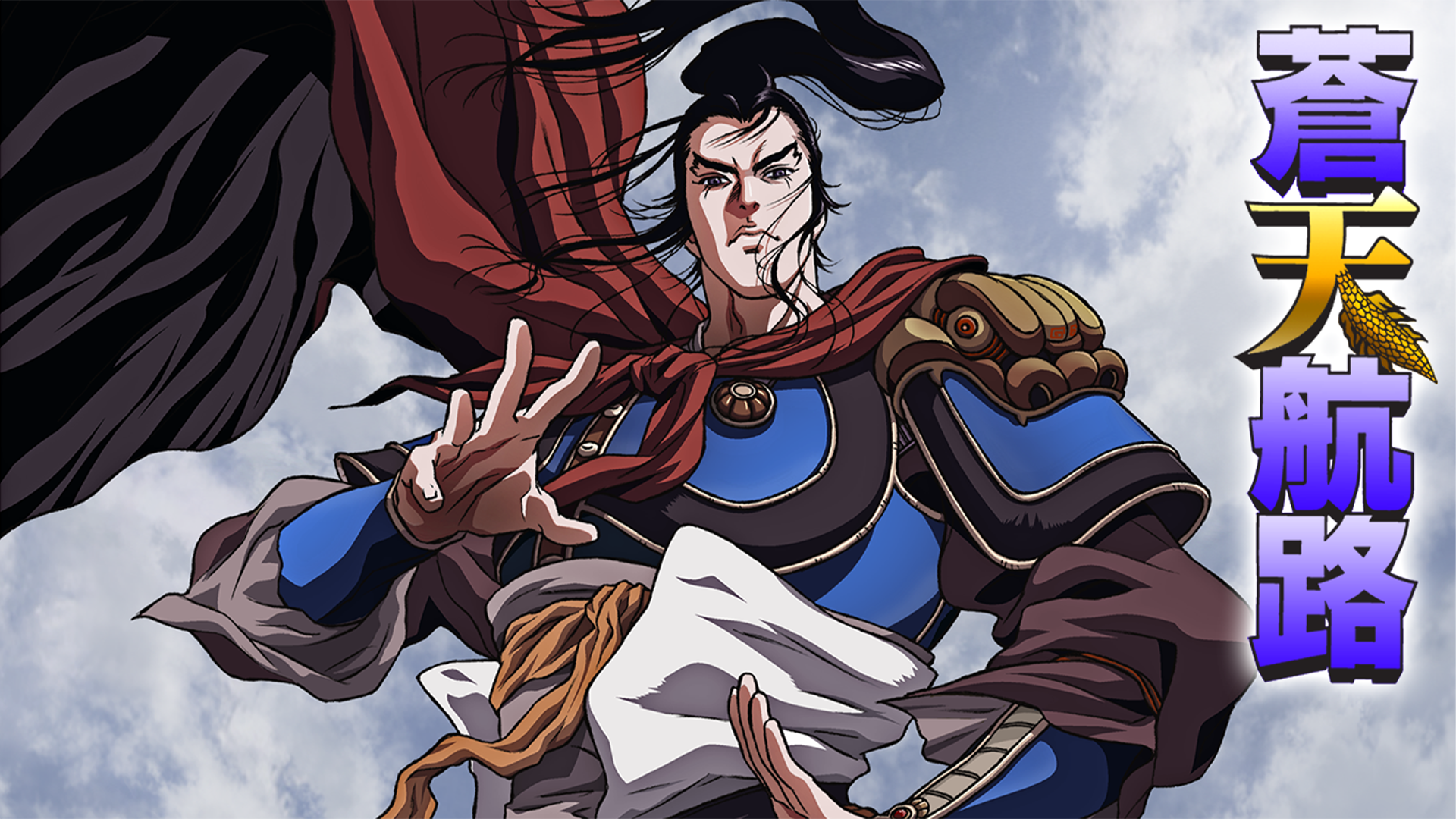
Souten Kouro" is a manga and anime based on the manga that was serialized in "Morning" magazine from 1994 to 2005 by Lee Gaku-ren (original story and draft) and Wang Xinta (artwork).
Originally, Cao Cao was considered the villain of the "History of the Three Kingdoms," but this historical work depicts the rise and fall of Cao Cao from the end of the Later Han Dynasty to the Three Kingdoms period in China. By depicting the Legend of the Three Kingdoms from an unprecedented new perspective, the film developed a new fan base in addition to the traditional Legend of the Three Kingdoms fans. This work led the Sanguozhi boom in the Heisei era, establishing the Sanguozhi as a genre in various media and triggering the birth of many boldly adapted works.
In response to Cao Cao's expedition to the west, the warlords of Ryoshu, led by Ma Chao of 西涼, rose in revolt.
Ma Chao, who clashed with Cao Cao's army at Tongguan, attacked Cao Cao along with Ma Wan. Cao Cao was injured and managed to retreat with the protection of Xu Chu.
Jia Xu, Cao Cao's strategist, came up with a plan to separate Cao Cao from Han Sui, the central figure of the military clique. As a result, warlords in the military clique thought that a secret agreement had been made between Cao Cao and Han Sui, causing a disturbance in unity and a total collapse of the army.
Ma Wan was killed in the battle, and Cao Cao, who had defeated Ma Chao and Han Sui, returned to Ye, leaving the rest to Xiahou Yuan.
Liu Bei no 入蜀: Hanchu seito (Sino-Chinese Conquest): Giou inauguration
The Liu Zhang of Ekishu welcomes Liu Bei and asks him to put down Zhang Lu, the founder of the Gobeido (Five Tomai Roads). However, Liu Bei does not move his army and instead turns his troops to Liu Zhang.
Liu Zhang vacated the castle when his base, Chengdu, was besieged, and Liu Bei gained Ikshu.
On the other hand, Cao Cao became Lu Weigong (chief adviser to the Emperor) and Lu Weigong Province was born.
After that, Cao Cao embarked on the subjugation of Zhang Lu in Han China and made Zhang Lu surrender.
After Cao Cao gained control of the Han Dynasty, he left the defense to Xiahou Yuan. After returning to Ye, Cao Cao became King Gi.
Battle of Hefei 〜 Battle of 濡須
In the battle against the Sun Quan army at Gappy, Zhang Liao drives Sun Quan to the brink.
However, Sun Quan took a blow from Zhang Liao himself and made a miraculous escape.
Two years later, Cao Cao mobilized as many as 200000 troops and advanced to 濡須 to confront Sun Quan's army.
Gan Ning of Sun Quan's army made a surprise attack on Cao Cao's garrison with a small army and took away 100 horses of Cao Cao's army.
Lü Meng proposed an all-out attack, but he received urgent information such as the death of Cheng Pu, an old commander, and the critical condition of Lu Su, and Sun Quan decided to surrender to Cao Cao. In response, Cao Cao returned to Ye and appointed his son Cao Pi as Crown Prince.
Battle of Mount Dingjun: The Birth of the Han Chinese King
Liu Bei begins to move to take the reins of government.
When Liu Bei's army advanced to Han China, Cao Cao sent Cao Hong as reinforcements to Xiahou Yuan, who was guarding Han China.
Xiahou Yuan chased Liu Bei into a corner, but was blocked by Zhang Fei and Ma Chao and could not kill him.
Later, Xiahou Yuan was again attacked by Liu Bei's army attacking Mount Dingjun, but he was killed bravely by the strategy of Zhuge Liang and the attack of Huang Zhong.
Cao Cao and Liu Bei confront each other in Han China. Fa Zheng, a strategist of Liu Bei's army, has reached the limit of his confrontation with Cao Cao in both mind and body, and he collapses.
Cao Cao repeatedly provokes Liu Bei's army, but Liu Bei avoids a full-scale confrontation.
Soon, Cao Cao decided to withdraw all his troops from Han Zhong. On the way, Liu Bei accompanied Han Zhong Wang and learned that Guan Yu in Jingzhou had begun to move northward toward Gi.
The Battle of Fan Cheng: The Death of Cao Cao
Guan Yu, which began to move northward, besieged Hanji Castle.
He forced Yu Jin, who had rushed to rescue the defensive general Cao Ren, to surrender, and killed Houtoku and Duke Cheng of Song.
This information encouraged anti-Cao Cao forces in various places and led to rebellions in various places. In response, the main force of Liu Bei also started marching toward Choan.
Xu Huang of Cao Cao's army challenged Guan Yu and succeeded in his plan to turn the tide.
Fan Sung returns to life, and Guan Yu changes course to the south after learning that its bases, Koan and Gangneung, were destroyed.
Kanu, who is heading south, realizes that the area around him is surrounded, but he rejects Sun Quan's offer of reinforcements and dismisses Sun Quan's army.
Guan Yu went further south and fought bravely, but was captured by Sun Quan's army and beheaded by Sun Quan.
Kanu's head reaches Cao Cao.
Cao Cao declared that he would worship Guan Yu, made a huge wooden statue and gave it the name "Gimu Sung-kun."
Cao Cao, who was dying of old age, was busy writing his will.
Then, he quietly breathed his last while drinking sake with Xiahou Dun who came to visit him.
His soul went looking for the crystal.
List of Soten Koro characters
Protagonist
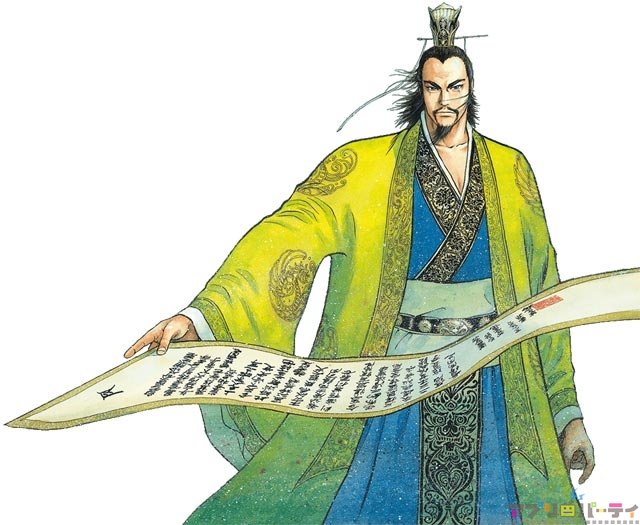
Cao Cao
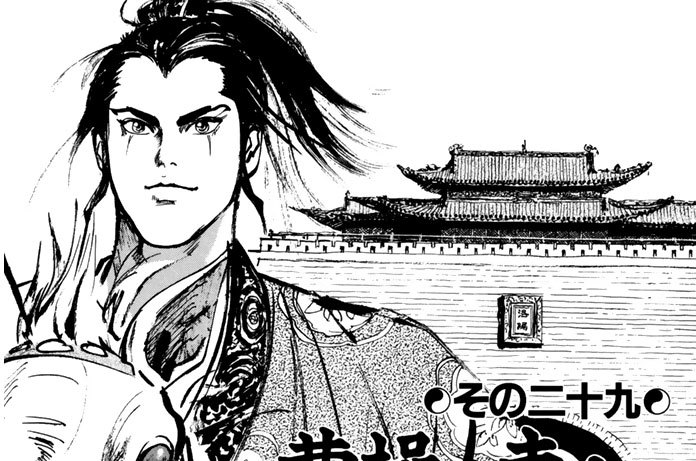
His azana (adult male's nickname) was Motoku, and his childhood name was 阿瞞; he was the grandson of the great eunuch Cao Teng.
He is well versed in military art, art of warfare and poetry, and shows his talent in various fields such as literature, music, architecture and cooking.
He used his wits that exceeded the abilities of ordinary people to fight in troubled times, to control Nakahara, and to obtain power under the protection of the emperor.
In the end, he ascended to the throne of King Wei and reigned over the country.
While they seek human resources as "heroes who show the most interest in people," they are opposed to Confucians as a hindrance to new values.
He is a "crafty man of troubled times" who is willing to slaughter and purge for his hegemony.
Cao Cao Shitenno
Xiahou Dun
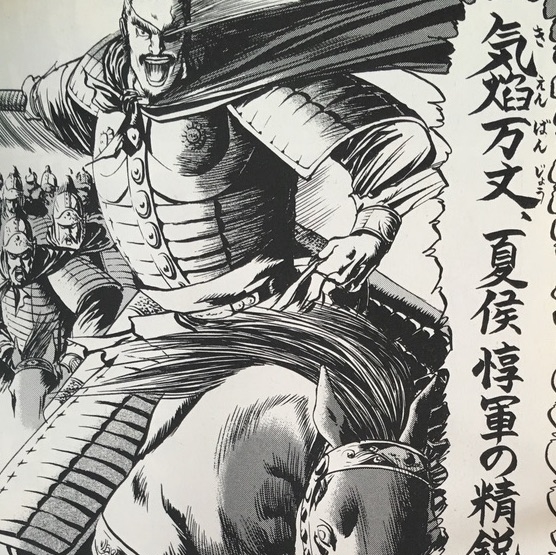
His azana (adult male's nickname) was Genjo. He was Cao Cao's cousin and childhood friend, and the oldest person since he raised an army.
He was the head of' The Four Heavenly Kings of Cao Cao' and a right-handed figure of Cao Cao, and was called' Tonnii' by other Four Heavenly Kings.
The only person under Cao Cao who can call him by his name and speak to him in an equal tone.
At the time of the subjugation of Dong Zhuo, his left eye was shot by an arrow and he pulled it out and ate it himself, which resulted in one eye.
Xiahou Yuan
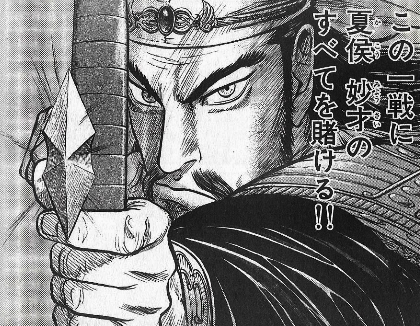
His azana (adult males nickname) was Myosai.
He was a cousin and childhood friend of Cao Cao and a cousin of Xiahou Dun. He was one of the' Four Loyal Retainers of Cao Cao.'
He was a master of archery.
He played an active role as commander of the Area Army, and was persuaded by Cao Cao to become' a king general.'
He died in the Battle of Mount Dingjun against Liu Bei.
Cao Ren
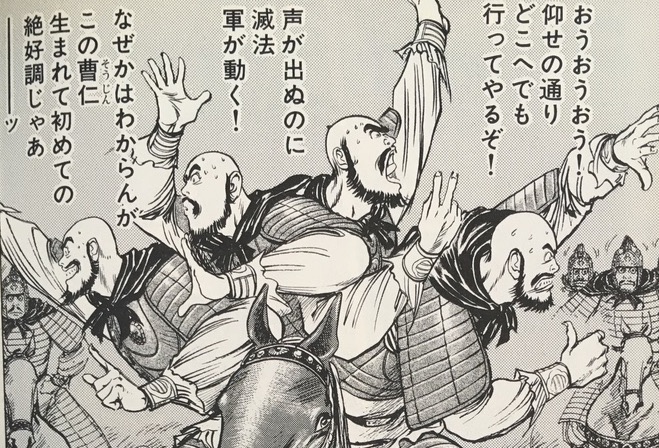
His azana (adult males nickname) was Shiko.
He was a cousin and childhood friend of Cao Cao and one of' Cao Cao Shitenno' (four loyal retainers of Cao Cao).
In the first half of the story, he did not achieve any results and tended to be idle, but he woke up in the Battle of Kando, and in the second half, he grew up to be a capable and strong general.
He is the type who shows his true potential to the extent that he is in a difficult situation.

Tags
Contents
- Overview of Soten Koro
- Outline and story of "Soten Koro"
- Juvenile to adolescent
- Kinu no ran
- Battle of Dong Zhuo
- Battle against the Cheongju Yellow Cloth Party
- Battle of Lü Bu
- Battle of Guandu
- Hokusetsu
- Battle of Nagaita
- Battle of the Red Wall
- Guxianling
- Battle of Tongguan
- Liu Bei no 入蜀: Hanchu seito (Sino-Chinese Conquest): Giou inauguration
- Battle of Hefei 〜 Battle of 濡須
- Battle of Mount Dingjun: The Birth of the Han Chinese King
- The Battle of Fan Cheng: The Death of Cao Cao
- List of Soten Koro characters
- Protagonist
- Cao Cao
- Cao Cao Shitenno
- Xiahou Dun
- Xiahou Yuan
- Cao Ren
- Cao Hong
- Wei military officers
- Xu Chu
- Yu Jin
- Dian Wei
- Pan
- Zhang Xiu
- Yue Jin
- Li Tong
- Zhang Liao
- Xu Huang
- Li Dian
- Man Chong
- Hōtoku
- Zhang He
- Zang Ba
- Shin (spicy)
- Song Il
- Chokan
- Wei civil servants
- Xun Yu
- Guo Jia
- Cheng Yu
- Xun You
- Jia Xu
- Liu Ye
- Wen Hui
- Chusei
- Liu Fu
- Sima Yi
- Zhang Ji
- Zhao Yan
- He Yan
- Guo Huai (or Arrowhead)
- Mao Jie
- Chen Lin
- Song Zhong
- Du Xi
- Hua Xin
- Cai Mao
- Zhang Yun
- Xun Yi
- Xun Can
- Cui Yan
- Du Ji (time)
- Jia Kui
- Teihi
- Yang Pei
- Lou Gui
- Zhong Yao
- Joeki
- Zheng Hun
- Dong Zhao
- Wei Kang
- Wei Feng
- Liang Mao
- Wang Can
- Ying Chang
- Xu Gan
- Liu Zhen
- Chen Jiao
- Wu Zhi
- Shushaku
- Chen Qun
- Chin 禕
- So-do, O Sho, O Tan, Zhang Quan, and Liu Wei
- Cao Cao officials
- Benriro
- Cao Ang
- Cao Pi
- Cao Zhang
- Cao Zhi
- Cao Xiu
- Cao Teng
- Cao Song
- Byakuren (White Lotus)
- Temiko
- Kanrin 霖明
- 甄姚
- Cao Rui
- Cao Jie
- Cao Anmin
- Cao Tai
- The Shu and Liu Bei Camps
- Liu Bei
- Military officer of Shu
- Kanu
- Zhang Fei
- Zhao Yun
- Huang Zhong
- Ma Chao
- Guan Ping
- Shuko
- Ma Dai
- Meng Da
- Wei Yan
- Yan Yan
- Chen Shi
- Lei Tong
- Wu Lan (look)
- Liao Hua
- Zhang Yi
- Civilian of Shu
- Zhuge Liang
- Cao Bao
- Xu Shu
- Ma Liang
- Mi Zhu
- Yin Guan
- Pang Tong
- Ma Su
- Fa Zheng
- Jian Yong
- Takuyo
- Li Hui
- Zhao Lei
- Sonro
- Wang Fu
- Liu Bei officials
- Hikiken
- Lady Gan
- Liu Ji
- Liu Shan
- Liu Feng
- Kure and the Sun Jian, Sun Ce, and Sun Quan camps
- Sun Jian
- Sun Ce
- Sun Quan
- Military officer of Wu
- Zhou Yu
- Lu Su
- Huang Gai
- Cheng Pu
- Han Dang
- Zu Mao
- Taishi Ci
- Wu Can
- Zhu Ran
- Lu Xun
- Shi Ren
- 阿獞
- Ding Feng
- Luo Tong
- Pan Jun
- 黥赤
- Eight Beasts
- Gan Ning
- Zhou Tai
- Zhang Qin
- Xu Sheng
- Chen Wu
- Pan Zhang
- Ling Tong
- Lü Meng
- Wu civil servants
- Chosho (Zhang Zhao)
- Zhang Hong
- Lü Fan
- Zhuge Jin
- Yu Fan
- Gu Yong
- 孫家 officials
- Son 燁夏
- Da Qiao
- Xiao Qiao
- Sun Shao
- Sun Jiao
- Later Han Dynasty
- Liu Hong
- Ryuben
- Ryu Kyo
- 亶公
- Empress Dowager Who
- He Jin
- Empress Dowager Dong
- Dong Cheng
- Empress Fu Shou
- Fukutoku
- 蹇朔
- Qiao Xuan
- 阿政
- Chen Fan
- Huangfu Song
- 厳忠
- Ding Yuan
- Gofu
- Cai Yong
- Wang Yun
- Sĩ Tôn Thụy
- Wang Zifu
- 呉子 ran (orchid)
- 种輯
- Kong Rong
- Kitsune (lucky 邈)
- Left ridge
- Oko (Wang Gong)
- Jujoji
- Zhang Rang
- Zhao Zhong
- Jian Shuo
- Dong Zhuo camp
- Dong Zhuo
- Li Ru
- Xu Rong
- Hua Xiong
- 李傕
- Lü Bu camp
- Lü Bu
- Chen Gong
- Gao Shun
- Chen Gui
- Chen Deng
- Song Xian
- Wei Xu
- Hou Cheng
- Yuan Shao camp
- Yuan Shao
- A military officer of the Yuan Shao army
- Kikugi (malted rice)
- Yan Liang
- Wen Chou
- Rikara
- Han Jun
- Liu Pi
- Chunyu Qiong
- Choi Gye
- Mutsugenshin
- Korean 莒子
- Lü Weihuang
- Guo Yuan
- Civilian of the Yuan Shao army
- Tian Feng
- Xu You
- Soju
- Shen Pei
- Yuan Shao officials
- Yuan Tan
- Yuan Xi
- Yuan Shang
- Consort Dowager Liu
- Yuan Shu camp
- Yuan Shu
- Ji Ling (pretty)
- Hashi 甤
- Li Feng
- Yue Jiu
- Beam steel
- Liu Biao camp
- Liu Biao
- Liu Qi
- Liu Cong
- Kuai Yue
- Fu Xun
- Liu Zhang camp
- Liu Zhang
- Chosho (Zhang Song)
- Gao Pei
- Yang Huai
- Teitaku
- Zhang Ren
- Xu Jing
- Suzuzhou warlords
- Ma Teng
- Han Sui
- Chenggong Ying
- Cheng Yi
- Liang Xing
- Yang Qiu
- Li Kan
- Ma Wan
- Troop
- Zhang Miao
- Bao Xin
- Gongsun Zan
- Tao Qian
- Qiao Mao
- Kong Zhou
- Lu Kang
- Liu Yao
- Gongsun Kang
- Lei Xu
- Other
- Lee Ryeol
- Suisho (crystal)
- Zhang Jue
- Cosen
- Huche'er
- Mr. Zou
- Anikiba
- Tadun
- Kyotan
- Terms of the Soten Koro
- 党錮 no kin
- Tai Hiramichi
- Kinu no ran
- Later Han
- Eunuch
- 俠
- Denkoku no Gyokuji
- Confucianism
- Wei
- Kure
- Shu
- Tenka Sanbun no Kei
- Words, lines, scenes from "Soten Koro"
- Cao Cao "Amore!"
- Cao Cao "Heaven"
- Cao Cao: "Well then!"
- Zhang Fei: "I'm a mere 侠者. I have lost sight of your place."
- Sun Quan "Don't say the point,"
- Behind the Scenes, Trivia, Small Stories / Episodes and Anecdotes of "Soten Koro"
- Author Lee Hak-in's Death and Impact
- The author was not familiar with "Sangokushi."
- Theme song and insert song of "Soten Koro"
- OP (opening): TRIBAL CHAIR "909"
- EDs (ending): Ogre You Asshole "Pinholes"