
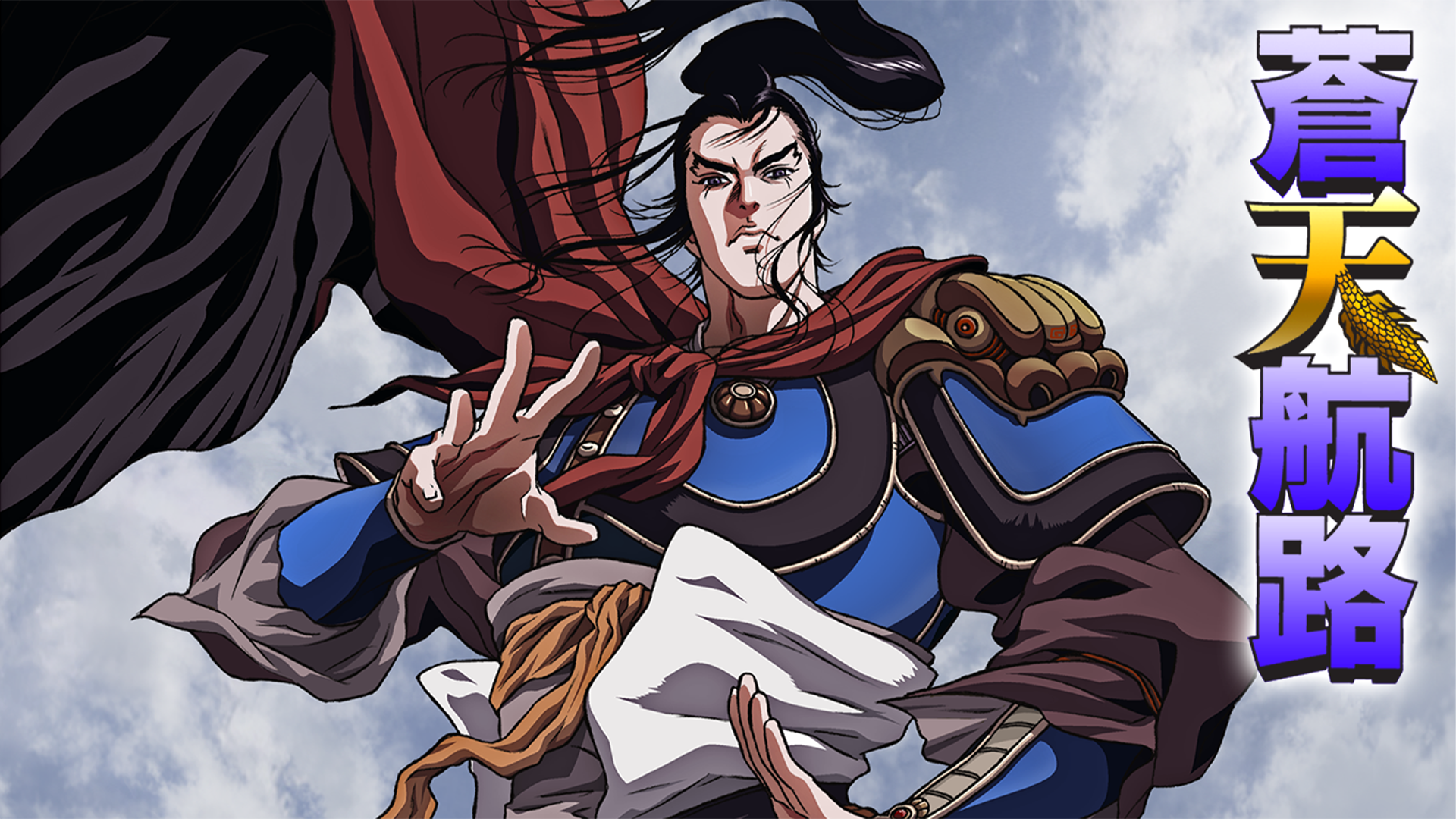
Souten Kouro" is a manga and anime based on the manga that was serialized in "Morning" magazine from 1994 to 2005 by Lee Gaku-ren (original story and draft) and Wang Xinta (artwork).
Originally, Cao Cao was considered the villain of the "History of the Three Kingdoms," but this historical work depicts the rise and fall of Cao Cao from the end of the Later Han Dynasty to the Three Kingdoms period in China. By depicting the Legend of the Three Kingdoms from an unprecedented new perspective, the film developed a new fan base in addition to the traditional Legend of the Three Kingdoms fans. This work led the Sanguozhi boom in the Heisei era, establishing the Sanguozhi as a genre in various media and triggering the birth of many boldly adapted works.
Overview of Soten Koro
"Soten Koro" is a comic serialized in "Morning" from 1994 to 2005 by Lee Hak-in (original and draft) and Gonta Kingu (drawing), and an anime based on the comic.
The catch copy is "Shocking Neo-Romance of the Three Kingdoms."
The Sanguo Zhi (History of the Three Kingdoms) of China, which is also popular in Japan, is a large-scale historical novel featuring Cao Cao, who was originally the enemy, as the main character and depicting the rise and fall of China from the end of the Later Han Dynasty to the Three Kingdoms Period through his life with a new interpretation.
Normally, many works based on "Romance of the Three Kingdoms" depict Liu Bei of Shu as the main character and Cao Cao of Gi as the enemy, but the main character of this work is Cao Cao, who was originally the villain.
Cao Cao is depicted as an exceptional hero with superhuman abilities, and other characters are boldly dramatized without being bound by conventional interpretations, and many strong and unique characters appear, regardless of whether they are famous or unknown.
In addition, the character of Cao Cao, who was' not bound by conventional concepts,' was emphasized, and the conflict between Cao Cao and Confucians, which was caused by this character, was also delved deeper than in other works related to "Sanguo Zhi."
The story begins with Cao Cao's childhood and ends with his death, not with the unification of the Three Kingdoms period by Jin.
At first, the series was written by Lee Hak-in for the original and by Gonta Kingu for the illustrations, but after Lee Hak-in died in 1998, it was written by Gonta Kingu alone.
As a result, the Lee Hak-in's credits have been changed to drafts.
With a total of 36 volumes, the comic became a hit that sold more than 10 million copies in total, and led the boom of "Sangokushi" (History of the Three Kingdoms) in the Heisei period.
In fiscal year 1998, he received the 22nd Kodansha Manga Award in the general category.
The largest climax of the first half of the original story, the' Battle of Kanto,' was made into a TV animation and broadcast on NTV from April to September 2009.
Outline and story of "Soten Koro"
Juvenile to adolescent
Cao Cao Mentoku (childhood name: 阿瞞) was born as the grandson of a grand eunuch and grew up without any problems.
Cao Cao, with his abundant talent and free-spirited lifestyle, was awed by the adults around him, and attracted to the bad-boys and girls of his age.
One day, Cao Cao learned that his cousins, Xiahou Dun, Xiahou Yuan, Cao Ren, and Cao Hong, were fighting with the "Bomb Squad," a group of thugs, and went to help them. On the way, he met Xu Chu, a boy of superhuman strength.
Cao Cao waged a war of words with Lee Ryeol, the head of the "Bakure-dan," and won a brilliant victory.
Lee Yeol was killed by Xu Chu, and the explosion group attracted by Cao Cao became his subordinates.
A few years later, Cao Cao, who had grown up, fell in love with Suisho, the daughter of Kojin, in the capital city of Luoyang.
The master of the teahouse sold the crystal to the great eunuch Zhang Rang, who was in power at the time, and used it as a sexual tool. When Cao Cao learned of this, he boarded the house of Zhang Rang and demanded the return of the crystal.
Zhang Rang refuses to return it and sends a guard to Cao Cao. It becomes a sword fight and Shisho dies in the confusion.
Cao Cao is also captured as a criminal and brought to justice by Qiao Xuan, who is feared to be the "Dragon of Luoyang."
At the age of 20, Cao Cao became Hokubu no (Northern Lieutenant). Those who violate the law will be severely punished regardless of whether they are public or private, and the security of Luoyang will be restored.
Soon, Cao Cao set out to uncover the truth about the "党錮 no Kin" scandal involving eunuchs who had been buried in the darkness.
After Cao Cao obtained the documents of accusation compiled by Chen Fan, who was killed by the ban of 党錮, he met the Emperor Liu Hong (Emperor Ling of Han).
Cao Cao reported the accusation to the emperor, but seeing its foolishness, he gave up on the future of the Han Dynasty.
Even after the report to the throne, the eunuchs were not convicted, and Cao Cao was appointed as the governor of Tongyeong County, Ji Province as a way to get rid of the trouble.
In Tonqung County, officials were corrupt and the people were suffering from high tax rates. Corrupt officials tried to conspire with Cao Cao, but Cao Cao wiped them out and pushed ahead with reforms one after another.
At that time, in 涿県, Liu Bei 玄徳 had a fateful encounter with Kanu 雲長 and Zhang Fei 益徳.
Kinu no ran
Under the tutelage of Zhang Jue, the founder of the Taoist sect, the "Tai Hiramichi" (great Taoist) had become a powerful group with hundreds of thousands of believers.
Zhang Jue, who originally had no ambition for tenka, took the phrase' Souten 已死' that Cao Cao had sent to tenka as the voice of tenka and decided to overthrow the Han Dynasty.
Tai Hiramichi rose in revolt, calling himself the' Yellow Coat Party,' and the' Yellow Coat Rebellion' broke out.
Cao Cao, who took part in the subjugation of the Yellow Coat Party as Kito no jo, was active in the Battle of Eigawa, which was a fierce battlefield.
Although Cao Cao cooperated with Sun Jian, a general from Jiangnan, and succeeded in occupying the Food Fort in Konyang, which was the most important stronghold of the Yellow Coat Party, Cao Cao, who noticed the reinforcement of the enemy, set fire to the fort, destroyed the whole ally and withdrew.
Before long, Zhang Jue fell ill and the War of the Yellow Coat ended. He plunged into a period of disorder in which many soldiers were stationed in various places, and Dong Zhuo of Suzuzhou started to advance his army to conquer the country.
Battle of Dong Zhuo
Dong Zhuo, who captured Luoyang, deprived the foolish Emperor Liu Ben (Emperor Shao of Liu Song) of the imperial throne and installed the bright Liu Kai (Emperor Xian of Han).
Dong Zhuo purged those who were involved in putting up Ryuben, and he himself became a shokoku, and the capital became a lawless area where Dong Zhuo and his troops committed all the violence.
Cao Cao was forced by Dong Zhuo to become a right-hand man, but he refused and escaped from the capital. He exhorted soldiers in various places and formed an anti-Imperial Dong Zhuo coalition led by Yuan Shao.
The two armies waged fierce battles between 汜水 no seki and Koro no seki, and Dong Zhuo set fire to Rakuyo and moved the capital to Changan.
Yuan Shao decided to withdraw, and the allied forces against Dong Zhuo were disbanded without fulfilling their purpose.
In Changan, the momentum to kill Dong Zhuo increased.
The daughter of Wang Yun, a Shito, plotted the assassination of Dong Zhuo but failed; however, she was favored by Dong Zhuo and made his wife.
Lü Bu, a vassal of Dong Zhuo, begins to see Utsusemi and kills Dong Zhuo.
At that time, Sun Jian, who was working to restore the scorched land of Luoyang, found the Imperial Seal of Denkoku, which was proof of the imperial throne, but he was attacked by an assassin and died during the subjugation of Liu Biao.
Battle against the Cheongju Yellow Cloth Party
Cao Cao was welcomed by 兗州 and confronted an attack from the Cheongju Yellow Cloth Party, the remnants of the Yellow Cloth Party.
Cao Cao holds the castle and attracts as many as one million members of the Cheongju Yellow Cloth Party, including women and children, to the battlefield.
When he defeated the desperate assault of the Cheongju Yellow Belt Party, which was about to starve to death due to food shortages, he declared that he would accept them as his own people. This led to the acquisition of 300000 soldiers called the "Blue National Guard" and one million people.
Battle of Lü Bu
An incident occurred in which all of Cao Cao's relatives, including his father Cao Song, were killed, and Cao Cao decided to attack Tao Qian, who was unable to fulfill his duty as a guard, despite the opposition of his followers.
When Cao Cao advanced his troops to Xu Zhou, the base of Tao Qian, he massacred even the people and farmers of Xu Zhou. For this act, his subordinate Chen Gong gave up on Cao Cao and led Lü Bu into the rebellion.
On the other hand, Liu Bei, who rushed to Xu Zhou to help Tao Qian, was preparing to counter Cao Cao's army, but the battle was avoided because Cao Cao withdrew when Lü Bu attacked. However, Tao Qian became ill from anxiety and passed away, leaving Liu Bei to take care of Xu Zhou.
After returning to 兗州, Cao Cao rescued his subordinate Xun Yu, who was nearly killed by Lü Bu, and declared that he would fight against Lü Bu's army for a year.
At that time, Sun Ce, the eldest son of Sun Jian, was living with Yuan Shu.
Sun Ce, who succeeded in regaining the 1,000 soldiers of the former Magoken Army that had been absorbed by Yuan Shu's army in exchange for the Imperial Seal of Denkoku, set out to subdue various places with his childhood friend Zhou Yu.
Sun Ce's army continued to advance rapidly, with more than 30000 soldiers, and Sun Ce became the hegemon of Yangzhou.
Cao Cao protects Emperor Xian of Han and Liu Kyo, who escaped to Luoyang.
Influenced by Cao Cao's words, however, Ryukyo decided to move the capital.
Around that time, Liu Bei, whose Xu Zhou had been taken away by Lü Bu, went to Cao Cao, who appointed Liu Bei as Boku of Yoshu and ordered him to retake Xu Zhou.
After Cao Cao captured Enjo Castle in Jingzhou, he captured Zou, who was known as the most beautiful woman in the world, and indulged in love affairs. Caught off guard, he was attacked by Choshu, who was supposed to have surrendered Enjo Castle and surrendered.
Although Cao Cao managed to escape, he lost Dian Wei, Zou, his eldest son, Cao Ang, his nephew, Cao Anmin, and his horse, which he had guarded.
On the other hand, Yuan Shu, who claimed himself to be the Emperor by obtaining the Imperial Seal of Denkoku, began to advance to Kyoto with Cao Cao as a treacherous retainer.
Cao Cao left the response to Yuan Shu to Xun Yu, and Xun Yu successfully defeated Yuan Shu's army.
Liu Bei lost the battle against Zhang Liao, a busho (Japanese military commander) of Lü Bu, and was captured at 下邳 Castle, the base of Lü Bu.
In response to this, Cao Cao set out to capture 下邳 Castle. On the other hand, Chen Gong, a strategist of Lü Bu's army, was trying to decide the winner and the loser in a field battle, but Chen Gui and Chen Deng, who had a secret relationship with Cao Cao, adopted a plan to hold the castle.
At one point, Lü Bu's army was thought to be at a disadvantage, but the situation reversed due to an attack using Lü Bu's military prowess, and he succeeded in holding out until winter came. However, Xun You, a strategist of Cao Cao, resisted Lü Bu's army, which was convinced of victory, by flooding, which caused Lü Bu's army to collapse, and Liu Bei succeeded in escaping.
Cao Cao executed Lü Bu, Chen Gong and Gao Shun, a strong general, and received Zhang Liao under his command.
At that time, Yuan Shao defeated Gongsun Zan and became the hegemon of the Four Provinces.
Battle of Guandu
Liu Bei, who was appointed as the Sashogun, received a secret Imperial command (Miccho) to kill Cao Cao from Emperor Xian of Han and Ryukyo. However, Liu Bei failed to kill Cao Cao and was assigned to subjugate Yuan Shu.
When the existence of the secret Imperial command was brought to light, Cao Cao had an audience with Liu Cong, who showed Cao Cao his intention of penitence, but Cao Cao declared that he would accept the Emperor as the head of his subjects.
Yuan Shu died of illness, and upon receiving the news, Liu Bei headed to 下邳 Castle.
Liu Bei kills Che Zhou, the assassin of Xu Zhou under Cao Cao, and breaks with Cao Cao.
Cao Cao crossed the Yellow River, sneaked into 黎陽, the base of Yuan Shao's army, with only six horsemen, and declared war through Yan Liang, a strong general under Yuan Shao.
When Zhang Xiu and Jia Xu, who had once defeated Cao Cao at Atejiro, offered to surrender to Cao Cao, Cao Cao accepted and led his own troops to attack Xu Zhou, where Liu Bei was. Liu Bei abandoned his wife and children and fled to Yuan Shao's headquarters in Ji Province.
Cao Cao took Liu Bei's eldest son, Liu Ji, as a hostage and received Guan Yu as his subordinate.
Liu Bei, who was put in charge of the vanguard of the battle against Cao Cao by Yuan Shao, and Yan Liang set out to capture Hakubasin, an important stronghold of the Yellow River. At this point, he chased down the defensive general Liu Yan, but the war changed completely due to the appearance of the General of the Beast in defense, and Yan Liang was killed. The identity of this General of the Beast was Guan Yu.
The army was destroyed by the attack of Zhang Liao, who replaced Guan Yu, and Zhang Fei fled with Liu Bei. The main force of Yuan Shao also arrived here, but Cao Cao dared to show up and provoked Yuan Shao, and he set a trap for Yuan Shao's Wen Chou who was following him and killed him.
The Cao Cao army temporarily abandoned Hakuba Port and withdrew to Kanto. Yuan Shao, who took the initiative in the battle, started marching all at once, claiming that it was the king's march.
In response, Cao Cao demoted the shogun to a private soldier and the strategist to a secretary, and he returned to Kyoto saying,' Draw out the instinct of private soldiers who are trying to survive.'
Around that time, Liu Pi of the former Yellow Coat Party raised an anti-Cao Cao army in Jonan.
Yuan Shao decides to send troops to Liu Bei to help Liu Pi. Liu Bei, who had been drunk due to the shock of Guan Yu becoming a vassal of Cao Cao, reunited with Zhao Yun and returned to Yeonam.
Sun Ce of Konan was looking for a chance to attack Kyoto, but he was attacked and seriously injured by a disciple of Taoist monk Gan Ji.
Sun Ce rose in arms despite the opposition of Zhou Yu, but his condition deteriorated and he passed away, leaving Zhou Yu and his younger brother Sun Quan to take his place.
Realizing that the time for the war to move was approaching, Cao Cao returned to Guandu, restored the shogun and military commanders to their original positions, and launched a counterattack.
Cao Cao, accompanied by Jia Xu and a small number of soldiers, went on patrol and burned down a huge military provisions warehouse in Usou, which was protected by Chunyu Qiong of the Yuan Shao's army. This made it impossible for the Yuan Shao's army to continue the war, and Cao Cao's army was victorious in the Great Battle of Guandu.
Hokusetsu
Liu Bei was living with Liu Biao in Jingzhou.
Guan Yu, who left Cao Cao and returned to Liu Bei, listens to Xu Shu about Zhuge Liang while consulting with him about human resources.
Liu Bei, Guan Yu, and Zhang Fei visit Zhuge Liang no Iori. The three are disgusted with Zhuge Liang's peculiarity, but as they visit Iori three times, they find hope in Zhuge Liang's Tenka Sanbu-no-Kei.
Cao Cao suppressed the northern four provinces and returned to Ye.
Realizing the poetic genius of his third son, Cao Zhi, Cao Cao sends Cao Zhi to Kyoto. Cao Zhi takes part in the Emperor's banquet and improvises with poems inspired by Kong Rong's. Kong Rong does not approve of Cao Zhi's poems, but Chen Lin supports Cao Zhi. Then Cao Cao appears and declares that all culture, scholarship, art and talent should be freed from the spell of Confucianism. It was the moment when "Kenan literature" blossomed.
Guo Jia, Cao Cao's strategist, suggested Hokubatsu (northern cutting), and Cao Cao led his army over the Great Wall of China.
Guo Jia developed a strategy centering on Zhang Liao's army and defeated the Karasuma clan led by Tadun.
Yuan Xi, the second son of Yuan Shao, and Yuan Shang, the third son, who had been staying with Tadun, fled to Gongsun Kang in Liaodong, but were executed by Gongsun Kang for fear of Cao Cao.
The northern expedition ended when the northern people, including the Senpezoku, obeyed Cao Cao, but Guo Jia died of illness.
Cao Cao assumed the position of Chancellor, which was the highest rank among his subjects.
Battle of Nagaita
Sun Quan avenges his father's death, Huang Zu.
Among his vassals, there was a growing desire to form an alliance with Cao Cao, but Zhou Yu suppressed the desire and dispatched Lu Su to investigate Liu Bei's movements.
In Jingzhou, Liu Cong decided to surrender, and Liu Bei, who was staying with Liu Cong, refused to surrender and ran away to Gangneung.
However, the speed of the advance slowed down because the people who admired Liu Bei followed them, and they were overtaken by the army of Cao Cao.
Zhang Fei stopped the attack of Cao Cao's army at Shingari.
At last, the army of Cao Cao was overpowered, but the separate troops of Zhang Xiu and Jia Xu attacked Liu Bei, who was in the lead.
Liu Bei left his wife and children and continued to run away, pretending nothing.
Zhao Yun arrives just a hair's breadth from his wife and children, who are in a difficult situation, and opens a blood line with 阿斗, the son of Liu Bei, in his arms.
Liu Bei wakes up as tenkabito (person becoming the ruler of the country) as he asks himself during his escape. When he reached Kanshin, he boarded the ship of Kanu, which he had kept ahead of him, and withdrew, declaring "Tenka sanbu" (three parts of the world).
Battle of the Red Wall
Cao Cao came up with a plan to go down the Yangtze River with a civilian.
On the other hand, Lu Su, a vassal of Sun Quan, formed an alliance with Liu Bei and, together with Zhou Yu and Zhuge Liang, went to a meeting of Sun Quan's army.
Sun Quan decided to resist Cao Cao and set sail the navy to Changjiang.
While traveling by ship, Cao Cao ate river fish presented to him and suffered food poisoning.
Gan Ning of Sun Quan's army attacks the fleet of Cao Cao's army by taking advantage of the dense fog. Gan Ning kills Cai Mao who is in charge of the navy of Cao Cao's army.
The Cao Cao army suffered extensive damage, and Cao Cao escaped with the help of Xu Chu and went missing.
The strategist of Cao Cao, Xun You, gathered the remaining soldiers together and camped in Urin to keep them strong.
Eventually, Cao Cao recovered and returned to the camp in Wulin.
When it became clear that Cao Cao was still alive, Sun Quan's veteran general Huang Gai planned to make a false surrender to Cao Cao's army.
Sun Quan's army launched a fire attack on Cao Cao's fleet facing Huang Gai. Cao Cao's army was engulfed in fire, and the battle at the Red Wall ended with Cao Cao's defeat.
Guxianling
Cao Cao trained the navy in preparation for the battle against Sun Quan.
After that, Cao Cao inspected Gappy Castle, which endured a 100-day fierce attack by 100,000 Sun Quan troops.
Cao Cao, who continues to advance southward, orders Xiahou Yuan to subdue Lei Xu in the Luo River, conveying his readiness as commander.
Xiahou Yuan, who defeated Lei Xu, begins his career as commander.
A proposal to marry Sun Quan's younger sister 燁夏 was made to Liu Bei, who had become a farmer in Jingzhou, and Liu Bei readily accepted the proposal.
Zhou Yu triumphantly returns to Sun Quan after defeating Cao Ren, a follower of Cao Cao.
Sun Quan, who recognized Zhou Yu's poor physical condition, proposed a leave of absence, but Zhou Yu rejected it and started to advance to the west. However, Zhou Yu's physical condition reached its limit, and he passed away by appointing Lu Su as his successor.
Cao Cao receives medical treatment from Hua Tuo, a renowned Confucian doctor.
Although Cao Cao acknowledges his talent, he finds that Hua Tuo is not honored for his talent in medicine. Cao Cao claims that the spirit of Confucianism is clouding people's abilities, and he devises a recruitment system that does not rely on Confucianism called Kyukenrei.
Xun Yu, Cao Cao's strategist as well as a Confucian, asked for the withdrawal of Gukenrei, but Cao Cao issued Gukenrei regardless.
A rift also developed between Cao Cao and Hua Tuo, and Hua Tuo died in prison.
Battle of Tongguan

Tags
Contents
- Overview of Soten Koro
- Outline and story of "Soten Koro"
- Juvenile to adolescent
- Kinu no ran
- Battle of Dong Zhuo
- Battle against the Cheongju Yellow Cloth Party
- Battle of Lü Bu
- Battle of Guandu
- Hokusetsu
- Battle of Nagaita
- Battle of the Red Wall
- Guxianling
- Battle of Tongguan
- Liu Bei no 入蜀: Hanchu seito (Sino-Chinese Conquest): Giou inauguration
- Battle of Hefei 〜 Battle of 濡須
- Battle of Mount Dingjun: The Birth of the Han Chinese King
- The Battle of Fan Cheng: The Death of Cao Cao
- List of Soten Koro characters
- Protagonist
- Cao Cao
- Cao Cao Shitenno
- Xiahou Dun
- Xiahou Yuan
- Cao Ren
- Cao Hong
- Wei military officers
- Xu Chu
- Yu Jin
- Dian Wei
- Pan
- Zhang Xiu
- Yue Jin
- Li Tong
- Zhang Liao
- Xu Huang
- Li Dian
- Man Chong
- Hōtoku
- Zhang He
- Zang Ba
- Shin (spicy)
- Song Il
- Chokan
- Wei civil servants
- Xun Yu
- Guo Jia
- Cheng Yu
- Xun You
- Jia Xu
- Liu Ye
- Wen Hui
- Chusei
- Liu Fu
- Sima Yi
- Zhang Ji
- Zhao Yan
- He Yan
- Guo Huai (or Arrowhead)
- Mao Jie
- Chen Lin
- Song Zhong
- Du Xi
- Hua Xin
- Cai Mao
- Zhang Yun
- Xun Yi
- Xun Can
- Cui Yan
- Du Ji (time)
- Jia Kui
- Teihi
- Yang Pei
- Lou Gui
- Zhong Yao
- Joeki
- Zheng Hun
- Dong Zhao
- Wei Kang
- Wei Feng
- Liang Mao
- Wang Can
- Ying Chang
- Xu Gan
- Liu Zhen
- Chen Jiao
- Wu Zhi
- Shushaku
- Chen Qun
- Chin 禕
- So-do, O Sho, O Tan, Zhang Quan, and Liu Wei
- Cao Cao officials
- Benriro
- Cao Ang
- Cao Pi
- Cao Zhang
- Cao Zhi
- Cao Xiu
- Cao Teng
- Cao Song
- Byakuren (White Lotus)
- Temiko
- Kanrin 霖明
- 甄姚
- Cao Rui
- Cao Jie
- Cao Anmin
- Cao Tai
- The Shu and Liu Bei Camps
- Liu Bei
- Military officer of Shu
- Kanu
- Zhang Fei
- Zhao Yun
- Huang Zhong
- Ma Chao
- Guan Ping
- Shuko
- Ma Dai
- Meng Da
- Wei Yan
- Yan Yan
- Chen Shi
- Lei Tong
- Wu Lan (look)
- Liao Hua
- Zhang Yi
- Civilian of Shu
- Zhuge Liang
- Cao Bao
- Xu Shu
- Ma Liang
- Mi Zhu
- Yin Guan
- Pang Tong
- Ma Su
- Fa Zheng
- Jian Yong
- Takuyo
- Li Hui
- Zhao Lei
- Sonro
- Wang Fu
- Liu Bei officials
- Hikiken
- Lady Gan
- Liu Ji
- Liu Shan
- Liu Feng
- Kure and the Sun Jian, Sun Ce, and Sun Quan camps
- Sun Jian
- Sun Ce
- Sun Quan
- Military officer of Wu
- Zhou Yu
- Lu Su
- Huang Gai
- Cheng Pu
- Han Dang
- Zu Mao
- Taishi Ci
- Wu Can
- Zhu Ran
- Lu Xun
- Shi Ren
- 阿獞
- Ding Feng
- Luo Tong
- Pan Jun
- 黥赤
- Eight Beasts
- Gan Ning
- Zhou Tai
- Zhang Qin
- Xu Sheng
- Chen Wu
- Pan Zhang
- Ling Tong
- Lü Meng
- Wu civil servants
- Chosho (Zhang Zhao)
- Zhang Hong
- Lü Fan
- Zhuge Jin
- Yu Fan
- Gu Yong
- 孫家 officials
- Son 燁夏
- Da Qiao
- Xiao Qiao
- Sun Shao
- Sun Jiao
- Later Han Dynasty
- Liu Hong
- Ryuben
- Ryu Kyo
- 亶公
- Empress Dowager Who
- He Jin
- Empress Dowager Dong
- Dong Cheng
- Empress Fu Shou
- Fukutoku
- 蹇朔
- Qiao Xuan
- 阿政
- Chen Fan
- Huangfu Song
- 厳忠
- Ding Yuan
- Gofu
- Cai Yong
- Wang Yun
- Sĩ Tôn Thụy
- Wang Zifu
- 呉子 ran (orchid)
- 种輯
- Kong Rong
- Kitsune (lucky 邈)
- Left ridge
- Oko (Wang Gong)
- Jujoji
- Zhang Rang
- Zhao Zhong
- Jian Shuo
- Dong Zhuo camp
- Dong Zhuo
- Li Ru
- Xu Rong
- Hua Xiong
- 李傕
- Lü Bu camp
- Lü Bu
- Chen Gong
- Gao Shun
- Chen Gui
- Chen Deng
- Song Xian
- Wei Xu
- Hou Cheng
- Yuan Shao camp
- Yuan Shao
- A military officer of the Yuan Shao army
- Kikugi (malted rice)
- Yan Liang
- Wen Chou
- Rikara
- Han Jun
- Liu Pi
- Chunyu Qiong
- Choi Gye
- Mutsugenshin
- Korean 莒子
- Lü Weihuang
- Guo Yuan
- Civilian of the Yuan Shao army
- Tian Feng
- Xu You
- Soju
- Shen Pei
- Yuan Shao officials
- Yuan Tan
- Yuan Xi
- Yuan Shang
- Consort Dowager Liu
- Yuan Shu camp
- Yuan Shu
- Ji Ling (pretty)
- Hashi 甤
- Li Feng
- Yue Jiu
- Beam steel
- Liu Biao camp
- Liu Biao
- Liu Qi
- Liu Cong
- Kuai Yue
- Fu Xun
- Liu Zhang camp
- Liu Zhang
- Chosho (Zhang Song)
- Gao Pei
- Yang Huai
- Teitaku
- Zhang Ren
- Xu Jing
- Suzuzhou warlords
- Ma Teng
- Han Sui
- Chenggong Ying
- Cheng Yi
- Liang Xing
- Yang Qiu
- Li Kan
- Ma Wan
- Troop
- Zhang Miao
- Bao Xin
- Gongsun Zan
- Tao Qian
- Qiao Mao
- Kong Zhou
- Lu Kang
- Liu Yao
- Gongsun Kang
- Lei Xu
- Other
- Lee Ryeol
- Suisho (crystal)
- Zhang Jue
- Cosen
- Huche'er
- Mr. Zou
- Anikiba
- Tadun
- Kyotan
- Terms of the Soten Koro
- 党錮 no kin
- Tai Hiramichi
- Kinu no ran
- Later Han
- Eunuch
- 俠
- Denkoku no Gyokuji
- Confucianism
- Wei
- Kure
- Shu
- Tenka Sanbun no Kei
- Words, lines, scenes from "Soten Koro"
- Cao Cao "Amore!"
- Cao Cao "Heaven"
- Cao Cao: "Well then!"
- Zhang Fei: "I'm a mere 侠者. I have lost sight of your place."
- Sun Quan "Don't say the point,"
- Behind the Scenes, Trivia, Small Stories / Episodes and Anecdotes of "Soten Koro"
- Author Lee Hak-in's Death and Impact
- The author was not familiar with "Sangokushi."
- Theme song and insert song of "Soten Koro"
- OP (opening): TRIBAL CHAIR "909"
- EDs (ending): Ogre You Asshole "Pinholes"