
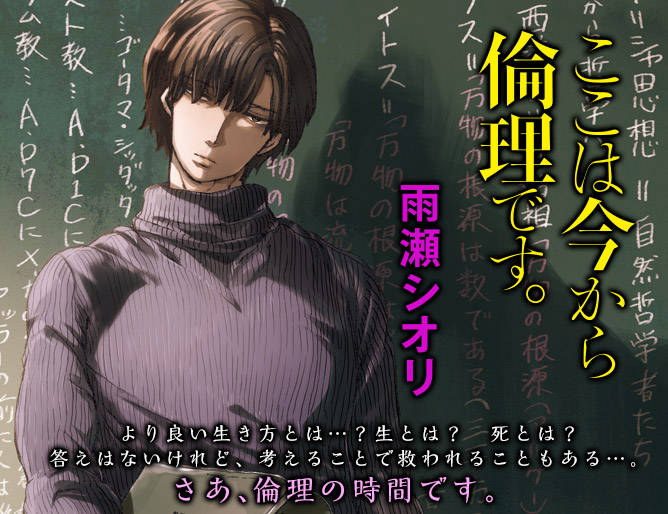
This is ethics from now on." is a manga work by Shiori Amase. It was serialized in the November 2016 issue of Shueisha's magazine Grand Jump PREMIUM. It depicts Takayanagi, a teacher in charge of the ethics department at a high school, dealing with students with various problems and anxieties and leading them to solutions to their problems. In January 2021, the series was dramatized with Hiroki Yamada in the lead role.
Chinese philosopher of the Chunqiu period; founder of Taoism; deified and worshiped Lao-tzu; the Taoist family of Shoshi Hakke is based on his ideas. In the Chinese history book Shiki, Lao-tzu is considered to be a person of the 6th century BC. On the other hand, historians have various opinions, including that he was a mythological person and that he integrated multiple historical figures.
Gautama シッダータ
The founder of Buddhism. In the world history of high school students, Gautama Maharishi is often written as "Siddharta." It is generally said to be Shakyamuni, but it is also called Buddha. Buddha is not a name but an honorific title meaning "a person who has attained enlightenment." Takayanagi's words were quoted when he talked with Honda and had many ethical conversations.
Søren Kirkegaard
A Danish philosopher who is said to be the founder of existentialism. Existentialism is an idea that seeks "the way to live by oneself, the way of one person as a reality (i.e., existence)." While HAZAMA went to play in the middle of the night and was free, Takayanagi had conveyed the words of Kirkegaard.
Socrates
Ancient Greek philosopher; famous for his "Wisdom of Ignorance"; often cited as the founder of ethics. Because he wanted to improve citizens through dialogue, his books did not exist, and the only way to decipher Socrates' ideas and character was to build on the works left by his disciples. It can be assumed that Takayanagi's emphasis on dialogue came from the philosophy of Socrates.
J. S. Mill
English philosopher; political philosopher; and economic thinker. In political philosophy he had a great influence not only on liberalism but also on the tide of social democracy. In his later years he identified himself as a socialist, but he is also known as an important philosopher of early scientific philosophy.
Epictetus
A Roman philosopher; a Stoic philosopher who claimed that the wise are not moved by misfortune. To Yasumura, who does not listen to the class, Takayanagi quoted his line when he talks about persona.
Immanuel Kant
German philosopher who perfected the Enlightenment. The subject of his study was human cognitive ability, and he thought that sensitivity and enlightenment were provided a priori, so he perfected the critical philosophy through the trilogy of "Critique of Pure Reason," "Critique of Practical Reason," and "Critique of Judgment."
Xunzi
A Chinese thinker and Confucian scholar. He advocated the theory of sexual evil. The theory of sexual evil is a claim to human nature advocated against the theory of sexual goodness advocated by Mencius. It comes from the saying, "A man's sex is evil, and his good things are false." Juda referred to Takayanagi in front of his students as being good.
Hannah Arendt
German philosopher; noted for his analysis of the mass society that gave rise to totalitarianism; observed the Eichmann Trial and analyzed the evils that were created by totalitarianism; Juda sheltered Takayanagi from Kondo's behavior, which had led him to the path of evil, by referring to Arendt.
Francis Bacon
English philosopher famous for "Knowledge is knowledge is power." His words are often quoted in the story. The first quote was made when Takayanagi spoke to Yagi and Sakai when he prevented Yagi's suicide.
Eric Hoffer
An American social philosopher known as the "Philosopher of Oki Nakate." He had no formal school education, was not a member of a company or university, and worked as a stevedore working hard to read, think, and write. In contrast to Tamura, who studied hard for his mother, Takayanagi quoted Hoffer as saying:
Karl Marx
He was the author of the German philosopher "The Theory of Capital." Socialism. Capitalism is an economic system in which capitalists freely start businesses, hire workers, and make profits. Socialism is the opposite of capitalism. Takayanagi explained this socialism in class using an example from New Hamony Village.
Friedrich Engels

Tags
Contents
- Overview of "Here is now ethics."
- The plot and story of "Koko wa Ima kara Shihon de."
- New third year students
- New Second Year Students
- Transfer
- Past edition
- Atami Travel Edition
- Seminar trip edition
- Characters in "Koko wa Ima kara Shihon de."
- Third year students
- Ichiko Aizawa (played by Mizuki Kayashima)
- Miyuki Sakai
- Yagi Maria (Yagi Maria)
- Kyoichi TANIGUCHI (played by Yuto Ikeda)
- Natsuko Natsuko
- Koki HAZAMA (played by Ao Watanabe)
- The Fukagawa period (played by Akana Ikeda)
- Yukito Toki river (played by Rihito Itagaki)
- Ryota YAMANO (played by Seishu Uragami)
- Mayu Yasumura
- Riku KONDO (played by Kaisei Kawano)
- SOGA no 涼馬 (played by Naoki Inukai)
- Hajime Tamura (played by Rairu Sugita)
- Kaori Minami (played by Seina Nakata)
- Yuri Takasaki (played by Sakura Kiryu)
- New second year students
- Okitsu 叶太
- 花琳 INOUE
- Yusuke Watano
- 隅井 Ouka
- Haruyama Tsuyoshi
- Rokumoto (six pieces)
- 鳥岡
- Mie Takeda
- Ryotaro Ryota TOGAWA
- Okayoshi Yoshikazu
- Kawanishi
- Nanjo
- Third year and second year teachers
- Takayanagi (played by Yuki Yamada)
- Kobayashi
- Hagiwara
- MATSUDA (played by Kentaro Tamura)
- Umezawa (played by Jun'ya Kawashima)
- Fujikawa (played by Ariei Umefune)
- Kihara
- Hiiragi
- Kamata
- Transfer teachers
- Tomoko Kuzuo
- Sumiko Ichii
- Hasui
- Other characters
- Professor
- Kaito KONDO
- Yuma
- Juda (played by Sonha)
- Kayashima
- Tsuge
- Minami 佐名
- Kikukawa (Kikukawa)
- The term "here is now ethics"
- Max Scheler
- Arthur Schopenhauer
- Laozi
- Gautama シッダータ
- Søren Kirkegaard
- Socrates
- J. S. Mill
- Epictetus
- Immanuel Kant
- Xunzi
- Hannah Arendt
- Francis Bacon
- Eric Hoffer
- Karl Marx
- Friedrich Engels
- Robert Owen
- Words, lines, scenes, and scenes of "Here is now ethics."
- Max Scheler: "Love Is the Bridge from Poor to Rich Knowledge"
- Schopenhauer "Everyone thinks that the limits of his vision are the limits of the vision of the world."
- Francis Bacon "Experience is the best proof, after all."
- Lao-tzu (Lao-tzu):' A good man considers it good, and a bad man considers it good. Virtue is good.'
- Gautama シッダータ "Don't believe anything, no matter what you read or are told, except that your own reason agrees."
- Behind the Scenes, Trivia, Small Stories / Episodes, and Anecdotes of "Koko wa Now de Rinri de aru."
- "Here is now ethics." was born when the author's aunt committed suicide.
- An author who is well versed in ethics but not in school affairs
- The author who worries whether or not to stick to' mysterious Takayanagi'
- Theme song and insert song of "Koko wa Ima kara Shihon de."
- Theme song: "How To Live (feat. Alisa)" by (feat.) "