
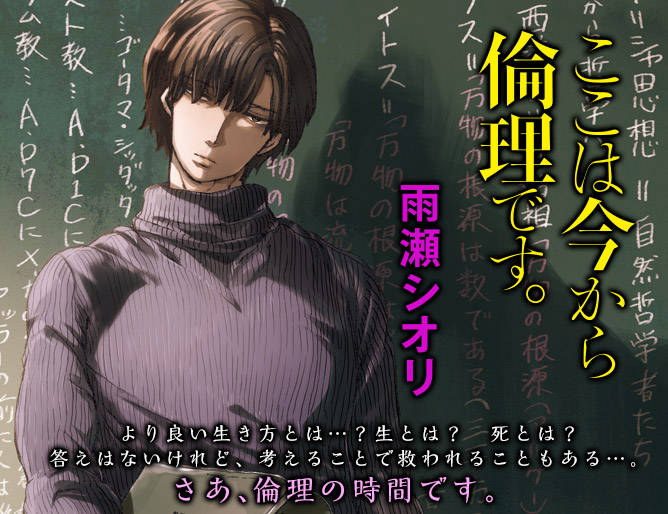
This is ethics from now on." is a manga work by Shiori Amase. It was serialized in the November 2016 issue of Shueisha's magazine Grand Jump PREMIUM. It depicts Takayanagi, a teacher in charge of the ethics department at a high school, dealing with students with various problems and anxieties and leading them to solutions to their problems. In January 2021, the series was dramatized with Hiroki Yamada in the lead role.
Overview of "Here is now ethics."
"Koko wa Ima kara Rinri de aru." was serialized by Shiori Amase in "Grand Jump Premium" (Shueisha) from the November 2016 issue to the November 2018 issue. Later, when the magazine was relaunched as "Grand Jump Mucha," he was transferred to the magazine. This manga series has been serialized since the January 2019 issue (first issue). It was the second in the Next Break category of "Minna ga Senna TSUTAYA Comic Awards 2018." As of June 2022, the total number of copies, including the electronic version, had exceeded 1.7 million.
Also, from January 16 to March 13, 2021, it was made into a drama with Yuki Yamada as the leading character in the NHK-sponsored drama "Yorudora."
This is a story about Takayanagi, who is in charge of a third year high school student who chose to take an ethics class. Takayanagi faces and solves various worries, anxieties, and problems that his students have.
Takayanagi's ethics class starts with 15 students: those who engage in non-consensual sexual activity, those who are so smart that they become frustrated with the inexperience of others, those who hurt themselves, those who are caught up in drug dealing, and those who attend. Takayanagi faces these students with his own unique point of view and stance, and deals with them through ethics.
The main feature of this manga is, after all, the words that Takayanagi uses when he solves students' problems from his own point of view. The wise words of a philosopher that are suitable for each student's event and Takayanagi's point of view that is uniquely attached to it are words that make not only students but also readers think. Since it is set in high school, Takayanagi speaks to high school students, but also to adult readers.
"Here is now ethics." is where you can come into contact with philosophy and ethical ideas that you don't usually feel close to.
The plot and story of "Koko wa Ima kara Shihon de."
New third year students
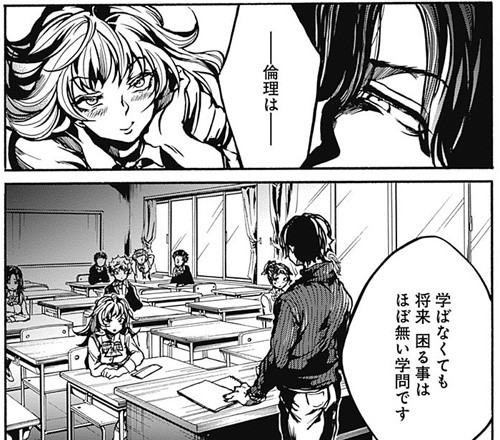
Takayanagi (right) and Ichiko Aizawa (left) preaching ethics
In the third year, students have to take elective classes. Among the various subjects, Takayanagi's ethics class has been assigned to 15 students.
There are a variety of students among them, including students who are, students who try to trick teachers, and students who trade drugs.
The new third year students will be able to see such students through to graduation.
Each student is assigned a spot, and each story is developed. Many students finish with one story. Some students take up to two stories. Takayanagi, as a teacher, solves the problems and worries of these students with his own unique point of view and philosophy. Also, the development of this story makes Takayanagi's past small. You can see the background of Takayanagi, such as why he thought so and what he talked about when he was a student.
As mentioned earlier, each student is assigned a spot in the story, which may be a foreshadowing but does not keep one student in the spot like a special hero. However, only Ichiko Aizawa, who was assigned a spot in the first episode of the new third year, is slightly involved in multiple stories.
Of particular interest is the story of the graduation ceremony at the end of the third year. In the first episode, Aizawa, who is in love with Takayanagi, confesses to Takayanagi after the graduation ceremony. As a result, only Aizawa is somewhat involved in other stories.
New Second Year Students
As the school year changes, the third year students are no longer in school. Takayanagi's ethics classes are not for the third year students, but for the new second year students. The new second year students will be in charge of 12 students. Even in the second year, there are students who have various anxieties and worries, such as X-gender students, students who engage in violence, and students who suffer from Crelambo syndrome.
As with the new third year, each student gets a spot, so the story continues with one or two episodes. However, there are two students who are particularly involved in other students' stories: one is 叶太 OKITSU, and the other is 鳥岡. The first is Okitsu, who is of gender X. He is also taking ethics classes, and he gets along with Rokumoto, who wants to cross-dress her, so he gets involved in the story of Rokumoto. The other is 鳥岡, a violent student who has the question, "Why shouldn't we kill people?" In the final ethics class, students have a discussion with each other, but the theme of the discussion in the new second year is the 鳥岡 question, "Why shouldn't we kill people?" Also, Kayashima, a friend of Takayanagi's from college, appears in connection with 鳥岡.
In the new second year edition, students who were taking classes at the time of the school year change are depicted as making positive progress. Then, Takayanagi is transferred to another school and it ends.
Transfer
Takayanagi transferred to another school without saying anything to Okitsu and others. At the new school, he was assigned to be a teacher in charge of ethics and class 2 c, along with Sumiko ICHII, who was in charge of classical and modern Japanese, and Tomoko Kuzuo, who was in charge of English. When introducing the new teacher at the opening ceremony, Takayanagi introduced himself in the same atmosphere that would make the students think he was "like a psychopath," and the transfer program started.
Past edition
Atami Travel Edition
According to the professor's suggestion, "Tora-san, take a nice trip", the trip will be a two person trip between the professor and Takayanagi. Takayanagi thinks like a "modern kid" to a professor like "Showa's stubborn father." Due to the changes of the times, the professor complains about the generation gap not only in the customs of the past but also in thoughts such as justice and correctness. In modern times, the story develops based on the small talk between Takayanagi and the professor about the anachronistic way of living of Tora-san and the sex difference that has never been seen before.
In addition to these stories about the times and trends, we will also learn why Takayanagi wanted to become a teacher and what kind of teacher he wanted to become.
Seminar trip edition
Since I traveled with Takayanagi before, I took the professor who complains about the trip to Nikkou as "メンドクセエ." In the graduation trip section of the seminar, all of the seminar students go to Nikkou together. You can see the interaction between Takayanagi and six other seminar students, including Kayashima in the story of 鳥岡. Therefore, there are many exchanges of Takayanagi between students that were not depicted in the previous trip to Atami.
Also, in the previous trip to Atami, there were many positive topics about Takayanagi becoming a teacher, such as why he became a teacher and what kind of teacher he wanted to become. However, this time, there are many negative topics such as worries and anxieties about Takayanagi becoming a teacher, and Takayanagi's negative feelings are revealed here.
Characters in "Koko wa Ima kara Shihon de."
Third year students
Ichiko Aizawa (played by Mizuki Kayashima)
She is known as a problem child because she doesn't care where she is on campus, and she doesn't submit assignments. She has been concerned about Takayanagi ever since he reproached her for having sex with a male student in the second grade. She told Takayanagi her thoughts, but she was told that she was "the type of woman who is educated." Since then, she has been trying to acquire an education suitable for him.
Miyuki Sakai
A very good girl. In junior high, she finished reading all the books in the library and realized that she could understand everything if she read. Because she has more knowledge than most people, her classmates, even teachers and parents, look down on her as being ignorant.
Yagi Maria (Yagi Maria)

Tags
Contents
- Overview of "Here is now ethics."
- The plot and story of "Koko wa Ima kara Shihon de."
- New third year students
- New Second Year Students
- Transfer
- Past edition
- Atami Travel Edition
- Seminar trip edition
- Characters in "Koko wa Ima kara Shihon de."
- Third year students
- Ichiko Aizawa (played by Mizuki Kayashima)
- Miyuki Sakai
- Yagi Maria (Yagi Maria)
- Kyoichi TANIGUCHI (played by Yuto Ikeda)
- Natsuko Natsuko
- Koki HAZAMA (played by Ao Watanabe)
- The Fukagawa period (played by Akana Ikeda)
- Yukito Toki river (played by Rihito Itagaki)
- Ryota YAMANO (played by Seishu Uragami)
- Mayu Yasumura
- Riku KONDO (played by Kaisei Kawano)
- SOGA no 涼馬 (played by Naoki Inukai)
- Hajime Tamura (played by Rairu Sugita)
- Kaori Minami (played by Seina Nakata)
- Yuri Takasaki (played by Sakura Kiryu)
- New second year students
- Okitsu 叶太
- 花琳 INOUE
- Yusuke Watano
- 隅井 Ouka
- Haruyama Tsuyoshi
- Rokumoto (six pieces)
- 鳥岡
- Mie Takeda
- Ryotaro Ryota TOGAWA
- Okayoshi Yoshikazu
- Kawanishi
- Nanjo
- Third year and second year teachers
- Takayanagi (played by Yuki Yamada)
- Kobayashi
- Hagiwara
- MATSUDA (played by Kentaro Tamura)
- Umezawa (played by Jun'ya Kawashima)
- Fujikawa (played by Ariei Umefune)
- Kihara
- Hiiragi
- Kamata
- Transfer teachers
- Tomoko Kuzuo
- Sumiko Ichii
- Hasui
- Other characters
- Professor
- Kaito KONDO
- Yuma
- Juda (played by Sonha)
- Kayashima
- Tsuge
- Minami 佐名
- Kikukawa (Kikukawa)
- The term "here is now ethics"
- Max Scheler
- Arthur Schopenhauer
- Laozi
- Gautama シッダータ
- Søren Kirkegaard
- Socrates
- J. S. Mill
- Epictetus
- Immanuel Kant
- Xunzi
- Hannah Arendt
- Francis Bacon
- Eric Hoffer
- Karl Marx
- Friedrich Engels
- Robert Owen
- Words, lines, scenes, and scenes of "Here is now ethics."
- Max Scheler: "Love Is the Bridge from Poor to Rich Knowledge"
- Schopenhauer "Everyone thinks that the limits of his vision are the limits of the vision of the world."
- Francis Bacon "Experience is the best proof, after all."
- Lao-tzu (Lao-tzu):' A good man considers it good, and a bad man considers it good. Virtue is good.'
- Gautama シッダータ "Don't believe anything, no matter what you read or are told, except that your own reason agrees."
- Behind the Scenes, Trivia, Small Stories / Episodes, and Anecdotes of "Koko wa Now de Rinri de aru."
- "Here is now ethics." was born when the author's aunt committed suicide.
- An author who is well versed in ethics but not in school affairs
- The author who worries whether or not to stick to' mysterious Takayanagi'
- Theme song and insert song of "Koko wa Ima kara Shihon de."
- Theme song: "How To Live (feat. Alisa)" by (feat.) "