
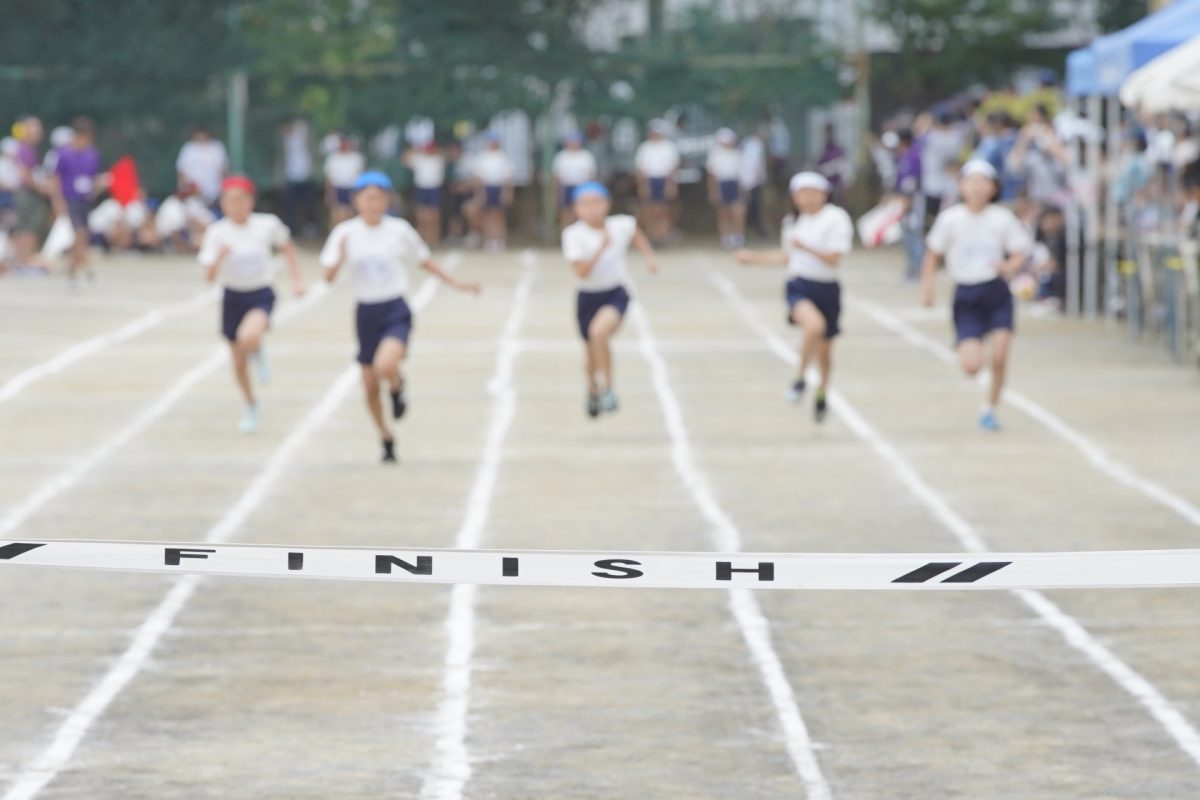
The following is a summary of the "hand-holding goal" at athletic meets. In order to prevent the slower runners from feeling uncomfortable during the athletic meet, the faster runners stop before the goal, and when all the runners have reached the goal, they hold hands to reach the goal at once. Although the term was well known, no schools could be found that actually practiced it, and it was whispered to be an urban legend. Here, we will introduce the contents of the investigation conducted by the radio program "Tamamusubi" and information found in newspaper articles and on the Internet.
I've never seen "let them finish together at a field day" in my own school or in the kindergartens and schools I sent my children to, but I wonder when and where it was done. - Togetter summary
togetter.com
Summary. Update: August 15, 3:30 p.m.
ネットだけ見ているとどうも右寄りの人が批判する「日教組的な教育」というのは私が学校に行っていた時代の日本にも今の日本にもほとんどなくて、1980年代後半から2000年頃までの10数年がピークだったように見えてしまうんだけど、そんなことがあるだろうか。
— 渡邊芳之 (@ynabe39) August 14, 2015
その頃には日教組の組織率もダラ下がり、左翼勢力の退潮も著しかったと思うのだが。
— 渡邊芳之 (@ynabe39) August 14, 2015
地域による差も大きいけど個別の学校による差も相当あった、というか校長先生や影響力のある先生の傾向も関わったのだろう。
— 渡邊芳之 (@ynabe39) August 14, 2015
そういう意味では「学校や教師の政治的道徳的な傾向を批判的に見る人が増えた」(から問題にされるようになった)のが80年代以降なのかね。
— 渡邊芳之 (@ynabe39) August 14, 2015
ざっと過去記事を検索してみた。なるほど「手つなぎゴール」はなかったが、徒競走で順位付けをなくす学校が少なからずあったことは確認できた。/ゆとりの象徴 徒競走「手つなぎゴール」が存在しなかった!!! - 健康ジャーナ https://t.co/JCCrEaRHrs
— kanda_daisuke (@kanda_daisuke) May 4, 2016
Asahi Shimbun Reporter
記事によると、80年代の後半には既に、運動会から順位付けをなくすことは是か非か、ということが議論になっている。なので、ゆとり世代とは無関係。
— kanda_daisuke (@kanda_daisuke) May 4, 2016
手つなぎゴールは知らんけど、ゴール手前で止まって「はい!皆で一緒にゴール!」は、嘘をつかれていなければあるよ。
— れんこん坊主 (@renkonbouzu) May 3, 2016
最後、点数発表なしって学校とも言ってたな
頭の良し悪しでしか成績判別出来ないじゃんって盛り上がってた記憶
「手つなぎゴール」神話は少なくとも90年代には石原慎太郎が言っていたぞ。ゆとりよりずっと前からの神話。 / “ゆとりの象徴 徒競走「手つなぎゴール」が存在しなかった!!! - 健康ジャーナ” (139 users) https://t.co/fPaKiHMKlW
— kamayan1192 (@kamayan1192) May 3, 2016
97~98年頃のニュース番組で小学校の手つなぎゴールの映像流れてたの覚えてるけど、あれは真実だったの? #tama954
— 二輪恭斗[ふたわきょうと](新呉鎮守府) (@odadami) 2016.05.02 14:17
Note: A month later, a sequel to the "hand-to-hand goal" verification will be broadcast on "Tamamusubi". Addition of its contents
June 13, 2016 broadcast of "Did Hand-to-Hand Goals Really Happen?" and aired on June 13, 2016.
A brief summary in chronological order.
------------------------------------------------
Second "Tamamusubi" research: history of events related to the "hand-tied goal".
------------------------------------------------
February 17, 1988 Asahi Shimbun Morning Edition [Debate Plaza "Abundance and the Japanese"] Agnes Chan said during a roundtable discussion, "For example, in sports meets, etc., let's all walk hand in hand without giving out prizes for first or second place. This is what you call fairness," she said, which she had seen on TV at the time.
July 15, 1997 Mainichi Shimbun (Mainichi Newspaper) As part of a 1997 survey by the Tokyo Metropolitan Elementary School Sports Federation, "50% of the schools had adopted the ability-based clown race.
October 4, 1999 Yomiuri Shimbun quoted a 1997 survey by the Tokyo Metropolitan Elementary School Physical Education Federation as saying that "80% of schools had adopted ability-based running.
March 2000 "Teachers Who Forgot Their Prayers" by Yasushi Aoki, a book written by a former principal who was the head of the 1997 survey of the Tokyo Metropolitan Elementary School Athletic Federation, mentions the 1997 survey but does not mention ability-based running.
June 10, 2003 Asahi Shimbun Niigata Edition Morning Edition [Sports Day is a Fun Festival] "Who is the field day for?" with a comment by an elementary school principal in Joetsu City, Niigata Prefecture. Such reflections led to several years of attempts to have everyone join hands just before the finish line so that everyone could reach the goal together". (When Tamamusubi staff re-interviewed the principal in 2016, he denied the hand-holding goal, saying, "I don't remember any such talk.)
October 13, 2003, Yomiuri Shimbun, in a column titled "New Century of Education / YOMIURI ON-LINE Many call for continuation of 'ranking'", referred to the "hand-tied goal", citing a 1997 survey by the Tokyo Metropolitan Elementary School Sports Federation. (Tamamusubi staff interviewed the current president of the Tokyo Metropolitan Elementary School Physical Education Federation in 2016. A teacher who was involved in the survey at the time denied the hand-tied goal, saying, "The survey was conducted at the time of the Sports Day, and I don't remember any survey on the events held.")
In light of this, the historical timeline of the hand-coupled goals has been updated (6.26.2016).
I have itemized below a timeline of the "hand-in-hand goals" to date, adding those that came up in a quick search on the Internet.
------------------------------------------------
History of "hand-tied goals" as researched by internet search (1) 1980's-1990's
------------------------------------------------
1980s-1990s The phenomenon of "hand-tied goals" occurred in elementary and junior high schools in Kyushu, according to a 2005 Nishinippon Shimbun article.
February 17, 1988 Asahi Shimbun Morning Edition [Discussion Plaza "Affluence and the Japanese"] Agnes Chan said in a roundtable discussion, "For example, in athletic meets, let's not give out prizes for first and second place, but let's all walk hand in hand. This is what you call fairness," she said, which she had seen on TV at the time.
1990 In the magazine "Buraku" vol. 42, published by the Buraku Mondai Kenkyujo (Institute for Buraku Studies), he wrote: "Is it enough if we hold hands and reach the goal?
1994 Email from a 33-year-old woman in Toyokawa, Aichi Prefecture, describing her experience, "When I was in elementary school, the principal's policy almost prohibited competition, and although it was not 'hand in hand,' I remember stopping just before the finish line and being made to finish with 'se-no-ko' when everyone was in place," from a 2016 radio broadcast of Tamamusubi
June 11, 1996 NHK "Close-Up Today" broadcast, "Sports Day without Competition: The ripple effect of educational reform without ranking.
1997 A survey by the Tokyo Metropolitan Elementary School Sports Federation describes that 80% of elementary schools in Tokyo do not rank students at fields days, and that some schools "hold hands at the finish line" (no one could confirm the survey results themselves) From a 2003 Yomiuri Shimbun article.
February 17, 1997 Asahi Shimbun morning edition, "In a recent issue of a professional magazine widely read by the Education Association, the chairman of a major company said he heard from people that - they all held hands to make it to the finish line."
(July 15, 1997 Mainichi Shimbun, as a 1997 survey by the Tokyo Metropolitan Elementary School Athletic Federation, "50 percent of schools had adopted the ability-based clutch race.")
1998 "Sports Sapio" magazine, Beat Takeshi: "Nowadays, people don't race in athletic meets, but run hand in hand.
September 24, 1998 At a meeting of the Education and Science Committee of the House of Councillors, Noriko Hayashi, a member of the Communist Party, stated that elementary schools in Miyoshi, Shobara, and Fukuyama, Hiroshima, have "hand-tied goals" in connection with the Buraku issue.
(October 4, 1999 Yomiuri Shimbun quoted a 1997 survey by the Tokyo Metropolitan Elementary School Athletic Federation: "80% of schools have introduced ability-based clutch races.")
(March 2000, Yasushi Aoki, author of "Teachers Who Have Forgotten Their Prayers," a book by a former principal who was the head of the 1997 survey of the Tokyo Metropolitan Elementary School Physical Education Federation, mentions the 1997 survey but does not mention ability-based clique races)
------------------------------------------------
History of the "Hand-to-Hand Goal" Internet search research (2) 2000-2006.
------------------------------------------------
2000 column in "Seiron" magazine: "Some teachers are advocating the abolition of the race, or even if they don't abolish the race, they are putting a gap at the starting line, or making the fastest children stop before the finish line to hold hands with the slowest children.
July 2000, Nikkei Business magazine, column: "At the athletic meet of the kindergarten my grandson attended, the children lined up side by side at the finish line and held hands with the slower children.
2001 Liberal Democratic Party monthly magazine "Monthly Liberal Democrat" "In the race, the children were made to run with thrusting power up to ninety paces, and after that^ they would finish together holding hands. When I was a child, there were honor contests, effort awards, and athletic meets.
February 8, 2001, Budget Committee of the House of Representatives, Minister of Education, Culture, Sports, Science and Technology Machimura: "These days, everyone holds hands three meters before the finish line, and they run into the finish line together.
July 2001 issue of "Mrs." magazine, Kiyoshi Shigematsu's column: "Nowadays, athletic meets are about running hand in hand.
November 27, 2001, House of Councillors, Liberal Party member Yuko Mori: "I'm actually seeing things like hand-tied goals."
February 26, 2002 Nihon Keizai Shimbun morning edition, column by Minoru Morio, Vice Chairman of Sony
August 22/September 4, 2002, "sapio" magazine, Yoshinori Kobayashi, "New Gomanism Manifesto 12," Chapter 173, "The Manner of Anti-Americanism," "The goal of the athletic meet is to hold hands in a horizontal line.
March 25, 2003, House of Councillors, LDP Haruko Arimura, "Hand-tied goal at some schools has become less common, but still exists," Education Minister Toyama, "I don't think it is that common anymore, but it was a reality."
June 10, 2003 Asahi Shimbun Niigata Edition Morning Edition [Sports Day is a Fun Festival] "Who is the Sports Day for?" with remarks by the principal of an elementary school in Joetsu City, Niigata Prefecture. Such reflections led to several years of attempts to have everyone join hands just before the finish line so that everyone could reach the goal together". (When Tamamusubi staff re-interviewed the principal in 2016, he denied the hand-holding goal, saying, "I don't remember any such talk.)
October 2, 2003 Nihon Keizai Shimbun evening edition, column by Kazuaki Tsuda, advisor to Suntory: "In some elementary schools, the students were made to line up side by side again just before the goal before reaching the goal."
October 13, 2003 Yomiuri Shimbun "New Century of Education / YOMIURI ON-LINE Many call for continuation of 'ranking'" referring to "hand-tied goals" citing a 1997 survey by the Tokyo Metropolitan Elementary School Sports Federation (Tamamusubi staff interviewed the current Tokyo Metropolitan Elementary School Sports Federation president in 2016. A teacher who was involved in the survey at the time denied the hand-tied goal, saying, "The survey was conducted at the time of the Sports Day, and I don't remember any survey on the events that were held.")
2004 "Economist" magazine, Hideki Wada, "In bad times, even the athletic competitions at athletic meets have the goal run in by holding hands."
2005 Yoshinori Kobayashi, "New Gomanism Manifesto 15," Chapter 225, "What is Disparity Society? "At athletic meets, people are forced to finish the race side by side.
2005: Akira Moriguchi, education critic, in his book, denies the existence of "hand-holding goal" as an urban legend.
October 2005 "Hand in Hand Goal - No One Has Seen the Scene" by Hideki Wada in "The Economist" magazine.
December 29, 2005 The Nishinippon Shimbun newspaper, "No ranking in athletic meets if it leads to discrimination. They hold hands to finish...Such a phenomenon occurred in elementary and junior high schools in Kyushu in the 1980s and 1990s."
February 28, 2006, LDP member of the House of Representatives, Nobutaka Machimura, "Hand-tied goals may sound like a joke, but there are many such things."
October 15, 2006 Asahi Shimbun column by Shotaro Takahashi: "Unranked athletic meets" beyond hearsay: "It seems to have spread quite widely in the form of hearsay."
November 17, 2006 Asahi Weekly Newspaper column by Makiko Uchidate, "The recent field day called 'hand in hand' goal" (in Japanese)
November 22, 2006 Diet questioning in the first Abe Cabinet. Taisuke Sato of the Democratic Party of Japan (DPJ) asked, "Have the prime ministers ever seen a hand-holding goal? The answer was, "I have never seen it, so I will try to explain it in a more realistic way in the future.
----------------
----------------
The debate over the nature of athletic competition has been around for a long time. The debate is broadly divided into "equality and fairness vs. competition," but the content of the debate varies widely.
Teachers in the field have been searching for ways to make athletic meets more enjoyable even for children with low motor skills, but this very awareness of the issue is criticized on the grounds that if they cater to children with low motor skills, children with high motor skills will not be able to play an active role and enjoy the event to the fullest extent.
The mere idea of creating race combinations by time and ability in a field race has also been criticized on the Internet as "pampering. I also saw the "by ability vs. by height" debate. The ability-based race is not only a consideration for slower children, but also "to make the race more interesting by making it close." In this debate, this argument by ability is also largely understood, and it seems that the understanding of the ability-based race is expanding.
However, the differences in the way in which the clasps are ranked and awarded are still the subject of great criticism. It is a debate of "no ranking vs. ranking. However, even if one says "no ranking" in a single sentence, there are various methods, each of which has its own conflicts, and each person has its own borders of "how much is acceptable" regarding the way of ranking and awarding at sports meets, such as "that much is fine, but that is too much".
No prizes (to be fair) vs. differentiation in prizes.
At the field day of baby-boomers, they said that they were given notebooks and erasers if they came first in the sprint race, and they said, "Those were good days. The prizes motivated kids who could only do sports". Nowadays, most schools probably don't have prizes in order of placement.
Not lining up for the equal flag vs. lining up for the equal flag
At athletic meets, children who have finished running are lined up in front of a flag in their order of arrival, and ribbons and other items are distributed to the children according to their rank. In some schools, the children who finished lower in the order were not allowed to line up at the flag because it was too painful for them to do so. When this was widely reported, it became a subject of criticism.
The "all cross the finish line at once vs. first place crosses the finish line.
It is a matter of course that in a clasical race, rankings are assigned. The "all finish at the same time" method breaks this rule. The start is the same. They run as fast as they can. But the goal is also the same. The fastest runners stop in front of the tape and wait for the slowest runners. When all the runners had arrived at the finish line, they would call out "Se~no" and hold hands to cross the finish line together. This was met with fierce criticism from the public. It was negatively known throughout the country as the so-called "hand-holding goal," and was criticized in the Diet as a symbol of "bad egalitarianism," and educational reforms were implemented. Now it remains only as an urban legend.
So, in the June 13, 2016 episode of "Tamamusubi," as in the previous episode, "There were schools where everyone scored a goal all together, but it wasn't a 'hand-holding goal' because they didn't hold hands! Too bad! There was no hand-holding goal!" But that conclusion is still not correct. The problem with the "hand-holding goal" and its use in the criticism of yutaka is not the "hand-holding" element, but the "all together goal" element. Whether or not they held hands and whether or not they called out "Se~~" are just different versions of the same thing.
While the "Tamamusubi" staff made such a strict distinction in defining "hand-tied goal," at the end of the article, they pulled out a past statement by Agnes Chan, "Let's all walk hand in hand and not give out prizes for first and second place at a field day," and even though there was no mention of "hand-tied race" or "goal" in the statement, they still did not define "hand-tied goal" as "hand-tied race" or "goal. Even though there was no mention of a "hand-to-hand race" or a "goal," he judged it to be the oldest of the newspaper bases for the hand-to-hand finish line. That is also strange.
The first argument of the exercise conference theory is "to make the difference between children who can do exercise and those who cannot" fair or not, and one of the arguments in the second level of how to "make it fair" is "to rank or not to rank," and furthermore, "how to rank" and "how not to rank" are Within the third level of discussion of the pros and cons of each method, the theme of "finishing all together" exists in parallel with such things as "with or without prizes" and "with or without equal flags. The "hand-in-hand goal" is only a theme in the fourth level, which is a further subdivision of the "goal all together" theme.
----------------
----------------
Is "all goals at once" really 100% nothing?
In a race to the finish line, the fastest runners stop and wait for the slowest runners, and when all the runners have reached the finish line, they hold hands and call out to each other, and then all run to the finish line together.
If you read the text alone and imagine it simply, it seems unusual, but if you think about it carefully, you may wonder, "Is it that unusual? But when you think about it, you start to wonder, "Is it really that abnormal?
First of all, the start is the same. The first runner does not cut the finishing tape. In other words, the finish line of the sprint race is just before the finish tape. The order in which they arrive at the finish line is assigned, and the winner is obvious to anyone who sees it.
What is different from a normal race?
The finish line is just before the finish tape.
After arriving at the finish line, the runners wait there (usually, they are lined up at the flag in the order of their arrival).
When all members of the race have arrived at the finish line, they cut the finishing tape in unison.
The goal tape is cut in unison when all members of the race are present.
The important thing is that,
The order of finish is inevitable.
The goal tape is cut only after the race is over.
The important point is that
It is easy to understand if you think of a "all together finish line (hand-tied finish line)" race as a "all together finish line (hand-tied finish line)" race with a ritual. Or, a "first-place finisher does not cut the finish line tape". There would still be many who would criticize this, but I don't think it would be "100% negative" as he said in "Tamamusubi". For those who have been thinking on a case-by-case basis, "I agree with the idea of a clash of flags, but I don't like the idea of a hand-tied finish line...", some may change their minds and say, "Well then...".

Tags
Contents
- TBS Radio's "Tamamusubi" investigates whether there really is (or was) a "hand-holding goal" at athletic meets.
- In "Tamamusubi," a 1997 Asahi article and Yoshinori Kobayashi's "Gomanism Manifesto" causal argument.
- In fact, there had been a previous "hand-in-hand goal" verification article written and talked about before.
- Even earlier, the Communist Party asked a committee question in the Diet about the "hand-in-hand goal" in connection with the Buraku Liberation League.
- Buraku Issue Magazine and "Hand in Hand Goal
- Newspaper article on the "hand-to-hand goal" in Kyushu around 1990.
- Criticism of "hand-holding goal" in conservative magazines and journals around 2000.
- The "hand-holding goal," frequently criticized since 2001 in the National Assembly
- Criticism of the "hand-holding goal" that became active around the year 2000
- Note: A month later, a sequel to the "hand-to-hand goal" verification will be broadcast on "Tamamusubi". Addition of its contents
- In light of this, the historical timeline of the hand-coupled goals has been updated (6.26.2016).