
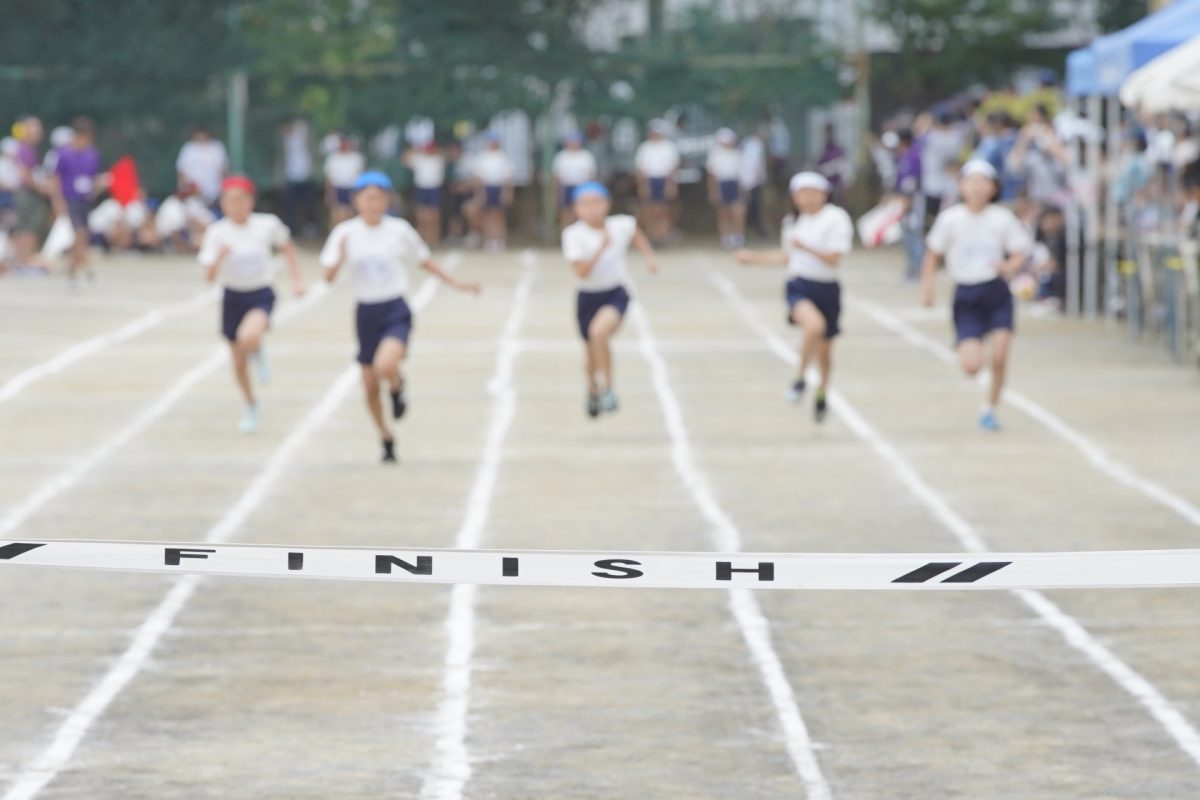
The following is a summary of the "hand-holding goal" at athletic meets. In order to prevent the slower runners from feeling uncomfortable during the athletic meet, the faster runners stop before the goal, and when all the runners have reached the goal, they hold hands to reach the goal at once. Although the term was well known, no schools could be found that actually practiced it, and it was whispered to be an urban legend. Here, we will introduce the contents of the investigation conducted by the radio program "Tamamusubi" and information found in newspaper articles and on the Internet.
The "hand-holding goal" is an instruction that, in order to prevent the slowest runners from being the last to cross the finish line, the fastest runners stop before the finish line and wait for the slowest runners to arrive, and when all the runners have arrived, they all join hands and finish the race together.
In the past, this was often cited as one of the reasons for school education reform, as it was "bad equal education. In recent years, when so-called "Yutori Education" is criticized, the "hand-holding goal" is sometimes criticized and ridiculed as one of the symbols of "Yutori".
However, while it is widely recognized, no schools have been found that actually practice (or have practiced) the "hand-tied goal," and it is considered to be an urban legend.
*The "hand-tied goal" is one example of the "unranked athletic meets," but it does not mean that "hand-tied goal" = "unranked athletic meets. NHK's "Close-Up Today," "Sports Day without Competition: Ripples of Education Reform without Ranking" (http://www.nhk.or.jp/gendai/articles/585/ index.html) was broadcast in 1996.
**Addition of "Tamamusubi" content from June 13, 2016 broadcast on page 2.
TBS Radio's "Tamamusubi" investigates whether there really is (or was) a "hand-holding goal" at athletic meets.
Monday, May 2, 2016 "Tamamusubi" Podcast Takeyama, go buy some gum! | TBS Radio AM954 + FM90.5 - Listen and you'll see!
www.tbsradio.jp
TBS Radio's 1pm wide program "Tamamusubi" May 2 "Takeyama, go buy some gum! podcast has been uploaded! Takeyama, go buy me gum!" on Mondays at 2:00 p.m. This is a "listener-help survey project" in which we receive requests from listeners and the Tamamusubi Monday team responds to them. Today's topic is "Yuto
On Monday, May 2, 2016, TBS Radio "Tamamusubi" aired a verification survey broadcast of "Hand-to-Hand Goal" as one of the program's corners.
Symbol of Yutaka - The clutch race "hand-holding goal" did not exist! - Health journalist
www.jarna.jp
(^^)/ I couldn't believe my ears when I heard the first news via Facebook. It turned out that the "hand-tied goal for classtime race," which was regarded as a symbol of Yutori education and a merkmal (landmark) for critics, did not exist anywhere in Japan. TBS radio program investigates "nonexistence" The May 2 broadcast of the TBS radio program "Tamamusubi" revealed that the "hand-tied goal" that is considered a symbol of "Yutori" education...
Summary article of the "Tamamusubi" broadcast.
In "Tamamusubi," a 1997 Asahi article and Yoshinori Kobayashi's "Gomanism Manifesto" causal argument.
In "Tamamusubi," an article in a past publication referring to the "hand-tied goal" was introduced, which the staff had searched for and had investigated when this story first existed, but the chronological order was not in order, making it difficult to understand the flow of the story, so it was organized in chronological order.
------------------------------------------------
History of "hand-tied goal" researched by "Tamamusubi
------------------------------------------------
1994 Email from a 33-year-old woman in Toyokawa City, Aichi Prefecture, who shared her experience: "When I was in elementary school, the principal's policy almost prohibited competition, and although it was not 'hand-holding,' I remember stopping just before the finish line and being made to finish with 'se-no-ko' when everyone was in line."
February 17, 1997 Asahi Shimbun morning newspaper, "In a recent issue of a professional magazine widely read in educational associations, the chairman of a major company told me a story that he had heard from others: -They all held hands to reach the goal.
July 2001 "Mrs." magazine, Kiyoshi Shigematsu column, "The field day of today is - everyone holding hands to run the kaketsukko".
February 26, 2002 Nihon Keizai Shimbun morning edition, column by Minoru Morio, Vice Chairman of Sony Corporation
Aug. 22, 2002 Sept. 4, 2002 issue of "sapio" magazine, Yoshinori Kobayashi, "New Gomanism Manifesto 12," Chapter 173, "The Manner of Anti-Americanism," "Athletic Meet Kaketsukko-game is a horizontal line with everyone holding hands at the goal.
October 2, 2003, Nihon Keizai Shimbun evening edition, column by Kazuaki Tsuda, Senior Advisor to Suntory: "In some elementary schools, children were made to line up side by side again just before the finish line.
2004 "Hideki Wada," Economist magazine, "In the worst cases, even athletic competitions are held hand in hand at the finish line.
2005 Yoshinori Kobayashi, "New Gomanism Manifesto 15," Chapter 225, "What is Disparity Society? "At athletic meets, people are forced to finish the race side by side.
October 2005 Hideki Wada, Economist magazine, "Hand in Hand, Goal In - No One Has Seen the Scene" (in Japanese)
October 15, 2006 Asahi Shimbun newspaper column by Shotaro Takahashi, "Undo Kai without Ranking," beyond hearsay, "It seems to have spread quite widely in the form of hearsay." http://b.hatena.ne.jp/entry/d.hatena.ne.jp/sava95/20061123/p2
November 17, 2006 Asahi Shukan, Makiko Uchidate column, "Athletic Meet called 'Hand in Hand' Goal in Recent Years" (in Japanese)
November 21, 2006 Diet questioning in the first Abe cabinet. Prime Minister Abe and others answered. The first Prime Minister Abe and his team answered, "I remember reading in newspapers and other media about the example of the race to the finish line, but I did not witness it on the spot. House of Councillors Meeting Minutes, 165th Diet Session, Special Committee on the Fundamental Law of Education, No. 1: http://kokkai.ndl.go.jp/SENTAKU/sangiin/165/0091/16511220091001c.html
In fact, there had been a previous "hand-in-hand goal" verification article written and talked about before.
This teaching of "hand-holding goal" at athletic meets has actually been suspected for quite some time. If you look on Hatena Bookmark and other sites, you will find that verification articles have also become popular entries.
In addition, education critic Akira Moriguchi wrote in his 2005 book that the "hand-tied goal" is an urban legend, based on his experience in education in Tokyo. Amazon.co.jp: BCKT's review of What was Lost in Postwar Education (Shincho Shinsho): http://www.amazon.co.jp/ review/R1CMBA8AEDMNMD/
Hand-in-Hand, Goal at Once" is a nationwide craze! - Imaginary Lines
d.hatena.ne.jp
Welcome Guest Blog Top Articles Login Free Blog Open Imaginary Lines 2006-09-28 ■ "Hand in Hand Goal Race" is all the rage in many parts of Japan! Regarding yesterday's entry, I found an article on Mr. Takaichi's official website that says, "Hand in hand race to the finish line is all the rage at sports meets around the country....
September 28, 2006 article. The Yomiuri Shimbun article from 2003 claims that the article is written in a way that seems to affirm the existence of the race.
Notes on the Hand-Carried Goal at the Sports Day (*Still unknown after all): nisimura | Memo
nisimura.txt-nifty.com
nisimura | Memo I may update intermittently or sporadically or when I forget. "I want to try Mofuru. | Top page | "Forest girl who is not a fairy" I blend into the forest, and not in a good way. " 2009.12.16 Hand-to-Hand Goal Memo for Sports Day (*Still unknown after all) I was looking at my email log and thought I should write this down after all. In a conversation with a friend, we got on the topic of hand-to-hand goals at athletic meets...
December 16, 2009. From a skeptical perspective, I scrutinized the content of a 2003 Yomiuri Shimbun article. Researching the "hand-tied goal" using library references. Cited in ↓.
In fact, only a minority of schools give ribbons or other items to clarify rankings at athletic events. According to a 1997 survey by the Tokyo Metropolitan Elementary School Sports Federation, about 80% of elementary schools in Tokyo do not rank children at athletic meets. They have children hold hands at the finish line and cut the tape together, or have the slowest children run a shorter course.
Source: hugo-sb.way-nifty.com
The Yomiuri Shimbun article of October 13, 2003. The article was also published on the Internet, and drew a great response from "The New Century of Education / YOMIURI ON-LINE: Many call for continuation of 'ranking'".
This 1997 survey by the Tokyo Metropolitan Elementary School Athletic Federation was cited elsewhere.
Even earlier, the Communist Party asked a committee question in the Diet about the "hand-in-hand goal" in connection with the Buraku Liberation League.
The "hand-holding goal" has often been mentioned in parliamentary questions, but to our surprise, it was the JCP that first brought it up.
At the 143rd session of the Diet, Committee on Education, Culture, Sports, Science and Technology, on September 24, 1998, Noriko Hayashi, then a member of the upper house of the Japanese Communist Party, raised the issue of the Buraku Liberation League's intervention in education, critically citing a school in Hiroshima Prefecture where "it is discriminatory to rank children in sports meets, so they are holding hands to reach the goal. He also critically cited the case of a school in Hiroshima Prefecture, where "it is discriminatory to give a ranking in athletic meets.
House of Councillors Meeting Minutes Information 143rd Diet Session, Committee on Education and Science, No. 3
kokkai.ndl.go.jp
143rd Congress, Committee on Education and Science, No. 3, Thursday, September 24, 1998, 10:00 a.m. ------------- Attendees are as follows Chairperson: Ms. Chieko Minamino Board Members: Mr. Yasushi Kano, Mr. Hiroshi Hase, Mr. Motoki Emoto, Mr. Akira Matsu, Ms. Yoshiyoko Kusakabe Committee Members: Mr. Ikuo Kamei, Mr. Shuji Kitaoka, Mr. Toshiya Nakamichi, Ms. Seiko Hashimoto, Ms. Mie Ishida, Mr. Taisuke Sato, Mr. Shoji Motooka, Mr. Eiichi Yamashita, Mr. Kimie Hatano, Ms. Noriko Hayashi, Ms. Chikage Ohgumi, Ms. Yoshiko Okumura ...
Noriko Hayashi.
I would like to know not only what is written in this handbook, but also what happens when what is written in this handbook is actually implemented in education. I think that I know only a small part of what is written in this handbook, but I would like to introduce some of the things that are happening.
First of all, there are elementary schools in Miyoshi, Shobara, Fukuyama and other cities. In elementary schools in Miyoshi, Shobara, and Fukuyama cities, there is a race called "kudasuki," or "running race," right? In this race, the order of first and second place is discriminatory, and everyone should reach the goal hand in hand. This absurd thing is being done in a very serious manner. I think that this issue can be dismissed as absurd, but there are more serious things going on than that.
Source: kokkai.ndl.go.jp
Buraku Issue Magazine and "Hand in Hand Goal
This "hand-in-hand goal" story. Is it also related to the Dowa issue, as the Communist Party is questioning it in connection with the Buraku Liberation League?
I searched further and found a story about the "hand-tied goal" in Volume 42 of "Buraku" published by the Buraku Issue Research Institute in 1990. However, it is not an "actual" story.
Buraku, Vol. 42, Buraku Mondai Kenkyusho, 1990 - Google Books
books.google.co.jp
Buraku, Vol. 42, Buraku Mondai Kenkyusho, 1990
Buraku (Buraku Mondai Kenkyujo Shuppanbu): 1990|Detail Bibliography|National Diet Library Search
http://iss.ndl.go.jp/books/R100000001-I051159525-00
Page 44
If so, what should we do on field day? Would they join the golle in single file holding hands? The Childcare Department of the Municipal Workers' Union, which had been hindered by these problems in its daily childcare activities, has now been restored to its original state and is now in good health. The school janitorial staff is also being discussed at the administrative and janitorial shellfish subcommittee....
Source: books.google.co.jp
This is exactly what the "hand-holding goal" is about.
It does not seem to be a statement that this is actually done at athletic meets, but rather an assertion in response to a demand by a discriminatory Buraku group, "Then would you be satisfied if we just hold hands and finish the goal in a row horizontally? It seems to be a story about a nursery school, not an elementary school.
Volume 42 of "The Tribe" is not in the local library and the context before and after has not been confirmed.
However, I checked the first sentence as far as possible using Google Book Search, and found the following sentence, which is analogous to the first sentence of "What should we do on a field day if we are going to have a field day? Shall we enter the golle holding hands in a horizontal line?
Page 44
The day-care centers and other facilities that had been closed for the past several months are now operating as usual, and the burden on parents is no longer onerous. It seems that the Childcare Department of the Town Workers' Union has suffered a lot when they joined the union. We were told that we could not provide daily childcare because we had to prepare reports on various study groups, etc., and that some children peed themselves even after entering elementary school ...
Source: books.google.co.jp
According to Wikipedia, the Institute for Buraku Studies, which published the book, is an organization that is at odds with the Buraku Liberation League and cooperates with the Japanese Communist Party.

Tags
Contents
- TBS Radio's "Tamamusubi" investigates whether there really is (or was) a "hand-holding goal" at athletic meets.
- In "Tamamusubi," a 1997 Asahi article and Yoshinori Kobayashi's "Gomanism Manifesto" causal argument.
- In fact, there had been a previous "hand-in-hand goal" verification article written and talked about before.
- Even earlier, the Communist Party asked a committee question in the Diet about the "hand-in-hand goal" in connection with the Buraku Liberation League.
- Buraku Issue Magazine and "Hand in Hand Goal
- Newspaper article on the "hand-to-hand goal" in Kyushu around 1990.
- Criticism of "hand-holding goal" in conservative magazines and journals around 2000.
- The "hand-holding goal," frequently criticized since 2001 in the National Assembly
- Criticism of the "hand-holding goal" that became active around the year 2000
- Note: A month later, a sequel to the "hand-to-hand goal" verification will be broadcast on "Tamamusubi". Addition of its contents
- In light of this, the historical timeline of the hand-coupled goals has been updated (6.26.2016).