
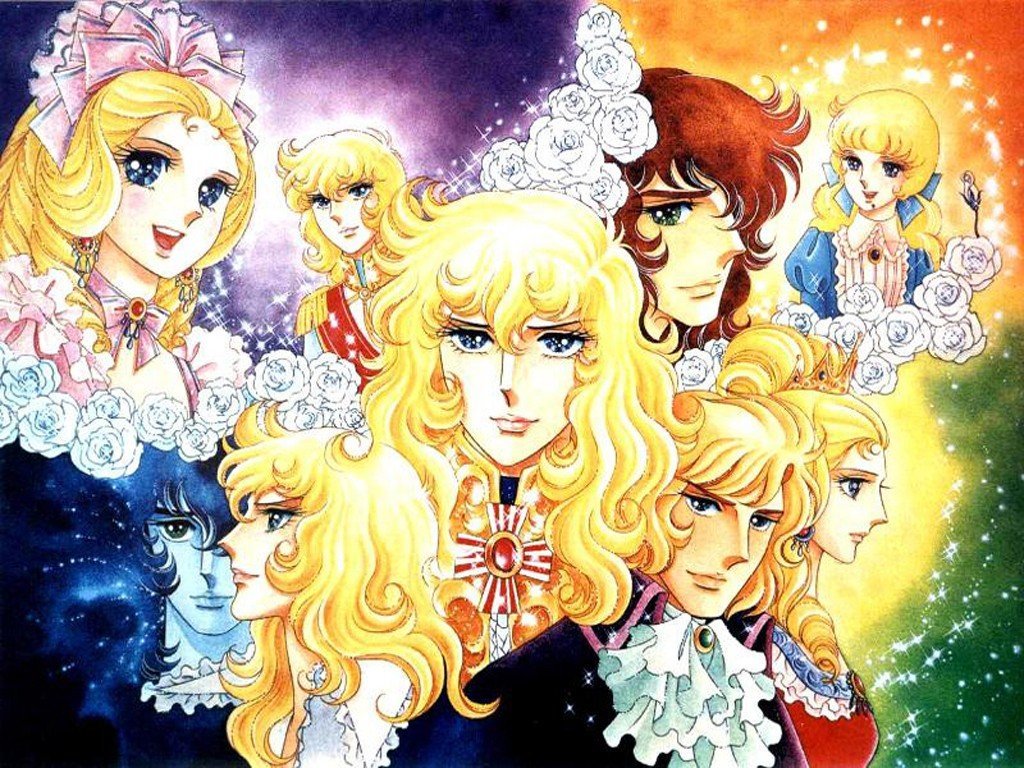
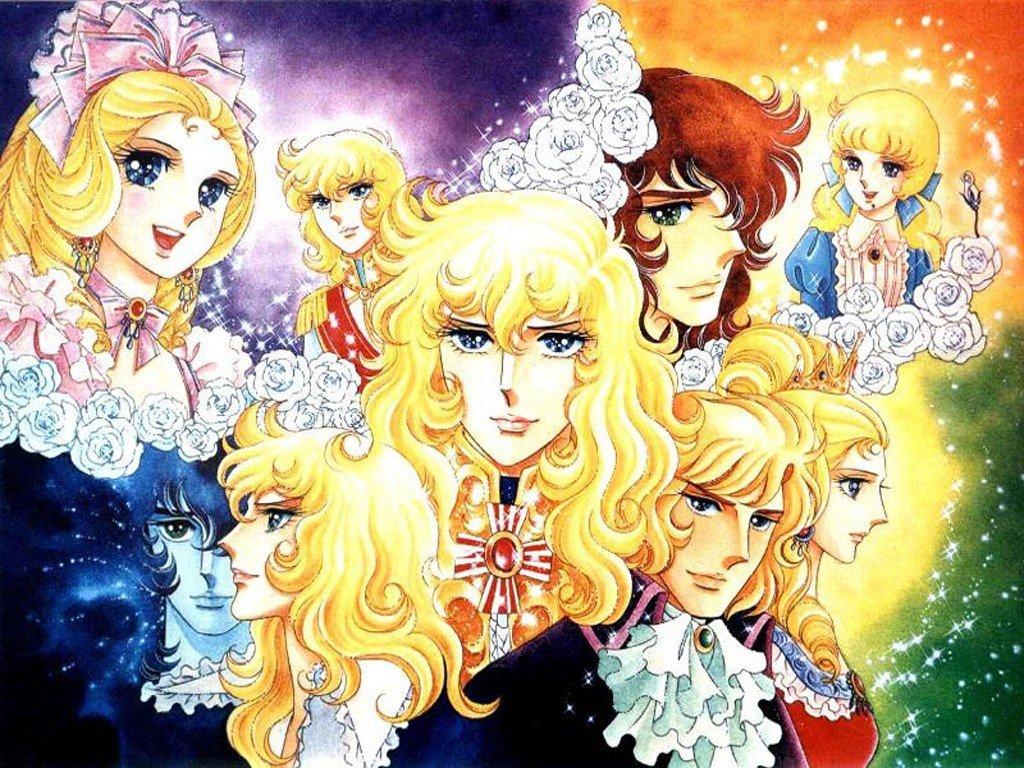
The Rose of Versailles" is a manga work written by Riyoko Ikeda, commonly known as "The Rose of Versailles. It was serialized in Shueisha's Weekly Margaret from 1972 to 1973. The story centers on Queen Marie Antoinette of France, Oscar, a beautiful man dressed in men's clothes, and Felsen, a Swedish nobleman, and takes place from the end of Louis XV to the time of Antoinette's execution. The series became explosively popular. With more than 20 million copies in circulation, it continues to be a much-loved work.
Overview of Versailles-no Bara
"Versailles-no Bara" is a girls' comic book by cartoonist Riyoko Ikeda. Based on the historical facts of the French Revolution, it depicts the life of Marie Antoinette and "Reijin in Men's Clothes" Oscar.
From the 21st issue in 1972 to the 52nd issue in 1973, the series was published in Weekly Marguerite. The first volume of the comic was released in October 1972, and the 10th volume was released in April 1974. In August of the same year, the Takarazuka Revue Tsukigumi staged "Takarazuka Grand Romance Versailles-no Bara" to boost its popularity. In 1975, the Nippon Broadcasting System started broadcasting the serial radio drama "Versailles-no Bara". The Takarazuka Revue also performed on stage one after another, creating an unprecedented "Belbara boom." Many collaboration products with Johnny's and major department stores were also released. In 1977, Shueisha started publishing the comic book paperback edition, which has sold over 20 million copies. In 1978, the production of the film "Versailles-no Bara / Lady Oscar" was announced and released in 1979. In October of the same year, the anime "Versailles-no Bara" started to be broadcast, and a video version was also released.
Since 1986, "Eikou no Napoleon - Eroica" (Glorious Napoleon - Eroica), which has a sequel component, has been serialized in the women's magazine "Fujin koron" (Women's Magazine). The series began in the May 1986 issue and reached its final appearance in the January 1995 issue. The name at the time of the series was "Eroica." The title was changed to "Eikou no Napoleon - Eroica" when the book and paperback edition were recorded. While there are real characters such as Marie Antoinette, Louis XVI, and Versen in this series, there are many original characters such as the main character Oscar and his childhood friend Andre.
The story begins in 1755, when three aristocratic children are born: Marie Antoinette, Oscar, and Versen. Later, Marie Antoinette is forced to marry for political reasons because of the French-Austrian alliance, and Oscar becomes an officer of the Imperial Guard as a Reijin in men's clothes and guards her. But Oscar falls in love with Versen, who is the lover of Marie Antoinette and whom she meets at a masquerade ball in Paris. At this time, the feelings of the three begin to intersect in a complicated way. Meanwhile, discontent was building up among the populace against the extravagant Marie Antoinette and the king, who did not blame her. The discontent soon grew so great that it developed into the French Revolution.
Outline and story of "Versailles-no Bara"
The Little Princess
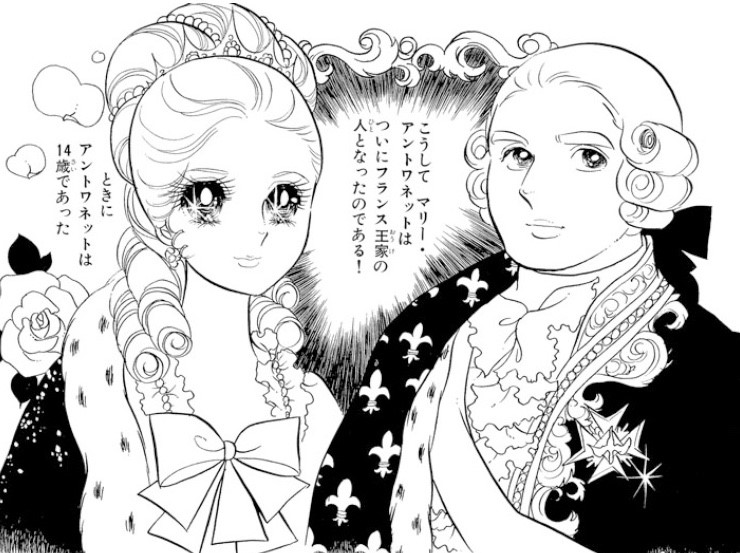
Marie Antoinette (left) and Louis XVI (right), a political marriage.
In 1755, three people were born in France, Sweden, and Austria who would later play a major role in the French Revolution. Oskar, the sixth daughter of the Jarges family, who had served the royal family as a soldier for generations and was raised as a man; Hans Axel von Felsen, the eldest son of a prestigious Swedish noble family; and Marie Antoinette, the youngest daughter of Maria Theresa of Habsburg Austria, whose charms were irresistible to all who saw her. Maria Theresa was the most famous of all the European empresses, and the most famous of all the European empresses, Maria Theresa. Maria Theresa was concerned about her relationship with France, which had long struggled for supremacy in Europe, and decided to marry Marie Antoinette to the Dauphin of France (later King Louis XVI of France) for political reasons.
In 1769, when Marie Antoinette was 14 years old, she finally received a formal marriage proposal from France. The whole of Europe was in a festive mood over this historic marriage. Maria Theresa, who saw Marie Antoinette preparing for the marriage, had an ominous premonition that her position as queen of France might bring her misfortune. In April of the following year, a lavish, multi-day party was held to celebrate the marriage of Marie Antoinette and the Dauphin of France. Marie Antoinette burst into tears at the loneliness of leaving her hometown and boarded a carriage for France.
Arriving in Versailles, the little dauphine began her new life. Having lived freely in Austria, Marie-Antoinette was fed up with the strict customs of Versailles. In Versailles, however, it is against custom for a woman of low rank to speak to a woman of high rank. She is excited by the fact that she, the Dauphine, is the highest-ranking person in the French royal family, where the queen has already died, and everyone is waiting for her to speak to them.
On the day of her first appearance at a party in Versailles, Marie-Antoinette first approached Oscar, whom she had been curious about for some time. Although Oskar was rarely seen at parties, he was there with his childhood friend André. Then, he noticed a woman staring at him from afar with a sharp gaze. The woman was the Countess du Barry, mistress of King Louis XV. The Countess of Du Barry was a prostitute, but she was favored by the King through a sham marriage to a nobleman, and she was an enemy of Marie Antoinette, who threatened her position. The rivalry between the two grew more and more pronounced, and some of the nobles in Versailles were betting on which of the two would be the first to break.
Just then, the Count de Merci was visiting France on behalf of Maria Theresa. He feared that relations between Austria and France would deteriorate if the king turned against the Countess du Barry, who had the king's backing. Marie-Antoinette, determined to protect her beloved homeland, finally called on the Countess du Barry, ending a feud that had lasted for two years.
Fed up with the routine of her life at Versailles, Marie-Antoinette spent every evening on the town. One night, Marie Antoinette took Oscar as her escort to a masquerade ball in Paris. While Marie Antoinette is excited at her first masquerade ball, a man is watching her. He is Felsen, an exchange student from Sweden. Felsen forcibly unmasks Marie Antoinette, and his eyes are captured by her beauty. This was the beginning of a great historical love affair.
At the end of April 1774, King Louis XV fell ill with smallpox. At the time, there was no effective treatment for the disease, and he could only wait for death. Despite the frantic nursing of the Countess of du Barry, Louis XV died on May 10. Marie Antoinette became queen of France at the age of 18.
The Countess of Polignac
Marie Antoinette became queen and gained great authority. First of all, she promoted her favorite, Oskar, and spent her days playing around and being extravagant. Then the Countess de Polignac emerged as the favorite of the young queen. The Countess of Polignac persuaded the queen to appoint a relative of hers to an important position, and taught her dangerous games such as gambling. Marie-Antoinette also showed an overt preference for the Countess of Polignac, who gradually became more and more influential at Versailles.
When Oskar saw how freely Marie-Antoinette spent taxpayers' money, he feared that France's finances would be strained. As he predicted, the citizens' lives were impoverished. Rosalie, who lived in downtown Paris while nursing her mother, was in such dire straits that she decided to sell herself, even though she was still a minor. She finally finds a job at the store of Rose Bertin, a tailor who is under the queen's orders, and heads home with light steps to inform her mother as soon as possible. However, he finds his mother bleeding and lying in front of the house, pinned under the carriage of the Countess de Polignac. The Countess Polignac spat at her, "Come to Versailles if you have a problem with me," and fled. Rosalie vowed to avenge her mother's death, keeping in mind her mother's last words: "My real mother was a noblewoman named Martine Gabriel.
Rosalie sneaks into a large mansion in Versailles, using the dress of the Countess de Polignac in the carriage as a marker. Seeing a woman in a similar dress getting out of the carriage, Rosalie grabbed a dagger and charged. Oskar noticed and slapped the dagger away. What Rosalie thought was Versailles was the residence of the Jarges family, where Oscar lived. It was Oscar's mother who she thought was the Countess de Polignac. She suggested to Rosalie that she work for him to improve her swordsmanship and go in and out of Versailles to find her mother's avenger. Unexpectedly, Rosalie ended up living the life of an aristocrat.
At the same time, Fersen, who had left France for fear of being rumored to be in love with Marie Antoinette, returned to France for the first time in four years to find someone to marry. As Oscar had expected, Marie Antoinette stopped her preferential treatment of the Countess of Polignac once and for all. The Countess of Polignac, feeling threatened by this, plots to get rid of Oscar, who is standing in her way. Late at night, she summons him in the name of the queen and attacks him. Oskar is stabbed in the left shoulder, and is prevented from coming out of Versailles for a while.
In the meantime, the Countess de Polignac arranges the marriage of her daughter Charlotte to a powerful nobleman, the Duc de Polignac. But Charlotte was only 11 years old. She was also in love with Oscar, and the marriage to the much older duke was too much for her to bear, so she took her own life. At the same time, Rosalie's birth mother, "Martine Gabrielle," turns out to be the name of the Countess de Polignac. Rosalie is unable to forgive the Countess de Polignac for murdering her mother and taking the life of her sister, Charlotte, even though she is the mother of her child.
With the death of Charlotte, the power of the Countess de Polignac at Versailles gradually declined. Meanwhile, Marie-Antoinette's favors were directed toward Fersen, and bad rumors about the two again spread throughout Versailles. Not only Oscar, but also Marie-Antoinette and Fersen, who were involved in the affair, sensed the cold atmosphere. They try to meet in secluded places as much as possible, but they still have the bitterness of not being able to express their love openly to the person they love.
The Necklace Incident
Rosalee had an older sister, Jeanne, who had once lived with her in the old town of Paris. She dreamt of a noble life and took a chance, pretending to be an orphan, to get a noble life under the Marchioness of Boolemblier. However, when she found out that the Marchioness of Boolemblier was not a noble enough to go in and out of Versailles, she killed her and inherited all her property. She made a man named Nicholas, who admired her, use the name of Count without permission, and her dream was to live in Versailles and her ambition was burning.
Jeanne was jealous of Rosalee, who was accompanied by Oscar at a ball held at the residence of a powerful nobleman. She was jealous of Rosalee, who was wearing a dress more gorgeous than her. She started a scheme to defraud Archbishop Rowan, whom she met at the funeral of the Marchioness of Volenbier. She lied to Rowan, who was shunned by the Queen, that she was the best friend of the Queen. She embezzled her property on the pretext of exchanging gifts for the Queen. She gained the trust of Rowan by hiring Oliva, a who looked exactly like the Queen, to marry Rowan.
One day, a jeweler named Vermeer came to Marie Antoinette and asked her to buy the diamond necklace that the former king had ordered for the Countess du Barrie. The necklace was so expensive that she couldn't afford it either. But she wanted Marie Antoinette to buy the necklace. Vermeer went to Joan, who was rumored to be close to the queen, and Joan asked her if she could recommend it to her. Joan tried her best to get a necklace that was far more gorgeous than ever. She asked Rowan to be her guarantor, told her her name, and bought the necklace. Soon she took it apart, gave it to Nicholas, and sold the diamond in England. This is the "necklace incident" that still remains in French history.
The case came to light when Vermeer demanded that the Queen pay for the necklace. The Oscar guards immediately arrested the people involved in the case and the trial began. Appearing at the court, Jeanne consistently pleaded not guilty. Although she was found guilty due to her blatant and repeated false statements, there were many people who protected her. Jeanne, who had been imprisoned, escaped one day. She was hiding in the town of Saberne, which was far away, and was conquered by the Oscar guards.
After the death of Jeanne, the "Necklace Case" was settled. However, Jeanne had more friends than expected, and Marie Antoinette realized that she was hated by the people. From this time on, Marie Antoinette began to refrain from the kind of extravagant entertainment she had always enjoyed.
Black Knight
Oskar's feelings for Felsen are growing, and wearing a dress for the first time in his life, he goes to the ball, which Felsen is also attending. Oskar had lived his life as a man. Dancing with Felsen as a woman is exactly what he had dreamed of. However, when his identity is about to be revealed, he shakes off Felsen's arm and runs away. As he was standing in the night breeze thinking, "Now I can give up," a black shadow suddenly strangled Oskar. Oskar, still in his dress, chases after the shadow, but it escapes. The black shadow is a "black knight," a bandit who targets only aristocrats.
The next day, Oskar attends a ball every night to catch the black knight. He chases after the black knight, but loses him when the black knight flees to the Palais Royal, the castle of the Duke of Orleans, the king's cousin. Oskar is hit from behind and loses consciousness, but someone pulls his arm and he loses consciousness.
When Oskar wakes up, he finds Rosalie, who is no longer with the Count de Polignac. Oskar sees the life of the common people in downtown Paris. He is surprised at how different life is from his own, and ashamed of himself for not having thought about it before. After recovering, Oskar takes Rosalie back to the Jarge family again.
Oskar is curious about the black knight and wants to catch him secretly and talk to him. To make the capture more certain, he had his childhood friend Andre dress up as the black knight and attack the nobleman's house. Oskar's hunch is right. The real black knight appears, and while Andre and Oskar are being chased down, the real black knight quickly whips Andre's one eye. The black knight fled to the Jarge family and escaped with Rosalie as a hostage. Oskar's plan failed. Andre's eye was seriously injured. Oskar deeply regrets when André says, "I'm glad it wasn't your eye.
Oskar was still suspicious about the relationship between the black knight and the Palais Royal. He makes a formal visit to the Palais Royal alone and is received by the Duke of Orleans. There, a salon is held for young people of all walks of life to engage in debate. Oskar is also involved in the discussion, but he is unable to obtain any information about Rosalie or the Black Knight, who has been taken away from him. As he leaves the salon, he discovers a piece of Rosalie's clothing wedged in the door of the staircase leading to the basement. Thinking it is a trap, he goes downstairs and is captured by men. When they put her in the dungeon, they find Rosalie there.
Andre learns that Oskar has gone alone to the Palais Royal, and while he is in absolute bed rest, he jumps out dressed as a black knight. Andre took them out of the dungeon without suspicion, but was soon discovered by the real black knight and got into a tussle with Oskar. To protect Oskar, who is outmatched by the man's arm strength, Rosalie picks up Oskar's dropped gun and fires at the black knight. The black knight falls and is taken into the Jarge family.
The black knight is actually Bernard Chatelet, a Parisian newspaper reporter. He had previously met Oskar in a bar, and Oskar remembered that he had spat out "the queen's dog" at Oskar, a member of the Kingsguard.
Bernard was born to a noble man and a commoner woman. The man had a wife and children, and when Bernard was five years old, he was evicted from his shop. His mother threw herself into the Seine River in winter with Bernard in her arms and died. Because of this, he harbored an intense hatred for the nobility.
He and Rosalie, who kindly takes care of him, gradually become attracted to each other because they both lost their mothers to the aristocrats as well. Oskar sees them together and proposes to marry Rosalie off to Bernard on the condition that she quit her job as a bandit. One evening, out of sight and out of mind, the two leave the Jarge family happily.
After talking with Bernard, Oskar gradually began to question aristocratic society. One day, he had an audience with Marie Antoinette and asked her to let him resign from the Kingsguard. Marie Antoinette appoints him to the French Guard, a position that is currently vacant. However, Marie Antoinette could not hide her upset at the unexpected words from Oscar, whose family has served the royal family for generations.
French Guard
Despite the opposition of his father, General Jarge, Oscar joined the French Guards as commander. Andre joined the French Guards with Oscar as a bodyguard. On the first day of the French Guards, he went to the parade ground for a rally, but there were no soldiers there. When Oscar went to the soldiers who were huddling in the barracks with drinks in one hand, the soldiers protested, saying, "I can't listen to women's orders." The leader of these soldiers was Alain de Soison, who was from the nobility.
On the first day of the training, it was Oscar, not the sky, that the soldiers pointed their guns at the order of the "rifle." Other commanders make a big fuss about the coup, but Oscar calmly asks the soldiers to agree to the discussion. When the soldiers say, "I can't work for a woman," Oscar provokes them with the arms of his sword, asking if there is anyone who him. Allan comes forward and the sword match begins.
Oscar had the upper hand in the first move, but he gradually became aware of Allan's high ability and changed his face. Oscar managed to finish by taking advantage of his lightness, but Oscar's heart was filled with emotion. Allan was the first person with this level of sword skills. However, contrary to Oscar's wishes, the soldiers' discontent grew. Oscar threatened, confined and harassed the commander, but Oscar never punished the soldiers.
One day in training, a soldier collapsed from malnutrition. Despite being well fed, Oscar became suspicious that there were other soldiers who were malnourished. On a previous day of meeting the soldiers, Dianne, Alain's sister, stared suspiciously at her holding a large furoshiki. In fact, the soldiers were sharing food for poor families and sending money to sell their swords. Oscar was shocked that the lives of commoners were so poor.
Unable to have relations with the soldiers, a military review was held with General Bouillet, Oscar's superior in the French Guard. The soldiers did not listen to the order, and Alain deliberately dropped his gun in front of General Bouillet and fell from his horse. Enraged General Bouillet ordered Alain and his soldiers to be suspended and left. When Oscar saw him off, he turned around and slapped Alain and his men. Since he could not bring his heart to submission, he had not dealt with them until now, but he expressed regret that his feelings were not conveyed. This incident gradually developed a bond between Oscar and the soldiers.
Oscar and André
Andre, who lost his mother when he was eight years old and came to the Jarge family with his grandmother. He always acted with Oscar as a playmate and gradually fell in love with Oscar. However, Andre, who was a commoner, could not marry Oscar, an aristocrat, no matter how much he wished. He was suffering from the feeling that he could not reach him even though he was nearby.
A while after joining Oscar and the French Guard, a marriage proposal came up to Oscar. The partner was Geraudel, who was a subordinate of Oscar when he was a member of the Royal Guard. Oscar refused to marry her because she could not become a woman again, but her father, General Jarge, did not listen to her. He said that he would hold a party for Oscar to find a marriage partner, inviting not only Geraudel but also many young people.
On the day of the party, there was a large gathering of young noblemen who had proposed to Oscar, as well as the ladies of Oscar's fans who had tried to stop them. However, Oscar appeared not in a dress, but in a gorgeous formal dress. In addition, soldiers from the French Guards stormed into the venue, causing chaos.
Jerodel chases Oscar, who escapes from the hustle and bustle and cools down on the balcony. Jerodel gently talks to Oscar, who continues to refuse to be happy as a woman. Being misled by the kindness of an unaccustomed man, Oscar slowly puts his lips on top of Jerodel. However, the moment his lips touch, Oscar pushes Jerodel and runs away. The presence of Andre, who suddenly crosses his mind, doesn't stop Oscar from beating his heart.
Andre, on the other hand, became preoccupied after Oscar's marriage was mentioned. One night, Andre was groomed and brought wine to Oscar's room. He was about to commit suicide with poisoned wine. However, while he was talking with Oscar, he suddenly came to his senses and thrust Oscar, who had put his mouth on the wine, to the ground. Regretting that he had tried to take Oscar's life by himself, he was determined to protect Oscar until his life ended.
Oscar was also aware of the importance of being Andre, who loved her. One night, Oscar called Gerodel and refused to propose marriage, saying, "If Andre gets unhappy, so do I." Gerodel also withdrew, saying, "If you (Oscar) get unhappy, so do I." He declared that he would live as a military officer for the rest of his life to his father, who had been trying to protect his daughter from the current world of unrest, and chose not to marry anyone for Andre's sake.
Trilogy of Three Sections
Due to the luxury of Marie Antoinette, the deficit of the French royal family was growing out of control. In order to overcome this financial crisis, the royal family and the High Court of Justice were at odds at the Gozen Kaigi. The High Court of Justice demands that if the king pushes ahead with the tax increase, a three part meeting should be held. The three part meeting consists of representatives of the first class (Buddhist monks), the second class (nobles), and the third class (commoners). Not only commoners but also anti-royal nobles demand that the three part meeting be held in order to weaken the power of the king. Marie Antoinette was troubled by the fact that even aristocrats are no longer allies.
The following year, the King proclaimed the convening of the Third Committee. At the opening ceremony, members of each rank lined up. Some representatives of the commoners, even aristocrats, were on the side of the commoners. When the King entered the venue for the opening ceremony, "Long live the King!" was shouted, but Marie Antoinette was not even cheered by the aristocrats. Marie Antoinette realized that it was not the Royal Family that the whole nation hated, but only herself.
In June, at the height of the Tripartite Meeting, the first prince, Louis Joseph of Lorraine, Duke of Guise, who was fighting an intractable tuberculosis spondylitis, fell into critical condition. In the desperate carelessness of Marie Antoinette, the 7-year-old prince quietly breathed his last. At that time, however, there was not even enough money left in the royal family to hold his funeral.
Since the opening of the session, the three committees had been a heated discussion between the aristocracy, the priests, and the commoners. In order to break the deadlock, the commoners joined hands with the aristocracy and the priests to open the National Assembly. Taking the situation seriously, the King's side proceeded with the maintenance of the army to dissolve the three committees, and the Oscars also strengthened security.
However, they did not comply with the king's order to dissolve the National Assembly. Oscar, who was ordered by General Bouillet to expel the Pleistocene members by force, refused the order, saying, "The army is not meant to point guns at the people." Angered, General Bouillet confined Oscar to the commander's office and said that he would put Alain and other soldiers in prison and shoot them to death. Seeing the soldiers being taken to prison, Oscar ran away after Andre, who was waiting outside the room, opened the door. He stopped the guards who had been dispatched instead of the French guards and protected the Pleistocene members.
When he returned to his home, General Jarge directed his sword at Oscar, saying, "We will eliminate traitors." Andre grabbed his hand from behind and pointed his dagger at him. General Jarge lowered his sword and left Andre, who was trying to protect Oscar even in exchange for his life. Oscar quietly told Andre, who had protected him, that he loved her. Andre lost his words to Oscar's confession, which he had been waiting for. It was a moment when his long-awaited love paid off.
French Revolution
The jailed soldiers were released unconditionally by Bernard, who was holding a rally in Paris. However, they were released in order to prepare for a possible popular riot. Immediately after that, the French guards, including Oscar, were ordered to appear, which is a de facto order to advance. The night before they appeared, Oscar and Andre were united.
On July 12, the French Guard led by Oscar went into action. When a riot broke out in Tuilley Palace Square, Oscar gave up his position as a nobleman and went to support the people. During the fierce battle, a bullet pierced Andre's body, which had become almost blind. Oscar, who had lost a loved one, could not stop crying as if half his heart had been ripped off.
However, the battle continued without mercy. On July 14, soldiers of the King fired at the people who rushed to the Bastille prison with weapons. This was the historic "attack on the Bastille prison." Oscar wiped his tears and headed for the Bastille prison to fight with the citizens. Judging that Oscar was in command, the King's army fired cannons at Oscar. The cannonballs hit Oscar's right shoulder and stomach. He refused to take care of Alan or Rosalee, who was in charge of rescuing the injured, and Oscar passed away as if he were following André.
The French riots became a revolution and became a European concern. While even royalist aristocrats fled to foreign countries because they felt they were in danger, only Versen came from Sweden to see the king and his wife. Versen did not care for himself. He proceeded with a plan to let the king and his family escape to the Austrians. At midnight on June 20, 1791, the king and his family left in a carriage pulled by a disguised Versen. Versen intended to accompany the king and his wife until they were handed over at the border, but the king opposed it. He decided to do so out of fear that acting with them would endanger the Versen. Versen defected to the Belgians with his back hair pulled. The king and his family headed for the Austrian border as planned.
The escape of the royal family was discovered at dawn, and an arrest warrant for the royal family was issued immediately. Security was placed along the border. At that time, the royal family was being held up in a carriage by a crowd of people. The people did not realize that the man in the carriage was the royal family, but one of the enthusiastic revolutionaries in the midst of the crowd recognized it. The royal family was captured in Wallennes, which was ahead of them, and was forcibly returned to the Tuileries. With this "Wallennes escape incident" as a turning point, the French Revolution rapidly shifted to the exclusion of the king.
The End of the Revolution
In August 1792, the King's family was stripped of all rights. A month later, it was decided that the 16th Wang Rui of the country would be executed. On January 12 of the following year, with the people watching, the 16th Wang Rui of the country climbed the guillotine hoping that his death would contribute to the development of the country. He was 38 years old.
Immediately after the king's execution, the parliament decides to separate the second prince, Louis Charles, from Marie Antoinette. The 8-year-old prince forgets his identity, his father and mother, and sings revolutionaries with soldiers. Later, Marie Antoinette, who is also separated from her daughter, Marie Thérèse, Madame Royale, is transferred to concierge prison for trial. It was Rosalee who was assigned to take care of Marie Antoinette.
As the trial of Marie Antoinette opens, it continues for several days with interrogations related to the previous squandering, the necklace case and the Valentinu escape case. On 15 October, Marie Antoinette was finally sentenced to death, and she said with tears, "It's finally over."
At 10:30 a.m. on October 16, 1793, Marie Antoinette left for the execution site. Amid a barrage of public taunts on her decapitated head, Marie Antoinette, who never gave up her pride as the Queen of France, passed away. It was the 37 years of life of a woman who married the French Crown Prince at the age of 14.
After the Valentinu Escape, Versen had gone to Paris many times to save Marie Antoinette. After the death of Marie Antoinette, she returned to Sweden, but she never got married and continued to think of Marie Antoinette for the rest of her life. She became a cold-blooded power because she hated the people who had taken her loved ones. On June 20, 1810, she was massacred by the people who hated Versen. It was the same day as the Valentinu Escape, which Versen strangely continued to curse.
List of Versailles-no Bara characters
Main character

Related Articles
Summary of Versailles (Versailles) love relationships, couples, couplings, married couples, and lovers.
Versailles Rose (Versailles Rose)" is a manga by Riyoko Ikeda that was serialized in the manga magazine "Weekly Margaret" from 1972 and has been adapted into an anime, a stage play by the Takarazuka Revue Company, and a movie. Set in Paris, France, the manga depicts the lives of Queen Marie Antoinette of France and Oscar, the "Man Dressed in Men's Clothing," and others as the era moves toward revolution. The highlights of the film are Marie Antoinette's love story based on historical facts and the love game over Oscar.
Read Article
Versailles Rose (Versailles Rose) Quotes, Great Lines / Great Scenes and Scenes of Versailles Rose (Versailles Rose)
The Rose of Versailles" is a girls' manga by Riyoko Ikeda, set in France from 1770 to 17789. Since its serialization in Weekly Margaret, the manga has become popular among young girls and has been adapted into anime and Takarazuka. The romantic love lines and the cool lines about trying desperately to survive while being swallowed by the waves of the times have been loved by readers for many years.
Read Article
Meet the new Lady Oscar after 40 years! The Rose of Versailles" is back in production!
The Rose of Versailles" is a nationally famous girls' manga by Riyoko Ikeda. The love between Queen Marie Antoinette of France and Fersen, and the tragic fate of Oscar, a beautiful man-dresser, and his lover Andre, have brought tears to the eyes of girls not only in Japan but around the world. The manga world has been shocked by the new works.
Read Article

Ten animated films from 1991, which celebrates its 25th anniversary this year.
This year, 2016, marks the 25th anniversary and quarter-century of such works as "Kinko's Beware! The year 1991 was a boom year for Sunrise's robot animation. In addition to "Raijin-O" from the Eldoran series and "Phibird" from the Yusha series, the Gundam series "F91" and "0083" were produced as if they were competing with each other. We have selected 10 works that represent such an era.
Read Article

Takeo Yamashita's anime songs and special effects songs
A new "Lupin the Third" is still being made today. The theme of "Lupin the Third" is generally known as Yuji Ohno's song from the second series onward, but Takeo Yamashita's melancholy song from the first series also has a charm that cannot be discarded. Other representative anime and special effects songs composed by Takeo Yamashita are introduced below.
Read Article

Takeo Watanabe's World of Anison
Ani-song opening themes are the face of anime. As one of the composers of the early days of anime, Takeo Watanabe should not be forgotten; he passed away in 1989 at the young age of 56, but his songs will remain as anime works.
Read Article
Contents
- Overview of Versailles-no Bara
- Outline and story of "Versailles-no Bara"
- The Little Princess
- The Countess of Polignac
- The Necklace Incident
- Black Knight
- French Guard
- Oscar and André
- Trilogy of Three Sections
- French Revolution
- The End of the Revolution
- List of Versailles-no Bara characters
- Main character
- Marie Antoinette
- Hans Axel von Versen
- Oscar François de Jarge
- Andre Grandier
- Rosalee La Moliere
- People around Marie Antoinette
- Louis XVI (Louis o' Güstow Capet)
- Louis the 15th
- Duke of Orleans (Louis Philippe II, Duke of Orléans)
- Marie Thérèse, Madame Royale (Marie Thérèse, Madame Royale de France)
- Louis Joseph of Lorraine, Duke of Guise (Prince Louis, Duke of Burgundy)
- Louis Charles
- Maria Theresa
- Countess du Barrie (Madame du Barry / Mari-Jeanne ベキュー)
- Countess of Polignac (Martine Gabriel de Polignac)
- Charlotte de Polignac
- Anne d'Arpajon
- Florimond Claude, Comte de Mercy-Argenteau (Flolimont Claude de Merci アルジャント)
- People around Oscar
- Alain de Soison
- Geraudel
- Bernard Shatre
- General Járje (Renier de Járje)
- Countess of Jarge
- Marron Glace (BAYA)
- People involved in the necklace case
- Jeanne Valois de la Motte
- Nicolas de la Motte
- email from another party
- Archbishop of Louie de Rouen
- Oliva (Nicol de Oliva)
- Leto
- Other Characters
- La Moliere
- Duchess of Bourenbillier
- Rose Bertin
- Pierre, my boy.
- Sofia
- Baron San Remy
- Dianne de Soison
- Louis Antoine, Duke of Angoulême León Florel de Saint Just
- Maximilian I of Mexico de Robespierre
- Marquess of La Fayette
- Earl of Mirabeau
- Duke of De Geische
- Drue
- General Buye.
- Terms of the Versailles-no Bara
- Royal buildings
- Palace of Versailles
- Petit Trianon
- Palais Royal
- Bastille Prison
- Other buildings and families
- Louis Le Grand Academy
- High Court
- House of Valois
- Incident
- Necklace Incident
- Black Knight Incident
- Famous quotes, lines, scenes, and scenes from "The Rose of Versailles
- Marie Antoinette: "Today, Versailles is a hard man."
- Oskar: "Your Highness is looking at 200,000 people who are in love with you right now."
- The Countess of Polignac: "Come to Versailles whenever you want!"
- Oscar: "Watashi no Harukaze!"
- Andre: "Be happy that the chocolate wasn't hot!"
- Oscar: "F-Lance. Banzai!"
- Behind the Scenes, Trivia, Small Stories / Episodes and Anecdotes of "Versailles-no Bara"
- Oscar, a character born out of a backlash against male society
- After Oscar's death, I had to finish with 10 stories.
- Study painting during the series
- Collaboration with "Lupin III"
- Authors who have not seen the animated TV series
- About the Oscar dress.
- Rosalee's dress was originally Oscar's.
- Recreation of the Oscar dress by students
- Marie Antoinette's hair color change
- Theme song and insert song of "Versailles-no Bara"
- OP (opening): Hiroko Suzuki "Roses fall beautifully"
- ED (ending): "Light and Shadow of Love" by Hiroko Suzuki
- Insert and image song: Hiroko Suzuki "Watashi wa Habebito" (I am a captive)
- Inserted music and image song: Hiroko Suzuki, Reiko Tajima' Aikike no Hami' (Sorrow due to love)
- Inserted song and image song: Brownie "MAGICAL ROSE"
- Insert / Image Song: Brownie "C' est Toi"