

For those who suffer from tone deafness, karaoke is nothing but torture. It's hard to say no when it's for company, but you absolutely hate singing, and you feel depressed.... If you are in that kind of mood, here's a voice training program that will make you feel like a pro! I'm going to teach you a voice training method that will make you sound like a pro! If you know that tone deafness can be cured, you will feel a little better, won't you? If you have been refusing to try karaoke, maybe you can start using a microphone today!
▼ If you can do this, there is nothing to be afraid of! Let's make a mixed voice! ▼
Source: ameblo.jp
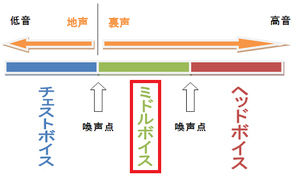
Don't you turn over or switch to a falsetto when you reach the limit of the high pitch while you are singing?
As you all know, there is a limit to the range of sounds that can be pronounced in the underground voice. You can make a falsetto at a volume close to that of the underground voice, and even if you switch to that falsetto, you will know that it has been switched to the falsetto!
The place where the earth's voice reaches its limit and switches to the falsetto is called the "cry point."
If you can get rid of this "calling point", you can sing freely from the earth voice to the back voice.
SO IF WE USE THE "MIXED VOICE" WE'RE GOING TO INTRODUCE NOW, WE CAN ELIMINATE THE "CALL CENTER"!
"Mixed voice" is the voice between the earth voice and the falsetto voice, so you can think of it as "mixed voice of earth voice and falsetto voice".
If you can use this mixed voice, there will be no boundary between the earth voice and the background voice, and all the voices from the earth voice to the background voice can be heard as one voice, so the range from the earth voice to the background voice becomes the range you can use.
The person in the video above puts it out like chest voice → mix voice → head voice → mix voice → chest voice.
▼ To make a mixed voice! ▼
With mixed voice, it's more like you get the hang of it and pronounce it rather than practice and master it.
Of course, in order to master the mixed voice, you need to be able to do abdominal breathing, the correct way of pronunciation, the muscles around the throat that are trained to some extent, and the head voice.
On the other hand, some people who are able to do the basic things mentioned above can do it in a week, others can do it unconsciously, and others can take more than a month.
As far as I know, I would like to write down how to get the knack of mixed voice at ↓.
1: When I make a mixed voice, I feel as if I am mixing my natural voice with my falsetto. The sound of the natural voice is deep in my throat and the sound of the falsetto echoes around my nose.
2: Practice producing a low pitch with a falsetto. (The shape of the throat of the falsetto will give you the sensation of producing the same voice as the background voice, so adjust the voice so it becomes a mixed voice.)
3: The feeling of mixing (riding on) the underground voice with breathing leakage.
4: The upper body is weak except the abdomen.
5: Make an edge voice with a falsetto (because the pronunciation of the falsetto edge is the closest to that of the mixed voice)
7: Think from belly to mouth as one tube
8: Generate voice from belly (image is important)
9: The voice coming out of the abdomen passes through the greatly expanded chest. The image of the voice resonating in the expanded cavity
10: Also, let your voice echo through your wide-open throat as if you were yawning.
11: The image of the tube from the chest to the throat spreading widely and the voice from the belly echoing through it.
12: The last pass point, from low to high tone by opening and closing the vocal cords, adjusted to the height that comes out
13: The higher the pitch, the lower your consciousness. The higher the pitch, the lower your face.
14: But the direction of the voice sounds like it's coming through the top of your head.
15: Speak as softly as possible so as not to raise your voice in the high notes.
16: The volume of voice is adjusted by the amount of breath from the abdomen. The throat and chest do not try to increase the volume of voice.
17: Don't think you can't do it.
For those who can't get a feel with just the above sentences, I recommend the popular and effective book "YUBA Mezzot" which comes with a CD and has a content that makes it easy to get a feel for the mixed voice.
If you don't have the money to buy a book!, there is a song with the same content as the CDs of "YUBA Mezzot" under the name of JOYSOUND's "Three minutes before karaoke, singing the throat of a man (Toru Yuba)", so please practice to get the sense of the mix there.
▼ Are there different types of mixed voice? ▼
・ Earth voice type. Thick and straight basic mix that is said to be an extension of the correct chest voice.
The tone is basically chest-like, and although the range varies from person to person, it is commonly used by many professionals.
Examples of expression: hyde, Masayuki Tanaka, yuzu, hata, motomori, and many others
・ Metal type. A rock mix that produces an aggressive tone by putting a sharp closure on the extension.
The characteristic is that the head component is strong, and the tone color balance is very high.
Subjects who experienced the event: TOSHI, Koshi Inaba, etc.
・ Reduction type. A delicate mix that is said to be limited even for professionals and only suitable for talented people.
The vocal cords are made shorter to achieve a soft, neutral voice from the low to high range.
Among these, there are individual differences, and the rate of change in voice quality varies depending on the vocal cord reduction rate.
As the overall tone of the voice is strong, it is easy to be misunderstood that the closure is only loose.
Expression subjects: Kazumasa Oda, Masamune Kusano, Hideaki Tokunaga, Tom
▼ Let's apply vibrato! ▼

Source: zenback.itmedia.co.jp
I want to sing with vibrato like a professional.
Vibrato comes out unexpectedly easily if you get the hang of it.
Using the video below, let's start singing in long tone, then go up and down with 「↑↓↑↓↑↓」 and your favorite vowels.
vibrato1
There is vibrato5, so let's try as much as we can.
If you can't even tune it to the video above! Haha! Here are some ways to get a feel for vibrato:
1 Ha, ha, ha, ha Do your dog's ha-ha-ha until you can do it fast.
When I can do 2 1, I'm going to give you a long tone of "Ah," and I'm going to lower my abdominal muscles.
Try to speak up.
3 When you're ready to do this, check out the vibrato practice video above to see if you can.
▼ Let's sing in a good voice by echoing your voice ▼

Source: www.hitomi-pr.co.jp
How do you make a good voice?
In order to make a good voice, I have written many times before that it is basic to relax the upper body above the chest, to remove the choking and raising, and to make a firm voice.
There are fundamental and overtones in the sound. If the sound is concentrated in one place, only the fundamental stands out and you can hear the muffled sound.
If you can use your chest, throat, mouth and nasal cavity to make a sound, the harmonics will increase and it becomes a comfortable sound like the resonance of other strings of a piano.
In other words, let's make a deep bass sound like a foreigner's, and make it a comfortable high pitch sound.
▼ How to sound your voice ▼
[High-pitched sound echoing on the head]
To produce a high-pitched sound on the head, the vocal cords must first be pulled firmly to obtain the sound generated by the switching frequency of the fine vocal cords.
High-Pitched sounds that are cracked, noisy, or muffled (low-pitched, dry high-pitched sounds) are hard to echo in the head.
If you start with the normal edge voice and do the high-pitched sound and the voiced edge voice properly, you can get the sound of the high-pitched sound.
After that, the important thing for the whole head to be echoed is that the nasal cavity must be echoed.
In order to get that feeling, I think high-pitched humming or falsetto humming are good.
If you start to feel the sound in the back of the upper part of your nose, you will feel it. Next, open your mouth vertically.
When the voice is placed on the back (base) of the upper front teeth, the sound reaches not only the mouth but also the nasal cavity and head.
If you want your voice to echo at the top of your head, try to speak more loudly toward the hard palate (maxilla).
[Bass echoing in the chest]
This is a training to strengthen the male real voice (chest / chest), but first let's practice the sound of the chest from the middle and low sound range.
If you make a target on your lower front teeth when you start speaking in your middle or low range, you should be able to get the sound in the middle from the Muneage.
As you proceed to the bass, you move the target of your voice to the middle of your tongue, and the sound reaches even further to the cuckoo below your chest.
In the beginning, it is good to check the sound of your voice by putting your palm on your chest.
When the resonance of the chest with a strong bass sound is obtained, multiple resonance such as nasal cavity will be obtained naturally, and the sound will increase further.
[Speak each range smoothly]
The bass goes around the cuckoo, and as the scale goes up, the bass goes up to the chest (or back, depending on the person)
It is good to bring from the Muneage part to the back of the head from the lower part of the throat to the back of the head, and from the nasal cavity resonance to the top of the head in the high tone.
I think the movement of the sound and consciousness is difficult due to the nuance, so it will be easier to do it if you move your hand up and down to the pitch in the beginning.
▼ Let's make your tongue smooth! ▼
No matter how good I was at singing, no matter how much I tried to sing with emotion, my tongue was not smooth and I couldn't catch the lyrics. That's a waste.
In order not to be so, let's do "smooth tongue training".
Before that, I think there are people who have a problem with only high-pitched sounds. Those people are likely to have the following causes.
Most of the people who open their mouth and throat widely and whose smooth speech gets worse as the pitch goes higher are only those who are so conscious of their throat being flat that they "open sideways" and put too much force on their tongue (mainly the base of their tongue) that they can't pronounce smoothly. Therefore, if you consciously open your throat vertically, your smooth speech will get better.
The other one is the pattern that your smooth tongue is getting worse because your throat is strained. This is the only way to be conscious of the weakness, so let's do Dr. Eric's stretching all over.
▼ Training to improve your smooth tongue ▼
In the video below, read "The Song of Ambo".
Since this poem contains all 50 words, it is a very effective training for smooth tongue since you can check which words you are not good at at the same time you can practice smooth tongue evenly with 50 words.
Japanese pronounciation(online): Tongue twister
If you don't like videos, try searching for "Amebo no Uta."
Next, there is a high level of skill training that makes you think there is no more effective skill training.
It is one of the eighteen best plays of Kabuki called Soroburi.
This soroburi is used by voice actors, actors, announcers, and other voice and language professionals for training in vocalization, pronunciation, and articulation.
It's awfully difficult, so take your time at first, but read it to the end. If you do it every day, you should be able to do it!
If you can do this, your speech will be almost perfect.
The Lines of Soroburi: Voice Acting Research Institute
www.d7.dion.ne.jp
These lines are used by voice actors, actors, announcers, and other voice and language professionals to train their vocalization, pronunciation, and articulation. Please make use of these lines.

Contents
- ▼ Stretch before voice training ▼
- ▼ Basics of singing! Let's master abdominal breathing! ▼
- ▼ Let's strengthen the power of exhaling and control! ▼
- ▼ Ju-on? Vocal Fly (Edge Voice)! ▼
- ▼ How to make an edge voice ・ Practice ▼
- ▼ Soft lips! Lip roll! ▼
- ▼ Don't laugh. la-ga, ya-ya, ya-ga, ta-la ▼
- ▼ Let's train your throat muscles! ▼
- ▼ Let's train the cricothyroid and obturator muscles with a falsetto! ▼
- ▼ Train your chest voice ▼
- ▼ How to practice chest voice ▼
- Don't raise the pitch of the earth!
- ▼ Let's make a head voice! ▼
- ▼ How to practice head voice ▼
- ▼ There are two types of head voice? ▼
- ▼ If you can do this, there is nothing to be afraid of! Let's make a mixed voice! ▼
- ▼ To make a mixed voice! ▼
- ▼ Are there different types of mixed voice? ▼
- ▼ Let's apply vibrato! ▼
- ▼ Let's sing in a good voice by echoing your voice ▼
- ▼ How to sound your voice ▼
- ▼ Let's make your tongue smooth! ▼
- ▼ Training to improve your smooth tongue ▼
- ▼ Always be conscious when singing ▼
- Reference Links