
For those who suffer from tone deafness, karaoke is nothing but torture. It's hard to say no when it's for company, but you absolutely hate singing, and you feel depressed.... If you are in that kind of mood, here's a voice training program that will make you feel like a pro! I'm going to teach you a voice training method that will make you sound like a pro! If you know that tone deafness can be cured, you will feel a little better, won't you? If you have been refusing to try karaoke, maybe you can start using a microphone today!
Source: cplus.if-n.biz
Introduction
I think there are many people who are tone-deaf and have a low voice, and these days singers and songs are all high key songs, so they can't sing.
So did I.
But the more people practice, the higher pitch they can make.
Moreover, if you become good at singing, you will be able to produce your voice with correct pronunciation, so your speaking voice will be much better!
This time, I would like to summarize the voice training that I did until I, who had been said to be super tone-deaf, came to be called "like a professional!" in karaoke.
▼ Stretch before voice training ▼
Stretching may be unexpected, but it is surprisingly important. Just like when you do warm-up exercise when playing sports, when you speak out, you use your throat muscles, so stretching before doing Voitre will increase the effect of Voitre many times!
So please make sure not to forget to stretch before doing Boytreh.
Referring to the video below, let's loosen up around the neck.
It seems to be good to do it while breathing out.
▼ Basics of singing! Let's master abdominal breathing! ▼
Source: kenkou-island.or.jp
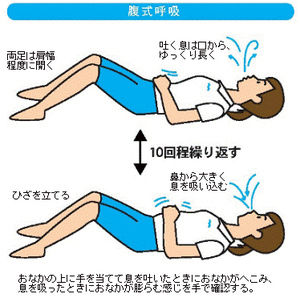
Abdominal breathing exercise (1)
1: Lie on your back with your right and left hands on your navel.
2: Try breathing with your hands on your navel.
3: Then I think the area around the navel naturally rises up. This is abdominal breathing.
How is it? When you lie down, you will naturally have abdominal breathing, so first try this way to get a sense of abdominal breathing.
Source: d.hatena.ne.jp
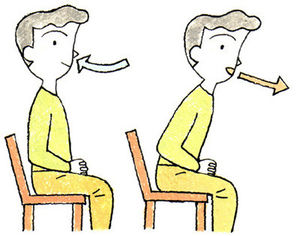
How to practice abdominal breathing ②
1: Straighten your back and sit on a chair with your right and left hands on your navel.
2: Tilt your body forward when you are ready.
3: If you bend your body forward, breathe in through your nose as if your stomach is swollen.
* At this time, if the breast part is lifted up, it will costal respiration.
4: Once you have confirmed that your abdomen is swollen, raise your body while exhaling slowly from your mouth. ← If your abdomen is dented at this time, you are able to perform correct abdominal breathing.
Once you get the knack of abdominal breathing from the above practice method, try breathing in and abdominal breathing on the spot without lying down.
Voice Training vol. 1 abdominal breathing
It is explained in the video, so please refer to this.
Source: plaza.rakuten.co.jp
Abdominal breathing practice ③
Once you get a sense of abdominal breathing to some extent, try to pronounce with abdominal breathing.
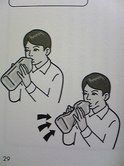
If you don't know if you can make a sound with your abdominal breathing! Inhale the air in an empty PET bottle with your mouth, and use that breath to say "ahhhh!" That's the sound you make with your abdominal breathing.
This training to breathe in and out the air in the PET bottle can also strengthen the diaphragm other than abdominal breathing practice, so it will also lead to increase the volume of your voice!
* If you do this method too much, you will run out of oxygen, so be careful not to overdo it.
▼ Let's strengthen the power of exhaling and control! ▼
In singing, the ability to exhale and the ability to control your breath are very important!
I'm sure you've all had this before, but don't you have the experience of being able to make a high-pitched sound at the beginning of a single phrase of a song, but not being able to make a high-pitched sound in the latter half because you're breathing less?
If you can control your breath, you will be able to sing at a constant volume of breath, so you will be able to make a high pitch sound from the beginning to the end. Also, if you have the ability to exhale, it will lead to an increase in your voice volume, and the ability to exhale and control your breath will be very useful.

Training to develop the ability to exhale
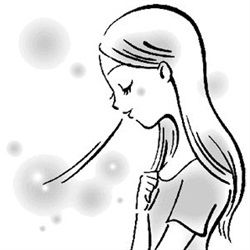
1: Put your index finger in front of you.
2: In this state, breathe in for 5 seconds, and blow it out for 5 seconds as if it were a candle (blow it out at the 5th second).
2: Next, stretch your arms as far as you can, and in the same way, think of your fingers as candles, inhale for 5 seconds, and blow them out for 5 seconds (same as above).
Try both of these exercises, gradually increasing the time between 10 and 20 seconds. * Of course, do it with abdominal breathing.
Source: geocities.yahoo.co.jp
Training to control breathing
1: Relax your body and breathe as hard as you can with abdominal breathing.
2: Breathe in lightly at first, then breathe out more and more strongly.
3: Next, as in 1, let's exhale while adjusting the power of exhaling alternately, weak at first, strong in the middle, and weak in the middle.
* Don't point your mouth like you do with a candle. Try between 0 and 30 seconds as much time as you can.
▼ Ju-on? Vocal Fly (Edge Voice)! ▼
Up to this point, we have been doing nothing but breathing training, but this is the basics of the basics, so if you haven't been able to do the above, the Boytreh we are going to do will have little effect. Now, let's start doing the real Boytreh? (speaking out)!

Source: peppa-aji.sakura.ne.jp
What is Edge Voice?
As shown in the video below, a voice that sounds like a curse is called an "edge voice" in Japan.
This Edge Voice sounds like a very plain practice, but it's a very effective Voitre.
Effect 1: The obturator muscles (which open and close the vocal cords and control the amount of breath) are strengthened.
2: You can also use this to get the resonance of the chest at low frequencies.
3: Good for the training of the high tone phonation which does not use the throat holding up.
4: By training the opening and closing of the vocal cord firmly, the effect of removing noise such as high-pitched sound also comes out.
▼ How to make an edge voice ・ Practice ▼
To make an edge voice, you gradually lower the scale as you speak. When you reach the point where you can't lower the pitch any further, I think you can hear the sound of vocal cords vibrating. This is an edge voice.
To produce this edge voice in various scales, open your throat like when yawning, and open your mouth in the shape of a. ← This throat shape is the most ideal throat shape when you sing. Next, let's try to exhale weakly. Next, change the exhaling breath gradually to a voice.
Then, you can make a voice with the vocal cord closed, so you should get an edge voice.
Let's do the musical scale training with this Edge Voice using the video below.
▼ Soft lips! Lip roll! ▼
This is a lip roll that anyone who has ever eaten Voitre knows.
This is the best way to practice singing in the Boytre menu, and it has the following effects.
- The back of the voice will fit nicely.
・ Breathless.
- You will be able to take notes.
- Improve your voice
And if you do lip roll like this, you will acquire the ability to control vocal cord.
You will learn learn how to minimize the amount of breath when you sing, you will be able to sing to places you haven't been able to sing before with one breath, and you won't have to use your breath to sing for nothing, so it will also lead to weakness.
Honestly, even if other Boytrees are troublesome, if you do this with abdominal breathing and edge voice, you will become good at singing to some extent.
Then, let's do the same musical scale training as Edge Voice.
oct_scale
Let's change it to a falsetto if it change it to the back voice.
▼ Don't laugh. la-ga, ya-ya, ya-ga, ta-la ▼
First, let's look at the video below.
I think there are people who know it, but it is Professor Eric who is famous in the world of Niconico Voitre.
The effects of "LaGa", "YaYa", "YaGa", and "TaLa" that Mr. Erick is doing are as follows.
・ Making the throat weak
Make the throat open.
・ Relax your throat muscles
- You can feel the sound at the base of your tongue.
So if you do this stretch
Because it creates an ideal condition (I will explain more about it later) when the throat is open and weak = when you make a voice, the appearance of the voice will be greatly different if you do it before singing or before Boytre.
In addition, since you can feel the sound at the bottom base, it also helps you to grasp the feeling of "head voice" or "mixed voice" that comes out later.
[Boytre] Warm-up Part 3 ~ Improving the Voice Quality ①
www.nicovideo.jp

Contents
- ▼ Stretch before voice training ▼
- ▼ Basics of singing! Let's master abdominal breathing! ▼
- ▼ Let's strengthen the power of exhaling and control! ▼
- ▼ Ju-on? Vocal Fly (Edge Voice)! ▼
- ▼ How to make an edge voice ・ Practice ▼
- ▼ Soft lips! Lip roll! ▼
- ▼ Don't laugh. la-ga, ya-ya, ya-ga, ta-la ▼
- ▼ Let's train your throat muscles! ▼
- ▼ Let's train the cricothyroid and obturator muscles with a falsetto! ▼
- ▼ Train your chest voice ▼
- ▼ How to practice chest voice ▼
- Don't raise the pitch of the earth!
- ▼ Let's make a head voice! ▼
- ▼ How to practice head voice ▼
- ▼ There are two types of head voice? ▼
- ▼ If you can do this, there is nothing to be afraid of! Let's make a mixed voice! ▼
- ▼ To make a mixed voice! ▼
- ▼ Are there different types of mixed voice? ▼
- ▼ Let's apply vibrato! ▼
- ▼ Let's sing in a good voice by echoing your voice ▼
- ▼ How to sound your voice ▼
- ▼ Let's make your tongue smooth! ▼
- ▼ Training to improve your smooth tongue ▼
- ▼ Always be conscious when singing ▼
- Reference Links