
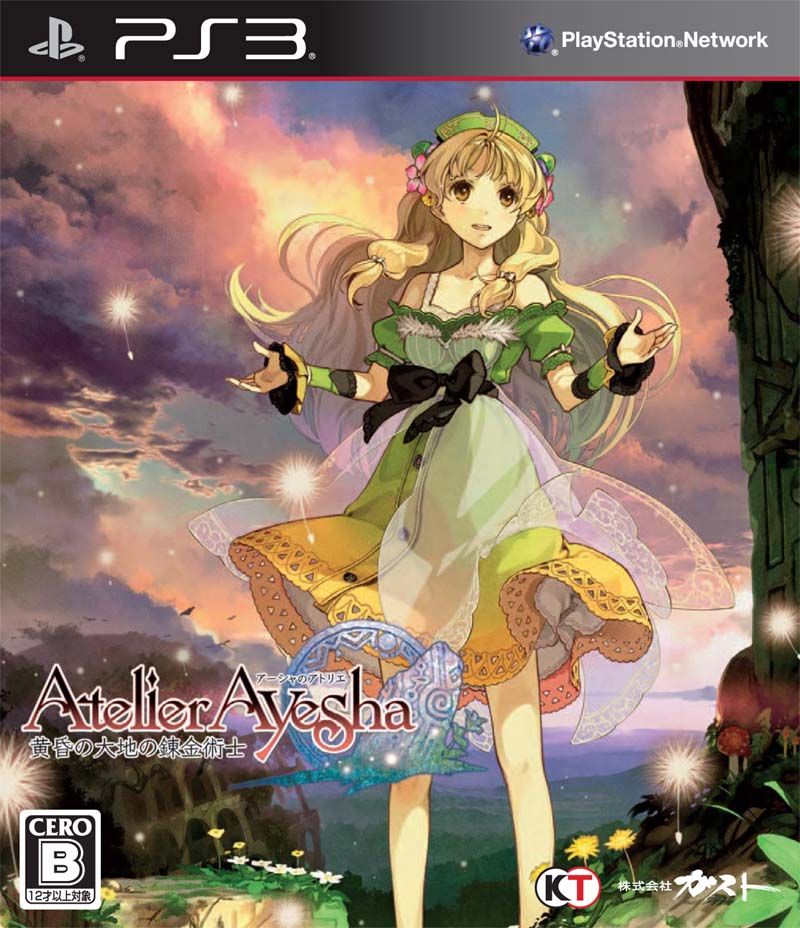
Asha's Atelier: The Alchemist of Dusk (A14)" is a PlayStation 3 software developed by Gust (now Koei Tecmo Games) and is the 14th title in the Atelier series of alchemy-themed RPGs. Like the previous titles in the series, the story is based on a cheerful style, but the story takes place in the twilight age, when alchemy, once a flourishing art, has fallen into disuse. The story is about Asha, a young pharmacist girl who learns alchemy and searches for her missing sister in a dying world.
When you move to an area, an event may occur. If you meet the criteria for multiple events that occur in the same area, you can re-enter the area and see another event. For example, if you just keep going in and out of a store in the city, the event will move on. In the previous version of the series, each character's standing picture was inserted in the event scene, and the character's facial expression was changed according to his or her emotion. However, in this version of the series, the 3D character model was changed to show his or her emotion with gestures.
In the Atelier series, when the main character examines the object of the barrel, he utters the line' Taru,' which is the promise of the series, but in this series, he can only listen to the barrel in the garden of the atelier.
Mixing
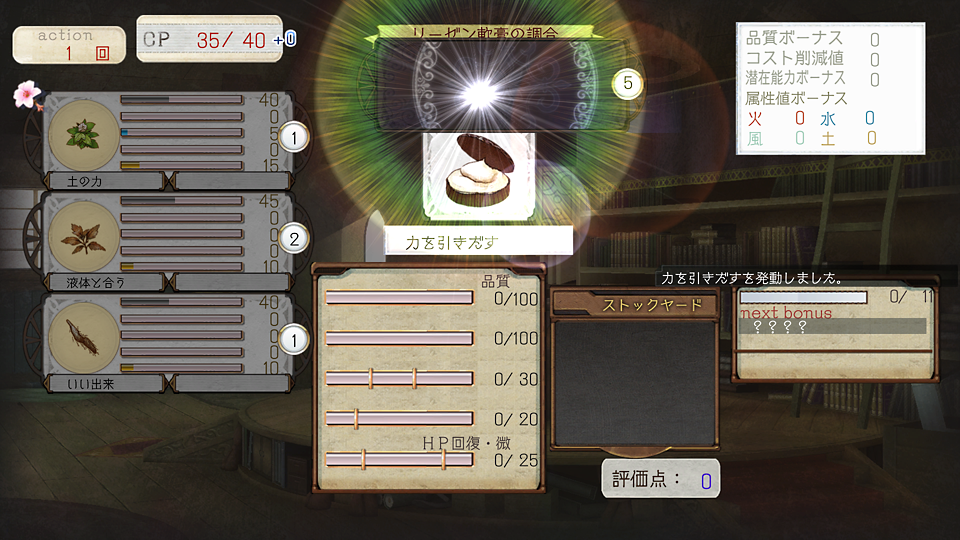
Mixing screen
Blending is the basic activity of the Atelier Series. It involves blending material items acquired through gathering, combat, or purchase to create a completely different blended material from the new item or original material. This is done for the purpose of creating items dedicated to Asha for use in combat or in the field, but it is also an important activity involved in the involved in the progression of the story. The area where blending is possible is the city, and the blending begins when you look at the Renkin Gama in your own studio or rented house. A recipe is required for blending, and these are available at street shops, dungeons, and battle events. In the previous series, blending sometimes failed, but in this series, there is no failure. Instead, the required Renkin level is set for each blended item, and blending is not possible until this level is reached. Each item that is used as a raw material for blending has items related to quality, attribute values, characteristics, and potential characteristics, and items that inherit these characteristics can be created by combining these items in blending. Therefore, if each item that is used as a raw material has different characteristics, the characteristics that are inherited by the blended item will change. In some cases, the items necessary for blending are specified by category, while in other cases, only specific items are specified. The characteristic of blending unique to this series is the order in which the materials are put in and the blending skills (described later). The blending result changes depending on the order in which the materials are put in. The material items that are obtained through collection and combat were given characteristics randomly for every material in the previous series, but in this series, the characteristics given for each material item are determined (although the equipment items are random). Therefore, the characteristics of the items produced by blending are determined mostly by the selection and order of the materials and the blending skills (described later).
CP
CP is a point which indicates the cost consumed at the time of material input and is deducted by the level of the item. It has the value of Renkin level x 2 + bonus. It is also reduced by the use of blending skills (described later). Blending is possible even if there is a shortage, but if there is a shortage, the characteristics of the items added after that are not carried over to the blended items. On the contrary, the quality deterioration of the blended items can be prevented by adding low-quality items after the CP is used up. In the conventional series, MP (described later) was consumed at the time of blending, but by adding this concept, MP is no longer consumed at the time of blending in this series.
Compounding skills
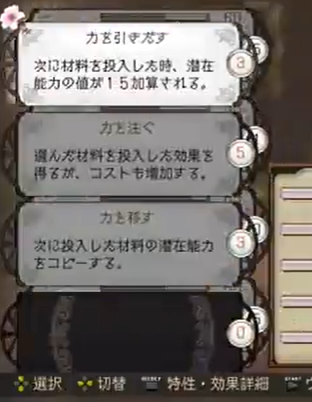
Listing of a preparation skill. The number next to the name is the CP required to use the skill.
Blending skills are special commands that can be entered before a single ingredient is put in to determine the blending sequence. You can choose one of four options: "draw power," "pour power," "transfer power," and "cancel power." You have to raise the level of alchemy to master it. There is no upper limit on the number of times you can use it, but it consumes CP separately from the ingredient. "Draw power" is a blending skill that can raise the potential of the ingredient to a certain level. It costs less and can be adjusted so that unnecessary characteristics are not added when you run the "transfer power" command. The skills are detailed below.
"Chikara wo Oeru" is a skill to increase the cost and re-introduce the material you want to introduce next. "Chikara wo Utsushi" is a skill to transfer all the potential of the material to be used to the blending item. In blending, if the potential is added later, it will be pushed out in order from the one reflected earlier and will be overwritten, so it is often used at the end. "Chikara wo Ukeru" is a skill to remove only one potential assigned to the item to be blended. This skill alone has 0 cost among the blending skills and can be activated even when the CP is used up.
Attribute Value
An attribute value is a value set for each material that indicates how much of the "fire", "water", "wind", and "earth" attributes it has, and the effect varies depending on how much of these attributes the item being compounded contains. It is not offset or augmented for each attribute, only the concept of adding to each attribute individually. The effect information of the potential ability is hidden until the compounding item is made by adjusting the required attribute value once, but once the effect is expressed, the information can be confirmed on the spot.
Properties
A characteristic is a concept that affects the formulation of each ingredient. There are 0 to three properties for each ingredient. When the ingredient is put in, five properties are stored in a place called a "stockyard." If five properties are exceeded, they are discarded and overwritten, starting with the oldest property. When certain properties are combined, they have a stronger effect on the formulation.
Potential
Blending items are classified into categories such as attack, recovery, support, weapons, armor, decoration, and materials, each of which has a primary effect. The additive effect added to this is called a "potential effect." It is a property that is activated when the blended item is used. Equipment such as armor and decoration is permanently activated as long as it is equipped. It is generated by the total level of input materials. Up to five items are stocked as candidates for expression. However, as with the characteristics, the excess is written over in order from the oldest. The potential that can be added to each item that is created is determined. For example, weapons and armor cannot have the same potential.
Combat
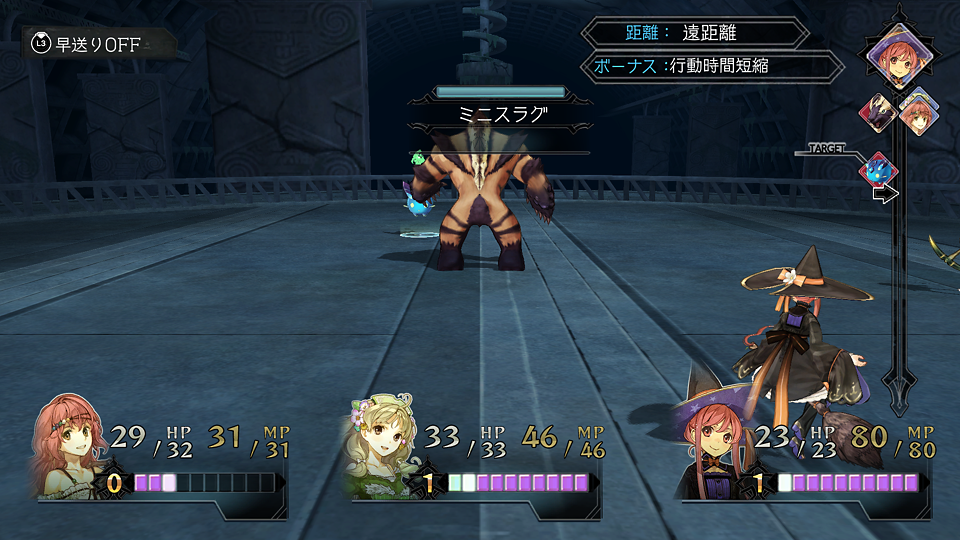
Combat screen
Basic of combat
A party is always organized by up to three members, including Asha. The basic strategy is to let the character act by selecting a command: attack, skill (in the case of Asha, an item), move, or escape. This is a cost-turn type of battle. Positions are important in tactics, as they can be moved to four positions: front, left / right side, and back when the opponent is at the center, and attacks from the back always result in a critical hit and increased damage. This aggressive strategy can be used by moving, but it can also be used to disperse for range attacks or to concentrate for use of range recovery items. However, since this is a cost-turn type of operation, it is necessary to consider waiting time before taking action. An attack from the opponent does not hit the player from the back, but there are many opponents who have powerful techniques. If the conditions are met, the party members can select a special killing technique, and as an active command (described later), the party members can shield each other from attacks from the opponent, or they can use cooperative techniques.
There is a concept of HP and MP in combat. HP represents physical strength, and when it reaches 0, the character is no longer able to fight. MP is the point required to use the skills and items described below. Skill activation and use of items must leave a value equal to or greater than the specified MP.
Count
For emcount, contact with an enemy on the dungeon field triggers a battle. If, at the time of contact, Asha can swing the staff to strike, it is Asha's pre-emptive attack, and the party members are placed next to Asha in the battle situation. After the battle, the opponent becomes invincible temporarily, and during this time, even if you touch the opponent, it does not become a battle. If the opponent is weak, you can kill the opponent just by hitting the staff on the field without fighting.
Active command
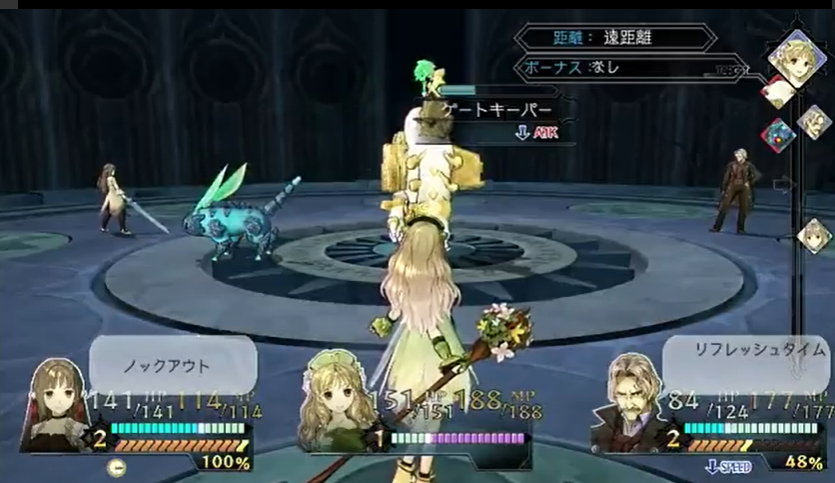
A balloon from a character is evidence that an active command is possible
Active commands are cooperative commands that are activated when two party members press the △ and □ buttons when a gauge has accumulated. The commands that can be used vary depending on the position of the gauge and the enemy or friend. You can chase the enemy, protect your friends from the enemy's attack, and sometimes have the effect of reducing damage or inhibiting the enemy's action. If two people can use active commands at the same time, you can change the character that uses the command with the L1 or R1 button or the arrow keys.

Related Articles
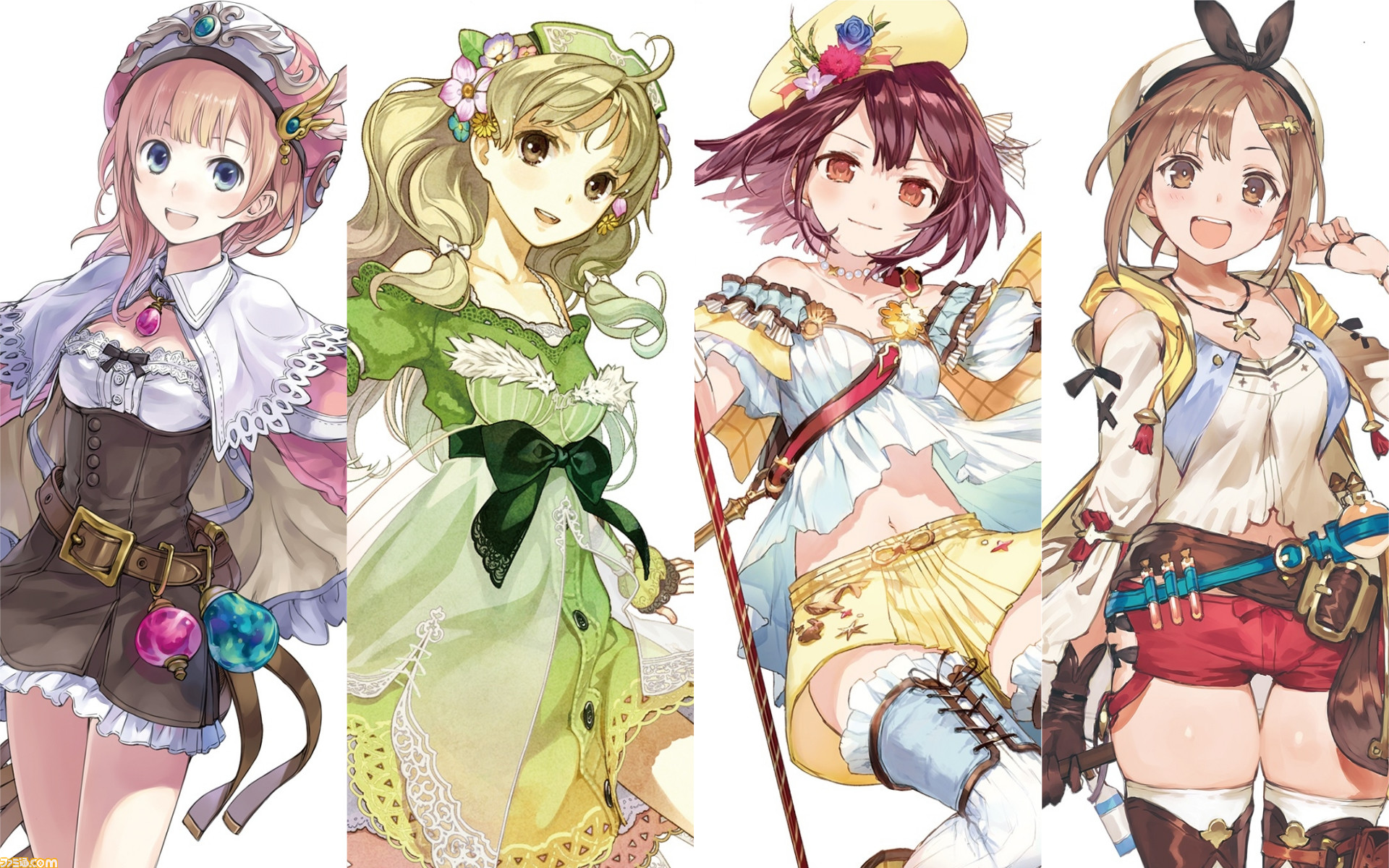
In-depth summary of the main characters of the Atelier series
The "Atelier series" is a series of RPG games based on the theme of "alchemy. The publisher is Koei Tecmo Games' Gust (formerly Gust Co., Ltd.). The series is called the "Atelier series" because the word "Atelier" appears in the names of most of the titles. Most of the main characters are girls, and their names are often included in the XX part of the title, "XX's Atelier.
Read Article
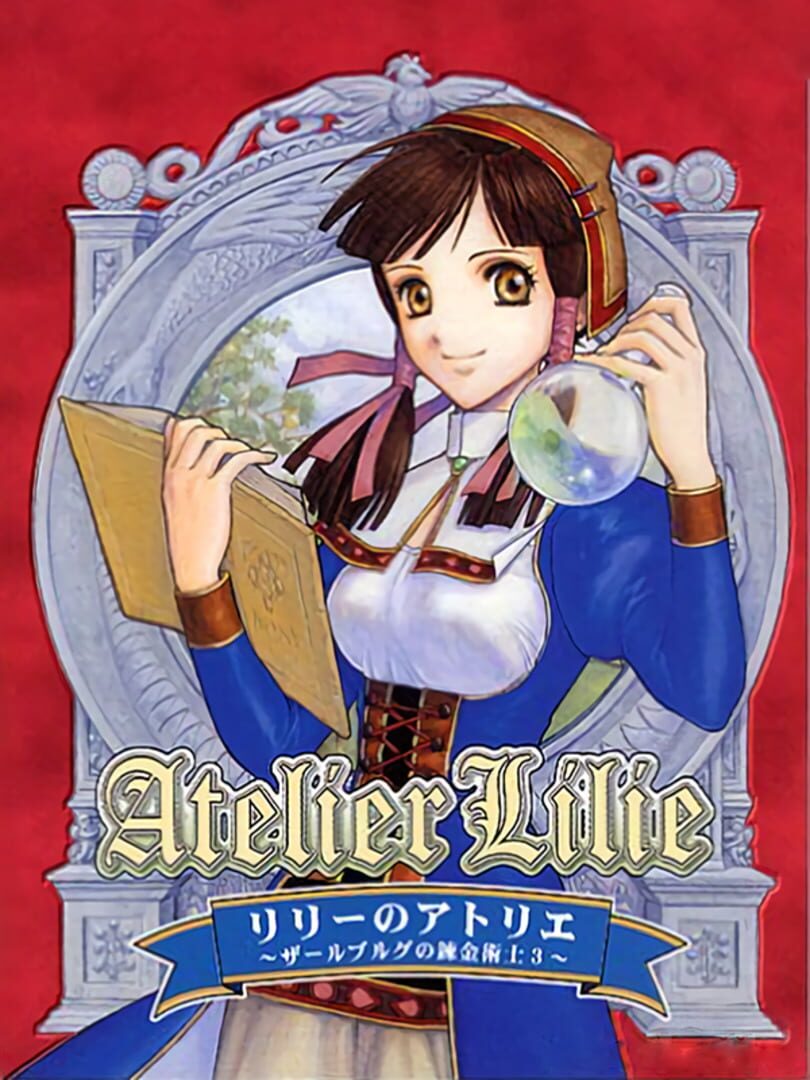
Lily's Atelier - The Alchemist of Saarburg 3 (A3) Spoilers and Discussion Summary
Lily's Atelier: The Alchemist of Saarburg 3" is the third title in the Atelier series of RPG games for the PlayStation 2 from Gust. It is set in a time before the first game, "Marie's Atelier: The Alchemist of Saarburg". The main character Lily and her friends come to Saarburg from the continent of El Vador to spread alchemy. They aim to complete the academy by exhibiting their alchemical creations at the annual "exhibition" held at the castle to gain recognition and funds.
Read Article
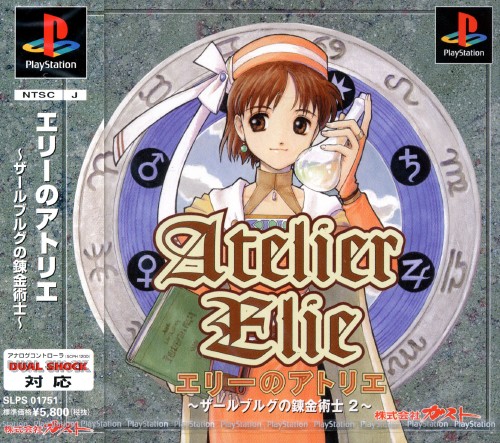
Spoiler commentary and discussion of Elie's Atelier - The Alchemist of Saarburg 2 (A2)
Elie's Atelier: The Alchemist of Saarburg 2 (A2)" is a sequel to "Marie's Atelier: The Alchemist of Saarburg", an RPG game for the PlayStation released by Gust. A girl named Elfir, who was wandering between life and death after contracting an infectious disease, was saved by a woman named Marlone, who was on a journey as an alchemist. Elfir, who survived, admired Marlone and entered a prestigious alchemy academy in Saarburg to become an alchemist herself.
Read Article
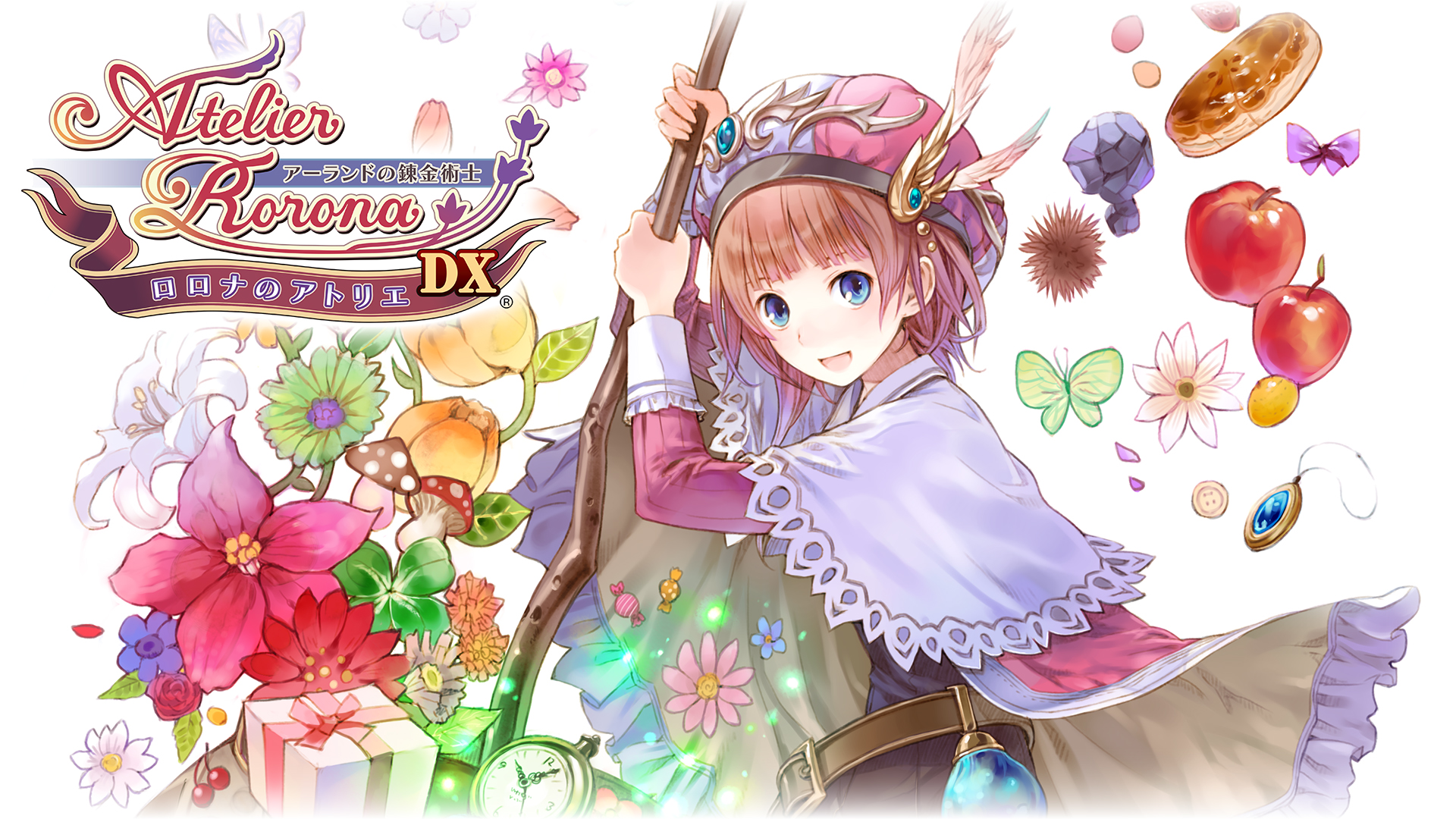
Spoiler commentary and discussion of Rorona's Atelier - The Alchemist of Arland (A11)
Rorona's Atelier: The Alchemist of Arland" is the 11th title in the Atelier series of RPG games for the PlayStation 3 from Gust. Later remakes were made and a DX version was released as a set with the sequel. A girl named Rorona lives with her master in the Atelier of Alchemy in a corner of the Kingdom of Arland. One day, a knight comes from the castle and tells her that if she does not continue to fulfill the tasks given by the castle for three years, the atelier will be torn down. Rorona becomes the owner of the atelier as a new alchemist and faces the three-year task to protect the atelier.
Read Article
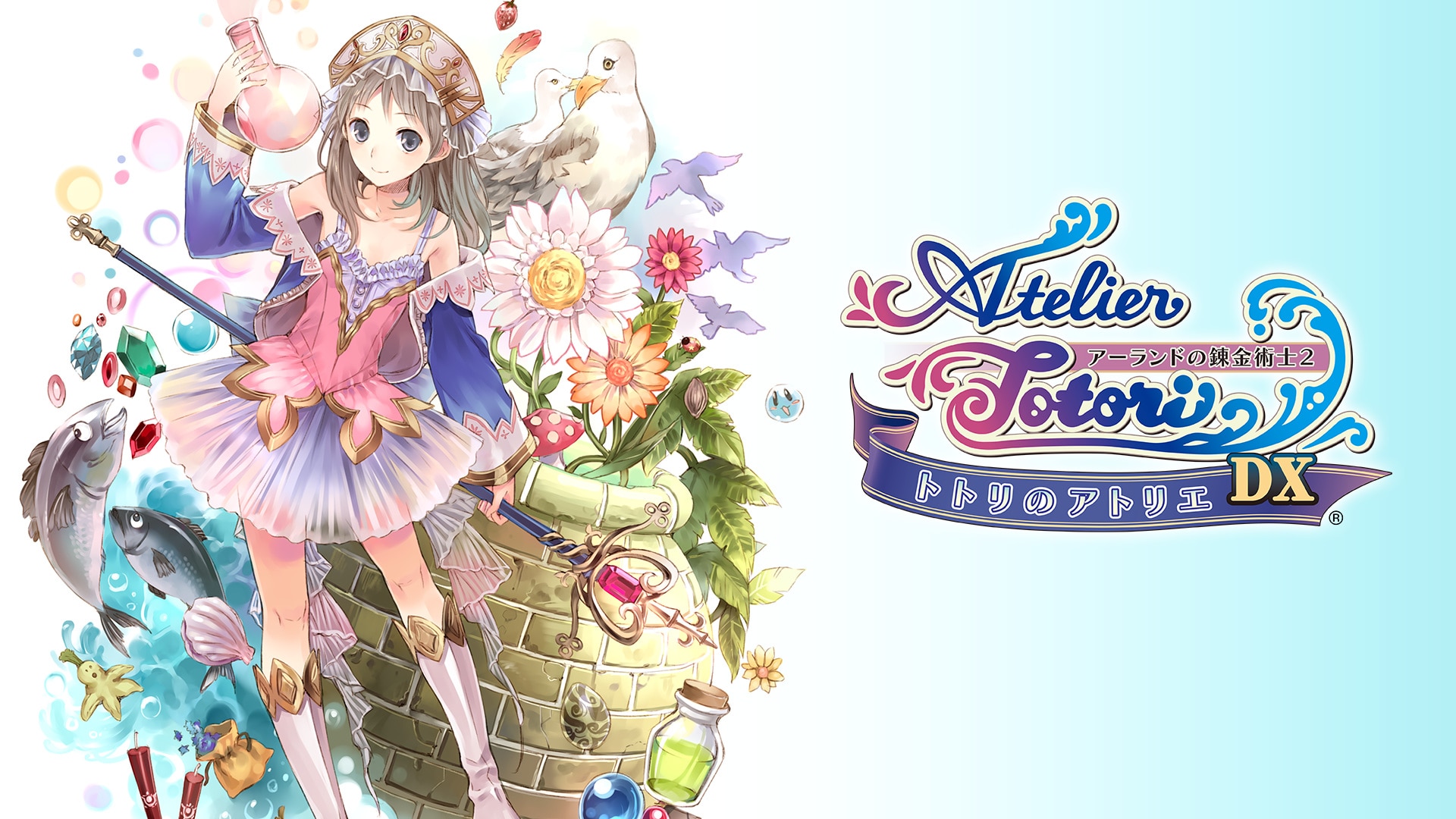
Spoiler commentary and discussion of Totori no Atelier - Alchemist of Arland 2 (A12)
Totori no Atelier -The Alchemist of Arland 2 (A12)" is a sequel to "Rorona no Atelier -The Alchemist of Arland", an RPG game for the PlayStation 3 released by Gust. In a small fishing village called Aranya in the Republic of Arland, there lives a girl named Totori, who is Rorona's apprentice. Totori decides to become an adventurer in order to follow in the footsteps of her mother, who went on an adventure when she was a child and has since disappeared. Totori's adventure begins as she dreams of being reunited with her mother.
Read Article
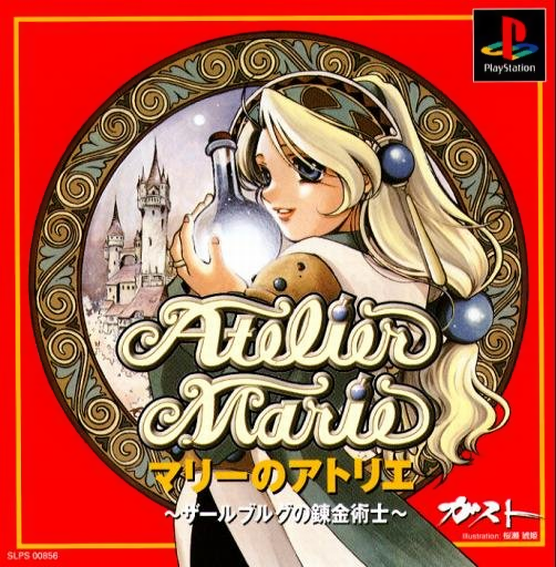
Marie's Atelier - The Alchemist of Saarburg (A1) Spoilers and Discussion Summary
Marie's Atelier: The Alchemist of Saarburg (A1)" is an RPG game for the PlayStation released by Gust. The game was later ported to various consoles, including the Sega Saturn version with additional events and endings. The main character, Marlone, was studying at an academy to become an alchemist, but his grades were not good enough to graduate. The academy then issued a graduation exam: "Run an alchemy store in town, create a high-level item, and submit it to the academy. Marlone is to take the 5-year graduation exam while running the store.
Read Article
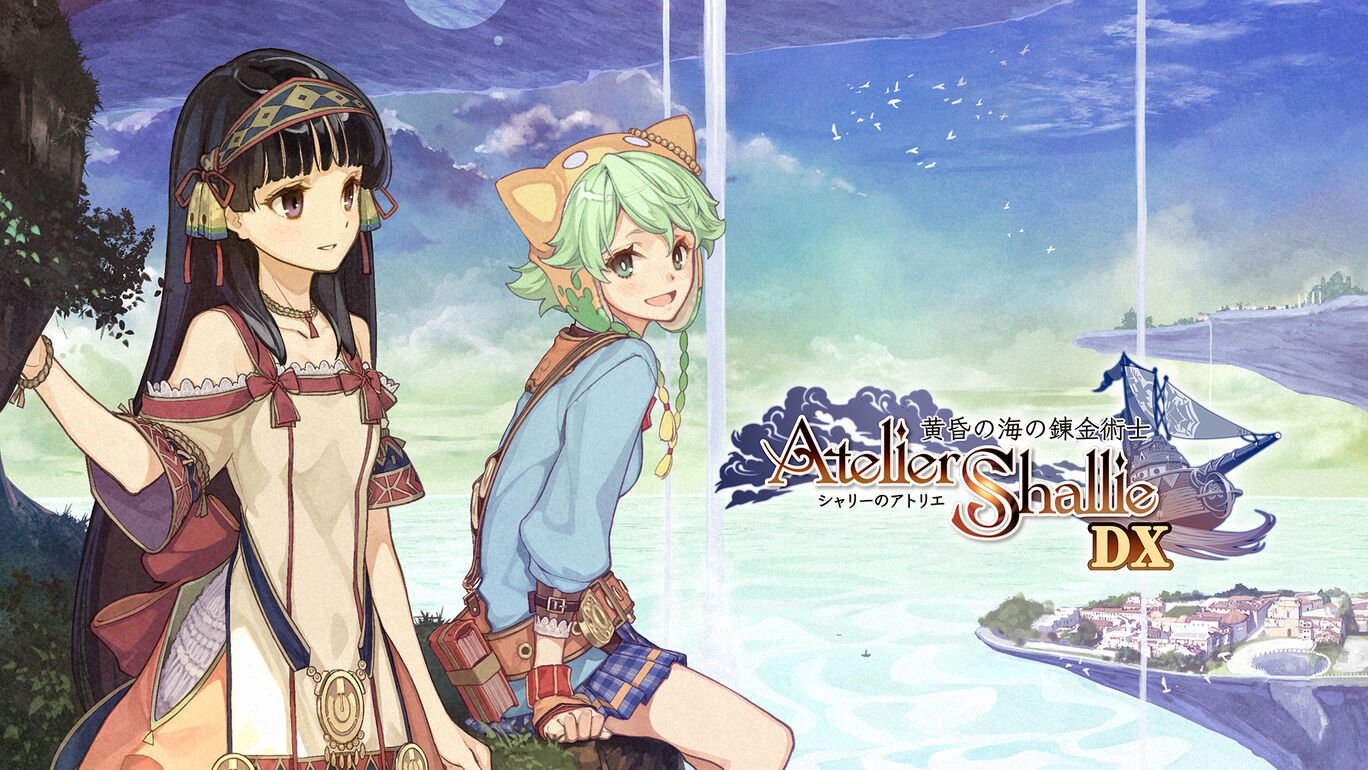
Spoiler commentary and discussion of Shari's Atelier - The Alchemist of the Twilight Sea (A16)
Shari no Atelier: Alchemist of the Dusk Sea (A16) is the 16th title in the Atelier series of alchemy-themed RPGs developed by Gust. Gust was later known as Koei Tecmo Games. It is also the third and final installment of the "Twilight Series" and was released in 2014 for the PlayStation 3. The main characters in this work are the two Charlies "Charistella" and "Charlotte," and the story unfolds from different perspectives, as in the previous "Atelier of Esca and Logie."
Read Article
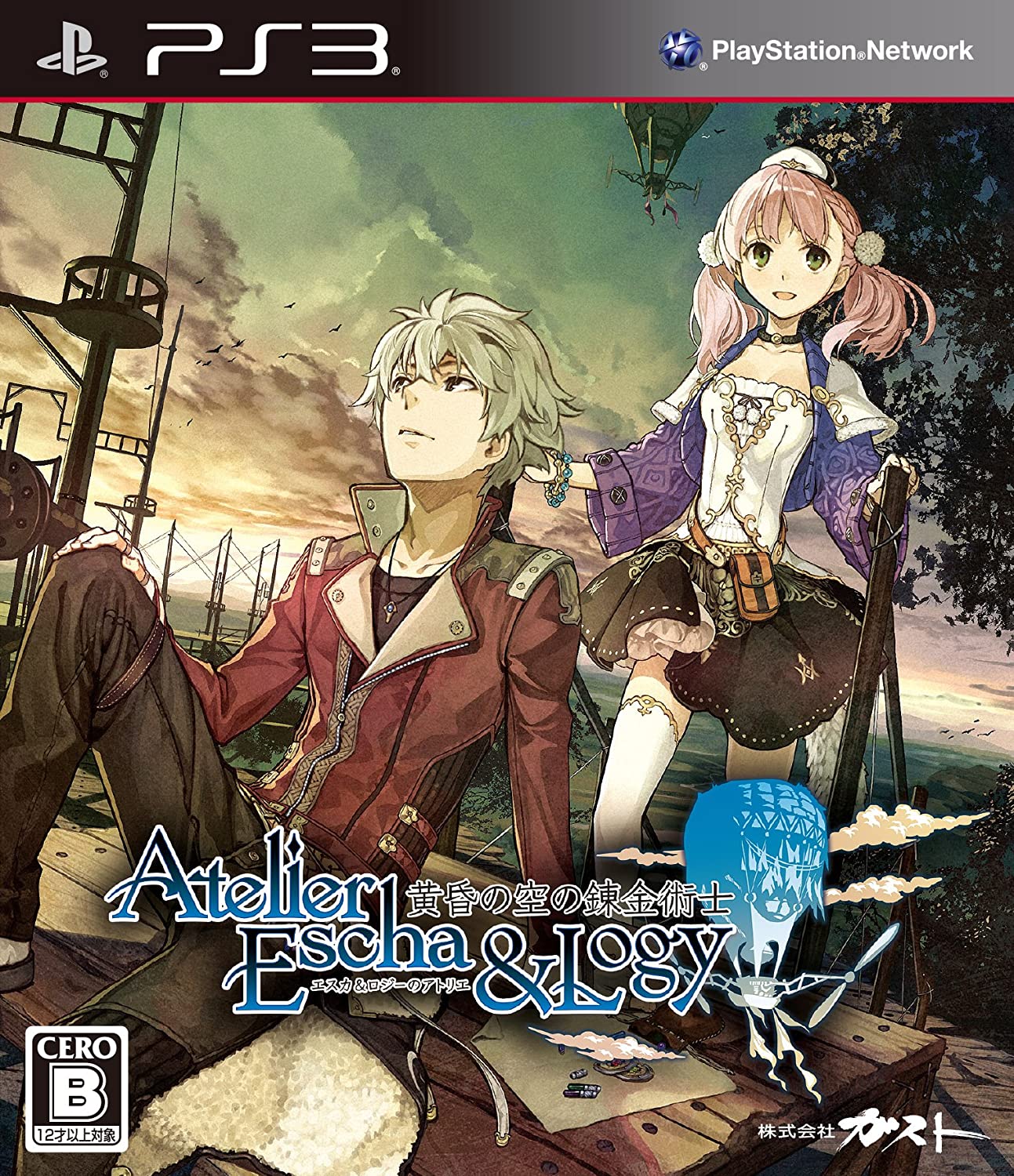
Spoiler commentary and discussion of Eska & Rosie's Atelier - The Alchemist of the Dusk Sky (A15)
Esca & Logy: Atelier of the Dusk Sky (A15)" is the 15th title in the alchemy-themed RPG "Atelier series" developed by Gust (later Koei Tecmo Games) for the PlayStation 3, and the second installment in the "Dusk Series". The main characters in this title are two alchemists, a young girl named "Esca" and a young man named "Rosie," and the story is told from different perspectives depending on the protagonist chosen.
Read Article
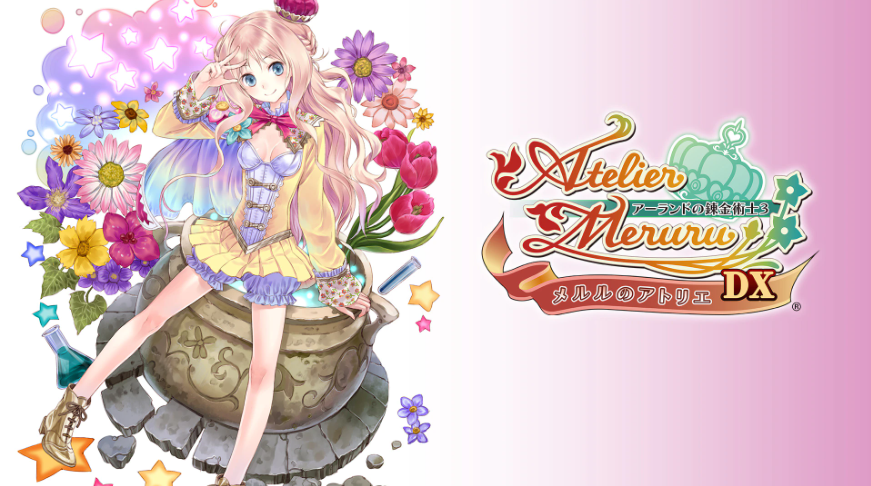
Spoiler commentary and discussion of Meruru's Atelier - Alchemist of Arland 3 (A13)
Meruru's Atelier: The Alchemist of Arland 3 (A13)" is a sequel to "Totori no Atelier: The Alchemist of Arland 2", an RPG game for the PlayStation 3 released by Gust. Meruru, the princess of the small frontier kingdom of Arles, apprentices herself to Totori, an alchemist sent from the Republic of Arland. Overcoming her parents' opposition, Merle learns alchemy and struggles to improve the kingdom's national interests and pioneering projects. This is the story of how the Earls grows up to be a great company by the time it fully merges with the Republic of Arland five years later.
Read Article
Spoiler commentary and discussion of Yudie's Atelier - The Alchemist of Gramnath (A4)
Released by Gust in 2002 for the PlayStation 2. It is the fourth title in the "Atelier series". It is set in the time line after the previous title "Lily's Atelier: The Alchemist of Saarburg 3," and there are several connections with the "Saarburg series. A remake with new elements was released later in 2010. Yudie, who flew to the future due to an alchemy failure, is on a quest in Gramnath to return to his original world.
Read Article
Spoiler commentary and discussion of Violato's Atelier - The Alchemist of Gramnath 2 (A5)
Released on June 26, 2003 by Gust Inc. for the PlayStation 2. This is the fifth title in the "Atelier series," an RPG in which players grow through the use of alchemy. The story takes place in "Gramnath", a world about 25 years after the previous title "Yudie's Atelier: The Alchemist of Gramnath". In order to be recognized by his parents, Violato uses alchemy to revitalize his village.
Read Article
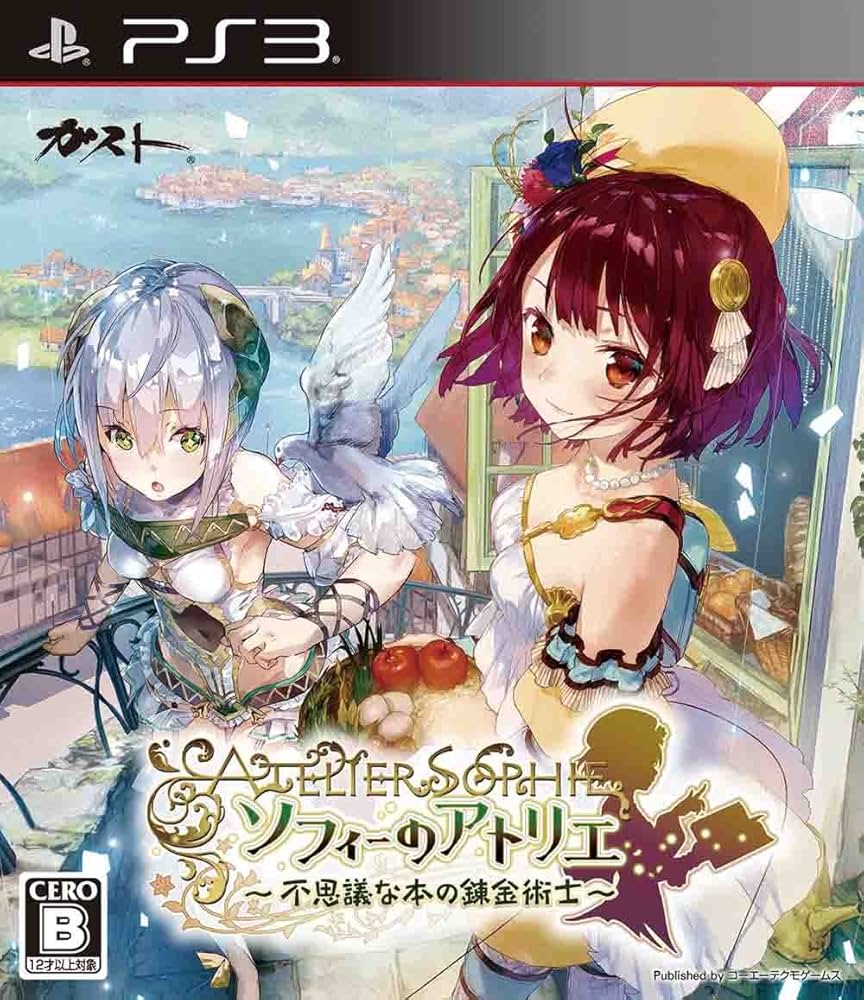
Sophie's Atelier" is a completely new Atelier series.
It has only been a short time since the release of Koei Tecmo's very popular "Sophie's Atelier," which has had its release postponed, but its content was a new series that was very different from the past Atelier series! While it inherited the elements unique to the previous Atelier series, such as alchemy and world map gathering, it was a legitimate evolution so that players could enjoy the Atelier series even more. In this article, we summarize the key points of the new series along with the key points of the new series. (Spoiler alert)
Read Article
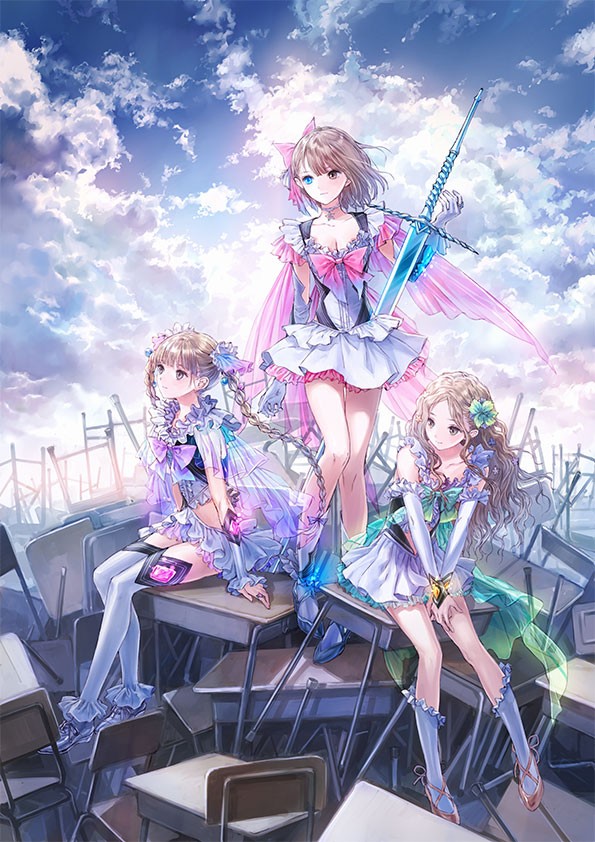
BLUE REFLECTION: The Sword of the Girl Who Dances in the Phantom (BLUE REFLECTION) Spoilers and Discussion Summary
BLUE REFLECTION: The Sword of the Girl Who Danced in the Phantom" is a heroic role-playing game developed by the Gust brand, an affiliate of Koei Tecmo Games, and was announced as the third game title in the "Gust Bishojo Festival" following "Phyllis atelier" and "Yorononokuni 2". It is set in modern Japan. Set in modern Japan, the main story is about friendship and battles between 15 girls in the real world and "Common," an alternate world created by human minds and emotions.
Read Article
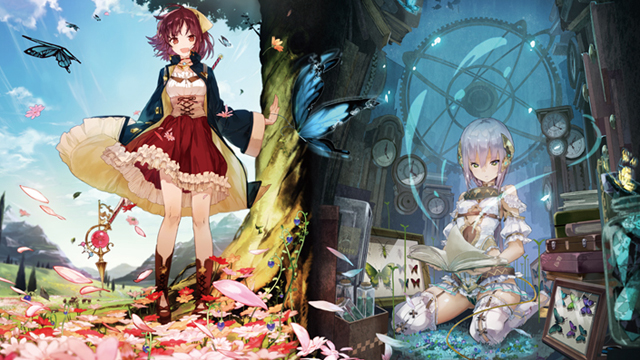
Summary of successive Atelier series
The Atelier series is a series of challenging mix-and-match RPGs released by Gust (now Koei Tecmo). The Atelier series has a different worldview for each of the two or three games, and each has its own unique characteristics. Here is a summary of the differences. There are now more than 20 games in the series as a whole, and some people may not know which one to start with. Please use this as a reference for those who are not sure which one to start with.
Read Article
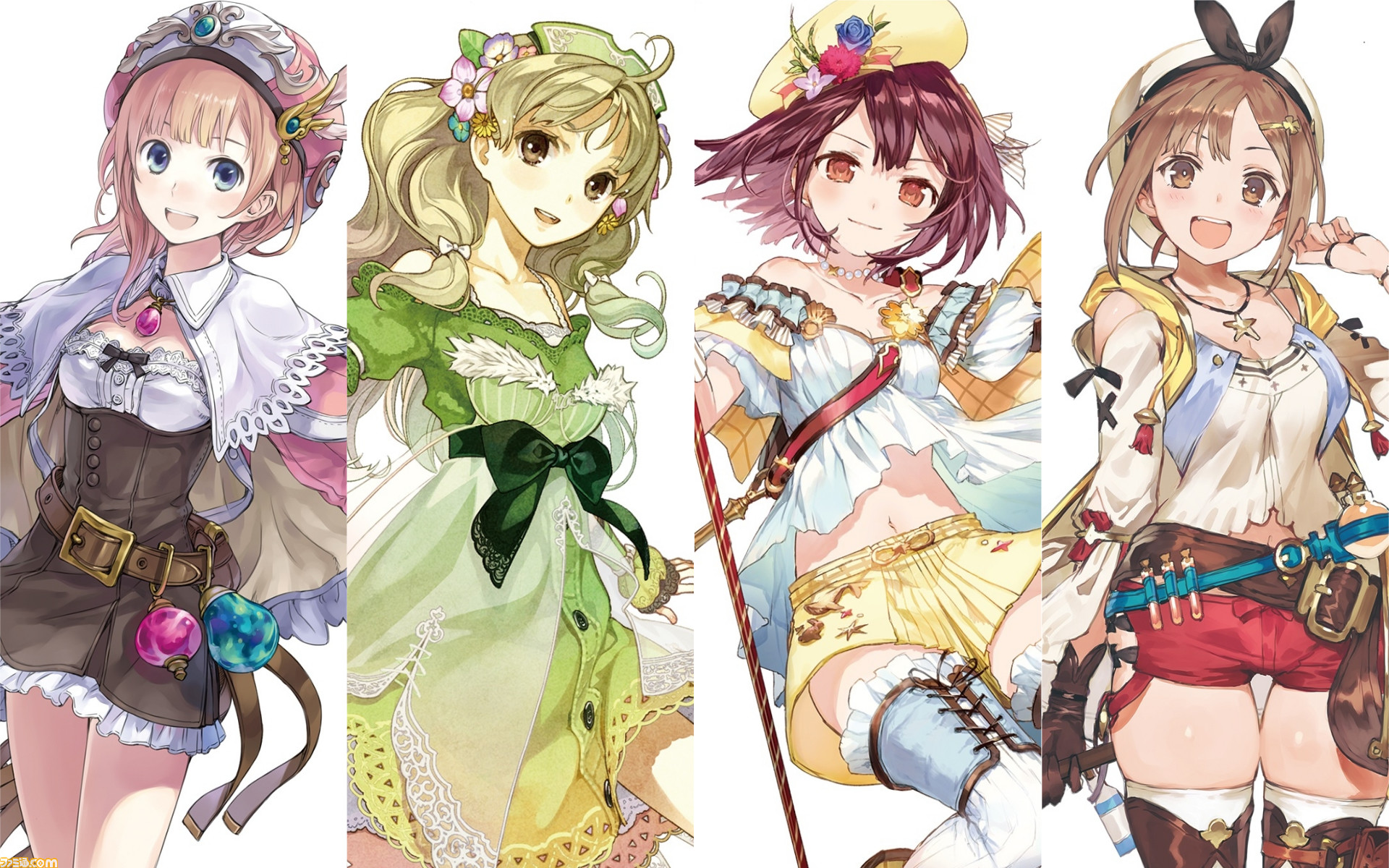
Atelier series strategy site summary
The "Atelier series" spins a variety of stories based on the theme of "alchemy. The "Atelier series" is further subdivided into several series due to differences in systems, styles, etc., and many people find it difficult to understand the series, but there is basically no story connection between the series, so it does not matter which series you start playing. Here we have compiled a list of strategy sites for each title in the Atelier series.
Read Article
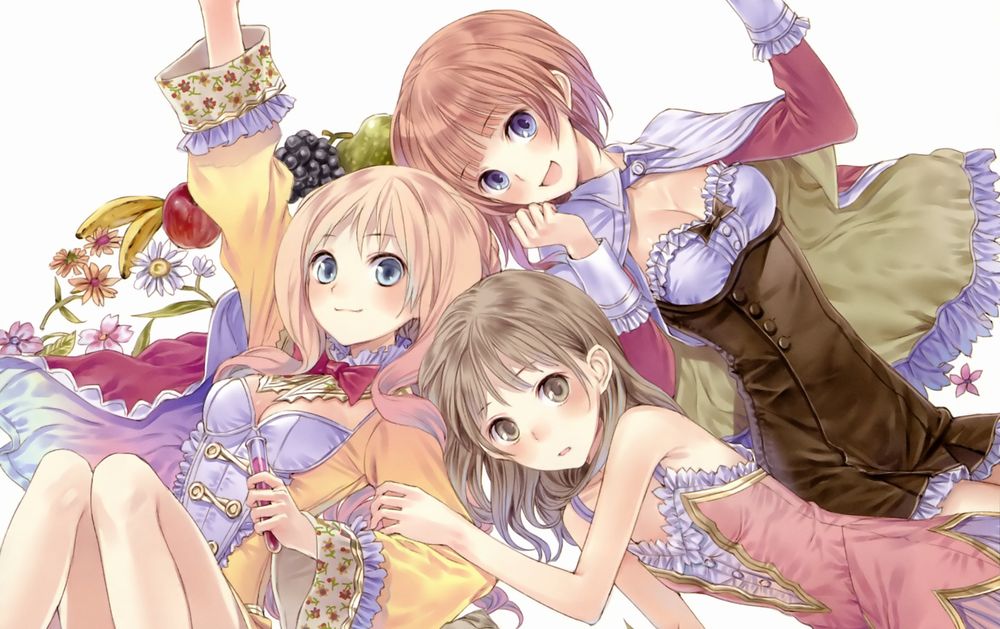
A compilation of illustrations of the Atelier series by Mel Kishida [Atelier of Rorona, Totori, and Meruru].
In the "Atelier series" of games, illustrator Mel Kishida is in charge of character design for the three games called the Arland series: "Rorona's Atelier: The Alchemist of Arland", "Totori's Atelier: The Alchemist of Arland 2", and "Meruru's Atelier: The Alchemist of Arland 3". Mel Kishida is in charge of character design. Here is a collection of illustrations of the "Atelier series" by Mel Kishida.
Read Article
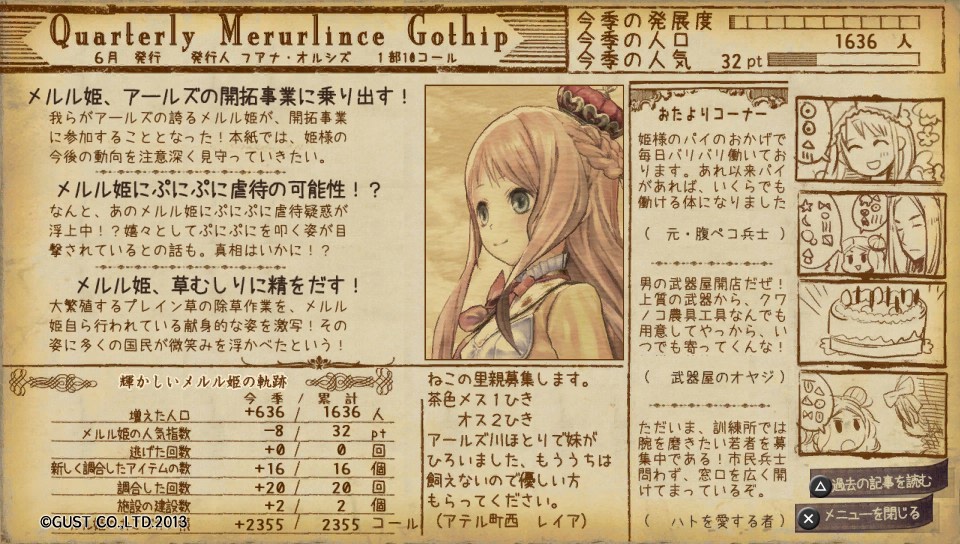
(1) Kawaraban (newspaper) of "Meruru no Atelier PLUS" is an interesting summary to look at.
In "Meruru's Atelier PLUS: Alchemist of Arland 3," there is a Kawaraban (newspaper) that Juana-san makes for us. Kawaraban is a kind of newspaper that mainly records the activities of the main heroine, Merle, and includes stories and columns, etc. The contents are very interesting to read. This time, we have compiled such Kawaraban. (All images are self-taken by the uploader.)
Read Article
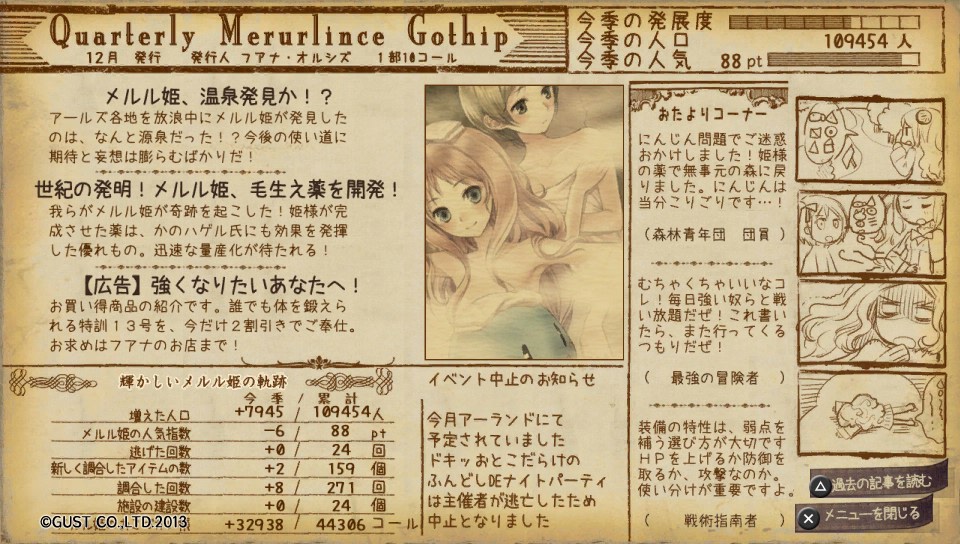
(2) Kawaraban (newspaper) of "Meruru no Atelier PLUS" is an interesting summary to look at.
This is a continuation of Kawaraban (Newspaper) (1) of "Merle's Atelier PLUS". There are a lot of things of interest in the articles, the four panels, and even the column below. There is a lot of crazy interesting content in this issue as well (laughs). If you are curious about how Kawaraban is created, please play the full version (PS3, PSVITA). (The image is a selfie of the uploader)
Read Article
Contents
- Outline of "Atelier Ayesha: Yonago no Daichi no Alchemist"
- The plot and story of "Atelier Ayesha: The Alchemist of the Land of Twilight"
- Chapter 1: Beginning of the Story
- Chapter 2: Atelier Ayesha to Fitzberg
- Chapter 3: Filzberg to Survey of the Arthur Herb Garden
- 4. Investigation of the Glass Studio Site
- Chapter 5: Survey of Haros Village
- Chapter 6 Visit to Nibankan 1
- 7. Collection of Shining Flowers 1
- Chapter 7, Section 1,' Petals of Eating Flowers'
- Chapter 7, Section 2,' Petals of Water Lilies'
- Chapter 8 Challenges from Keith Griff
- Chapter 9: To Hornheim
- Chapter 10: Gathering Shining Flowers 2
- Chapter 10, Section 1,' Yoshoku no Hanabira'
- Chapter 10, Section 2,' Petals of Wetland'
- Chapter 10, Section 3,' Petals for the Repose of Souls'
- Chapter 10, Section 4, "Petals of Darkness"
- Chapter 11 Visit to Nibankan 2
- Chapter 12: Refining Essential Oil of Koka ~ Conquering Riesengang's Slag
- CHAPTER 13. LOCATING NIO
- CHAPTER 14: THE STORY TO THE TRUTH
- Chapter 14, Section 1: ASHA's Rebuttal
- Chapter 14, Section 2: Visiting Steinfader
- Chapter 14, Section 3 Visit to Nibankan 3
- Chapter 15: Charge of Igdrasil
- Ending
- Search for the truth
- Game system of "Atelier Ayesha: Alchemist of the Land of Twilight"
- Time limit
- Multi-ending
- The end of the journey (bad end)
- Working sister (normal end)
- A sorcerer and alchemist (Wilberend)
- The Future of Women Exterminators (Reginaend)
- And three of us. (Linker ends)
- Hunter Life
- Treasure hunter
- GIRLS' PARTY!
- Hermitage of the Wise
- Basic action
- Map and move
- Sampling
- Other
- Events
- Mixing
- CP
- Compounding skills
- Attribute Value
- Properties
- Potential
- Combat
- Basic of combat
- Count
- Active command
- Skills
- Equipment
- Other
- Request
- Store
- Bazaar
- Fair
- Diary of memories
- Circular play
- Characters from "Atelier Ayesha: The Alchemist of the Land of Twilight"
- Protagonist
- Ayesha Altugle
- Party member
- Nio Arthur (Nio Altugle)
- Regina Curtis
- Keisgriff Hazeldine (Keithgrif Hazeldine)
- Julis Grunden (Juris Grunden)
- Wilbel Forl-Elsried (voll Erslied, Wilbell)
- Linka, Linca
- Other characters
- Marion Quin
- オディーリア (Odileia)
- Harry Olson
- メリエッタ Muir (Merietta Muir)
- Ernie Littleton
- Nanaca Grunden (Nanaca Grunden)
- Ranan エッツ (Ranun Ets)
- Fred Rodfork (Fred Rodfork)
- Kyle タレンバート (Kyle Tarenbert)
- Tanya Forta (Tanya Folta)
- Igudrasil
- Items from "Atelier Ayesha: The Alchemist of the Land of Twilight"
- Items common to all types
- Material item
- Offensive item
- Odor bag
- Kraft
- Brightcraft
- Fram
- Zeitfram
- レヘルン
- スニーレヘルン
- Donorstone
- Donstern
- Exabum
- ヒンメルシェンク
- Book of Revelation
- Flaming water
- Freezing water
- Poisonous water
- Black Eclipse
- Tengen Hojin
- Perfume of passion
- Mirror of the mirage
- Recovery item
- Riesen's ointment
- Special effect cream
- Squash tee
- Brain-smart decoction
- A compress for a craftsman
- Body temperature manipulation patches
- Household plasters
- One tablet large recovery tablet
- Mental extract
- Aroma mist
- Elixir of the lost gods
- Baguette
- Royal Koppe
- Hot Baguette
- Black Baguette
- Danish
- Crispy Danish
- Caramel danish
- Flower Muffin
- Bitter muffin
- Soft muffin
- Star of Pan
- Venus of Pan
- Oceanstar
- Omanju
- Meat Manju
- Veggie Manju
- Country-style bread
- Traditional Bread
- Stonebread
- Vegetable Soup
- Bean soup
- Sunset Consommé
- Jigoku no Otsuyu
- Cheese
- Aged cheese
- Brewed Cheese
- Auxiliary item
- Strong ointment
- Exorcism
- Cold-proof powder
- Powder of physical activity
- Mineral powder
- Secret Medicine / Double-speed Maru
- The Pill of Silence
- Forbidden capsule
- Mist spray to ward off evil
- ゲヌーク watering can
- Mysterious Charm
- Totem of Power
- Crystal Guard
- Needleless syringe
- Craftsman's Grindstone
- Professional whetstone
- Nyukon no Toishi
- Industrial wheel
- Sophisticated dyes
- Ground dye
- Magic dye
- Projection dye
- Combat equipment items (weapons and protective equipment)
- Weapon
- Protective gear
- Combat equipment items (ornaments)
- Ring of Fulfillment
- Mysterious Talisman
- Phoenix bracelets
- Selvage
- Unglazed Omamori
- Feather ornament
- Popli
- Furry gloves
- Dragon-scale symbol
- Shadow Cloak
- THE CHAIN OF THE SOUL.
- Noiseless shoes
- Cards for Flower Divination
- Resonance bell
- Glass tiara
- Search equipment item
- Portable container
- Basket
- Yamashi's Dice
- Shoes of the Wandering People
- Collect Glass
- Terms in "Atelier Ayesha: The Alchemist of the Land of Twilight"
- Concepts, events, and occupations
- Ancient and Old Period
- Pre-period
- Twilight
- Great destruction
- Cradle
- Slag
- Luminous flower
- Homunculus
- Alchemy
- Magician
- Place name and location
- Relic
- Arthur Herb Garden
- Glass studio
- Steinfader
- Center
- Nibankan
- Salt Desert
- Riesengang
- Fitzberg
- Hornheim
- Behind the scenes, trivia, and small stories / episodes and anecdotes of "Atelier Ayesha: The Alchemist of the Land of Twilight"
- The Secret Story of the Birth of "Atelier Ayesha" by the Production Director OKAMURA To Okamura
- Expression of the "Dying World and Age" that is significantly different from the previous series
- The motif is "Noah's Ark."
- The theme song and insert song of "Atelier Ayesha: Yonago no Daichi no Alchemist"
- OP (opening): Nomiyama 睦未' Kayo'
- ED (ending): Annabel "Altair"
- Insert: Rurutia "Mystic Pendulum"
- Additional song: Nagi Yanagi' Ibara'
- Insert: "Stargazer" by Saya
- Insertion song: Myo' Tasogare'
- Insert: Chirinuruwowaka "Yoi-no-Hoshi"
- Poem: Haruka Shimotsuki,' Yume no Oriku Ie' (House of Weaving Dreams)