
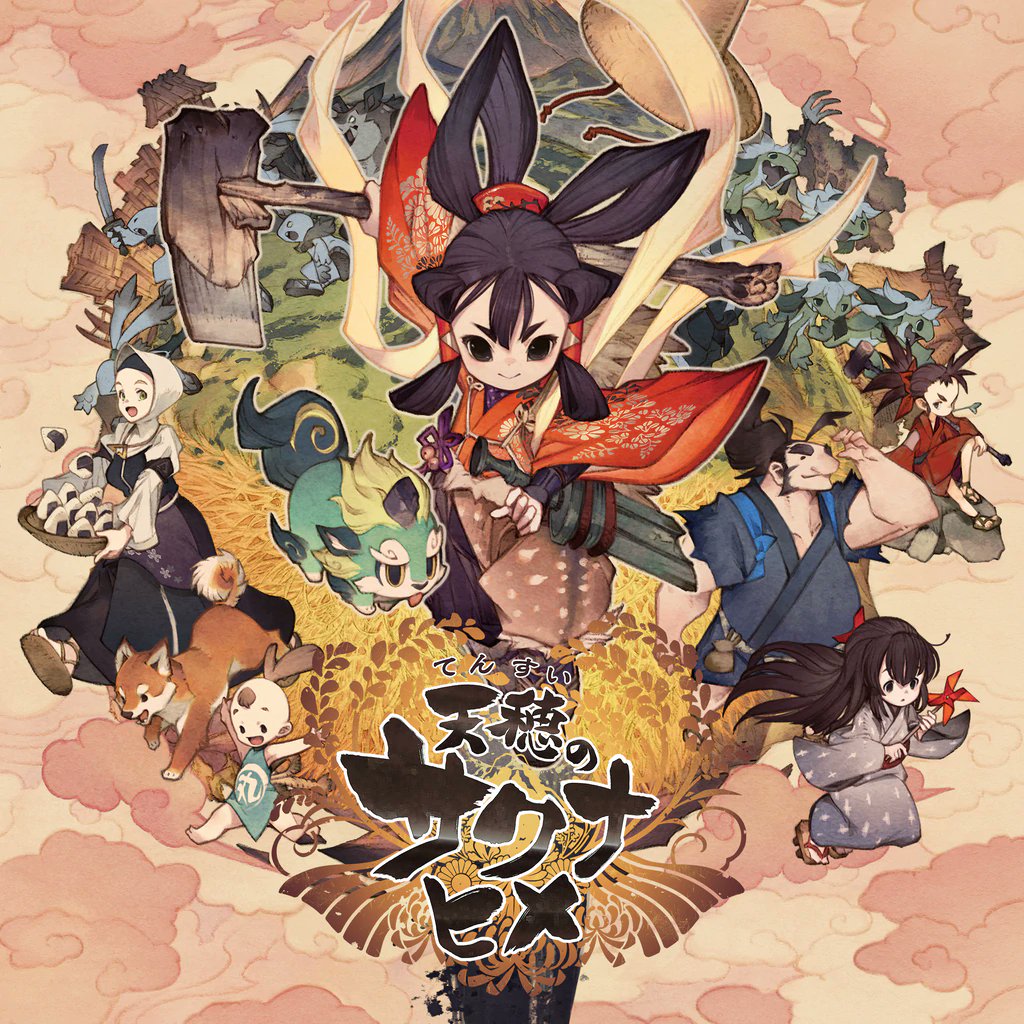
The game is an action RPG created by the doujinshi game circle "Eaderuwaisu" and released by Marvelous for PS4, Nintendo Switch, and PC. The story follows the main character Sakunahime, a god of war and a fertility goddess, as she engages in rice cultivation on Hinoe Island, an island infested with demons, while exterminating them and unraveling the island's secrets. The game is divided into two parts: rice farming and action. The rice farming part of the game is so well-designed that the Ministry of Agriculture, Forestry, and Fisheries' website has become a wiki for the game.
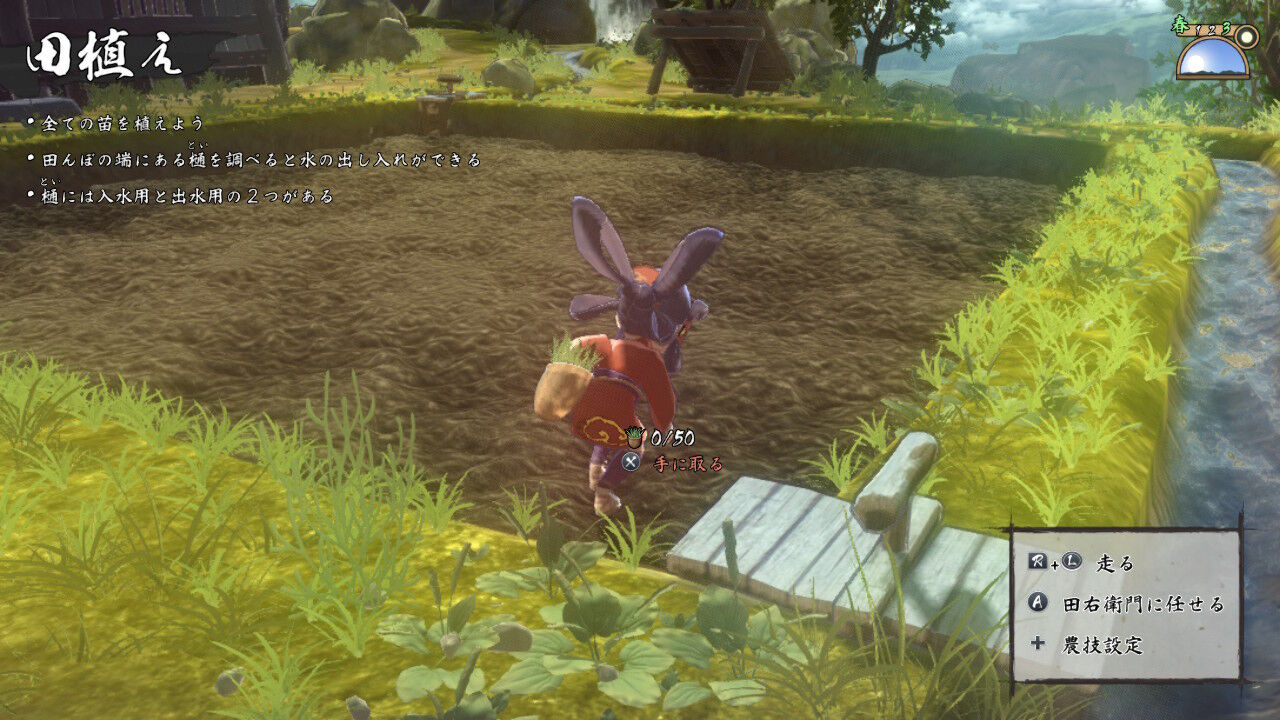
Rice planting is a steady process in which the サクナヒメ is moved little by little while the seedlings are planted one by one.
The first step is to "wake up" the rice field by digging up the soil that has hardened during the winter to prepare it for rice planting. Before the rice is raised, fertilizer is sprinkled on the soil to increase the amount of nutrients in the soil.
Before seedlings are planted, the seed rice is sorted to separate the good seed rice from the bad seed rice. After the seed rice is placed in a tub of water, mud is added to the water and stirred in, causing the water to become heavier and the lighter seed rice to float. The lightweight seed rice is the bad seed rice that has not been filled with the right contents, so it is removed and only the sunken seed rice is used for sprouting. The more mud is mixed in, the better the quality of the rice will be, but the lower the yield will be. Later in the game, it becomes possible to sort the seed rice not with mud but with salt. Salt is a precious commodity, but using salt to sort the rice can make the rice more resistant to disease.
Once the seed rice has germinated and become seedlings, the rice is planted. At first, you can only plant one seedling at a time, but as you continue rice cultivation, you will learn a variety of useful skills, such as planting multiple seedlings at the same time and being able to see the squares that will guide you to the right place to plant your seedlings. In addition, planting seedlings close together is "dense planting" and planting them far apart is "sparse planting," which affects the quality and yield of the rice, so it is necessary to change the planting method depending on the type of rice you want to grow.
Summer
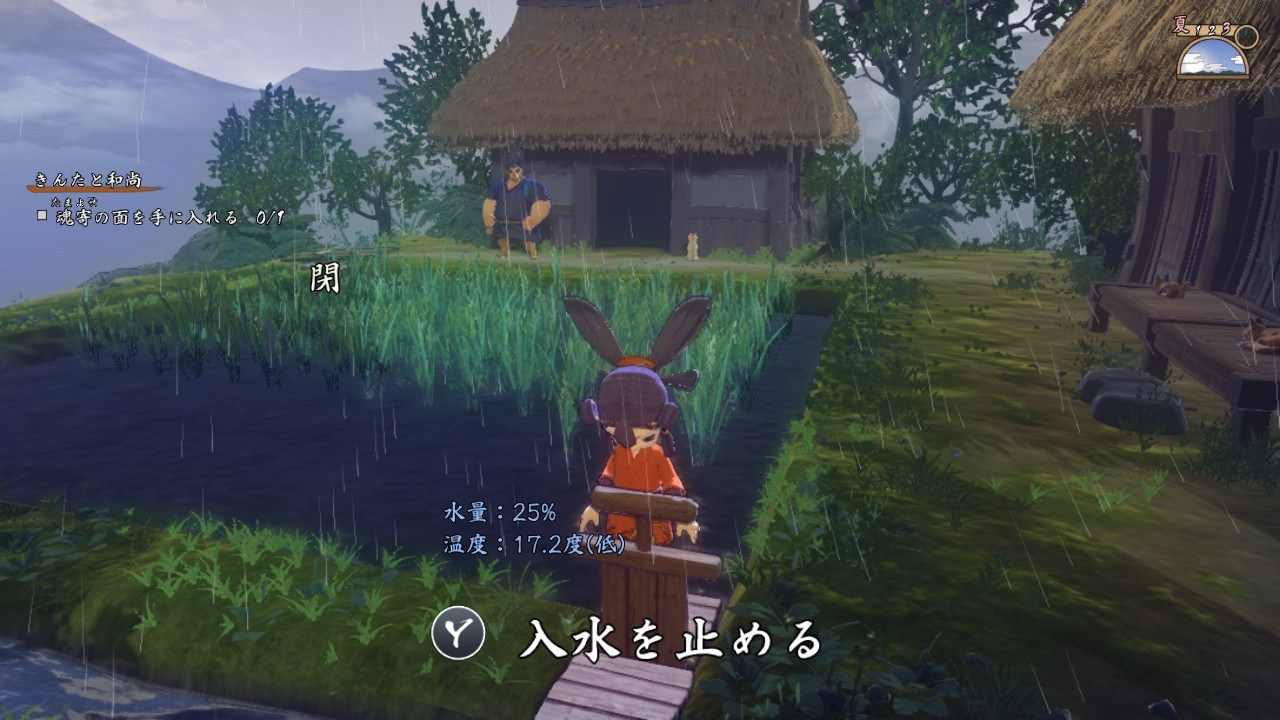
There are two gutters in the rice field. One is for water to flow in and the other is for water to flow out. If you open both of them, it becomes a "kakenagashi".
After rice planting, the farmers remove weeds and adjust the amount of water to watch the rice grow.
When it rains, the amount of water increases, so if you don't want to increase it, drain the water. When it's sunny, the water evaporates little by little, so add water as needed. Also, the water temperature rises and falls depending on the amount of water, so it is necessary to adjust the amount of water to prevent it from going up and down too much.
When a rice plant grows, it enters a stage called "Shibetsu" where the number of stems grown from the seedling increases. If the number of stems increases too much, it adversely affects the growth of the rice plant. Therefore, in "Sanji Shibetsu", it is necessary to drain the water in the rice field to prevent the rice plant from growing too much. This is called "Nakaboshi" and the degree of Nakaboshi can be checked from the rice field status screen.
At the end of the third stage of tillering, the ears of rice begin to appear. Rice plants at this stage need a lot of water.
autumn
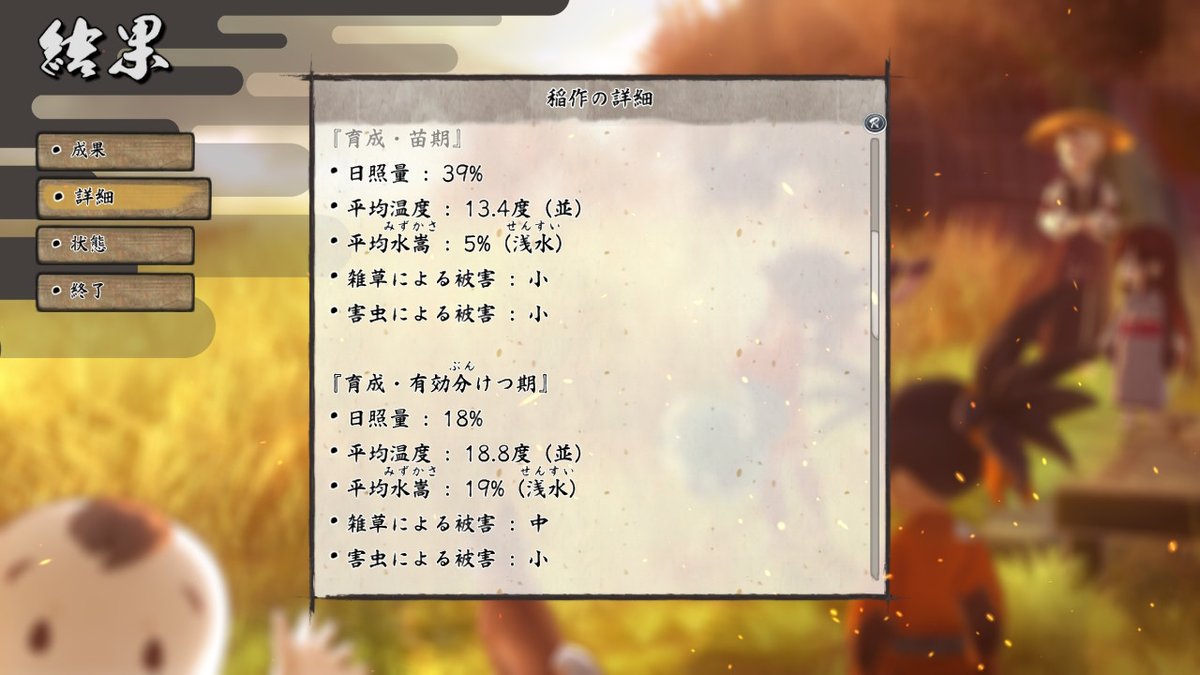
A screen showing the results of rice cultivation for the year. You can look back in detail on the temperature and depth of the water, the amount of sunlight, whether or not there is primary fertilizer, whether or not there is mid-drying, etc.
When the rice plants have matured, a notice is sent, and the rice fields are finally ready for harvesting. If the water in the rice fields is drained prior to harvesting, the rice fields will dry up more easily when the rice is piled up.
After harvesting, the rice is dried by "inagake" (rice piling). If it continues to rain during this period, the rice may not be dried completely, but it is necessary to finish the process by winter.
When the rice is dry, threshing is done. At first, a primitive tool called a "koki-bashi" is used, but when you proceed with the game, you make a "chiga-koki" and it makes the work easier. As you proceed further, a "foot threshing machine" is completed with the design of ココロワヒメ, and threshing is finished in no time.
After the threshing is finished, the rice is moved to "momisuri" (rice hulling). This is the last stage of rice cultivation. At first, a pestle and a mortar are used, but when the game is going on, the reed spider makes a "stepping mortar" and the work gets faster. When the game second half comes, a "water wheel" is built on the pass at the initiative of ココロワヒメ, and the rice hulling will be finished if you leave it for about half a day even if you do nothing. The degree of momisuri can be adjusted, and it can be stopped at any stage of brown rice, partially polished rice, and polished rice. Furthermore, partially polished rice has a stage from 1 minute to 9 minutes.
After the rice hulling is finished, the rice production for the year is complete and you can see the results. You can check the status of the rice and the details of the rice production for the year. It is at this time that the サクナヒメ status rises.
Winter
Off-season for rice cultivation. There is nothing much to do, but on the last day of winter, a notice will be sent out urging people to start rice planting, so that the rice can be raised and the seed rice sorted.
Fertiliser
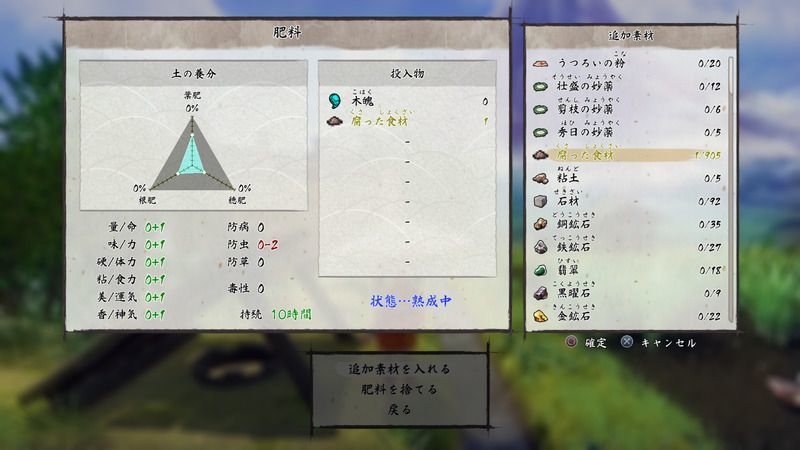
The fertilizer creation screen. The triangle graph shows the state of the nutrients in the soil. If you put too much ingredients that contain salt, it will cause salt damage, and if you put meat, it will cause insects to spring out.
If you scoop up the contents in the toilet and take it to the pit, you can make fertilizer. The condition of the soil changes depending on the material you mix.
When we want to use medicines against diseases and pests, we need to mix them as ingredients of fertilizer.
There are three types of soil nutrients: 葉肥, 根肥, and ear manure. They can be increased by fertilizing, but high status does not necessarily mean good. Excess nutrients can lead to disease. You can check the condition of the soil on the fertilizer creation screen or in the rice field.
Diseases, pests, and beneficial insects
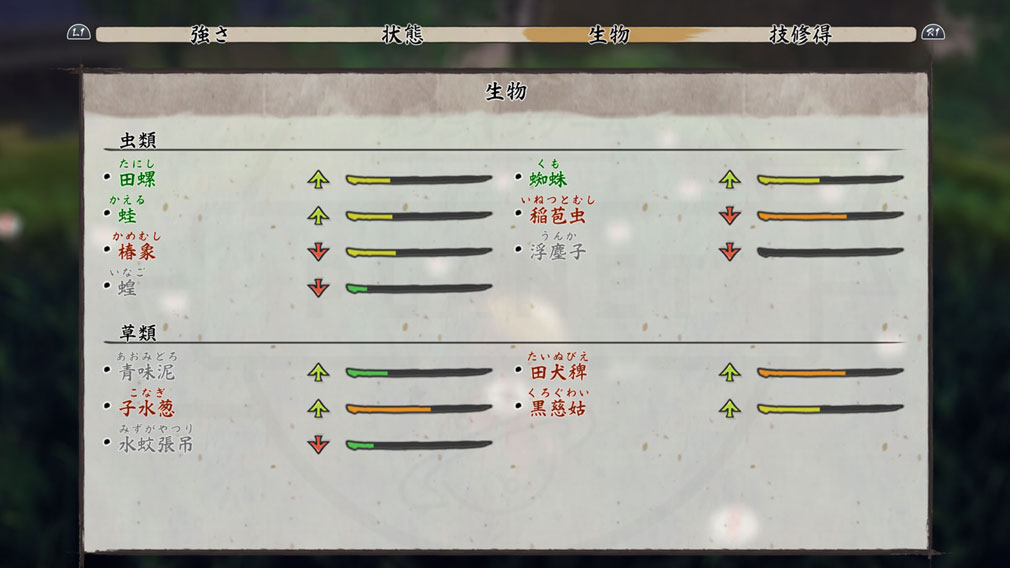
The state of insects and grass. During rice cultivation, people wander around the pass looking for beneficial insects.
Rice plants suffer from various diseases. Each disease has its own cause, and there is a medicine that suits it. Excessive use of medicine can also cause diseases, so it is necessary to determine how to use it. In addition, it is necessary to think about where to use the anti-insect medicine because it is effective against beneficial insects.
Depending on the growing process of the rice plant, various harmful insects are attached to the rice plant. If too many harmful insects are attached to the rice plant, it may cause diseases, reduce the rice status and yield, and have various negative effects. We will respond by using medicine, beneficial insects and ducks.
There are three types of beneficial insects on the pass: frogs, dragonflies, and spiders. They appear randomly around rice fields, inside houses and barns, and behind buildings. If you catch them, you can release them into the rice fields. They control harmful insects. Different beneficial insects eat different kinds of harmful insects, so even if you increase the number of frogs, for example, you cannot prevent all harmful insects.
If you put a duck in a rice field, it will eat insects, but it will also eat a spider of beneficial insects, and it will not eat all the harmful insects. Rice is grown by balancing all the elements.
Rice cultivation conference
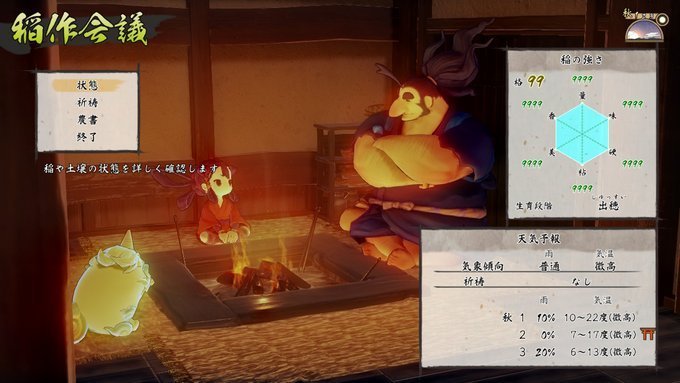
Rice cultivation meeting.
He held a conference on rice cultivation at サクナヒメ, Tamaya and Taemon.
You can check the weather and temperature forecast for a few days, the condition of the rice, and the farm book, and you can apply for a change in the weather by dedicating Kihaku to Kamhituki.
Farmers' books can also be found in their belongings.
Agricultural book
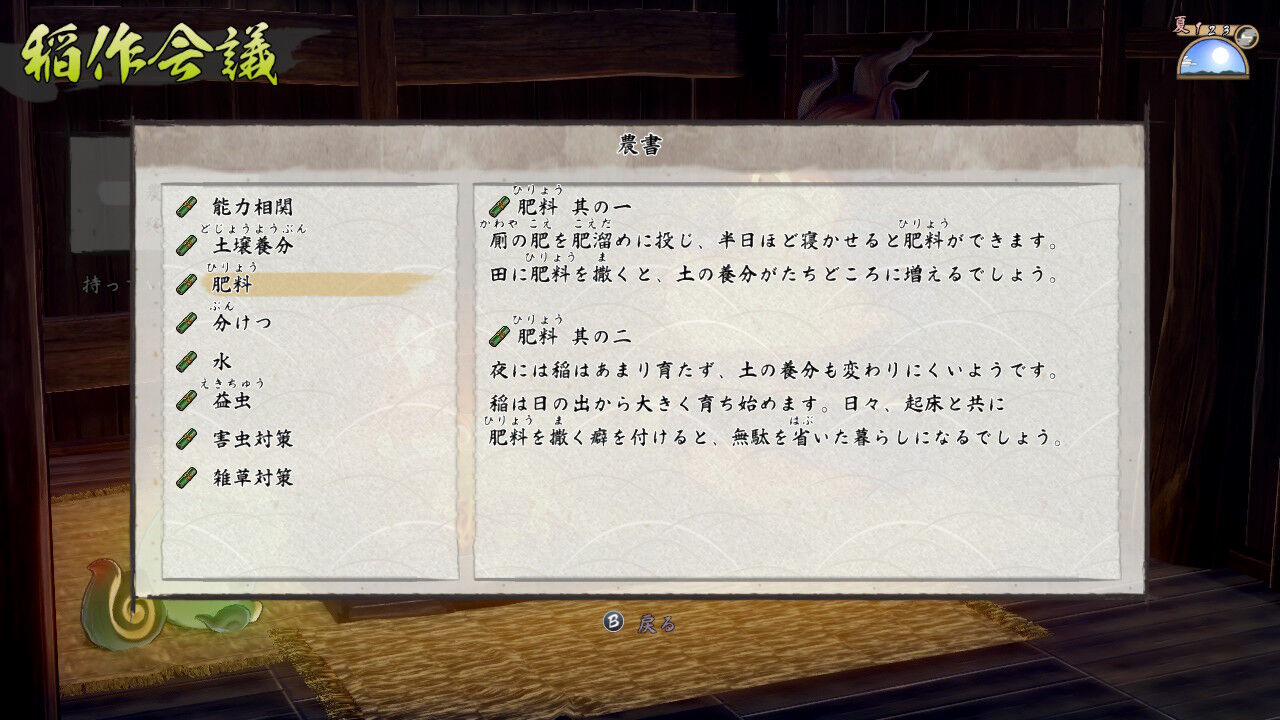
A section of a farm book that can be referenced as needed without having to keep everything in mind.
This is a how-to book on rice cultivation left at home by サクナヒメ's mother, Toyohana. It will be released as the story progresses. After the release, you can check it from the rice cultivation meeting and your belongings.
There is a wide range of information, including explanations of the growing stage of rice, how to grow rice according to the rice's status, explanations of soil and fertilizers, measures against diseases and pests, beneficial insects and medicines, etc. Since it is an essential index for rice production, you will be engaged in rice cultivation while referring to agricultural books during the game.
Rice status
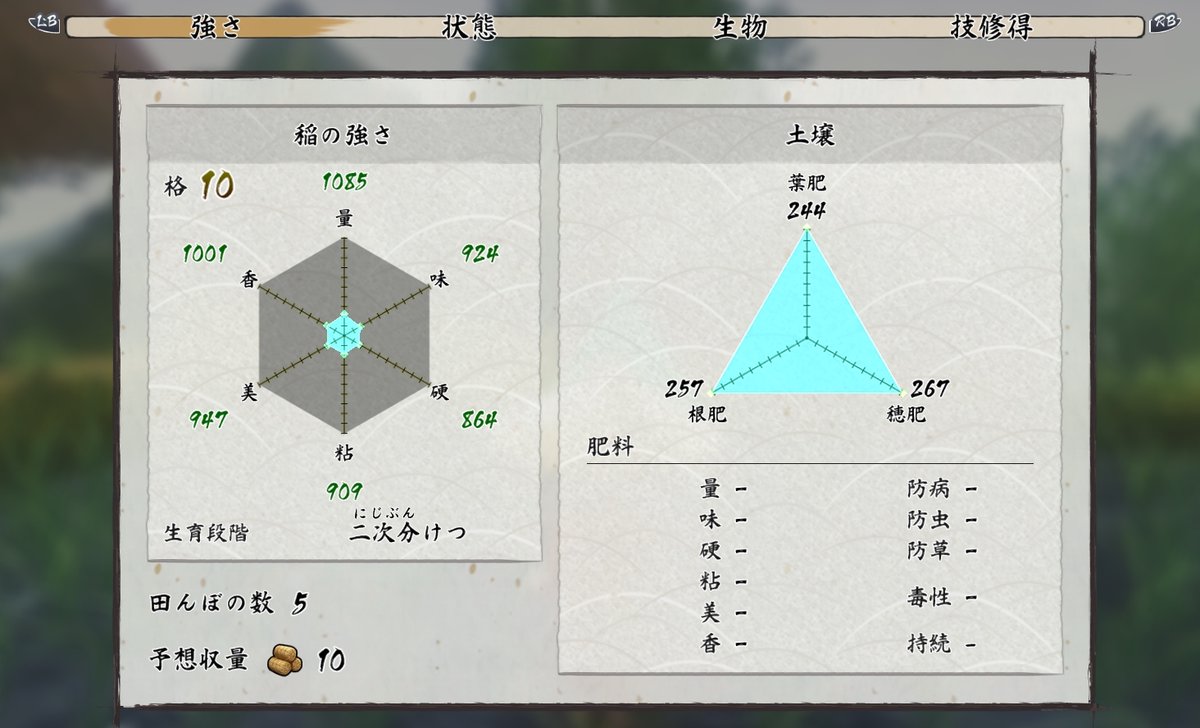
Rice status screen can be seen from the rice field.

Contents
- Outline of "Amenohohi no サクナヒメ"
- Outline and story of "Amenohohi no サクナヒメ"
- Lazy サクナヒメ
- Living in Onijima
- Around the fireplace
- Little Fruit and Teksari Dango
- The Second and the Creation Tree
- Fate of Ishimaru
- ヒノエ Island
- Missionary Milte's Journey
- Problem child itchy
- Schools in Milte
- The Gift of Kaimaru
- Kinta and Barley Rice
- Ogre extermination plan
- Problem child
- Way beyond the two worlds
- The Kappa and Kaimaru
- Asigumo people
- Southern volcano
- Amahoho
- False spikes
- Coco ロワヒメ and サクナヒメ
- God of volcanoes
- Wounded Rabbit
- タケリビ and Toyohana
- Taemon's Wish
- Ishimaru of the fort
- TO FIGHT WITH THE DRAGON.
- Destruction
- Modori-dango
- Wisdom of Coco ロワヒメ
- Revived Demons
- Ishimaru and Taemon
- How to revive rice fields
- Reconstruction of weaving, smithery and livestock huts
- The Fate of the Rabbit Og
- End of Ishimaru
- サクナヒメ's determination
- Blacksmith Kinta
- Hoshidama no Tsurugi
- Yuino Ongaeshi
- Stay or go.
- The Future of Kaimaru
- Kinta to Osho
- Yui no Senmon
- Festival
- ヤナト Taue-uta
- Dairyu (オオミズチ)
- Let's go home.
- Tencho no サクナヒメ game system
- Basic Flow
- rice cultivation
- Spring
- Summer
- autumn
- Winter
- Fertiliser
- Diseases, pests, and beneficial insects
- Rice cultivation conference
- Agricultural book
- Rice status
- Combat and gathering
- Combat
- Equipment
- Martial arts and Hagoromo-waza
- Shikon
- Dietary effect
- Gathering
- Hanasaki Sakuna
- Characters from "Amenohohi no サクナヒメ"
- Friends of the Pass
- サクナヒメ
- Old man
- Taemon
- Milte
- Kinta
- YUI (
- Kaimaru
- A resident of ヒノエ Island
- Ashigumo
- Kappa (water imp)
- God of the capital
- Kamhitki
- Coco ロワヒメ
- サクナヒメ's parents
- タケリビ
- Toyohana
- Enemies of サクナヒメ
- Ishimaru
- Yomitan 0 (ヨモツホムスビ)
- Dairyu (オオミズチ)
- Other
- Visitors
- Tencho no サクナヒメ items
- An item obtained in combat
- Kohaku
- Items only available at night
- An item obtained by collecting
- Collection point
- Gathering companions
- What you can get in the pass
- Items to pick up
- An item available for trade
- The term "Amenohohi no サクナヒメ"
- ヤナト
- Second generation
- Tree Creation
- Ame no Ukiha Bridge
- ヒノエ Island
- Onijima
- Hoshidama no Tsurugi
- Iseuwatari no Hire
- Kohaku
- Behind-the-scenes stories, trivia, and small stories / episodes and anecdotes of "Amenohohi no サクナヒメ"
- The main members of the development are only two members of the coterie circle "Erderu Isuzu".
- The producers actually grew rice to understand rice farming
- THE TOPIC OF "HANASAKI, FAIRY freesia," THE PREVIOUS WORK OF "ERURUWA ISU", APPEARS IN THE CONVERSATION IN サクナヒメ.
- The theme song and inserted song of "Amenohohi no サクナヒメ"
- Theme song: "ヤナト Taue-uta Kannagi - Kaminagi" by Saya Asakura