
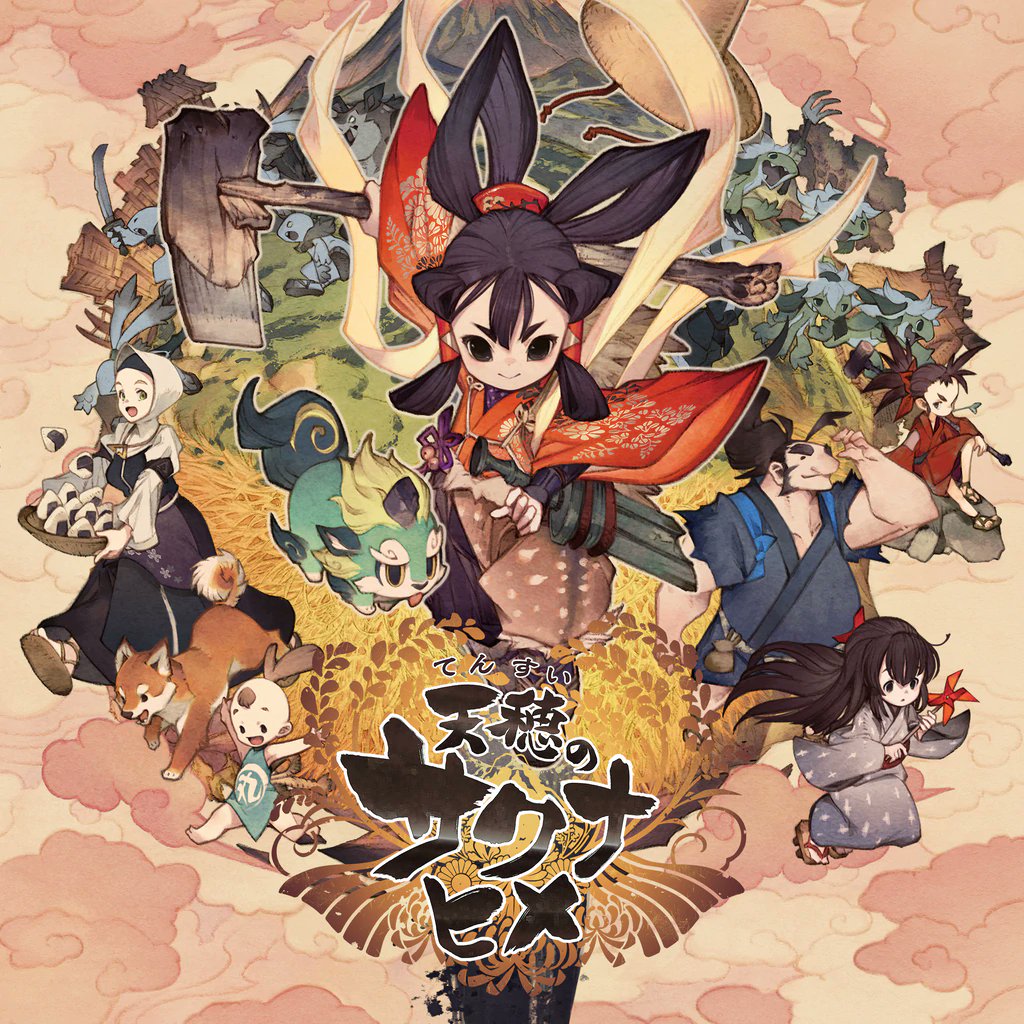
The game is an action RPG created by the doujinshi game circle "Eaderuwaisu" and released by Marvelous for PS4, Nintendo Switch, and PC. The story follows the main character Sakunahime, a god of war and a fertility goddess, as she engages in rice cultivation on Hinoe Island, an island infested with demons, while exterminating them and unraveling the island's secrets. The game is divided into two parts: rice farming and action. The rice farming part of the game is so well-designed that the Ministry of Agriculture, Forestry, and Fisheries' website has become a wiki for the game.
When the second spring came and サクナヒメ reluctantly started working voluntarily, it was discovered that Yui had handicraft skills. Because she said she could make kimonos from scratch as long as she had a loom, サクナヒメ built a loom hut. Yui made kimonos one after another, but she did not show anyone that she was weaving.
When the area around the pass was almost completely cleared of ogres, Taemon proposed to spread rice fields outside the pass as well because the area around the pass had become safe. They decided to plant rice with everyone at the pass. When they were young, they started planting rice with everyone except Tama-ya, who had no real identity. However, since the rice fields are large, the work is hard and it takes time to finish. When the Kaimaru, who was hanging around the area, fell down and started crying, Milte was angry that it was noisy, and Kinta and サクナヒメ also began to quarrel. Milte scolded the children, but no one would listen to him. When they were no longer able to work, Taemon started singing a song. It was a song that サクナヒメ had never heard of, but Kinta knew the song. This is the "Taue-uta" (rice planting song) that farmers sing when they plant rice. When they work hard and for a long time, all they complain about comes out of their mouths and they feel depressed, so they began to sing it to finish the work happily and quickly.
サクナヒメ and the others who had finished rice-planting singing the rice-planting song following Taemon's example felt as if they were a little closer to each other.
The Second and the Creation Tree
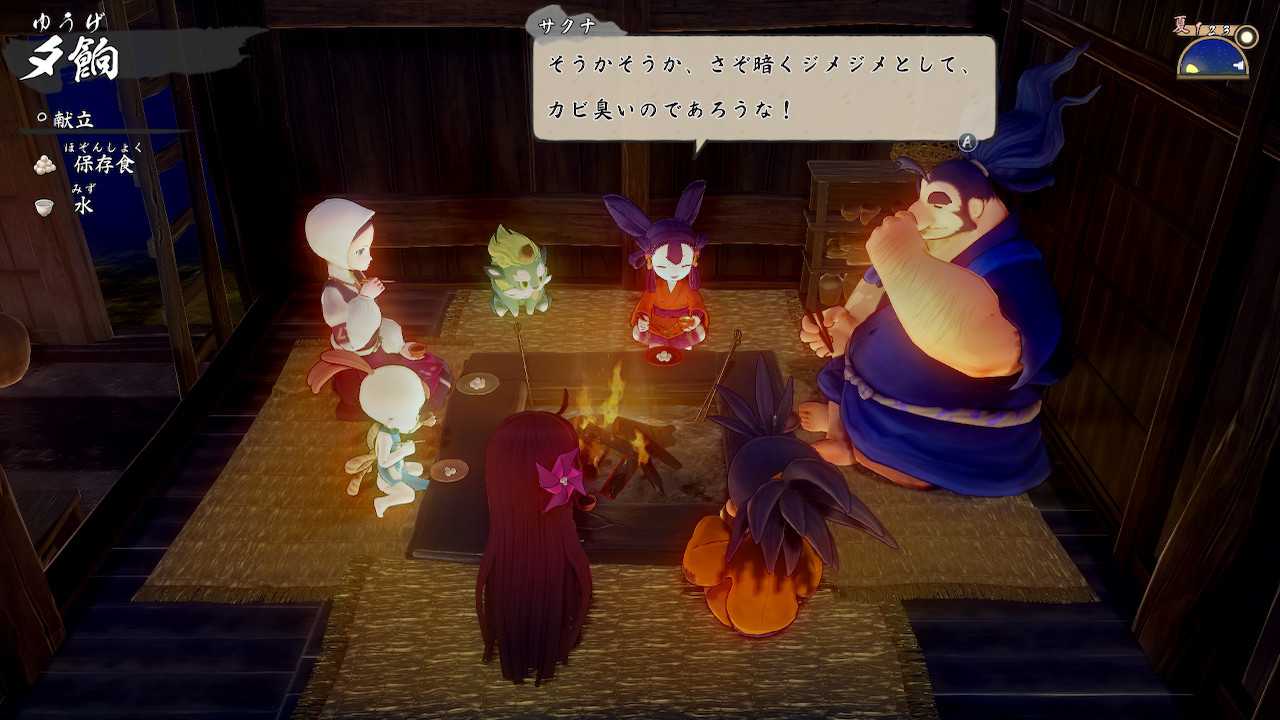
サクナヒメ laughs when she hears that the world at the foot of the mountain is in turmoil.
It is mainly Tama-ya's job to teach Taemon and others who came from outside the world of Cho the origin of the world of the gods.
The world of the Summit, where the gods live, and the world of the Foothills, where humans live, are "two worlds." The two worlds are connected by a huge tree called the "creation tree," which is designed to circulate souls and spirits. What happens on one side appears through the creation tree and on the other side in some form. When the world of the foot becomes rough due to war and famine, the harvest decreases even in the world of the summit, and many ogres appear out of resentment. It is the god's job to make them what they should be. If the god wields the power of fertility, the harvest increases even in the world of the foot, and if he kills the ogres, the hearts that have been rough due to war will calm down. There is no single cause, but the world is one.
The gods of ヤナト have a lot to do with the gods of Huang Hua, the country on the continent across the sea. There are many gods that only Kamhitki knows, but no god has been confirmed to be greater than all of them, as in the teachings of Foromism, which Milte believes. Listening to this story, Milte speculates that the god of Foromus and the god of ヤナト have the same words but different meanings.
The main god of ヤナト, Kamhituki, is the creation tree itself that creates the second generation, and its body is directly connected to the tips of the branches of the creation tree. Kamhituki is the ancestor of all the gods, and the gods outside the capital, such as the Asigumo tribe and the Oni beast gods, were also born from Kamhituki. However, this is a story from the time of the first Kamhituki, and it is not known how the gods born after the second Kamhituki were scattered.
Fate of Ishimaru
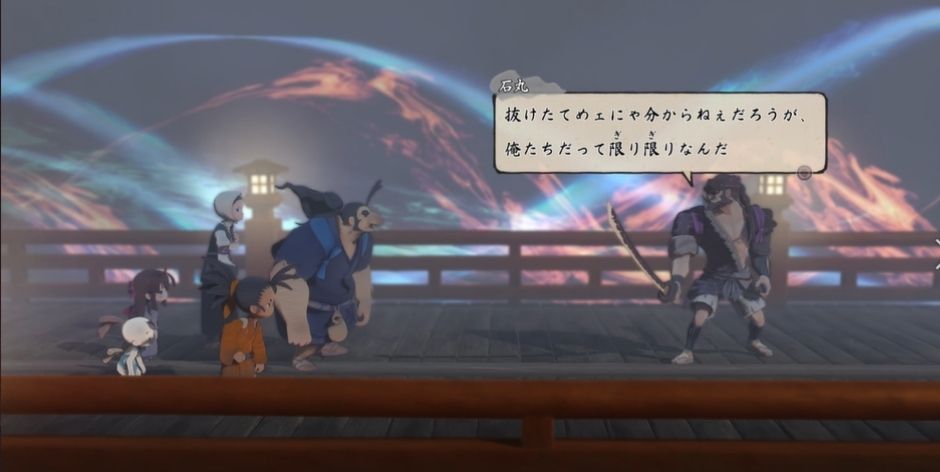
Taemon and Ishimaru are killed at Tenukihashi.
Taemon is concerned about the fate of Ishimaru, who was kicked off the bridge. Ishimaru was originally a bandit who was one of Taemon's friends, and although he is separated from him, Taemon remains hopeful that he may walk with him again as long as he is alive. To Taemon, Tama-ya tells the story of the clouds that were under the floating bridge.
The clouds under the bridges are the same type of clouds as the sea of clouds seen from Onbashira and the clouds floating off the coast of Onijima. There is nothing fixed yet. Before the formation of the second world, there was only this cloud everywhere. Growing out of nowhere was the creation tree. The growing creation tree mingled with the clouds to form the top world, and the roots that stretched out also mingled with the clouds to form the foot world. The second world, but not the second world, is the "origin cloud." The old men had no way of knowing what had become of the Ishimaru that had fallen there or where it had gone.
ヒノエ Island
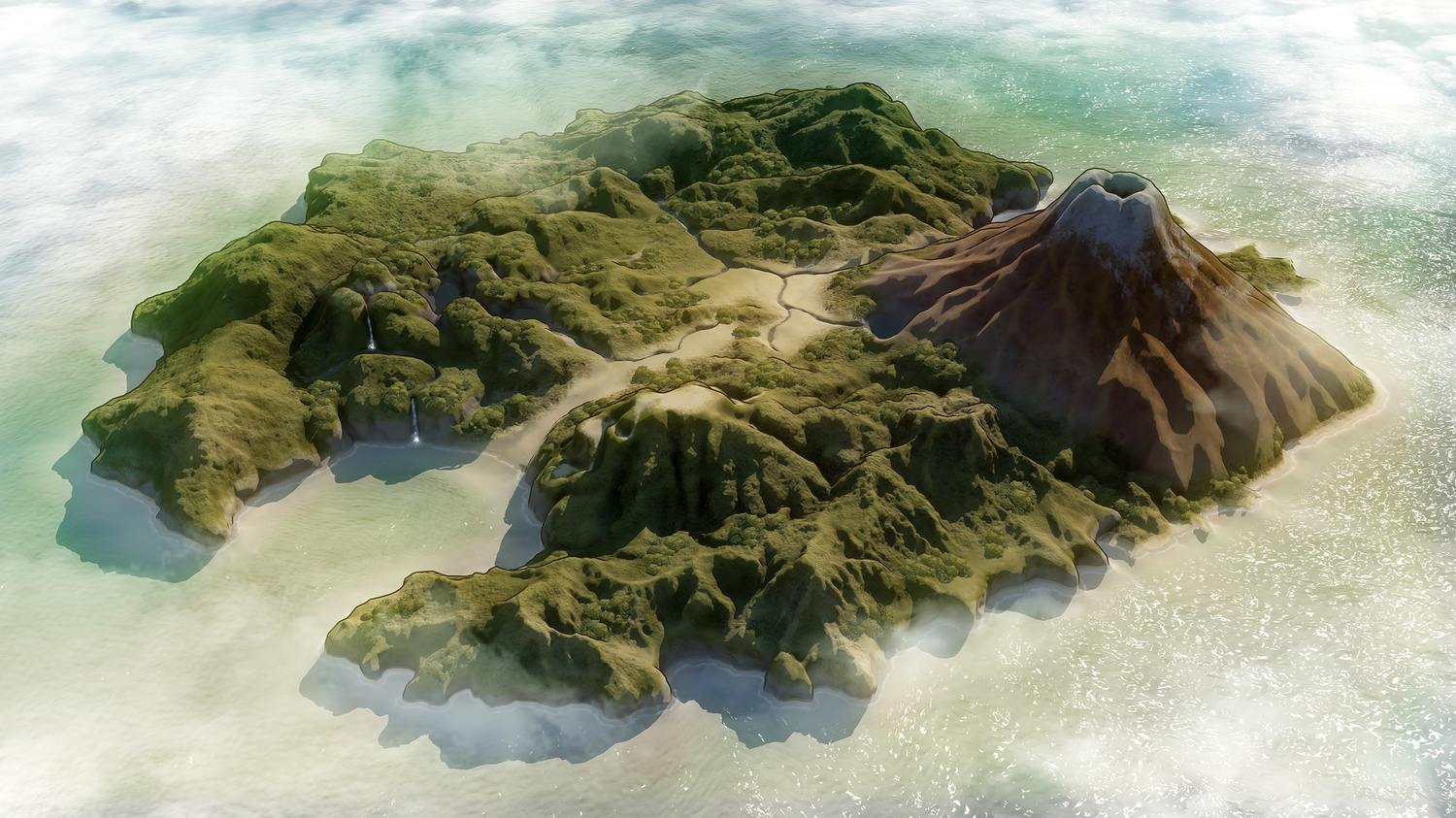
A panoramic view of the island. The pass is located around the center of the island.
The ashigumo that were born and raised on the island call their Onijima "ヒノエ." Onijima is the name given to them in the capital of Onbashira. The name comes from the fact that their predecessor, Kamhituki, who was frustrated with not being able to annex the island, called them this way out of frustration. The ashigumo tribe was also called the "ashigumo tribe" in the capital because they fought against the army sent from the capital hiding in reeds. It is said that サクナヒメ's father, タケリビ, who once lived on the island, kept calling them that way, and they began to call themselves as well.
ヒノエ is written in Chinese characters as "Hie," which gives a much brighter impression than the harsh "Onijima." All of them accepted Taemon's proposal to call it that because they were going to live on the island, and the サクナヒメ decided to call Onijima "ヒノエ Island."
Missionary Milte's Journey
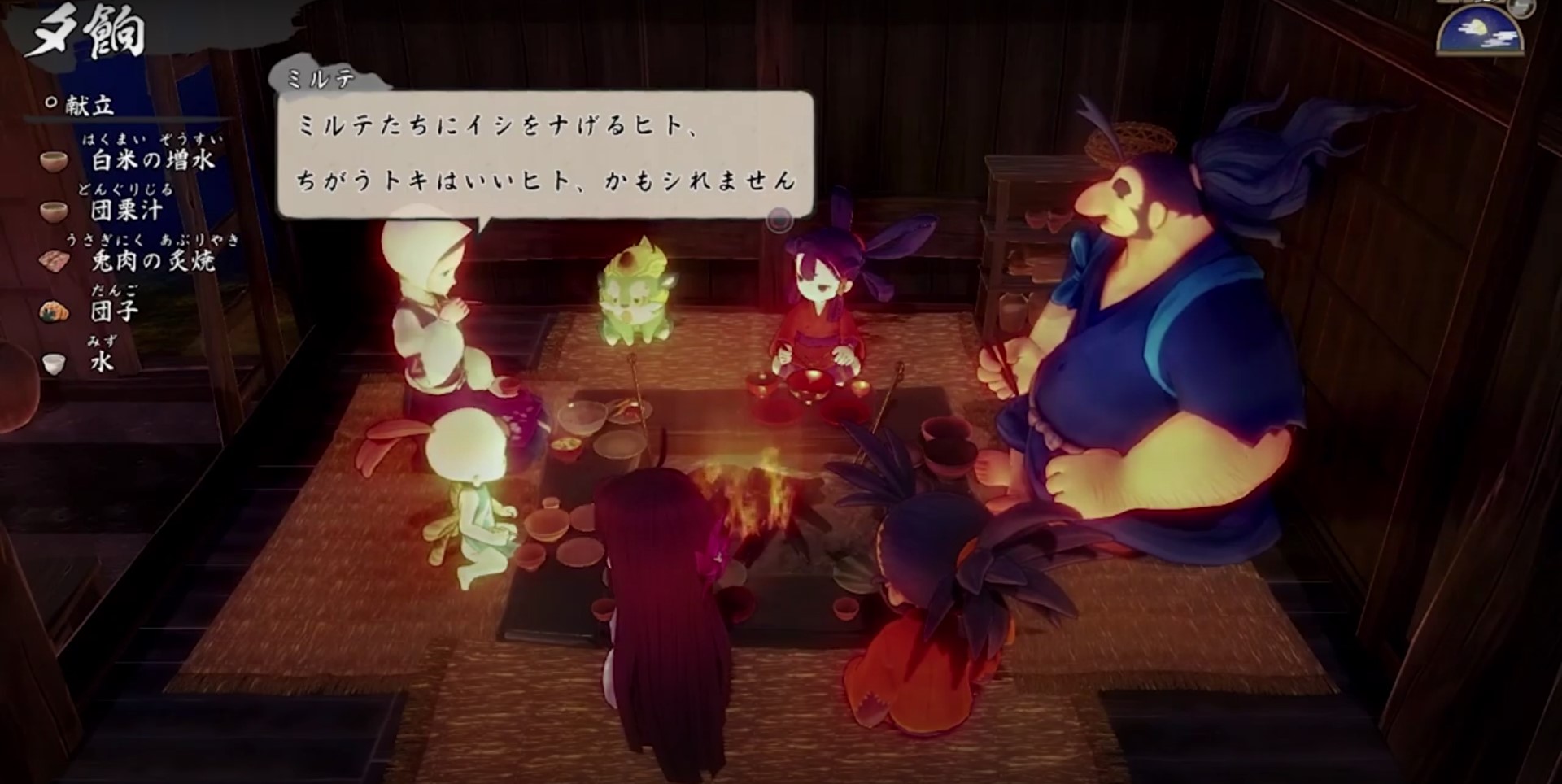
Milte, who has seen the ugliness of human beings through a harsh journey, still has the strength to not despair of the human world.
Milte, a missionary of the Phoromos religion, had traveled to various countries to proselytize, but his travels in ヤナト were never enjoyable. In every country, he disliked strangers, but this was especially true in ヤナト. Milte, along with a priest, proselytized in various towns, but most of the people in the town reviled them, throwing stones and spitting at them. Even so, there were sometimes people who were good to him, but he could not do so if ordered by a temple that disliked the increase of Phoromos followers. In the most difficult times, he had no house to live in.
When Kinta quits that all ヤナト people are like that, Milte replies, "I don't think so." People have both good and bad minds. The person who throws a stone at Milte may be a kind person in different situations. Milte says that it is important to know both the good and the bad.
They were all impressed by Milte's strength, but when they heard Milte say with a funny look, "The climate and people vary greatly from country to country, but in every country the droppings were always thrown," they were completely depressed.
Problem child itchy
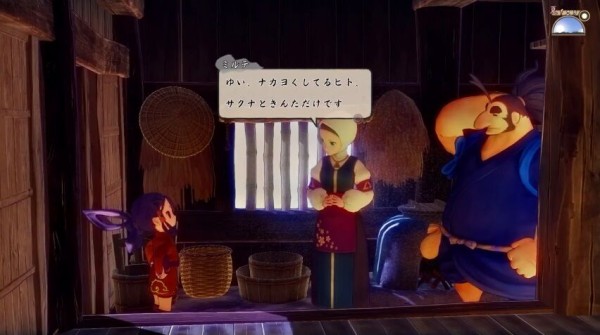
サクナヒメ is consulted about Yui's behavior. As the leader of the pass, he is more or less involved in human worries.
Yui was a quiet and polite girl in front of サクナヒメ, unlike Kin, who was a problem child full of mischief and curiosities, who was brought up in the same area and whose dialect was completely unknown to サクナヒメ.
One time, サクナヒメ came across Milte and Taemon talking to each other in an awkward way. When she heard the story, she found that Yui was in trouble because she didn't listen to Milte or Taemon at all. When サクナヒメ heard that she would be flatly stood up even if she promised to help with housework, she couldn't believe that she behaved like that even though she usually didn't have much trouble. When she heard it, she found that Yui was only friendly with Kinta and サクナヒメ and was extremely unfriendly with adults.
When サクナヒメ looked for Yui, he was looking at Kinta from the shadow of the weaving shed. When I asked him what he was doing, he said he was watching out for something bad to happen to him. I really wanted to keep doing it, but Milte was so insistent that I couldn't refuse it, so I couldn't stop making promises.
When サクナヒメ asked why she supported Kinta so much, Yui said that she had been saved by Kinta, and that she wanted to repay him, although Kinta probably doesn't remember it. When サクナヒメ asked her for details, she was told that サクナヒメ was the greatest person on the pass and that she really didn't want to tell anyone, so she refused to say anything more.
サクナヒメ sensed the complicated signs and did not pursue them any further, and he reminded her that she was not only a person who lived happily, so she had to be reconciled with others. Yui reluctantly agreed.
Schools in Milte
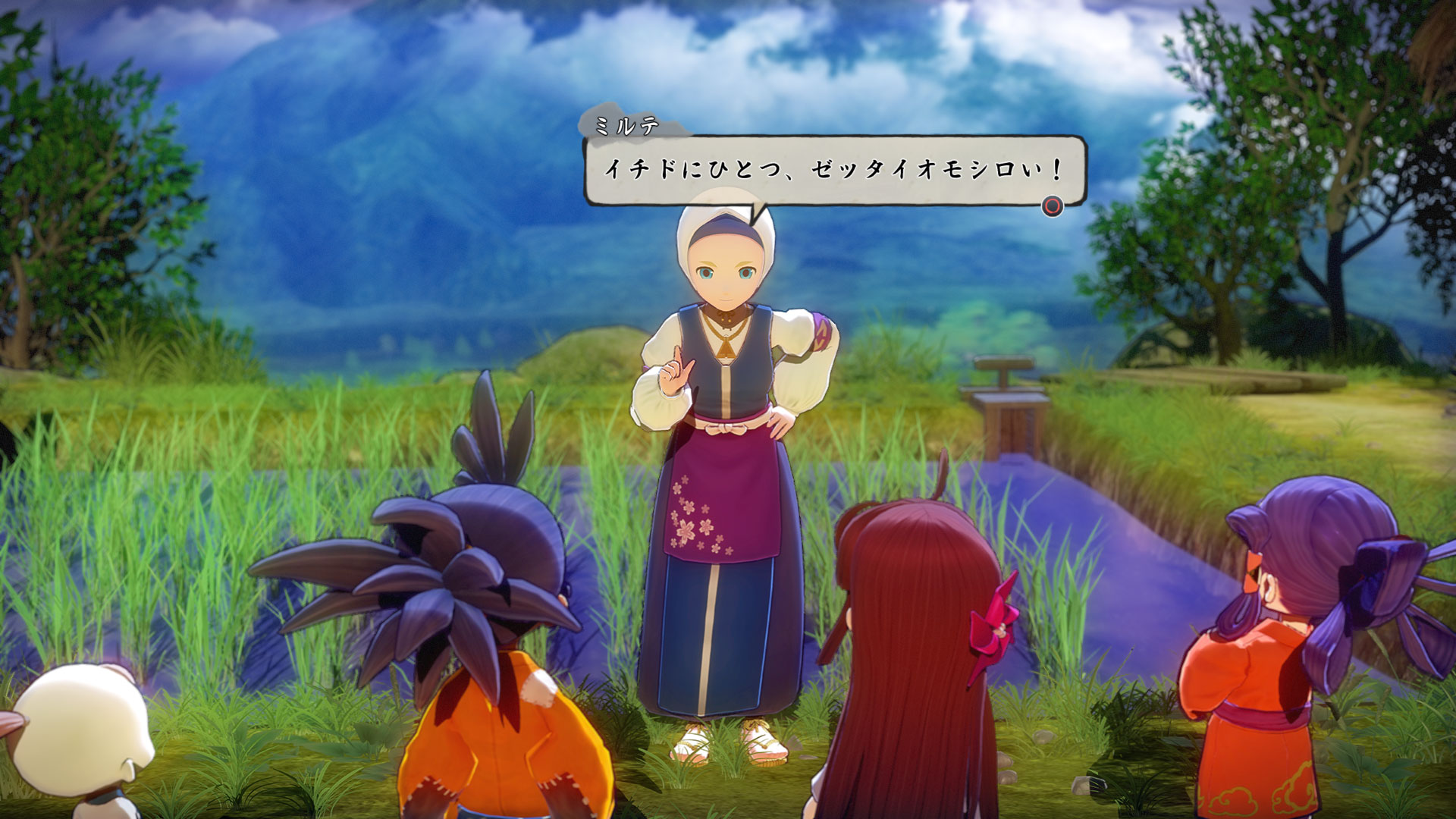
Milte suggests that children listen to her because she always tells them interesting stories.
One day, Milte calls together three of them, Kinta, Yui, and Kaimaru, and says that they are going to start a school. Milte's idea that they should have time every day to teach about reason, philosophy, and God is blatantly disliked by children.
When Milte persuades her that it is for children to have the wisdom to live when they grow up in the future, Kin throws up, saying that Milte is not perfect in ヤナト language, and that it is too much of a bother. Yui also tries to ignore Milte and leave, and Kaibara does not hide her hateful behavior. Finally, Milte cuts off the children's voices with a loud voice, and the situation ends in a disaster. Taemon, who sees Milte from a distance, says to サクナヒメ that Milte probably has an idea, so it would be okay to wait and see a little longer before sending a rescue boat. Tadaya, who also sees Milte, says to herself that there seems to be a lot of things to overcome on this island.
A few days later, Milte asks the サクナヒメ to gather the children. In response to the サクナヒメ's suggestion that it would be better for them to do so, they again gather the cucumbers, cucumbers, and turtles, and line up the サクナヒメ beside them. サクナヒメ, who is not convinced why they line up on this side even though they are adults, persuades them that it is for the Tama-ya to show the children an example. Milte starts talking.
The other day, I was sorry for trying to force everyone to listen to what they didn't want to hear. But I want to teach them this way every now and then. If we keep doing this, Milte may be disliked more, but it's more important for everyone to have the power to live. Instead, I promise to tell them something interesting one at a time. And, as you said, I will learn more about ヤナト's language.
サクナヒメ says that children with no money or status are rarely taught by free foreign scholars, and that Milte also makes fun of them, so he thinks that he has been deceived and asks if he wants to go out with them, so he sends out a rescue boat.
The children began to grudgingly listen to Milte, and the Milte school, which also included サクナヒメ, became very lively.
The Gift of Kaimaru
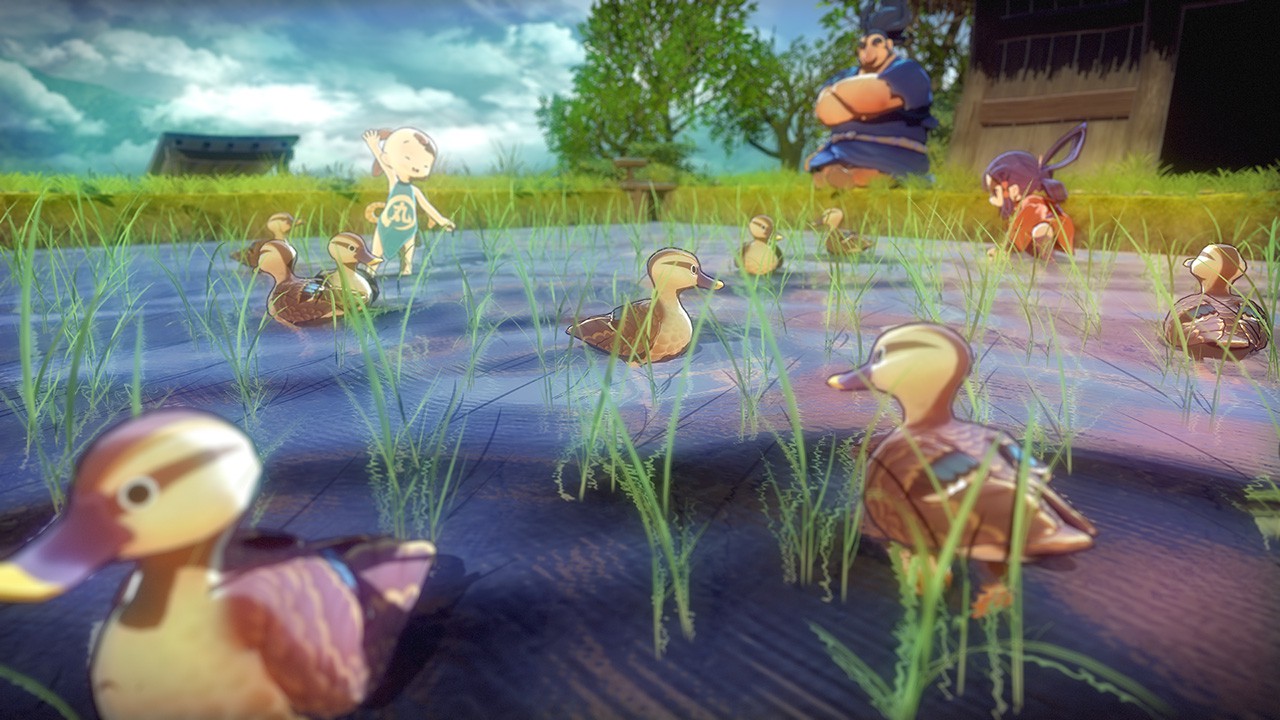
The aigamo farming method. If you leave it too much, it will eat the grown rice, so it is up to the player to decide when to release the duck.
One time, Kaimaru brought a dog from outside the pass. サクナヒメ scolded him for coming out of the pass by himself. According to Kaimaru's explanation, the dog sensed the presence of the ogre and was able to dodge the ogre, and as long as the dog was there, people in the pass could go out to collect the ogre. It was a mystery why Kaimaru could understand what he wanted to say because he could only speak by babbling, but if people could go to get food and materials, it was a great story. Kaimaru often brought the dog back, and eventually everyone in the pass was able to go out with the dog.
Once again, Kaimaru returned with a cat. He had never seen a mouse on the pass, but サクナヒメ decided to keep it as a rat hunter for the time being. The cat was of no use at all, just running out of food, but its loveliness kept the サクナヒメ from being driven out. In the end, サクナヒメ was so happy that Kaimaru would bring a cat all the time, and he would see it all over the pass.
On another occasion, the Kaimaru returned with a flock of Ogamo, and サクナヒメ thought of using them as food. However, it turned out that a farming book left in the barn by his mother, Toyohana, had a description of the' Aigamo Noho' (Aigamo Farming Method), in which young ducks were released into the fields and eaten by weeds and insects. The Kaimaru brought new Ogamo every spring, and the サクナヒメ was able to raise the quality of rice by farming with ducks.
Though he is powerless and can hardly speak words, he seems to be acting in his own way to serve everyone.
Kinta and Barley Rice
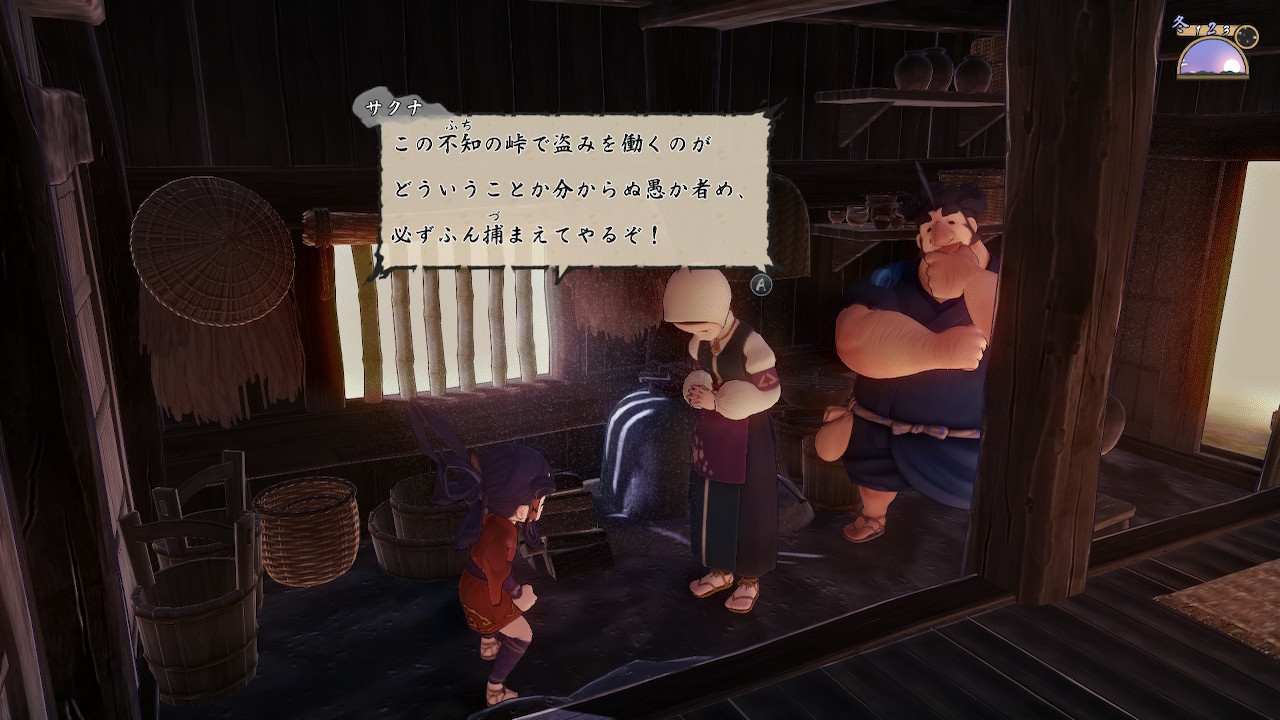
サクナヒメ, who had been looking forward to eating barley rice, been looking forward to is stolen.


Contents
- Outline of "Amenohohi no サクナヒメ"
- Outline and story of "Amenohohi no サクナヒメ"
- Lazy サクナヒメ
- Living in Onijima
- Around the fireplace
- Little Fruit and Teksari Dango
- The Second and the Creation Tree
- Fate of Ishimaru
- ヒノエ Island
- Missionary Milte's Journey
- Problem child itchy
- Schools in Milte
- The Gift of Kaimaru
- Kinta and Barley Rice
- Ogre extermination plan
- Problem child
- Way beyond the two worlds
- The Kappa and Kaimaru
- Asigumo people
- Southern volcano
- Amahoho
- False spikes
- Coco ロワヒメ and サクナヒメ
- God of volcanoes
- Wounded Rabbit
- タケリビ and Toyohana
- Taemon's Wish
- Ishimaru of the fort
- TO FIGHT WITH THE DRAGON.
- Destruction
- Modori-dango
- Wisdom of Coco ロワヒメ
- Revived Demons
- Ishimaru and Taemon
- How to revive rice fields
- Reconstruction of weaving, smithery and livestock huts
- The Fate of the Rabbit Og
- End of Ishimaru
- サクナヒメ's determination
- Blacksmith Kinta
- Hoshidama no Tsurugi
- Yuino Ongaeshi
- Stay or go.
- The Future of Kaimaru
- Kinta to Osho
- Yui no Senmon
- Festival
- ヤナト Taue-uta
- Dairyu (オオミズチ)
- Let's go home.
- Tencho no サクナヒメ game system
- Basic Flow
- rice cultivation
- Spring
- Summer
- autumn
- Winter
- Fertiliser
- Diseases, pests, and beneficial insects
- Rice cultivation conference
- Agricultural book
- Rice status
- Combat and gathering
- Combat
- Equipment
- Martial arts and Hagoromo-waza
- Shikon
- Dietary effect
- Gathering
- Hanasaki Sakuna
- Characters from "Amenohohi no サクナヒメ"
- Friends of the Pass
- サクナヒメ
- Old man
- Taemon
- Milte
- Kinta
- YUI (
- Kaimaru
- A resident of ヒノエ Island
- Ashigumo
- Kappa (water imp)
- God of the capital
- Kamhitki
- Coco ロワヒメ
- サクナヒメ's parents
- タケリビ
- Toyohana
- Enemies of サクナヒメ
- Ishimaru
- Yomitan 0 (ヨモツホムスビ)
- Dairyu (オオミズチ)
- Other
- Visitors
- Tencho no サクナヒメ items
- An item obtained in combat
- Kohaku
- Items only available at night
- An item obtained by collecting
- Collection point
- Gathering companions
- What you can get in the pass
- Items to pick up
- An item available for trade
- The term "Amenohohi no サクナヒメ"
- ヤナト
- Second generation
- Tree Creation
- Ame no Ukiha Bridge
- ヒノエ Island
- Onijima
- Hoshidama no Tsurugi
- Iseuwatari no Hire
- Kohaku
- Behind-the-scenes stories, trivia, and small stories / episodes and anecdotes of "Amenohohi no サクナヒメ"
- The main members of the development are only two members of the coterie circle "Erderu Isuzu".
- The producers actually grew rice to understand rice farming
- THE TOPIC OF "HANASAKI, FAIRY freesia," THE PREVIOUS WORK OF "ERURUWA ISU", APPEARS IN THE CONVERSATION IN サクナヒメ.
- The theme song and inserted song of "Amenohohi no サクナヒメ"
- Theme song: "ヤナト Taue-uta Kannagi - Kaminagi" by Saya Asakura