
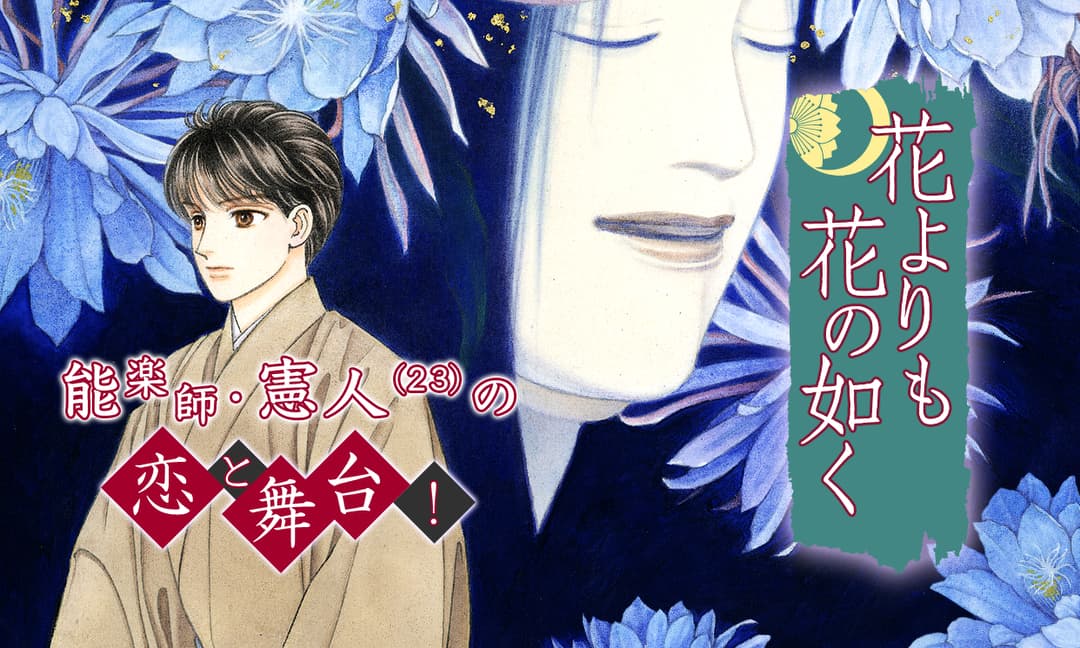
Hana Yori Hana no Yoku" is a manga by Narita Minako about the traditional Japanese performing art of Noh, which was serialized in Hakusensha's "Monthly Melody" magazine from 2001.
In 2006, the magazine was relaunched as the bimonthly "MELODY.
The work originally began as a spinoff read-off of the artist's serial "NATURAL" and became a serial.
Norito Sakakibara has been trained as a Noh performer by his grandfather since he was a child. Norito grows up while meeting various people.
Overview of "More Like Flowers Than Flowers"
Hana Yori Hana no Yoku" is a manga about Noh by Narita Minako.
It was first serialized in Hakusensha's "Melody Monthly" in 2001, and was moved to the bimonthly "MELODY" in 2006.
Originally a spin-off of the artist's serial "NATURAL," it became a serial work.
After the completion of "NATURAL," two more works, "Hana Yori Hana No Yoku" and "Ten no Hibiki" were drawn as Gaiden, and then the serialization officially started.
Norito Sakakibara, whose father was a Shinto priest and mother a Noh performer, is the older brother of Saimon Sakakibara, the Peruvian protagonist in Minako Narita's manga "NATURAL," who is devoted to basketball and archery and is the senior student of Miguel Sannomaru, who helped Miguel in his many dangers and gave him advice.
He is a trainee under his maternal grandfather, the Noh actor Sagaha Saijuro VI, who started out as a kobata and became his uchideshi (apprentice), and grew up to become a full-fledged Shitekata Noh performer.
While developing his skills as a Noh performer day by day, he also engages in friendly competition with his fellow Noh performers, learns about the world of expression outside of Noh through a TV drama in which he appears and gains friends, and struggles with his younger brother, who was adopted by his father's family to become a priest.
Synopsis and story of "More Like Flowers Than Flowers
The World of Noh
Norito Sakakibara has been training as an uchideshi (apprentice) under his grandfather, Hiroto Aiba, a.k.a. Sojuro Aiba, a Noh performer, for about 20 years.
Norito did not live in the house like other uchi-deshi, but commuted from his home. One day, while riding the train to practice, he was mistaken for a pervert.
After receiving advice from his lawyer, Norito decides not to pay the settlement and to wait for the results of the investigation, while preparing himself for house arrest. After investigating the other woman, he finds out that she is a person who was said to be a liar at the company he worked for.
The next day, Norito meets the woman on the train and gives her a ticket to the play. He gave her a ticket to the stage because he felt sorry for the woman who was said to have a habit of telling falsehoods.
When Norito spots the woman on stage that day, he sharpens his mind and concentrates on his performance. The woman was so moved by his serious attitude toward his performance that she dropped the charges against him.
Norito was happy to be able to concentrate on Noh again.
A new candidate for an uchi-deshi (apprentice) arrived at the Sofukai.
His father is a Noh performer named Morisawa Gaku. He is patient, able to endure hard training, and considerate of others, but the problem is that he has brown hair.
The members of the Sofukai felt that Raku's hair color was inappropriate for the Japanese performing arts, even though he was born with it, but they changed their minds when they saw Raku's earnest devotion to his training.
One day, Raku was chosen to play the role of Ikkaku Sennin in the Noh play "Ikkaku Sennin.
It was the first time for Raku to wear a mask on stage, but he performed the role of the Issakaku Hermit with great skill.
For an overseas performance in New York, Norito was to play the role of the heroine, Nyogo, in the Noh play "Koi no Omoni (The Burden of Love).
Norito felt pressure to perform this difficult role, but he successfully performed the role, matching his own feelings with the role of the female role, and the New York performance was a success.
After returning to Japan, Norito found a Noh mask named "Waka Onna" in an antique store in Kyoto. Thinking that it would be perfect for his next performance, he buys the mask, even though it is a little expensive.
In the end, Norito did not use the mask, but it was used in "Izutsu," the return performance of Nakazawa Ryusei, a veteran Noh performer.
It was later discovered that the Noh masks that Norito had acquired in Kyoto had actually been lost by his great-grandfather during the postwar turmoil.
Sofukai was then scheduled to perform in Korea, but because of the violent anti-Japanese movement in the area, there was a possibility of incidents such as stones being thrown at them.
The performance began amidst a heightened sense of tension, but the audience seemed to enjoy the performance, which was unexpectedly a great success.
Encounter after encounter
Through the introduction of Yoshinen Miyamoto, a Noh actor, Norito is offered a role in a TV drama.
Norito is asked to play an important role as the semi-leading character in a suspense drama, and although he is bewildered by the completely different world of Noh, he concentrates on creating the role.
His co-star Hazuki Miyamoto, Yoshitoshi's younger sister, is also a jazz pianist. While filming, Norito gets to know his co-stars, including Hazuki, well.
After the filming of the drama is over, Rin Fujii (Rin Fujii), who played the main character, offers to become Norito's apprentice.
Kenjin works hard at Noh practice while mentoring Rin, who has become his apprentice. Under such circumstances, Kenjin, on the recommendation of Yorojuro, decides to try his hand at "Dojoji," a milestone for a Noh actor.
With "Dojoji" in mind, Norito strives to practice "Kasuga Ryujin," a difficult piece to perform.
On the day of the performance, Norito arranges a meeting with Takao Nakazawa, who was at the performance hall, at his home. Takao Nakazawa was a colleague of Norito's great-grandfather, and Norito had hoped to hear his thoughts once, so he was given the opportunity to speak with him.
When Norito visited Nakazawa's house later that day, he told him that he wanted to use the Noh mask of a young woman he had recently discovered in Kyoto for the stage of "Dojoji".
Later, Norito became a lecturer at a non-profit organization founded by Yoshinori Aso. Around the same time, Hiroto, a.k.a. Aiba Yojuro, decided to hand over his name to his son Takuto, and Takuto's succession performance was held.
Takuto gave an uncanny performance in the play "Ataka" at the performance. Takumito became Aiba Yosojuro, and his father Hiroto took the name Aiba Taiichi.
Norito was to play the role of a blind man on the next stage, but he lacked confidence in his own abilities. He goes out for a drink with Rin Fujii, gets drunk, and wanders into Mt.
Norito stands there with no recollection of why he is here, but he is saved by a young blind man who happens to be passing by.
The young man's name is Nozomu Takeuchi, and he works as a massage therapist at a clinic at the foot of Mt. Nozomu's way of life without hesitation was utilized in the creation of Norito's role, and Norito was able to play the role of "Semimaru," a blind man.
Afterwards, Norito listened to Nozomu play the violin, which he says is a hobby of his. Nozomu's performance was unexpectedly skilled, and Kenjin encouraged Nozomu to try his hand at music.
Still unable to take action, Norito arranges a session with Hazuki, a pianist, to help Nozomu. It was the first time for Nozomu to play with other players, but he enjoyed the session with Hazuki freely and openly.
Unexpected new disciples
Norito is staying at a shrine that is his father's family home for an outdoor performance in Aomori.
At the shrine where Norito is staying, he sees a woman praying for the Ox late at night and realizes that she is a spectator who came to see his daytime stage performance in a gothic lolita fashion.
Rumors had been circulating about the woman's late-night visit to the shrine, but Kenjin sensed that there was something going on and quickly covered for her. The woman, who happened to witness the incident, takes a liking to Norito and decides to become his apprentice.
Norito is puzzled by the unexpected offer of an apprenticeship, but with the encouragement of those around him, he decides to accept the woman as his apprentice.
The woman's name is Karin Onodera, and she is a student at the same university as Ayaki, Norito's younger sister. According to Ayaki's story, Hanashi was the subject of a rumor within the school, and according to the rumor, Hanashi was dating a university lecturer, but he already had a wife. Cornered, Hanashi is said to have placed a picture of herself from the past in a cursed straw doll and struck it against a tree in an Ushi-no-mori ritual.
As they were talking about this, Hanashi walked by and Norito followed her. Hanashi gets into a cab, reaches the ocean, and shouts as loud as she can into the sea to shake off all her stress.
Hanashi, who had never been able to speak out loud before, seems to feel refreshed by shouting as loud as she can.
Relationship with Hazuki
Later, Norito was cast in a TV drama series, but due to their mutual busyness, he was unable to see Hazuki for days at a time.
Then, Norito learns that Hazuki had been the victim of a stalker in the past. Hazuki then contacted Norito saying that she felt like she was being followed, and Norito decided to look for a man named Shichijo, who he believed was repeatedly stalking her.
According to those who know Shichijo, he is self-centered and has a tendency to lose his temper. After receiving information that he was from the Kansai region and attended a university in Kyoto, Norito and Hazuki arrive at the university where Shichijo attended.
After talking to the receptionist at the university about the situation, Ueda, a female staff member who said she knew Shichijo, agreed to show them to his house.
Norito and Hazuki met Shichijo's mother at his parents' house, who told them that Shichijo had already died in a traffic accident. According to his mother, all the recent stalking of Hazuki was done by her.
When the mother found out that Shichijo had been stalking her before her death, she visited Hazuki to apologize. The mother apologizes to Hazuki again, saying that she did not like the way Hazuki treated her at that time, and that she had harassed her.
Norito returns to Tokyo and practices Noh hard. He is visited by Ueda, the man who guided him to Shichijo's house.
Hearing that Ueda is going on a pilgrimage to Shikoku on behalf of Shichijo's mother, Norito suggests that he create a website and have his mother watch his pilgrimage every day.
Norito has decided on "Kiyotsune" as the program of the Sakaki-no-kai, a society he has founded, and is busy preparing for it.
As a result, he is unable to pay attention to Hazuki, and a rift develops again between the two. Norito tries to get in touch with Hazuki, but she is also busy with her work as an actress, and their phones are disconnected.
Meanwhile, Ueda's website was showing his pilgrimage, and Norito was cheering Ueda on as he watched. Norito finds a sentence about Shichijo on the website.
It says, "Shichijo seemed to be having a hard time, so I told him, 'Why don't you come home? He was killed in an accident on his way back to his hometown by car.
After reading the letter, Norito asked Ueda if he could be present on the day of the petition.
On the day of the memorial service, Norito waits for Ueda near Nagaoji Temple and together they cross the final mountain. Then he sees Hazuki and Shichijo's mother at the last temple.
Ueda, who had safely completed the 88 temple visits, said that he was now going to Koyasan to pay his respects.
On their way home, Norito and Hazuki were able to talk about each other and clear up their misunderstanding.
As the number of disciples increased, Norito decided to use his home as a new training place.
One of his students is a woman named Sugiura, and when Norito hears that her house is like a garbage dump, he decides to help her clean it up.
Sugiura is currently separated from her husband and lives with him while taking care of her sick father.
Her father was unable to throw away the things in the house, and the house has become like a garbage mansion with no place to stand on.
Norito realizes that Sugiura's father, who could not throw things away, wanted his daughter to cherish not only the future but also the past. Then, Sugiura's father notices that he hears a cat meowing in the house.
The cat seems to have entered the Sugiura house with its parent and child, and the Sugiura family decides to take custody of the cat and its child.
Due to the influence of that cat and its parent and child, the Sugiura's father also became willing to dispose of the garbage. He began to open the window that had been closed until then.
Sugiura felt the aroma coming from the bakery outside the window and was glad that his father was paying attention not only to the past, but also to the present and the future.
On the day of the presentation by his apprentices, including Sugiura, Hazuki was also there, which made Kenjin happy. Then, Sugiura's father came to the venue with her husband, and Sugiura suddenly ran into the bathroom.
Norito and Norito's mother, who had accompanied her to the restroom, thought that she might be pregnant.
After the performance of "Seikyo," Norito was upset when he heard his father, Taiichi, praising Raku. He wondered how he had done, and asked Hazuki what she thought.
The answer he received was, "I think it was good, but it wasn't my best performance. Norito was depressed, thinking that perhaps he had not been able to concentrate on some parts of the performance.
He then starts talking about the other day when he cleaned up the trash at the Sugiura house, but Hazuki coldly replies, "You are kind to everyone, aren't you?
When he talks about the other times he helped people, such as saving Onodera, Hazuki tells him to "stop that".
Learning from Children's Caring
A children's presentation of "Tsuchigumo" (The Earth Spider) was coming up, and rehearsals for the performance had begun.
Norito wants to show these children the stage once, so he takes Nagisa Yamaguchi, the guardian of the children's Noh play, and her friend Izumi to a firelit Noh play.
The day before the performance, Norito contacts Nagisa's mother, who has never come to a rehearsal, to see if she can come to the performance, but she replies that it would be difficult for her to go to the performance.
When he asks Hazuki about it, she tells him, "It's not something you need to worry about. Still concerned, Norito talks to Izumi's mother and tells her that he wants to talk to Nagisa's mother directly.
Nagisa hears the conversation between these adults and says, "I think your mother is really having a hard time. If the teacher talks to her directly, I think it would be too much for her", she tells Norito.
Nagisa's words depress Norito, and he is unable to say anything to Nagisa's mother.
Meanwhile, he receives a phone call from Hazuki's older brother Yoshitoshi, but the caller hangs up in the middle of the conversation. Wondering why, Norito asked Yoshitoshi the next day what was going on.
He found out that Hazuki had been wondering whether or not to contact Norito, so Yoshitoshi decided to call him on his own cell phone, but Hazuki took the phone away from him in the middle of the call.
Apparently, he was wondering whether or not to contact Norito because the performance of "Dojoji" was about to start.
The day of preparation for the performance of Kodomo Noh. The children's spirits were rising as the show was finally about to begin.
Then, Norito notices that Nagisa is nowhere to be seen at the venue and goes outside to look for her.
Then, Norito finds Nagisa crying outside the venue. It was then that Norito realized what had happened. Although she was concerned about her mother and tried to be strong by telling him that he didn't have to force her to come to the show, Nagisa was really lonely.
How could she not miss her mother not coming to watch the show?
Resentful that he had not noticed this before, Norito decided to try to persuade Nagisa's mother once again. He boldly contacted Nagisa's mother and asked her to come see the play, and surprisingly, she readily agreed.
However, she seemed to be very busy, and the sounds coming from the phone were very noisy. He was surprised to see a news program on the TV that he had casually turned on.
The news program reported that a criminal had been arrested in a street riot case, and the police officer in charge of the case shown on the news program was Nagisa's mother.
Norito had heard that Nagisa's mother was a public servant, but he did not expect her to be a police officer.
Norito was convinced that the incident was the reason why Nagisa had been unable to come to rehearsals and was unsure if she would be able to come to the performance, and that the reason why she was suddenly able to come to the performance was because the incident had been solved.
Norito was very happy to finally know that Nagisa would be able to see his play.
On the day of the Children's Noh performance, Nagisa and the other children performed their roles beautifully, and the play ended without incident. Nagisa's mother was in the audience, and Norito was relieved to see her.
The day before the children's performance, Norito had told his brother Yoshitoshi that he had not been able to see Hazuki, and had asked her when her birthday was.
Norito had decided to go see Hazuki on that day in order to mend his relationship with her. On the day of her birthday, Norito came to Hazuki's house with a large bouquet of flowers.
Hazuki was happy to receive the large bouquet, thanked Norito for his hospitality, and handed the bouquet to her brother Yoshitoshi. Norito was curious and asked Hazuki if it was Hazuki's birthday, and she told him it was.
When Norito was about to ask Hazuki's birthday, he asked Yoshitoshi, "What's your birthday? He answered that it was his birthday.
Norito was disappointed to learn this, but decided it would be nice to be able to celebrate Yoshitoshi's birthday, to whom he had been indebted.
Characters and Characters in "More Flowers Than Flowers
Noh Players of the Aiba Family
Norito Sakakibara
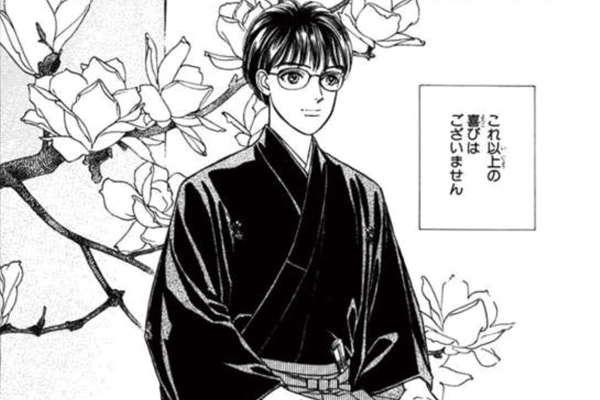
The main character. His real name is "Norito," but he is called "Kento" by everyone around him, including his family.
He has been trained under his maternal grandfather, a Noh performer, since his childhood, and at the age of 22 became an apprentice to the 6th generation Sotojuro Aiba.
His first Shite was "Kyosho.
He and his younger brother Saimon, who was adopted by his paternal uncle as the successor to a Shinto priest when he was a child, have an uneasy feeling that they cannot open up to each other, although it does not come to the surface. They get along well.
Although his facial features are not bad, he is not handsome. His family calls him "Nobita" because he wore glasses until he appeared in the drama.
He became friends with Yoshitoshi Miyamoto's sister, Hazuki, a Noh actor who co-starred in the drama, through their hobby of jazz, and they started dating despite their various differences of opinion.
Even after they begin dating, their feelings for each other often rub each other the wrong way.
Although Kenjin had always been devoted to Noh, he appeared in the two-hour drama "Ishi ni Negai Wish" as the semi-leading role of a Noh performer, and through his interaction with his co-stars and surroundings, he came to know the world of other forms of expression besides Noh.
This drama led to the starring actor, Rin Fujii, becoming his apprentice.
He accompanies Takumijin to Dojoji Temple to thank him in the dictionary in volume 9 of the comics. Sangyojuro's remarks led to his first performance as a shite in "Dojoji" at the age of 30.
Hiroto Aiba
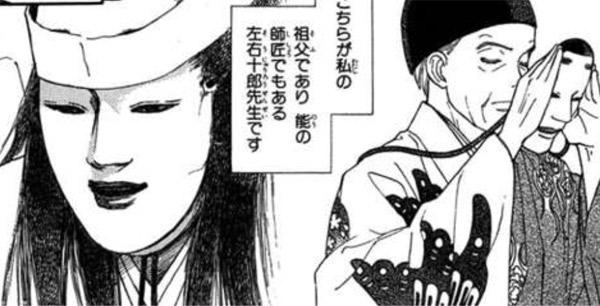
Noh performer. He is the head of the Sofukai, which is thought to be the Kanze school, and is the 6th generation Aiba Sōjūrō.
In the 11th volume of the comics, he handed over the name to his eldest son, Takuto Aiba, and took the name Taiichi Aiba himself.
He is a shite actor. His training is rigorous, sometimes even to the point of using his hands, but this is a sign of his sincerity toward Noh, and he politely consults with his students, including Norito, about their problems.
He is also very attentive to the problems of his pupils, including Norito, and is a great advisor to them. He once wondered whether Norito or Saimon should succeed him.
Takuto Aiba
Soyo Soyo is the seventh generation of the Soyo family of Noh performers. He is a Noh performer of the Shite style of the Sofukai. His artistic style is dynamic but also delicate.
He is Norito's maternal uncle and Kaito's father.
He is misunderstood by the in-house sales crew when he is told on a moving train, "Father, I'm not afraid when I'm being a woman.
Noh performers belonging to Sofukai


Contents
- Overview of "More Like Flowers Than Flowers"
- Synopsis and story of "More Like Flowers Than Flowers
- The World of Noh
- Encounter after encounter
- Unexpected new disciples
- Relationship with Hazuki
- Learning from Children's Caring
- Characters and Characters in "More Flowers Than Flowers
- Noh Players of the Aiba Family
- Norito Sakakibara
- Hiroto Aiba
- Takuto Aiba
- Noh performers belonging to Sofukai
- Raku Morisawa
- Kaito Aiba
- Naotsugu Watarai
- Naokaku Watarai
- Yoichi Igarashi
- Yasutaka Ishii
- Kuritaro Iwamura
- Other Noh Players
- Yoshitoshi Miyamoto
- Hiroya Sakamoto
- Ko Shiraishi
- Ichisuke Igarashi
- Ryusei Nakazawa
- Other characters
- Hazuki Miyamoto
- Rin Fujii
- Yoshinori Aso
- Nozomu Takeuchi
- Sakakibara Family
- Sakakibara Saimon
- Takanori Sakakibara
- Ayaki Sakakibara
- Takashi Sakakibara
- Saeko Sakakibara
- Suzune Sakakibara
- Terms for "More Like Flowers Than Flowers"
- function
- actor-in-training in kabuki
- noh chorus
- guardianship
- kyogen performer
- side seating (to stage right in noh)
- Lian Shan (Xia period method of Chinese divination)
- young woman
- face (i.e. the human face)
- Dojoji temple
- Famous quotes, lines, scenes, and scenes from "More Flowers Than Flowers
- I really didn't do it, so it's weird for me to say this, but whatever the outcome, I pray that there will always be people who believe in you and approve of you."
- I don't dye anymore.
- Once you try it, you'll be addicted. It feels so good!"
- 'How could I not have known him better? He was a 'natural enemy!
- I can hear the sounds of the musical instruments, the sky at dusk, the horizon, the stars are starting to come into view, and everything is just so perfect! I didn't want to stop! I didn't want to stop.
- Backstory, trivia, and small stories/episodes/anecdotes about "More Flowers Than Flowers".
- Volume 1 of the e-book version includes a spin-off
- There's a cartoon called "Wish Upon a Stone."