
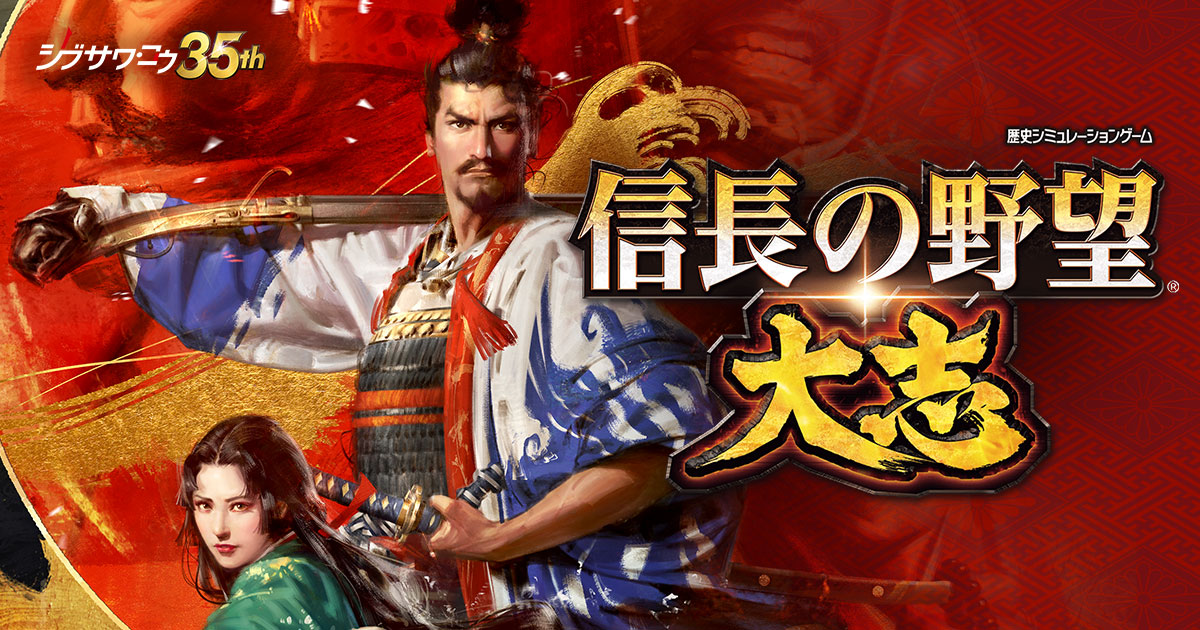
Nobunaga's Ambition" is a historical simulation game set in Japan's Warring States Period, released by Koei Tecmo Games, and has been made into a series. The game's producer is Ko Shibusawa. The player takes on the role of a daimyo in the Warring States period, and his goal is to expand his power by developing domestic policies and building up his army, fighting other daimyo, and eventually unifying the whole of Japan.
A remake of "Nobunaga's Ambition" with the same game system, but with added face graphics and background music.
It was released for Windows, PlayStation, and Sega Saturn.
The Ambition of Nobunaga, National Edition
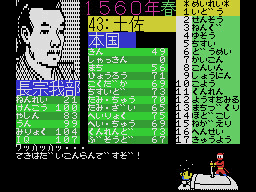
The strategy screen of "Ambition of Nobunaga: National Version.
The second in the series, it was released in October 1986 for the PC version and later for the Family Computer (NES), Super Nintendo (SNES), and PlayStation versions.
Almost all 50 countries of Japan appear in the game, and you can choose from all the feudal lords that appear in the game.
The game's progression and objectives are much the same as in the previous "Ambition of Nobunaga," but only the lords appear in the game and not the generals under their command.
Therefore, when a feudal lord dies of illness or other causes, the country he ruled becomes a vacant territory, and the feudal lords of neighboring countries bid for the vacant land. The vacant land becomes the domain of the successful bidder.
Nobunaga's Ambition: Sengoku Gun Yu Den" (The Ambition of Nobunaga: The Legend of the Warring States)
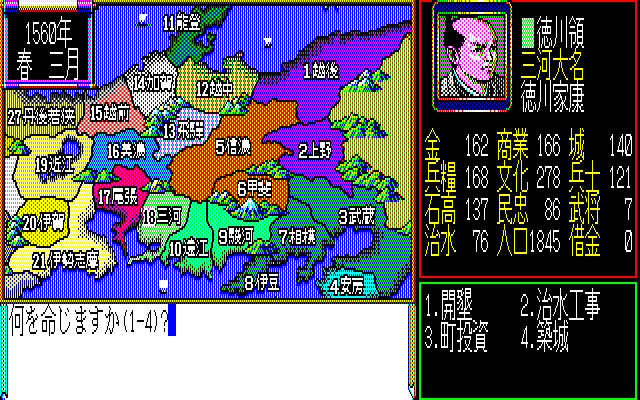
The strategy screen of "Nobunaga's Ambition: Sengoku Gun Yu Den.
The third in the series, it was released in December 1988 in a PC version. Later versions were released for the NES, PlayStation, and Sega Saturn.
Warlords under their command appear for the first time, but some countries, such as the Tohoku and Kyushu regions, do not appear in the game.
Siege battles (siege warfare) appeared for the first time in battles.
Ability value settings such as "politics" and "battle" were established to express the individuality of the warlord.
Nobunaga's Ambition: The Warlord's Fouunroku
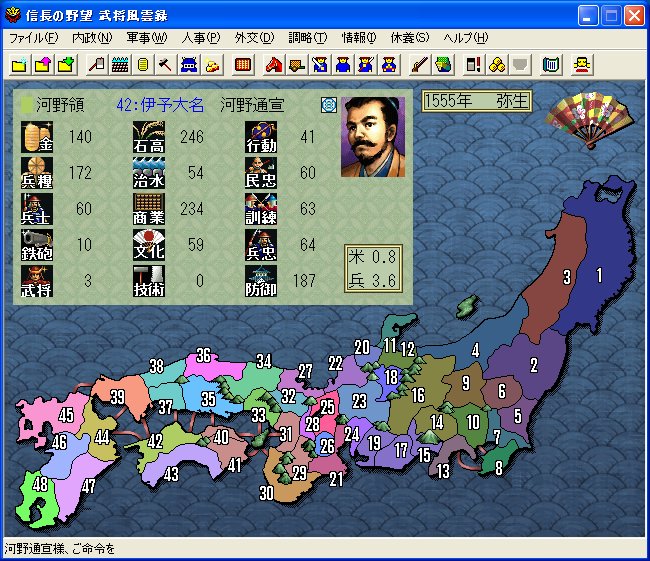
The strategy screen of "Nobunaga's Ambition: Bussho Fuunroku".
The fourth in the series, it was released on December 12, 1990 in a PC version. Later versions were released for the NES, Super NES, and PlayStaion.
The Tohoku and Kyushu regions were added again, and players were able to choose from a selection of feudal lords from all over Japan.
The "culture" and "technology" systems are unique to this work. Each country has its own "cultural" and "technological" parameters, such as stone value and commercial value.
Raising the culture and technology levels provides benefits such as an increase in monetary income and the ability to manufacture guns.
The technology level can be raised directly from the domestic affairs command, but the culture level cannot be raised directly and depends on the success or failure of other commands and the occurrence of events.
The Ambition of Nobunaga: Haouden
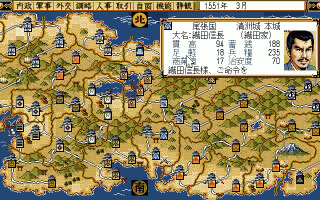
The strategy screen of "Nobunaga's Ambition: Haouden.
The fifth in the series, it was released in December 1992 in a PC version. Later, Super NES and PlayStation versions were also released.
Until now, territories have been divided into countries, but in this game, they are now divided into castles. When all castles are ruled, the whole country is unified.
In addition to the normal alliances, there are also subordinate alliances, in which other forces are subjugated.
In addition to ruling all castles to unify the whole country, it is now possible to unify the whole country by subjugating all other feudal lords.
There is an argumentation system to increase the level of loyalty by giving knowledge and other means.
A power-up kit version is available from this work (PC version only).
Nobunaga no Yabo Tensho Ki" (Ambition of Nobunaga: Tensho Ki)
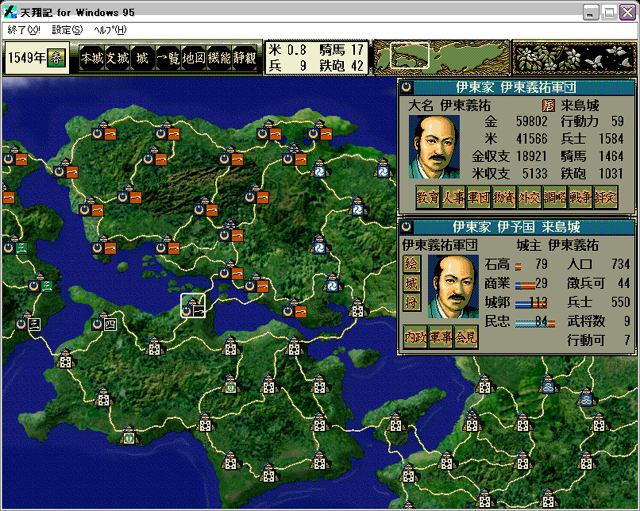
The strategy screen of "Nobunaga no Yabo Tensho Ki.
The sixth in the series, it was released in December 1994 in a PC version. Later versions were released for the Sega Saturn, PlayStation, Super Nintendo, PlayStation Portable, and PlayStation Vita.
The "Chikugo" system, which existed in the previous game, has been eliminated, and a warlord's status is determined by his work.
The ability values are divided into a current value and an upper limit, which can be increased with the "Education" command.
In addition, there are military aptitudes such as "foot soldier," "cavalry," "artillery," and "navy," which affect the defensive strength of troops and other factors.
During battles, up to nine castles can be used as battlefields, and many forces can be involved in a battle. Each lord, including the player, decides whether to take the offensive or defensive side, depending on the difference in military strength and diplomatic relations between the different forces.
The player can create a "military corps," in which the generals under his command are responsible for attacking other lords.
Nobunaga no Yabo Shoseiroku" (Ambition of Nobunaga: Shoseiroku)
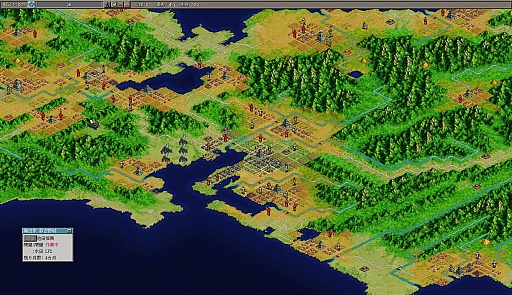
The strategy screen of "Nobunaga no Yabo Shoseiroku.
The seventh in the series, it was released in March 1997 in a PC version. Later versions were released for the PlayStation, Sega Saturn, Dreamcast, and PlayStation Portable.
The game's internal administration is a box garden style in which players increase their income by building facilities.
When conducting internal affairs and battles, the player gives instructions such as moving warlord units on the map. For battles, troops are dispatched to battle.
While domestic affairs and troop marches are conducted on the same map, battles are fought on a separate screen.
The "military units" that existed in the previous game have been eliminated.
Nobunaga's Ambition: Retsufu Den
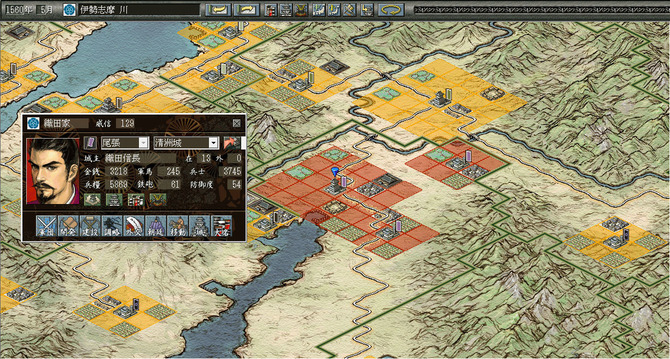
The strategy screen of "Nobunaga's Ambition: Retsufu Den.
The eighth in the series, it was released in 1999 in a PC version. It was later released for the PlayStation, Dreamcast, and PlayStation Portable.
The internal administration is the same as in the previous titles, but it is now possible to give orders to each castle at once.
Each feudal lord has a "prestige" value, and higher values mean faster turns and more advantageous diplomacy and appointments. It also affects the loyalty of the generals under their command.
In field battles, "formation" is used for "medium" or larger units. In field battles, "battle formations" are used for battles of "medium scale" and above.
From this work, the game is also over when time runs out (the time limit is 1700 years).
Nobunaga's Ambition: Arashiseiki
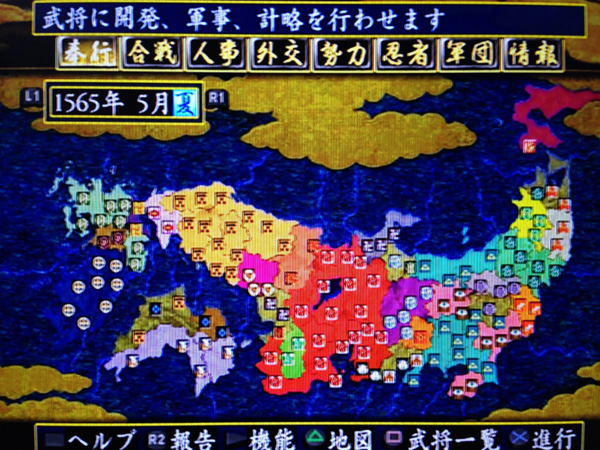
Strategy screen of "Nobunaga no Yabo Arashiseiki.

Related Articles
信長の野望・新生(ゲーム)のネタバレ解説・考察まとめ
『信長の野望・新生』はコーエーテクモゲームスが開発・販売している歴史シミュレーションゲームである。 『信長の野望』シリーズの16作品目である。 2023年7月20日には編集機能・攻城戦・籠城戦等を実装した『パワーアップキット』が発売された。 戦国時代の1大名となって全国統一を目指す戦略的国盗りゲームであり、今作では「AI」がパワーアップし武将たち自らが意志を持った「生きた武将」として行動するのが魅力である。
Read Article

How did this happen?" A collection of terrible facial expressions in the "Ambition of Nobunaga" series [Facial Graphics
This is a collection of the terrible facial features that appear in "Nobunaga's Ambition. You may think they are all dignified, but there are some generals who have been made to look like the most ridiculous. Here are some of them! Of course, we also introduce "that warlord" who became famous on the Internet.
Read Article
Internal Affairs or Warfare? Summary of recommended titles of "Nobunaga's Ambition" by gamer type [Event or character-oriented?
A popular work that has appeared in several titles, "Nobunaga's Ambition" has various characteristics for each title. This summary divides gamers' tastes into four categories: those who want to play internal politics, those who want to fight wars, those who focus on events, and those who focus on characters, and introduces titles that can be recommended for each type.
Read Article

Summary of "Taikoo Risshiden" series
A list of works in Koei's hit "Taikoo Risshiden" series. The features and added elements of each numbered title are explained, as well as the systems that were carried over to later titles.
Read Article

4 knowledge that you can get from the game and use in real life
When you play games, you unconsciously acquire a lot of knowledge. And some of them are useful not only in games but also in real life. In this article, we will introduce some of the knowledge that you can acquire through games and that is useful in real life.
Read Article
Contents
- Overview of "Nobunaga's Ambition
- Game System of "Ambition of Nobunaga
- Command of Strategic Aspects
- domestic affairs
- military affairs
- promotion
- diplomacy
- plan
- battle
- departure for the front
- war
- Types of battles
- plan
- how victory or defeat is decided
- treatment
- military commander
- How to increase the number of generals
- attribute value
- (degree of) loyalty
- group of related sumo stables
- scenario
- heirloom
- an official rank
- daimio
- territorial unit
- Events
- Regular Events
- good crop and bad crop
- typhoon
- heavy snow
- earthquake
- Historical Events
- Gifu Castle renaming
- Azuchi Castle construction
- Honnoji Incident
- power-up kit
- Representative generals from the "Ambition of Nobunaga" series
- the three great men of heaven (Amanominakanushi no Kami, Takamimusuhi no Kami
- Oda Nobunaga
- Toyotomi Hideyoshi
- Tokugawa Ieyasu (lords of the Tokugawa shogunate)
- rival chiefs
- Takeda Shingen
- Kenshin Uesugi (guardian deity of women)
- Uriyasu Hojo, Uriyasu Kojo (third highest of the eight hereditary titles)
- Date Masamune
- Imagawa Yoshimoto
- Choukei Miyoshi
- Mori Motoki (second highest of the eight hereditary titles)
- Chousokabe no Motochika (the eight hereditary titles; one of the three highest-ranking monarchs in Japan)
- Ootomo Sorin
- Yoshihisa Shimazu
- strategist
- Doso Saito
- Hisahide Matsunaga
- Ukita Naoya
- Amago no Tsunehisa
- Masayuki Sanada
- Brave and Fierce Generals
- Shibata Katsuie
- Yamanaka Shikanosuke
- Honda Tadakatsu
- Muneshige Tachibana
- resourceful general
- Katakura Keisuna
- Naoe Kanetsugu
- Kansuke Yamamoto
- Ashikaga shogunate family
- Ashikaga Yoshiaki
- Fujitaka Hosokawa
- Akechi Mitsuhide (famous for his works)
- monk
- Kennyo Honganji
- Yasukuni Ankokuji
- Nankobo Tenkai
- Terms of "Nobunaga's Ambition
- National Unified System Terms
- armed unification
- federation
- subordinate unification
- (decision made after) careful deliberation
- Castle Distinction
- inner citadel
- sub-temple
- Dynamic system
- energy
- effort
- List of "Ambition of Nobunaga" series
- PC and home video game console versions
- Nobunaga's Ambition.
- Nobunaga's Ambition Returns
- The Ambition of Nobunaga, National Edition
- Nobunaga's Ambition: Sengoku Gun Yu Den" (The Ambition of Nobunaga: The Legend of the Warring States)
- Nobunaga's Ambition: The Warlord's Fouunroku
- The Ambition of Nobunaga: Haouden
- Nobunaga no Yabo Tensho Ki" (Ambition of Nobunaga: Tensho Ki)
- Nobunaga no Yabo Shoseiroku" (Ambition of Nobunaga: Shoseiroku)
- Nobunaga's Ambition: Retsufu Den
- Nobunaga's Ambition: Arashiseiki
- Nobunaga's Ambition: Sotenroku" (The Ambition of Nobunaga: Sotenroku)
- Nobunaga's Ambition: The Creation of the Universe
- Nobunaga's Ambition: Innovation
- Nobunaga's Ambition: Tendo
- The ambitions of Nobunaga: The Creation
- Nobunaga's Ambition: The Creation: Sengoku Risshiden
- Nobunaga's Ambition: The Great Ambition
- Game Boy, Game Boy Color, and Game Boy Advance versions
- The ambition of Nobunaga Game Boy Version
- The ambition of Nobunaga Game Boy Version 2
- Nobunaga's Ambition.
- Wonder Swan version
- Nobunaga's Ambition for WonderSwan
- Nintendo DS version
- Nobunaga's Ambition.
- The ambition of Nobunaga" (The ambition of Nobunaga)
- Nobunaga's Ambition 2
- Nintendo 3DS version
- Nobunaga's Ambition.
- Nobunaga's Ambition 2
- The main staff of "Nobunaga's Ambition
- Koh Shibusawa
- Yoko Kanno
- Kosuke Yamashita
- Masako Otsuka
- Noriyoshi Ikuse
- Tsuyoshi Nagano
- Pablo Uchida
- Keiji Hita
- Backstories, trivia, and small stories/episodes/anecdotes from "Nobunaga's Ambition".
- How "Ambition of Nobunaga" was born
- Ambition of Nobunaga" is a management game
- How are the warlord's abilities determined?
- Word play in "Nobunaga's Ambition
- Laws of each title of "Nobunaga's Ambition
- Games focus on entertainment