
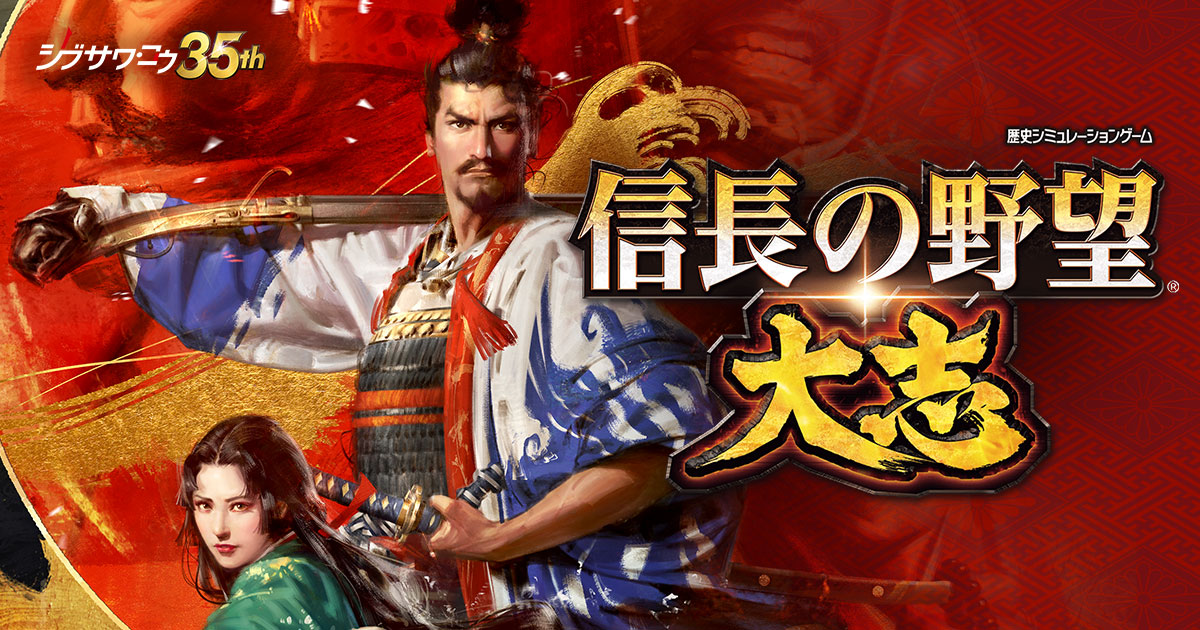
Nobunaga's Ambition" is a historical simulation game set in Japan's Warring States Period, released by Koei Tecmo Games, and has been made into a series. The game's producer is Ko Shibusawa. The player takes on the role of a daimyo in the Warring States period, and his goal is to expand his power by developing domestic policies and building up his army, fighting other daimyo, and eventually unifying the whole of Japan.
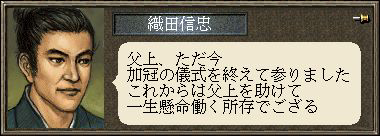
In "Nobunaga's Ambition: Retsufu Den," this message appears when a general who has reached his prime appears.
The following methods are commonly used to increase the number of generals in one's own family.
(1) Genpuku: Generally, at the age of 15, a warlord will appear at a predetermined castle. In many cases, which generals appear in which castles is determined to some extent. Depending on the work, only the family (sons, brothers, etc.) of a feudal lord or subordinate warlord may appear at the time of gembuku.
(2) Appointment: Appointment of a ronin from one's own territory.
(3) Naiou: Convincing a subordinate general of another feudal lord to turn over to the feudal lord's family.
(4) Battle: Capturing enemy generals in battle and appointing them for post-war treatment.
attribute value
Warlords have a set of ability values, which represent characteristics such as strengths and weaknesses.
Ability values affect the effectiveness and success or failure of commands, as well as the attack power of troops in battles.
Here are some examples of major ability values and the commands that affect them.
Politics: This is a numerical value of political power. A high value increases the effectiveness of domestic affairs commands and the success rate of diplomacy and appointment commands.
Valor: This is a numerical value of a general's personal strength. A high value increases the attack power of troops in battle, allowing them to inflict more damage on the enemy.
Wisdom: This is the numerical value of a general's skill in strategy. A high value increases the success rate of diplomacy and strategy commands. It also increases the success rate of strategy during battles.
Leadership: This is the numerical value of the skill in commanding troops. A high value increases the defensive power of troops in battle, reducing damage to the enemy.
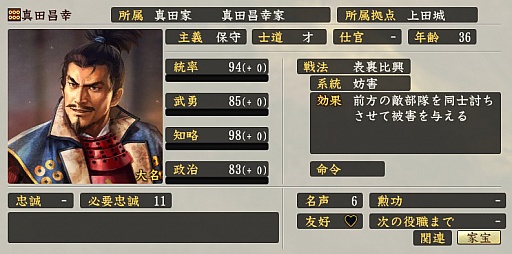
Warlord screen of "Nobunaga's Ambition: The Creation: Sengoku Risshiden". The general shown is "Masayuki Sanada".
In this work, the highest basic value of each ability is 100, so we can see that this warlord has a well-balanced ability value.
(degree of) loyalty
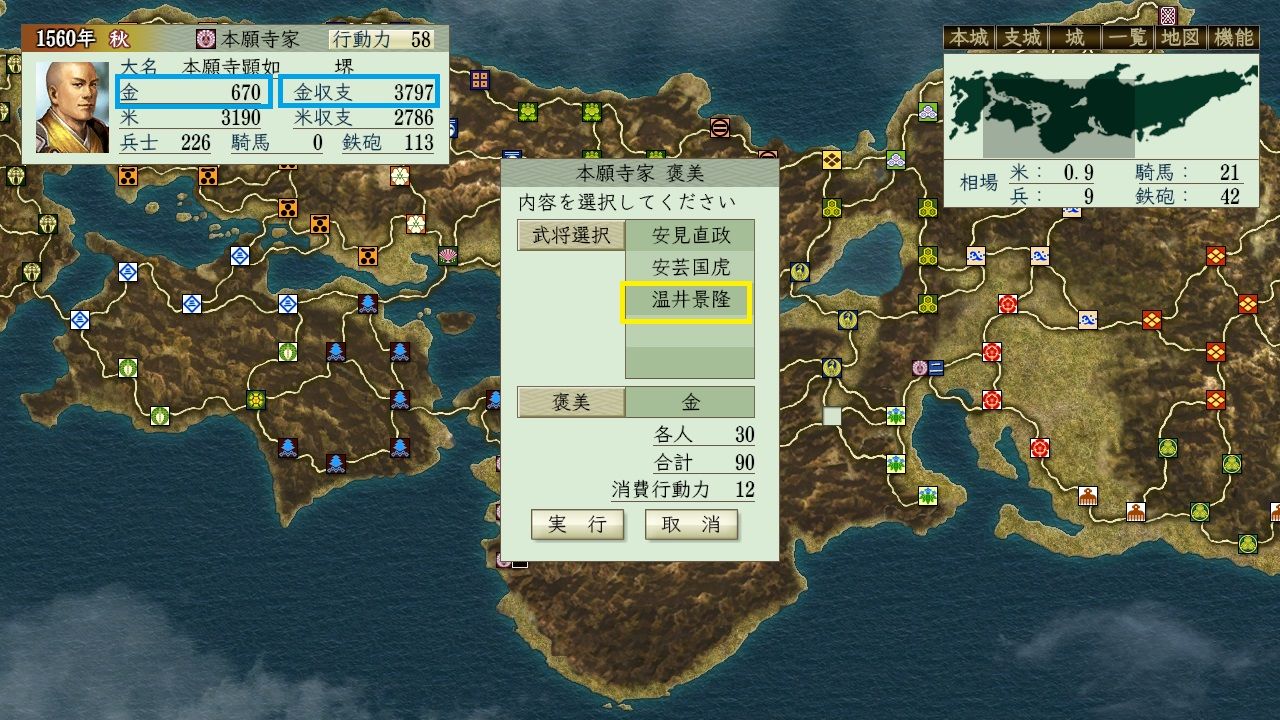
Rewards" are given in the form of money or rations. The loyalty of the general who gave the reward is increased.
A numerical value that expresses a warlord's loyalty to his feudal lord. A high loyalty level makes it harder to betray one's own house, while a low loyalty level may cause a warlord to turn to another house.
In some works, compatibility is set by a numerical value, and if the values are close, the compatibility is good and the loyalty level is high. Conversely, if the values are far apart, the compatibility is poor and the loyalty level is low.
Loyalty is increased by giving money, food, and heirlooms.
Loyalty decreases when family heirlooms are confiscated or when a family is pillaged by another family.
group of related sumo stables
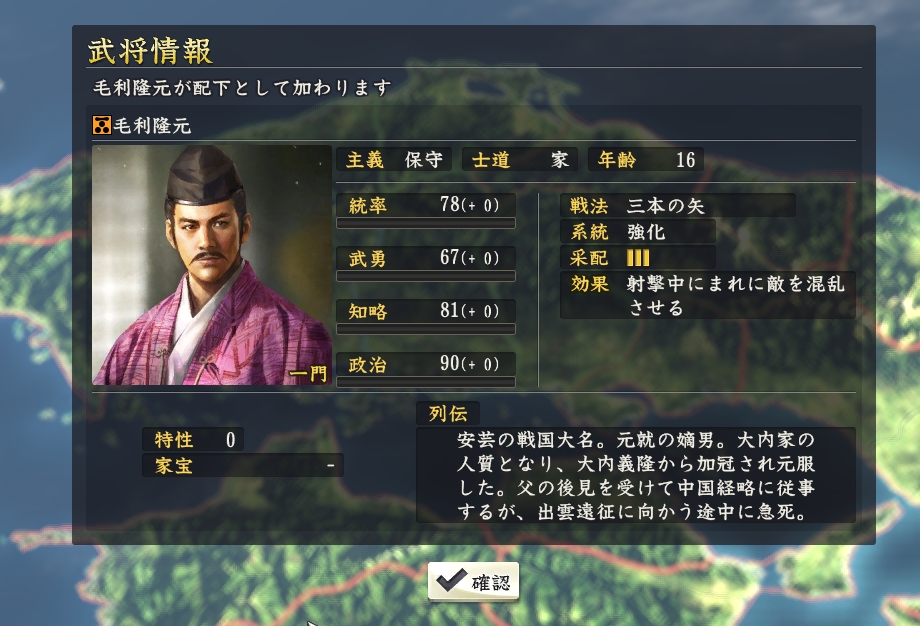
Takamoto Mori is the eldest son of Motonaga Mori and a member of the Mori family. He appears in the same castle as Motonaga when he attains his former age.
Warlords who belong to the same family are called "Ichimon Warlords," and they appear at the residence of their fathers and other family members when they reach the age of 18.
In particular, the Ichimon warlord of a feudal lord has an additional level of loyalty and is less likely to betray his family. In some works, they may never betray you.
If the selected daimyo dies, the game continues with his successor being chosen, but in some works, only the daimyo's Ichimon Warlord can succeed him.
In addition, other warlords may become dissatisfied with the successor and start up a new family, independent of the Daimyo family.
In such cases, there is no problem if the successor is decided in advance and goes into hiding.
scenario
The game can be played in a variety of ages.
It is set in the Warring States period, but ranges from the end of the 15th century, when Hojo Soun was active, to the Battle of Osaka.
Although the game is set in "Nobunaga's Ambition," it can be played before Nobunaga's birth or after his death.
The following are the main scenarios that appear. Some scenarios may or may not exist, depending on the work.
The number of generals in each scenario peaks in the 1560s and 1570s and gradually declines.
1495: This scenario takes place some time after the outbreak of the Onin War and the beginning of the Age of War.
1534: Scenario around the time of the birth of Nobunaga Oda.
1546: Scenario around the time of Nobunaga's first year of marriage.
1560: Scenario around the time of the Battle of Okehazama, when Nobunaga fought Yoshimoto Imagawa.
1571: Scenario when Nobunaga was besieged by lords from all over Japan.
1582: Scenario before Nobunaga died in the Honnoji Incident.
1589: Scenario when Toyotomi Hideyoshi was on the verge of unifying the whole country.
1600: Scenario around the time of the Battle of Sekigahara, when the eastern and western armies fought.
1614: Scenario based on the Battle of Osaka, where the Tokugawa and Toyotomi sides fought.
While the above scenarios are based on historical facts, there are also hypothetical scenarios in which all the generals of the works appear, regardless of time period or age.
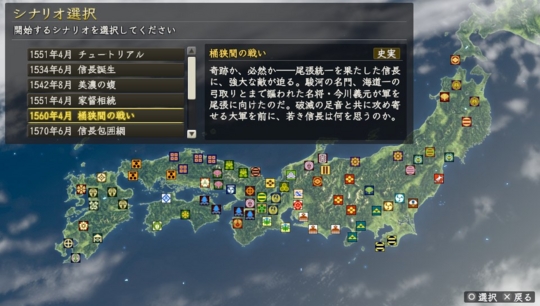
Thus, you can play with various scenarios (the screen is "Nobunaga's Ambition: The Creation").
heirloom
Heirlooms are like items that, when given, increase a general's ability and other values. When given to subordinate generals, they also increase loyalty.
Heirlooms are often referred to as venerable masterpieces, masterpieces and swords, and are categorized as tea utensils, swords, famous horses, books, and imported goods.
Basically, they can be obtained by commanding the purchase of supplies, but depending on the work, they may also be obtained through events.
In many works, some generals initially possess certain heirlooms.
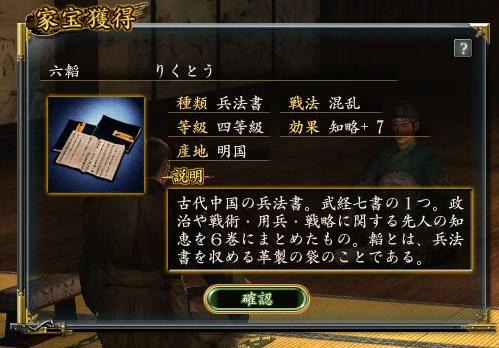
Ancient military strategy books, such as "The Six Languages of War," said to have been written by Taigong Wang during the Zhou Dynasty in ancient China, also appear as family heirlooms.
an official rank
It refers to the grade of government office, which in the case of Japan is based on the Ritsuryo government system, and in the Warring States period, it is often used to describe the hierarchy in the case of samurai families.
Basically, it is negotiated by the Imperial Court, and the daimyo is appointed to the position. The ranks can also be conferred on subordinate generals, which increases their loyalty.
When a general is appointed to an official position, his politics and other aspects of his life are increased.
The type of official rank varies from work to work, but the highest rank is usually the Shoichi Kanpaku.
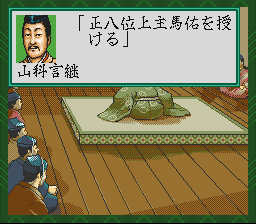
When an official rank is conferred, a message from the official, such as "I confer (name of official rank)," is displayed (screen from "Nobunaga's Ambition: Haouden").
daimio
The daimyo families appear in a wide range of works, from the feudal lords of the Warring States period to powerful clans and provincial lords, as well as the Honganji forces.
In the early works, the number of daimyo families was small, but it gradually increased from famous to minor ones.
Daimyo families are identified by their family crests, for example, the Oda family is distinguished by the Oda jukuri, the Toyotomi family by the Taiko-kiri, the Tokugawa family by the mitsuba hollyhock, and so on.
The family crest of the feudal lords was first introduced in "Nobunaga's Ambition: Sengoku Gunden" and established in "Nobunaga's Ambition: Haouden" and later.
The scope of each daimyo's rule is reproduced in each scenario based on the historical power chart.
For example, in the 1582 scenario, the Oda clan has established a vast sphere of influence centered on the Kinki region, recreating a situation in which Nobunaga is on the verge of unifying the country.
In many cases, the diplomatic relations of each feudal lord are also reproduced based on historical facts.
Taking the Oda family as an example, Nobunaga Oda formed an alliance with Ieyasu Tokugawa, so there are scenarios in which the Oda and Tokugawa families are allied in their initial state.
Daimyo (feudal lords) other than the player may increase their national power, invade other countries, etc., at the discretion of the computer.
Depending on the game, each daimyo has a "rating," with higher ratings making it easier for the daimyo to become powerful and lower ratings making it harder for them to expand their power.
The "rating" is set high for the great generals such as Nobunaga Oda, Hideyoshi Toyotomi, and Ieyasu Tokugawa.
territorial unit
The territorial unit of a feudal lord was a country until "Nobunaga's Ambition: Busyoshi Fuunroku," but from the next title, "Nobunaga's Ambition: Haouden," it became a castle.
In other words, when you rule a country, you rule all the countries, and when you rule all the castles, you have unified the whole country. The same goes for attacking in battle.
In "Nobunaga's Ambition: Haouden" and most of the later works, the country is divided into provinces such as "Owari Province" and "Mino Province," and the castles that appear in the works always belong to one of the provinces.
However, "Mutsu Province" and "Dewa Province" are divided into "Mutsu, Rikuchu, Rikuzen, Banjo, Iwashiro (Mutsu Province)" and "Hago, Hamae (Dewa Province)" in many works.

Related Articles
信長の野望・新生(ゲーム)のネタバレ解説・考察まとめ
『信長の野望・新生』はコーエーテクモゲームスが開発・販売している歴史シミュレーションゲームである。 『信長の野望』シリーズの16作品目である。 2023年7月20日には編集機能・攻城戦・籠城戦等を実装した『パワーアップキット』が発売された。 戦国時代の1大名となって全国統一を目指す戦略的国盗りゲームであり、今作では「AI」がパワーアップし武将たち自らが意志を持った「生きた武将」として行動するのが魅力である。
Read Article
How did this happen?" A collection of terrible facial expressions in the "Ambition of Nobunaga" series [Facial Graphics
This is a collection of the terrible facial features that appear in "Nobunaga's Ambition. You may think they are all dignified, but there are some generals who have been made to look like the most ridiculous. Here are some of them! Of course, we also introduce "that warlord" who became famous on the Internet.
Read Article
Internal Affairs or Warfare? Summary of recommended titles of "Nobunaga's Ambition" by gamer type [Event or character-oriented?
A popular work that has appeared in several titles, "Nobunaga's Ambition" has various characteristics for each title. This summary divides gamers' tastes into four categories: those who want to play internal politics, those who want to fight wars, those who focus on events, and those who focus on characters, and introduces titles that can be recommended for each type.
Read Article

Summary of "Taikoo Risshiden" series
A list of works in Koei's hit "Taikoo Risshiden" series. The features and added elements of each numbered title are explained, as well as the systems that were carried over to later titles.
Read Article

4 knowledge that you can get from the game and use in real life
When you play games, you unconsciously acquire a lot of knowledge. And some of them are useful not only in games but also in real life. In this article, we will introduce some of the knowledge that you can acquire through games and that is useful in real life.
Read Article
Contents
- Overview of "Nobunaga's Ambition
- Game System of "Ambition of Nobunaga
- Command of Strategic Aspects
- domestic affairs
- military affairs
- promotion
- diplomacy
- plan
- battle
- departure for the front
- war
- Types of battles
- plan
- how victory or defeat is decided
- treatment
- military commander
- How to increase the number of generals
- attribute value
- (degree of) loyalty
- group of related sumo stables
- scenario
- heirloom
- an official rank
- daimio
- territorial unit
- Events
- Regular Events
- good crop and bad crop
- typhoon
- heavy snow
- earthquake
- Historical Events
- Gifu Castle renaming
- Azuchi Castle construction
- Honnoji Incident
- power-up kit
- Representative generals from the "Ambition of Nobunaga" series
- the three great men of heaven (Amanominakanushi no Kami, Takamimusuhi no Kami
- Oda Nobunaga
- Toyotomi Hideyoshi
- Tokugawa Ieyasu (lords of the Tokugawa shogunate)
- rival chiefs
- Takeda Shingen
- Kenshin Uesugi (guardian deity of women)
- Uriyasu Hojo, Uriyasu Kojo (third highest of the eight hereditary titles)
- Date Masamune
- Imagawa Yoshimoto
- Choukei Miyoshi
- Mori Motoki (second highest of the eight hereditary titles)
- Chousokabe no Motochika (the eight hereditary titles; one of the three highest-ranking monarchs in Japan)
- Ootomo Sorin
- Yoshihisa Shimazu
- strategist
- Doso Saito
- Hisahide Matsunaga
- Ukita Naoya
- Amago no Tsunehisa
- Masayuki Sanada
- Brave and Fierce Generals
- Shibata Katsuie
- Yamanaka Shikanosuke
- Honda Tadakatsu
- Muneshige Tachibana
- resourceful general
- Katakura Keisuna
- Naoe Kanetsugu
- Kansuke Yamamoto
- Ashikaga shogunate family
- Ashikaga Yoshiaki
- Fujitaka Hosokawa
- Akechi Mitsuhide (famous for his works)
- monk
- Kennyo Honganji
- Yasukuni Ankokuji
- Nankobo Tenkai
- Terms of "Nobunaga's Ambition
- National Unified System Terms
- armed unification
- federation
- subordinate unification
- (decision made after) careful deliberation
- Castle Distinction
- inner citadel
- sub-temple
- Dynamic system
- energy
- effort
- List of "Ambition of Nobunaga" series
- PC and home video game console versions
- Nobunaga's Ambition.
- Nobunaga's Ambition Returns
- The Ambition of Nobunaga, National Edition
- Nobunaga's Ambition: Sengoku Gun Yu Den" (The Ambition of Nobunaga: The Legend of the Warring States)
- Nobunaga's Ambition: The Warlord's Fouunroku
- The Ambition of Nobunaga: Haouden
- Nobunaga no Yabo Tensho Ki" (Ambition of Nobunaga: Tensho Ki)
- Nobunaga no Yabo Shoseiroku" (Ambition of Nobunaga: Shoseiroku)
- Nobunaga's Ambition: Retsufu Den
- Nobunaga's Ambition: Arashiseiki
- Nobunaga's Ambition: Sotenroku" (The Ambition of Nobunaga: Sotenroku)
- Nobunaga's Ambition: The Creation of the Universe
- Nobunaga's Ambition: Innovation
- Nobunaga's Ambition: Tendo
- The ambitions of Nobunaga: The Creation
- Nobunaga's Ambition: The Creation: Sengoku Risshiden
- Nobunaga's Ambition: The Great Ambition
- Game Boy, Game Boy Color, and Game Boy Advance versions
- The ambition of Nobunaga Game Boy Version
- The ambition of Nobunaga Game Boy Version 2
- Nobunaga's Ambition.
- Wonder Swan version
- Nobunaga's Ambition for WonderSwan
- Nintendo DS version
- Nobunaga's Ambition.
- The ambition of Nobunaga" (The ambition of Nobunaga)
- Nobunaga's Ambition 2
- Nintendo 3DS version
- Nobunaga's Ambition.
- Nobunaga's Ambition 2
- The main staff of "Nobunaga's Ambition
- Koh Shibusawa
- Yoko Kanno
- Kosuke Yamashita
- Masako Otsuka
- Noriyoshi Ikuse
- Tsuyoshi Nagano
- Pablo Uchida
- Keiji Hita
- Backstories, trivia, and small stories/episodes/anecdotes from "Nobunaga's Ambition".
- How "Ambition of Nobunaga" was born
- Ambition of Nobunaga" is a management game
- How are the warlord's abilities determined?
- Word play in "Nobunaga's Ambition
- Laws of each title of "Nobunaga's Ambition
- Games focus on entertainment