
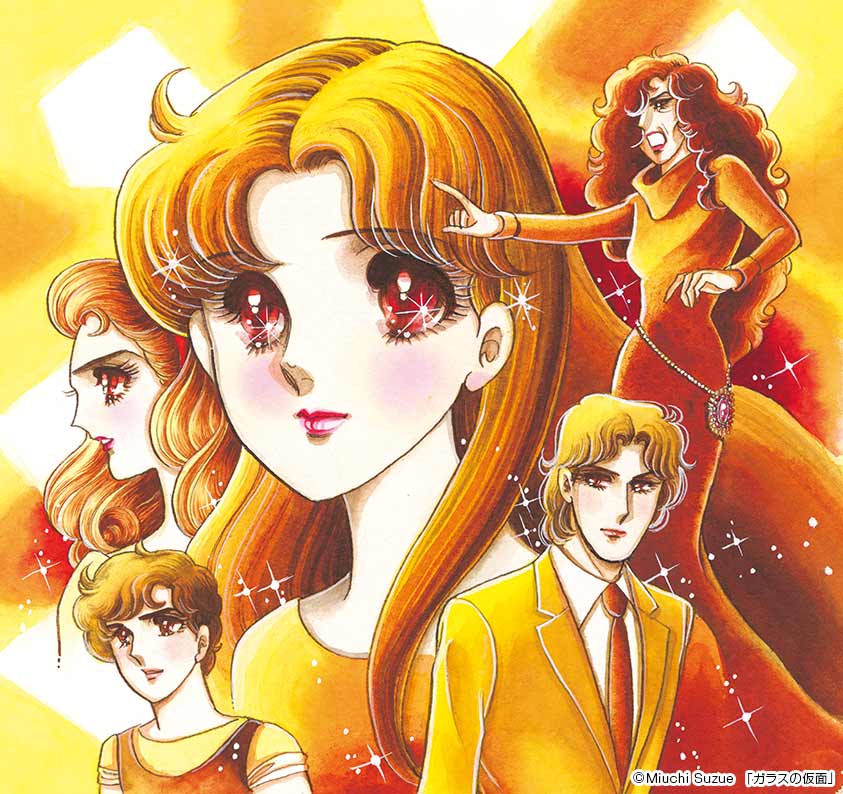
Glass Mask" is a Japanese girls' manga by Suzue Minauchi that has been serialized in Hakusensha's "Hana to Yume" magazine for more than 40 years since 1976, and as of September 2014 had sold more than 50 million copies, making it a bestseller that is considered a milestone in girls' manga.
Maya Kitajima, an ordinary young girl, has a burning passion for theater and puts everything she has into it, allowing her talent to flourish. Competing with the thoroughbred Ayumi Himekawa in the theater world, she aims to produce a masterpiece, "Benitenjo," which has never been seen before.
the earth (historically, esp. as opposed to the heavens)
[Background
The last issue is soil.
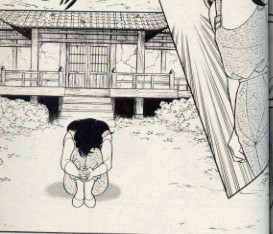
Ayumi focused on the variation of soil. Stones, rocks, sand, clay, texture, properties, types. Soil that changes into various things. Ayumi focused on Jomon-style earthenware and worked on an act using a rope.
Maya lies down on the earth and feels the soil. There, she focused on what is born, grows, and dies in the soil.
Associating with things that grow upwards, things that grow from the root, the soil that gives birth to all life, and mothers, she began to work on expressing the power of the earth, the mother of the earth.
Ayumi's performance
Ayumi uses a rope to express the earth. First, she performed a powerful and dynamic dance, and then created earthenware vessels using the rope. She draws water, drinks water, carries water, and puts things in earthenware vessels. All of this is expressed in a powerful dance, and at the end, the earthenware breaks and returns to the earth. The dancers expressed ancient life and the energy of the earth through their dance.
Maya's performance
The Maya became a seed buried in the earth and grew and sprouted in the earth.
Protected and nurtured by Mother Earth, the buds burst forth under the bright sun. The hopeful feeling of the seed was beautifully expressed.
Through these tasks, Ayumi thought and calculated in her head and acted, while Maya took in everything by instinct and sensation and acted as she naturally was. Ayumi was repeatedly astonished by Maya's instinct and talent.
celestial maiden
Background
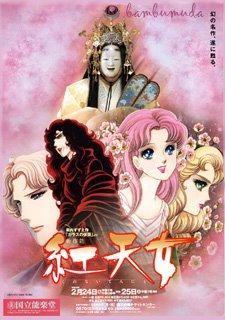
Red Tennyo" is said to be a fantastic masterpiece.
It is a masterpiece of Gekko-za written by Kazuyoshi Ozaki, the head of Gekko-za, and was a hit role for Chigusa Tsukikage.
Once upon a time, Chizu had no parents or relatives and lived under the care of a master who allowed his young children to steal and commit other crimes. One day, he was discovered by Kazuren Ozaki when he stole into the Gekkoza's dressing room, and he ended up being taken care of at the Gekkoza. He was taught Japanese dance and other arts with the troupe members, and Chiizu's talents developed. Eventually, she received the stage name Tsukikage Chigusa and began to appear on stage as an actor, becoming a popular performer. Soon after, the war broke out and the Gekkoza was torn apart. Ichien Ozaki, who lost his troupe and theater in an air raid, disappeared, and Chigusa, who was left behind, continued to search for him by asking Ichien's relatives and others for his whereabouts. Chigusa heard about Ume-no-Tani from Ichien's sister and went to Ume-no-Tani, where she found Ichien.
Seeing Chigusa emerging from among the plum trees, Ichiren saw in her the image of the Red Queen and said passionately that Chigusa was the only one who could play this role. Referring to the legend of the plum tree in an old shrine in Ume-no-Tani, Ichien wrote "Kohten-Onna", which became the first play to be performed by Gekkoza after its dismemberment.
The stage production of "Benitenjo" was a great success, and Gekkoza was back on its feet. After that, Chigusa Tsukikage became the signature actress of Gekkoza.
A man named Eisuke Hayami, who appeared as an enthusiastic fan of Gekkoza, began to approach Chigusa repeatedly, but she politely refused his advances. Eisuke, who wanted to help Gekkoza, began to take care of everything necessary for regional performances, including advertising, securing theaters, and transporting props, and became an indispensable figure for Gekkoza.
Eisuke was so pleased with the success of Gekkoza that he expanded the company's operations to include other productions as well as his own theater, thereby increasing its power.
However, most of Eisuke's influential collaborators were yakuza, and the theater company had to deal with yakuza as well. Eisuke decided to cut ties with Eisuke and set up Daito Geino, which took out many members of the Gekkoza troupe and dealt a severe blow to Gekkoza. With Eisuke as its enemy, the Gekkoza gradually fell into decline and financial difficulties. Soon after, Ichiren lost a lot of money on stocks, and Gekkoza became unable to run its business. When Chigusa learns that Eisuke is the one who offered her the stock offer and brought down the Gekkoza, she hates Eisuke and decides to stay with him and support him forever instead of accepting Eisuke's offer to take her out of the company. Chigusa tells Ichien of her secret feelings for him since childhood, and Ichien accepts her feelings. After spending the night with Chigusa, Chigusa hangs himself, leaving the rights to perform "Red Heavenly Woman" to Chigusa.
The remaining Chigusa hears the words of her valet, Genzo, who says that only Chigusa can perform "Benitenjo," and decides not to follow Ichirren. Continuing to hate Eisuke, who had wronged her, Chigusa joined a rival company of Daito Geino, where she became a very successful actress and a force to be reckoned with. Then, she was involved in an accident on stage when a light fell on her and burned half of her face, ending her acting career.
Synopsis.
A long time ago, in the era of the Northern and Southern Dynasties. The emperor, wishing for peace, asks a Buddhist priest to carve statues of celestial maidens. The Buddhist sculptor carved many statues of celestial maidens, but he could not find one that he liked. He wondered what he should do to carve a Buddha statue that would contain the spirit of the nymph. Someone told him that there was a thousand-year-old plum tree in a certain place, and if he cut it down and carved a statue of the nymph, he would be able to create a wonderful elephant with the spirit of the nymph in it.
The Buddhist priest set out on a journey in search of the plum tree, where he met a maiden, the Red Tennyo, the spirit of the plum tree made of a thousand-year-old plum tree.
On his way to the forbidden Red Valley, the Buddhist priest was caught in a war and lost his memory, and was rescued by a village girl, Ako Yoru. Ako Yoru was a goddess who heard the voice of the gods, but she fell in love with the Buddhist priest and gradually lost her divine powers. While spending time with Ako Yoru, the Buddhist priest witnessed Ako Yoru's divine power, which led her to gradually regain her memory. When the village chief and the warlords who had once received Akonyoru's divine power learned that Akonyoru's divine power was about to disappear, they tore Akonyoru and the Buddhist priest away from each other. Akonyoru is exhausted and weak after being torn away from the Buddhist priest.
When the warlord comes to check on him, he hears the voice of God and the will of God from the weakened Akonyoru, and he becomes determined to put an end to the warring world.
However, the warlord alone could not stop the war, and a fierce battle ensued. The war spread to Beniya, where Akoya lived, and he and the village chief entered the forbidden land to protect the Great God of Red.
The Buddhist priest hurriedly came to the Red Valley, and the sight of the burned village and the heaps of mutilated corpses completely awakened his dormant, distant memories. He remembered his mission, which was to dig a Buddha out of a thousand-year-old plum tree. As he was about to enter the forbidden land, he heard from the village chief that Akonya was weak, that he was being restored to his body by the Great Red God, and that the Great Red God was a thousand-year-old plum tree and that Akonya was its incarnation.
The Buddhist priest was reunited with Akonya in front of the plum tree.
That was the end of Tsukikage's performance. The scene of the confrontation between the Master and Akonya was left to the next generation of BENI TENJIN, Ayumi and Maya.
The scene of the battle between the Buddhist priest, who had to cut down the plum tree and carve a Buddha to fulfill the mission entrusted by the emperor, and Akonyoru, the incarnation of the plum tree, was not performed, and Genzo recounted the story that followed.
Several years had passed since the battle, and the whereabouts of the Buddhist priest were unknown. However, in various countries, a monk who mysteriously carved Buddha images instead of Buddhist prayers has gained a reputation. When the monk carves Buddha images and prays, the drought-stricken skies give way to rain, and the barren lands produce abundant crops. The blessing also resides in the Buddha image carved by the monk. The monk never stays in one place, but continues his journey while carving Buddha images. The Buddha image carved by the monk was inscribed with the Chinese character for "true.
Glossary of "The Glass Mask
celestial maiden
This work is considered a visionary masterpiece in the theater world.
It was written by Kazuyoshi Ozaki. It became the signature work of the Gekkoza theater, organized by Ozaki, and Chigusa Tsukikage played the role of Benitenjo, which was her biggest hit.
As only Chigusa Tsukikage or an actress whom Tsukikage had nurtured and approved could play the role of Benitenjo, the spirit of the plum tree, Tsukikage had to scramble after his retirement from show business to find a Benitenjo to replace him, and found Maya Kitajima in Yokohama.
After the death of Kazuyoshi Ozaki, Tsukikage, who had been handed over the performing rights, tentatively decided that Ayumi Himekawa, who had won the Academy Grand Prize for Arts for her performance of "Juliet," would be the next BENITENNYO. Maya Kitajima was not awarded the same prize as Ayumi Himekawa.
In the end, Maya Kitajima won the Academy Award for Best Performance for "The Forgotten Wilderness," so the two were forced to compete for the Red Heavenly Maiden.
Purple Rose People
It all started when Masumi Hayami was so moved by Maya Kitajima's first performance that she gave her a purple rose to express her feelings. Hayamizu was trying to get the rights to perform Benitenyo from Tsukikage Chigusa, so he sometimes used dirty tricks to hunt Tsukikage down. Because of this, Maya, his student, resented him so much that he could not honestly write down her name, so he wrote "I am your fan" and has been sending her flowers every time she performs since then.
When Maya is in trouble, he assists her by giving her these purple roses, and as a foot-long uncle to Maya, she is very grateful to him.
He helps Maya in any number of ways, from arranging for Tsukikage's hospitalization, to providing a rehearsal space for the role of Helen, to helping Maya get into high school, and even renovating the theater.
Since she started having Seito as an intermediary, she has been receiving gifts and messages of gratitude from Maya.
Hayami says and does things that may cause Maya to resent him, but behind his back, he continues to encourage her by giving her purple roses.
Until "The Forgotten Wilderness," Maya had no way of knowing who the person with the purple rose was, but a message she received from the person with the purple rose led her to suspect that the person with the purple rose was Hayami.
From then on, Maya's feelings for Hayami rapidly grow.
Tsukikage Theater Company
A theater institute started by Chigusa Tsukikage to gather talented actors from all over Japan and train the next generation of Koutenjo candidates.
With the support of Aoyagi Productions, the theater company had its own dormitory and other facilities in addition to the institute.
However, the group's membership plummeted due to obstruction from Hayami, who wanted the rights to perform "Benitenjo," and Hajime Onodera, the director of Ondine Theater Company, as well as rumors that Tsukikage was the president of Aoyagi Productions. In order to survive, the company had to win a prize in a national theater competition, but again, Onodera's interference disqualified the Tsukikage Theater Company, and Aoyagi Productions cut off its support.
The research institute and the dormitory were evacuated, and the remaining members of the troupe were reduced to about five, including Rei Aoki.
The rehearsal space is gone, but the company has been able to rent an underground theater, which it uses as its base of operations.
Gekidan Tsukikage became friends with Gekidan Ikkakujyu, whom they met at a national theater competition, and since then they have held several joint performances.
Ondine Theatre Company
An actor training institute run by Daito Entertainment.
Ayumi Himekawa and Yuu Sakurakoji are members of the group. In the past, Maya saw an advertisement for membership, and was going to apply, but gave up because of the huge monthly costs.
They competed in a theater competition with the theater troupe Tsukikage and tied for first place, and participated in the national competition.
At the national competition, they won third place in the audience's choice and first place in the jury's selection.
Hajime Onodera is the president and director of the company.
unicorn troupe
Gekidan Ikkakujyu represented Hokkaido in a national theater competition in which Gekidan Tsukikage and Gekidan Ondine also participated.
They had a reputation as a potential winner.
They train early in the morning with running and stretching, and are good at actions that use their bodies in a big way.
The leader of the troupe is Taichi Hotta. Members of the troupe include Hajime Tabe, Satoru Hosokawa, and Keiko Ninomiya, the most famous member of the troupe.
Gekidan Birds and Beasts Caricature is the model for Gekidan Ikkakujyu.
Hawk Street Group
It is one of the world's leading advertising agencies, chaired by the grandfather of Hayami Masumi's matchmaking partner, Takamiya Shiori.
It also operates a wide variety of other companies in the import, railroad, department store, hotel, transportation, construction, and food industries. In addition, the company has affiliated groups in the media-related fields, such as Chuo Television and Chuo Newspaper. The president of the Takatong Group is a man nicknamed Emperor Takamiya, who is also known as the mastermind behind the political and business world.
Takamiya Shiori's father is the president of Chuo Television.
Daito Entertainment
Eisuke Hayami, who left Okayama for Tokyo at the age of 14 to start a small transportation company, was captivated by a performance of "Red Heavenly Woman" by Chigusa Tsukikage, and expanded his business to support Chigusa, becoming successful enough to have companies all over Japan and to support the plays of the Gekkoza.
However, because many of his early collaborators were yakuza, he was cut off by the organizer, Kazuyoshi Ozaki, and had no choice but to start his own entertainment company. He had no choice but to start his own entertainment company, Daito Entertainment.
With many talents and theaters, it has become a leading entertainment company.
Eisuke Hayami is also involved in a wide range of other businesses, including Daito Real Estate, Daito Kosan, and Daito Kanko, not limited to the transportation business.
Eisuke Hayamizu, the founder of the company, was unable to have children when he was young and spent his life without marrying.
He married Masumi's mother and strictly raised Masumi as his successor, and the Daito Group is currently run by Eisuke as chairman and Masumi as president.
Icchu star school
Maya Kitajima, who had given up on entering high school, enrolled in this high school through an arrangement with the Purple Rose People.
Many celebrities attend this school, and it has a performing arts department.
The drama club is famous.
Maya, who had been expelled from the entertainment industry and was looking for a place to put on a play, found the school's gymnasium.
Maya staged a one-woman show, "Bianca the Female Pirate," as one of the performances at the school's cultural festival, and it was a great success. After receiving requests from the students, the play was re-performed, and after the re-performance, "Street Rain" and other plays were also performed.
Maya's one-woman show was so well received that the drama club offered her a chance to perform in their play, which was also well received.
It was the place where Maya, who had been expelled from the performing arts world, was able to make a comeback.
Famous quotes, lines, scenes, and scenes from "The Glass Mask

Related Articles
Can't Die Until I Read the Final Episode! The World of Long Form Shoujo Manga
The final installment of this long-running manga never seems to arrive, making us want to shout, "How long is this going to go on? and you want to scream, "How long is this going to go on? This tendency is mainly seen in shonen and seinen manga published in magazines such as Jump, but there are also epic manga in the shoujo manga genre. I can't die until I read the last episode! Here are some long-form shoujo manga.
Read Article
Late Night Gintama⁉"Osomatsu-san" Episode 7 Parody Summary
Episode 7 is all about Totti! We've also included a parody of Totti... and this time we've put together a parody of episode 7!
Read Article
A summary of seven reasons why The Glass Mask is not quite finished!
Kochikame" has come to an end, but there are many manga that never end, such as "Golgo 13" and "Berserk. There are also manga that "for some reason" never end, such as "The Glass Mask. Here is a summary of the reasons why they never end. Glass Mask" is a Japanese girls' manga by Suzue Minauchi, which began serialization in 1976.
Read Article
Tags
Contents
- Outline of "The Glass Mask
- The story behind "The Glass Mask
- The Girl with a Thousand Masks meets the Moon Shadow
- Rehearsal and purple roses at Tsukikage Theater Company
- Fighting in a Theater Competition
- Stage Arashi" Maya
- On Helen, the "Miracle Worker"
- Maya's success and scandal
- Re-emergence, and with Ayumi
- Return to show business and "Red Heavenly Woman
- Characters in "The Glass Mask
- Maya Kitajima
- Tsukikage Chigusa
- Rei Aoki
- Sayaka Minazuki
- Mina Sawatari
- Yasuko Kasuga
- Genzo Kobayashi
- Ayumi Himekawa
- Yuu Sakurakoji
- Hajime Onodera
- Mai Aso
- Masumi Hayami
- Eisuke Hayami
- Saeko Mizuki
- Hijiri Karato
- Ichien Ozaki
- Norie Otobe
- Ryuzo Kuronuma
- Gekidan Ikkakuju
- Shigeru Satomi
- Kikuko Harada
- Utako Himekawa
- Mitsugu Himekawa
- Kei Akame
- Haru Kitajima
- Sugiko Yamashita
- Shiori Takamiya
- Hiroko Kusaki
- Hiroshi Yoshizawa
- Peter Hamill
- The Glass Mask" play within a play
- Frauenkelmesser
- Wakakusa Monogatari (The Tale of the Young)
- comparison of statures
- destiny
- Castle of Ashes
- Gina and the Five Blue Jars
- White Youth
- Love in the Old Castle
- Beauty and the Beast
- prince's family register
- river running between Tokyo-to and Kanagawa Prefecture
- Snow White
- storm-drenched hill
- Smile of a Stone
- Japanese bird cherry (Prunus grayana)
- miracle-worker
- Splendor of the heavens
- Rainbow Memory
- beyond red light
- White Jungle
- Shangri-la
- golden seed
- Portrait of Carmilla
- Yasha-hime Monogatari (Tale of the Yasha)
- Romeo and Juliet
- Lady Pirate Bianca
- shower
- Frankenstein's First Love
- My work No.707 My Beloved Olympia
- Juliet
- A Midsummer Night's Dream
- La Traviata
- The Two Princesses
- Anna Karenina.
- Isadora!
- Forgotten Wilderness
- unsewn part of a hanging sleeve on a traditional Japanese woman's garment
- fire
- water (esp. cool, fresh water, e.g. drinking water)
- the earth (historically, esp. as opposed to the heavens)
- celestial maiden
- Glossary of "The Glass Mask
- celestial maiden
- Purple Rose People
- Tsukikage Theater Company
- Ondine Theatre Company
- unicorn troupe
- Hawk Street Group
- Daito Entertainment
- Icchu star school
- Famous quotes, lines, scenes, and scenes from "The Glass Mask
- The scene where Maya jumps into the ocean in the middle of winter and picks up her ticket.
- I'm going to be an actress!"
- The scene where Tsukikage protects Maya from her mother who came to bring her back.
- The scene where Maya confronts Ayumi in a challenge that requires her to keep performing with only four words.
- To have a "purpose in life" is to discover for oneself the value of living as a human being.
- The scene where Maya's mask comes off for the first time.
- The scene where Masumi Hayami gets upset when Maya hugs her.
- You can hit me or break me or do whatever you want...! I don't know how to apologize.
- I can't tolerate a miserable actor like you! I can't tolerate a lowly actor like you...!
- Oraaaa, it's Toki!
- I'll be waiting for you for two years!
- No matter how thick the shadows are, you can't have shadows without light..."
- The signal won't be red forever.
- Masumi-sama, the sea inside you is too wide for me to see..."
- Come on! Jane!"
- The scene where Hayami, alone in the midst of a typhoon, shows up for the first day of the stage performance of "The Forgotten Wilderness".
- The storm inside me doesn't look like it's going to let up anytime soon..."
- The dream is over..."
- The scene where the two really mean what they say to each other after the Red Tennyo rehearsal in the Valley of Plum Blossoms.
- "You must remember... I hate purple roses.
- The scene where Hayami protects Maya at her own risk.
- The scene where Hayami embraces Maya when she can no longer fool herself about her feelings.
- The scene where Shiori tried to commit suicide by entering the pond with the purple roses she hated.
- The scene where Hayami nodded his head to stay by Shiori's side, but could not give up his feelings for Maya and divulged his true feelings to Sei.
- Theme song for "The Glass Mask
- 1984 Aiken version OP: Mariko Ashibe "Glass Mask
- 1984 Aiken version ED: Mariko Ashibe "Purple Light
- 2005 Tokyo Movie Version OP: Candy "Promise" (Episodes 1 - 26)
- 2005 Tokyo Movie Version OP: Aiko Ikuta "zero" (Episodes 27 - 51)
- 2005 Tokyo Movie Version ED: Aina "Yasashii Sayonara" (Episodes 1 - 13)
- 2005 Tokyo Movie Version ED: Sister Q "Step One" (episodes 14 - 26)
- 2005 Tokyo Movie Version ED: Splash Candy "Honto ni narenakute" (Episodes 27 - 39)
- The Glass Mask" TV Drama
- Summary of the TV drama "The Glass Mask
- The Glass Mask" TV Drama Main Characters and Characters
- Theme song for the TV drama "The Glass Mask
- OP: B'z "Calling
- ED: Yuki Haruhara "Polar Star - Kimi Dake Dake Shinobu" (Polar Star - Only You Can Believe)
- Series 2 ED: B'z "Happiness
- Backstory, Trivia, and Anecdotes of "The Mask of Glass
- It was actually supposed to take about two volumes.
- Purple roses really are a thing.
- Total number of white-eye scenes is about 1,300.
- Masumi Hayami is officially on Twitter.
- Purple roses are given to the "Mask of Glass" project exhibition.