
Banished" is a city management simulation game developed by Shining Rock Software.
The player must lead the inhabitants of a banished city through a variety of survival strategies in order to keep the banished people alive.
Compared to similar city management simulations such as "SimCity," the difficulty level of "Banished" is a bit more severe.
Overview of Banished
Banished" is a city management simulation game developed by Shining Rock Software.
The title "Banished" means "banished (people).
It is pronounced "banished," but the katakana form often used by players is "banished.
The objective of the game is to keep the exiled people alive and inherit their development.
There is no scenario, and there is no goal that must be accomplished within a certain period of time.
The game content is to keep the inhabitants alive and to keep the settlement going.
Compared to "SimCity" and similar city management simulation games, the level of difficulty is a bit more severe.
Failure to adjust the balance of food self-sufficiency and population increase/decrease can lead to large-scale starvation and freezing to death. Other disasters, such as natural disasters like fires and tornadoes, plagues of the inhabitants, insect infestation of the fields, and livestock diseases, can also cause unexpected devastation.
The game can be purchased from the official website of Shining Rock Software or from Steam.
The price is 19USD, and Steam allows for payment in Japanese yen, and the purchase procedure can be done in Japanese, so the hurdle to purchase the game is low.
As of 2017, the game is only available for Windows, but Mac, Linux, and SteamOS versions are planned for the future.
Shining Rock Software has no plans to update the game, and the company's stance is that users should add additional features through mods (data files that extend the game's functionality).
The game is entirely in English. The game is written in English, but the text is short and plain, and the icons give a rough idea of the meaning.
If you can read a sentence as simple as "The reserve of Fire Wood is low," you will be able to play the game.
The tutorial is in English, which makes it a little difficult to understand, but it is enough to get a rough idea by watching the actual game on YouTube, Nico Nico Douga, and other video distribution sites.
About Mods
A mod is a user-made data file that modifies or adds to game data.
They include replacing textures and models in the game, adding new maps, items, etc., adjusting game balance, fixing bugs, localizing languages, etc.
Banished has a tolerant attitude toward mods, releasing the source of game programs and providing an environment where users can easily create mods.
In response to this, various mods have been created since the release of the source code, both domestically and internationally.
However, the balance of the game is not such that it cannot be played without installing mods, and the game can be played just fine in its vanilla version (with no mods installed).
The main mods used in Banished are mods for localizing the language of each country and mods called Colonial Charter (commonly known as CC).
Language localization mods are translations of the English text in the game into the language of each country. Since the translation is done by the individual user, the same "Japanese localization mod" may be expressed differently in different languages.
CC is a large scale mod called Mega MOD, and it is said that if you are used to the vanilla version and want to play with some mods, it is enough to install CC without installing any other mods.
With CC, you can set the terrain (flat or mountainous), temperature and weather conditions that affect the difficulty level of the game, add resources and facilities for processing them, and add food, crafts, and luxury items.
Mods created by other users can do the same, but the amount of modifications that can be done with CC is far greater, which is why it is said that "CC is all you need for mods.
The "Banished" System
residents
Residents, male and female, each have a life expectancy ranging from 0 to a maximum of 80 years.
At age 10 or older, men and women marry and have one to three children.
There is no concept of a family tree here, and a state of incest can also occur, with siblings C and D, the children of couple A and B, marrying and giving birth to a child named E.
Each resident has his or her own health and happiness level.
Health is a parameter related to the occurrence of disease. If it is low, the residents are more likely to get sick.
Happiness is a parameter that affects the behavior of residents. If it is low, people will abandon their jobs (i.e., lower productivity) and will not marry or give birth (i.e., lower fertility will lead to a decrease in the population).
The impact of both parameters is quite pronounced, with frequent illness and abandonment of work at levels below half.
Each resident takes up an occupation and works in the facilities assigned to him or her.
When they feel hungry or tired, they return home to eat and rest. If there is no food, clothing, firewood for warmth, or tools for work in the house inventory, they go to the barn or market to get them. This is the routine.
The placement of each building is important, because if the house, workplace, barn or market are too far away from each other, the person will starve or freeze to death during the journey.
Occupation of residents
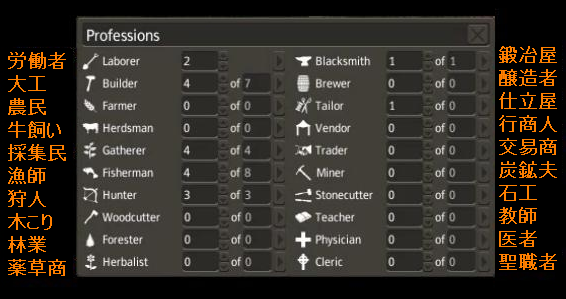
Resident positions can be worked by the player designating a citizen to some position.
Citizens who are not assigned to a specific job automatically become Laborers.
This occupation can be changed at any time.
The occupations are Builder, Farmer, Herdsman, Gatherer, Fisherman, Hunter, Woodcutter, Forester, and Herbalist, Blacksmith, Brewer, Tailor, Vendor, Trader, Miner, Stonecutter, Teacher, Physician, and Cleric. Adult residents are first classified as Laborers. From there, players are assigned to their respective professions.
Residents who are not Laborers are automatically replaced by Laborers when they die due to illness, accident, life expectancy, or other reasons.
Laborer
They are responsible for collecting wood, stone, and iron, transporting raw materials to storage facilities, and transporting raw materials to construction sites.
Adult residents, nomads, and those who have lost their jobs for whatever reason are categorized here.
Residents with occupations other than laborer automatically assume the role of laborer when they do not have a real job (e.g., farmers in the winter).
Builder (Carpenter)
The Laborer is responsible for the construction of new buildings.
The Laborer is responsible for transporting resources to the building site, but it is the Builder's job to build the facility from there.
If the building to be constructed is not located anywhere on the map, the builder does the same job as the laborer.
Farmer
They are responsible for cultivating fields, orchards, and manufacturing food. Work in the fields.
In the spring, they plant and care for the crops, harvest them in early to late fall, and transport them to a nearby warehouse. During the winter months, they are off-farm and do the same work as Laborers.
The fields are facilities that operate from spring through fall, and food cannot be obtained until the fall harvest season. Instead, the production volume is much higher than that of other food production facilities.
Herdsman
Occupation responsible for raising and slaughtering livestock on pastureland. They work in pastureland.
In the vanilla version, cows, sheep, and chickens can be raised, and food and resources can be produced from them; with the introduction of mods, llamas and ducks can be raised.
In addition to meat, livestock can produce by-products such as eggs from chickens, wool from sheep, and hides from cows. Eggs can be used as food, and wool and hides can be used to make clothing.
Because of the availability of by-products, meat production is not so large, but it is not affected by the weather as in the case of fields, and stable production is possible.
Gatherer (wild vegetable trader, wild vegetable picker)
A job that provides food to citizens by gathering raspberries and wild vegetables in the forest, working in a gatherers hut.
Raspberries and wild vegetables reappear without any work, so unlike farmers, who need seeds, and herdsmen, who need livestock, this occupation can provide food for the residents without any initial investment.
However, the production of raspberries and wild vegetables is small, so it is difficult to provide food for all the residents with only these.
Fisherman
A job that provides food to citizens by gathering fish from rivers and lakes and working in a fishing dock.
As with the Gatherer, no initial investment is required, and food production begins simply by building a fishing dock.
The food production is stable throughout the year, and the amount of food produced per unit area is the highest of all food production facilities.
Hunter
A profession that involves hunting deer and harvesting food and hides, working in a Hunting Cabin.
This is also a profession that only requires building a Hunting Cabin to start food production.
In the early stages of the game, it is better to leave food production to the Gatherer, Fisherman, and Hunters, and when the game has developed to a certain extent, to increase the number of Farmers and Herdsmen by building fields and grazing lands.

Contents
- Overview of Banished
- About Mods
- The "Banished" System
- residents
- Occupation of residents
- Laborer
- Builder (Carpenter)
- Farmer
- Herdsman
- Gatherer (wild vegetable trader, wild vegetable picker)
- Fisherman
- Hunter
- Woodcutter
- Forester
- Herbalist
- Blacksmith
- Brewer
- Tailor
- Vendor
- Trader
- Miner
- Stonecutter
- Teacher
- Physician
- Cleric
- facility
- Houses, roads
- Wooden House, Stone House
- Boarding House (Row Houses, Apartment Houses)
- Dirt Road (gravel road), Stone Road (paved road)
- Bridges, Tunnel
- administration
- Well
- School House
- Hospital
- Town Hall
- Chapel
- Cemetery
- Material storage facilities
- Storage Barn
- Stock Pile
- Market
- Trading Post
- food production facility
- Crop Field
- Orchard
- Pasture
- Fishing Dock
- Hunting Cabin
- Gatherer's Hut
- Resource Manufacturing Facility
- Wood Cutter
- Forester Lodge
- Herbalist (herbalist's hut)
- Blacksmith (Blacksmithing)
- Tailor (sewing shop)
- Tavern (Brewery)
- Mine
- Quarry
- Natural disasters, illness
- hunger
- coldness
- disease
- Accidental death of a resident
- (crop) damage
- tornado
- fire
- Backstories, trivia, and small stories/episodes and anecdotes from Banished
- Number of producers
- River reclamation
- Cautions for installing mods
- Roots
- Pepper's Japanese translation