
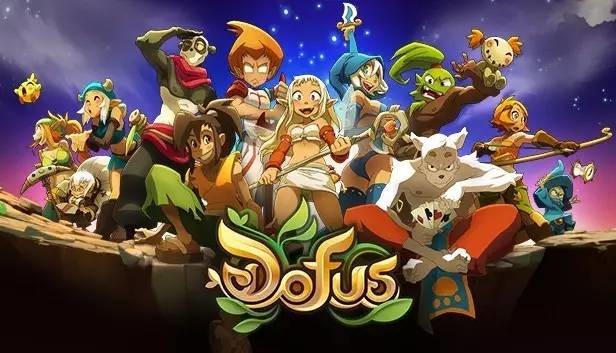
Dofus" is an MMO RPG developed and operated by the French company ANKAMA.
It is a 2D turn-based simulation RPG using Adobe Flash and is basically free to play.
Players travel in search of "Dofus," a magical egg left behind by a legendary dragon.
party
A party of up to 8 people can be formed.
The breakdown is free and there are no restrictions, such as all being healers or attackers unified.
In addition, multiple accounts and multiple client launches are officially approved, so if you want to, you can use 8 accounts and have all the members in the party be you.
side kick (rugby)
A sidekick is a person who assists the player in combat. They can be added to the party just like characters, and can join the PT to fight in place of the characters.
The number of sidekicks is limited to one per character. Sidekicks appear on the battlefield at the start of the battle by equipping them in the places set as equipment slots. Since sidekicks are counted as part of a party, it is not possible to have a party of 16 by forming a party of 8 and calling up 8 sidekicks.
It is only a "help function for solo players" and is not so useful as a force multiplier.
It is better to form a party with multiple accounts and multiple client launches, which are officially sanctioned.
Collection and production occupations
It is different from the class and is a so-called gathering and production job. The upper level of this class is also 200.
There are two main types of jobs: the harvesting jobs of farmer, fisherman, lumberjack, miner, and hunter, and the crafting jobs of alchemist, shieldmaker, tailor, baker, knight, weaponry craftsman, and lapidary.
There is no limit to the number of jobs that can be acquired, and a single character can master all of them.
Gathering: Gathering resources from fixed gathering points scattered throughout the field.
Crafting can be done at the production tables in the workrooms in towns and in the field.
Basically, the collected items are processed and made into equipment or consumable items.
For example, wheat collected by a farmer is processed into flour, which is then made into bread at a bakery. Miners use the ores they collect as materials for shield makers and weapon makers to make equipment items, and so on.
sorcery
Magic is the process of strengthening equipment and enhancing its status.
Equipment that has just been made has a wide range of status, and even the same equipment has different strengths. The role of sorcery is to reinforce the equipment and increase its status.
The success rate of magic depends on the level of the magician and the item level. Therefore, the above craftsmen who can produce equipment will raise their "magic craftsman" level at the same time.
Shield craftsmen, weapon craftsmen, tailors, and lapidary craftsmen are each capable of performing sorcery. And in order to perform magic, the level of "magic craftsman" is required. It is not strictly an occupation, but it is like a profession.
For example, a tailor who can create head and cloak equipment can become a tailoring craftsman, and can raise the level of tailoring magic.
Tailoring craftsmen can apply magic to equipment categories classified as tailors (head and cloak equipment). He cannot cast spells on equipment that does not fall into the tailor category (shoes, etc.). If you want to do so, you need to learn and raise the level of the magician of the relevant category.
For example, the "Genkei Bow," which has the effect of inflicting damage and recovery at the same time, is a very useless weapon because its damage and recovery are canceled out.
The weapon's status can be increased or decreased by using sorcery, so that it can be used as a powerful weapon by increasing its damage status while decreasing its recovery status, or by increasing its recovery status and using it as a "weapon that heals when hit", or by biasing it in either direction.
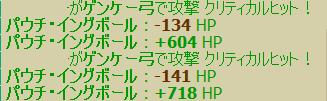

Even with the same equipment, there is such a difference depending on the magic.
The attack with the Genkei bow above is a "weapon that heals the target" because the amount of damage is less than the amount of recovery.
On the other hand, the attack with the lower Genkei bow is more damaging and inflicts damage on the target.
market
Dofus" allows players to buy and sell equipment and items they have acquired and manufactured. The unit of currency is the "kama".
In this game, where players cannot buy equipment or items from NPCs, the only way to buy items is through this market.
There are also so-called open-air stores, which are set up while players are logged out, but these are not very active.
The market is a form of consignment sales to the system, and players can set which items to sell, in units of 1, 10, or 100, and at what price.
For example, "1 piece of wheat sold for 10 kama," "10 pieces of wheat sold for 100 kama," "100 pieces of wheat sold for 1000 kama," and so on.
Sales and unsold items are sent to a bank (a facility that serves as an item warehouse) in each town.
quest
In "Dofus," there are no so-called "main quests" to advance the storyline.
The quests for unlocking elements are very short, sometimes ending with a simple "talk with an NPC on the next map.
The rest of the quests are based on understanding the world through the dialogue of NPCs and imagining each episode, and you can play the game without doing any of these quests.
extinct ancestor of the modern cow, Almanacus almanacus
One of the daily quests, which is to be done over a 365-day period, is to make a daily offering to a spirit called "Merid.
Meridos are like mourning gods, and each one is different, each having its own unique attributes. Each "Merid" is like a mourning spirit, and each one is unique, from "Merid of swords" and "Merid of tears" to "Merid of underwear" and other unique ones.
When you make an offering, you will receive a bonus according to the Merid of the day.
The bonus may be a bonus for a certain dungeon, an increase in the drop rate of a certain monster, an increase in the success rate of a magic spell, or the return of a portion of the materials used to make a piece of equipment, depending on the day.
Tributes and bonuses can be found on the dedicated website.
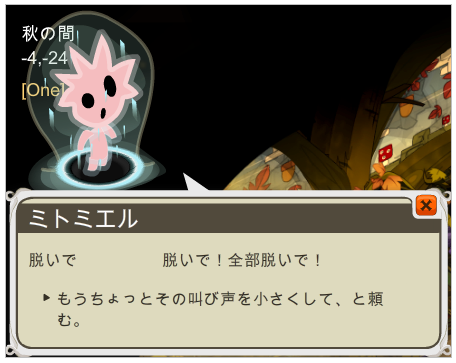
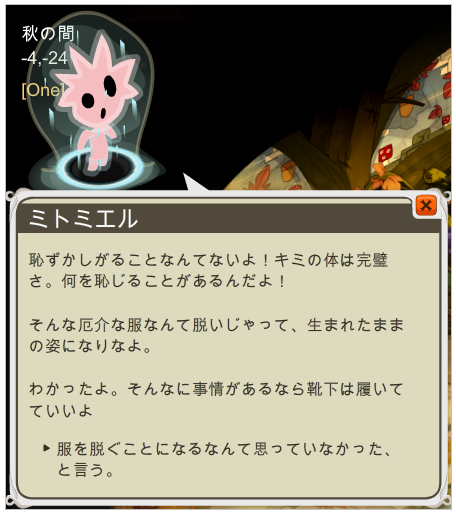
When you make an offering, you can have a conversation with Merid, but the content of the conversation is in a roundabout way that is uniquely French.
Mithomiel is the Merid for November 1, and she is the protector of "impudence. Take it off! The offering to Mithomiel, who insists, "Take off your pants!
Pet Mount
Pets and mounts (mounted animals) do not fight together like in other games, but rather "function as equipment" such as status increases.
Because they are treated as equipment, there are various types of pets and mounts, depending on their status.
The status of each type of animal grows by feeding it a specific food.
The main ways to obtain them are as rewards for quests, drops from boss monsters, or by paying for them.
These can be traded on the market, and pets that can only be obtained by paying for them can be purchased with in-game currency.
dungeon
You can enter the dungeon by talking to the NPC standing in front of each dungeon and consuming the "dungeon key.
The system is similar to a stage system with a series of 4 to 5 small rooms, and you must defeat the enemies in the small rooms to proceed to the next room.
The difficulty level is almost the same as in the field. In the field, the placement and enemy groups change depending on where you come in contact with them, but in the dungeon, they are fixed, so it is easy to create a pattern and go around in circles, which is ideal for leveling up.
The number of enemies changes depending on the number of people in the party.
In the same room of the same dungeon, if you go with a party of 4, the number of enemies per group will be 4, and if you go with a party of 8, the number of enemies per group will be 8.
The strength of the enemies does not change depending on the number of players; in fact, the more players there are, the longer it takes to fight each battle.
The number of enemies does not decrease even if two people challenge the same dungeon, but the minimum number of enemies is four.
The strength of party members is not limited by the dungeon they enter.
For example, if a high-level player who has reached his or her maximum level enters a low-level dungeon for beginners, his or her level will remain at the maximum value of 200.
Naturally, if a high-level player who has reached his or her highest level enters a low-level dungeon for beginners, the battle is over in an instant.

Related Articles
Class Summary for Wakfu
Classes are the races of "Wakfu," the MMO and animated film developed by the French company ANKAMA, and the MMO's predecessor, "Dofus. The MMO version of the game allows players to choose a class when they create their characters.
Read Article
Spoiler commentary and discussion of Wakfu (animated version of Wakfu)
Wakfu" is an animation produced by the French company ANKAMA. The worldview is similar to that of the MMORPG of the same name, and the story is about a boy named Hugo who has the ability to use a portal to travel at any moment, and his journey to find his "real family" with the support of various friends. In Japan, the film is available on Netflix and Disney XD.
Read Article
Summary of Wakfu Spoilers and Discussion
Wakfu" is an MMO RPG developed and operated by the French company ANKAMA. It is a 2D turn-based simulation RPG using Adobe Flash and is basically free to play. Players travel through "12 worlds" that have been completely devastated by a catastrophe called "Ogrest's Chaos.
Read Article
Summary of famous quotes, lines/scenes and scenes from Wakfu
Wakfu is an animation produced by the French company ANKAMA. The original story is based on the world of the MMO (online game) of the same name. Various spin-offs have been created, ranging from short movies to manga. The first season aired in France in 2008, and the Japanese dubbed version will air on Disney XD on July 23, 2017.
Read Article
Contents
- Overview of Dofus
- Synopsis and story of Dofus
- Classes in Dofus
- feca
- Osamodus.
- Nutrov
- Sulam
- xerol
- Ecaflip.
- Enillipsa.
- yiop (i.e. a fever that brings with it an intellectual or psycho-developmental disorder)
- clapper (two long pieces of wood that are clapped together; used in gagaku, etc.)
- sadida
- sugar cane juice
- mandawa
- tactician
- zobar
- steamer
- heliotrope
- huppertemarge
- eugenic
- Game System of "Dofus
- combat system
- Level/Status
- equipment
- Movement/Action
- self-challenge
- party
- side kick (rugby)
- Collection and production occupations
- sorcery
- market
- quest
- extinct ancestor of the modern cow, Almanacus almanacus
- Pet Mount
- dungeon
- Backstory, Trivia, and Anecdotes of "Dofus" (Dofus)