乙嫁語り / A Bride's Story

Ototo Yome Gatari" is a historical manga by Kaoru Mori that was serialized in the bimonthly magazine "Fellows!" (Enterbrain) from October 2008 and in the newly launched "Blue Knight" (KADOKAWA) from April 2021. Fellows!" was a bimonthly magazine that changed its name to "HARUTA" (published 10 times a year). This work was the magazine's signature title.
The story takes place in the region around the Caspian Sea in Central Asia, and depicts the life and culture of Otowome and other people living in the harsh natural environment.
Thirteen volumes of comics have been published in book form, and 12 volumes have been published in a collector's edition. In 2010, the manga won second place in the "National Bookseller's Choice Recommended Comics" list. In 2011 and 2013, it took second place in the "Manga Grand Prix" and won the grand prize in 2014. It won the Intergenerational Award at the "Angoulême International Cartoon Festival 2012" in France and was selected as one of the 10 best graphic novels for teens by the National Library Association in the United States. An exhibition of original artwork was also held at Tokorozawa Sakura Town from February to March 2022.

Related Articles on 乙嫁語り / A Bride's Story

Reviews, Ratings and Comments on 乙嫁語り / A Bride's Story

乙嫁語り / A Bride's Story
10

A cartoon about Central Asia, where everything is just beautiful.

Ototo Yome Gatari" is a work by Kaoru Mori and is set in Central Asia in the late 19th century.
At the beginning of the story, Amir, a girl from the nomadic Hargar family, marries into the family of Karluk, the boy head of the Eihon family, who lives a sedentary life in the town. Despite the presence of the Eihon family, who are 12 years older than Karluk, and Amir's own father, who wants to use his daughter as a tool in a political marriage, Amir, who has a lively and sincere personality, and Karluk, who is young but responsible and aware as a husband, gradually grow close to each other.

Although these two may seem to be the main characters in the story, the real protagonist is actually Smith, a young Englishman who travels throughout Central Asia and keeps ethnographic and geopolitical records. In his travels, he meets and interacts with various people, especially beautiful brides, maidens, and widows, and documents local culture and conditions (although Amir and Karluk, who appear at the beginning of the manga, have a particularly large part in the story).

Most of the people Mr. Smith comes into direct contact with on this journey are good people, both women and men. In addition, even when there is an altercation, the story generally has a happy ending, making the manga a stress-free read despite its unusual theme of modern Central Asia.

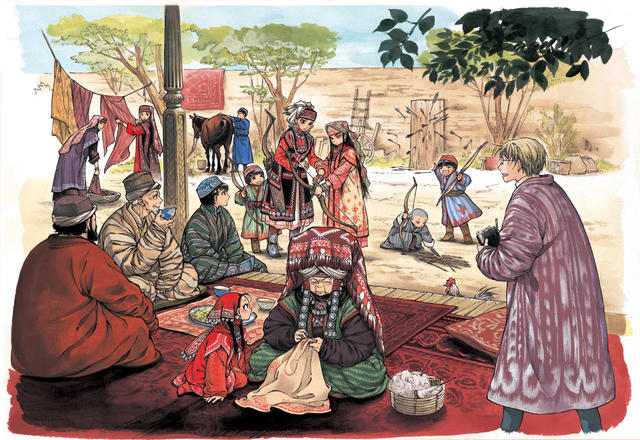
The greatest highlight of this manga is the depiction of clothes, rugs, ornaments, and animals that are so precisely drawn that it hurts the eyes. In particular, the depiction of the heroine's wedding dress and the bedding used for the betrothal ceremony is so detailed that it is no exaggeration to say that each frame is a work of art.
These are all important elements for people living in the magnificent, beautiful, and harsh environment of Central Asia, and the artist's drawings convey this more eloquently than the text.

The story structure of "Ototo Yome Gatari" is interesting, but just looking at the beautiful pictures, including the backgrounds, is soothing and immerses the reader in the world of modern Central Asia, which is something we are not usually exposed to. I think this work can be enjoyed by everyone, not only by history buffs and manga fans.

乙嫁語り / A Bride's Story
9

Manga set in Central Asia to the Middle East

Central Asia is rarely featured in Japanese manga.
The theme of "Okko-no-Monogatari" is brides and grooms in a wide range of regions, from Uzbekistan in the 19th century, just before the war with Russia, through Kazakhstan, Turkmenistan, and other Central Asian countries to Afghanistan and the Middle East.
The story centers on 20-year-old Amir, who married 12-year-old Karruk, and Smith, an Englishman who met Amir and Karruk as they traveled from place to place, but there are also omnibus elements.
The things a bride wears, what is necessary for a wedding, sister marriages that we do not know at all, etc. In Japan, where many people do not know Central Asia or the Middle East, the world of the 19th century, which is even more unknown, is depicted with precise lines that represent the slow passage of time and the universal inseparability of people's love, hearts, and homes. The work depicts the inseparability of love, heart, and home as universal things.
You may have seen somewhere in old photographs, in documentary footage of places in the mountains where cameras seldom come, people wearing beautiful intricate embroidery and trinkets on fabric.
That figure appears directly in the manga.
When you get to the Middle East, that embroidery and trinkets disappear, women wear burqas and chadors, and then you get as far as the Turkish port city of Antalya, where people are once again dressed in colorful clothing.
The differences in dress and customs between the regions and the bewilderment of the people are shown from the point of view of Smith, who is a rhapsodic figure in the work, and the reader is able to empathize with her. This manga shows the daily life of the highlands and snow fields, with sheep and horses as livestock, through the artist Kaoru Mori's drawing ability.

乙嫁語り / A Bride's Story
10

A tale of a marriage between the historic atmosphere of the Middle East and the peaceful people of the Middle East.

This is a beautiful work that was selected as one of the best in the manga category a few years ago, and is well known by those in the know.
The artist's ability to express himself is very wonderful.
The magnificent backgrounds, furnishings, and artistic houses that can be seen in the intervals, as well as the beauty of the folk costumes that are drawn in each episode, are truly enchanting.

The stories depict how each of the characters met their significant others and how they came to spend their lives happily.
Some of the stories are about battles that give a glimpse of the historical background, but most of the stories are about ethnic troubles. There is also some love in the story, which is an important element of the story.
However, there are basically no brutal scenes.
Most of the stories are very atmospheric and comforting.

In the midst of the peaceful stories, there are many scenes that make me laugh unexpectedly, and I felt the overall balance of the story is wonderful.
I found the overall balance of the stories to be excellent.
However, I would recommend this work to be read before going to sleep as well, as it is a very calm and pleasant read.

Also, perhaps it is the spirit of the author, but the way she draws the animals is extraordinary!
They are vividly alive and are expressed in a truly wonderful way.
The artist himself seems to love such work, and you can tell that he enjoys drawing them.
The postcards are also quite enjoyable and make me naturally curious about her other works as well.

The manga is so tasteful that I bought all the volumes myself.
If you haven't picked it up yet, this is one of those works that I really recommend.

乙嫁語り / A Bride's Story
8

Exotic stories of everyday life with detailed drawings.

This manga is just amazing in the beauty and precision of the drawings. The quality is such that you will want to display every page as it is.
The story takes place in Central Asia in the middle of the 19th century. The story progresses from the perspective of Smith, a young Englishman traveling for academic research. As the name suggests, the story focuses on the brides Smith encounters in each place he visits, and even amidst the rigid marriage customs of the time, the way they struggle with their own love lives is depicted in a funny and sometimes hilarious manner.
The differences in customs and lifestyles from place to place are also interesting and make you feel as if you are traveling with the Smiths. Although there are some major disturbances, the story basically unfolds peacefully and is sure to appeal to those who like nomadic tribes, embroidery, horses, bows and arrows, etc. As mentioned at the beginning of the book, the story is about a maiden's wife who is married to a man who has been married to a man who has been married to a woman.
As mentioned at the beginning of this article, one of the charms of Otowome Narrative lies in its intricate paintings. People of this period wore richly embroidered clothing, and the embroidered patterns on every page, on the costumes of the characters and on the decorations in their rooms, are so detailed that one can only marvel at them.
The various animals that appear in the book, which depicts nomadic tribes, are all realistic and full of energy, which adds color to the story. This is a work that will make you feel happy not only by enjoying the story, but also by simply looking at the pictures.
In these times when it is not easy to travel abroad, why not immerse yourself in this story and experience the atmosphere of a foreign country instead?

乙嫁語り / A Bride's Story
10

I recommend this manga to those who like gentle romance manga and, incidentally, to those who like the history of Central Asia.

The manga I would like to introduce is "Ototo Yome Gatari" written by Kaoru Mori and published by Enterbrain.
I am sure that many of you are familiar with this manga, as it has won numerous Manga Grand Prize awards, but I would like to introduce it to you because it is a manga that I myself would like to read again and again and again and again to share my love for.
The story takes place in 19th century Central Asia, where the main character, Amiru, marries Karluk, who is eight years younger than her.
As the title suggests, the story depicts the married life of Amir and Karluk, the love lives of the people around them, the living conditions of the time period, and the gross history of modernization, sometimes featuring newlyweds who are different from Amir.
The highlight of the book is the illustrations, which are detailed and delicately drawn in every panel based on background research of the period.
As you read the manga, you are drawn in by the people's clothing, animals, and knick-knacks, as if you were actually there.
The depiction of embroidery on carpets and clothing unique to Central Asia makes us think about the dexterity of the women who lived in that era and the traditional craftsmanship that is dying out.
(Speaking of knick-knacks, Amir's friend Pariya makes a comb case that is so much to my liking that I am now planning to make one myself.)
) The characters in the book include the main characters, Amir and Karluk, the people of the Eihon family (especially the grandmother is wonderful!), and the Englishman, Smith, who is staying at the inn. ), the Englishman Smith, Amir's friend Pariya, and the new wives Smith meets on his travels, each and every one of them has the charm to become a main character.
As of September 2020, the book has already been published in 12 volumes, and if you are a manga reader, the number of volumes is neither too many nor too few (although I personally always feel that the number of volumes is too few in the sense that I want to know more and more about the story), which seems to be just the right number to get into this story.
I don't think I can convey all the charms of Ototo Yome Narrative in my poor writing, but I hope that as many people as possible can learn more about the story and enjoy the world of Ototo Yome Narrative.

乙嫁語り / A Bride's Story
9

Nomadic lovers should not miss "Ototo Yomegatari.

The manga "Ototo Yome Gatari" is drawn by Mr. Mori, the author of "British Love Story: Emma. Ototo-yome" means "cute bride," and as the name implies, the main character is "Amiru," a beautiful and strong nomadic bride. The highlight of this manga is that it meticulously depicts the culture of maniacal Asian and Middle Eastern nomads. The embroidery that is drawn frame by frame conveys the artist's fierce enthusiasm. Even the animal drawings are like paintings, frame by frame. The women gather to bake bread, hunt with a bow on horseback, and create costumes for a wedding ceremony, all so carefully drawn that you feel as if you are living there with them. Conversely, the story does not move dramatically. While the story centers around the main character Amir and Smith, a traveler from England, it slowly continues with the lives of the people around them and little incidents. So, for example, if you are looking for flashy battle scenes or dramatic love stories like Emma's, you will find it somewhat lacking. The enjoyment of this manga depends on how well you fit into the nomadic lifestyle and how interested you are in details such as the furnishings and food depicted in the background. If you are interested in nomads from the start, or if you like the culture and clothing of Asia and the Middle East, you will find it more interesting and vividly conveys the local lifestyle than most travel guides.

乙嫁語り / A Bride's Story
8

Marry me now! I've been trying to do that for a while.

The author's drawings are beautiful and detailed. The beautifully drawn characters, climate, cuisine, and animals are all so unique and fascinating that it takes me 10 minutes to read or even observe a page. I was drawn into the work to the extent that I felt it took me 10 minutes to read, or rather observe, a single page. I recommend this book to anyone who likes to look at detailed illustrations and animals. Also, the main characters change as the story progresses, so what happens there and the people you meet change, and you will never get bored even if the theme of the work is everyday life or the local climate. As the name "Otsu-yome" suggests, there are many young wives or daughters-to-be who appear in the story. Although the environment surrounding these women does not allow them to freely fall in love, the process of deepening their love as a couple as a love story that begins with marriage, and the description of realizing that it is love, makes us feel happy when we read the story. Also, Amiru, one of the first main wives, is a hunter and hunts rabbits and handles them with great skill, and her younger husband Karluk is always surprised by her survival skills. Since the comics are published bimonthly, they are released only once a year, so I am faced with the dilemma of not being able to read the rest of the series immediately.

乙嫁語り / A Bride's Story
9

You can travel across time and countries.

The story begins in 19th century Central Asia, with the main character, 20-year-old Amiru, who has married 12-year-old Karluk. More like a manga specializing in history than a regular comic, the historical background, clothing, and food culture are painstakingly depicted, so that the reader is easily swept into the worldview and feels as if he or she is visiting the country. In particular, the embroidered cloth that women make to prepare for marriage in the region where Amir is depicted is depicted in many scenes and draws you in with its beauty. Even if you don't read the book, just looking at them is a delightful experience.
The main characters change from volume to volume as they move from region to region, allowing the reader to enjoy a variety of cultures. The stories are all centered around the theme of marriage and married couples, with many customs and scenes that are different from those in modern Japan, such as parents discussing and meeting each other for the first time on their wedding day, men and women not being allowed to go out together before marriage, marriage in their teens being considered normal, and large families with many relatives living together. The customs and scenes are fresh and interesting. The problems between the relatives of both families are dynamically depicted, sometimes leading to battles, and the scenes that make the viewer's hands sweat are vividly depicted. Although it is an epic story that spans countries, regions, and ethnic groups, the main characters and regions change from volume to volume, and the humor is well-paced, so the story is never overly broad or confusing.

乙嫁語り / A Bride's Story
9

Is it interesting? Yes, it is interesting.

Ototo Yomegatari" is a historical manga set in Central Asia.
This may sound like a very formal story, but it is not.
But this is not the case. Even if your knowledge of Central Asia is limited to "Where is Central Asia?

The first volume begins with the marriage ceremony between an older woman, Amir, and a younger boy, Karluk.
The local customs and culture are described in abundance, as much as possible.
There are many scenes of meals, and you can see how people ate these foods in those days. The food looks delicious.
The author carefully depicts every detail of daily life. And the way human relationships were different from those of today.
In this manga, there are many scenes of fierce battles.
People fight for various reasons, such as their livelihood, pride, and family.
Each person has his or her own position, and each has his or her own justice.
They fight on horseback and with weapons (from bows and arrows to swords and other modern weapons).
The story is filled with battles on horseback and with weapons (from bows and arrows to swords and other modern weapons), making the viewer keenly aware of how close to home battles were during this era, despite the appearance of peace.
Each volume of the book features a different "bride" (otsu-yome).
They are thin-skinned, energetic, and clumsy, and all have different personalities. And of course, the lives they lead.
I think it is rare to find such a carefully drawn historical manga.

Parent Tags