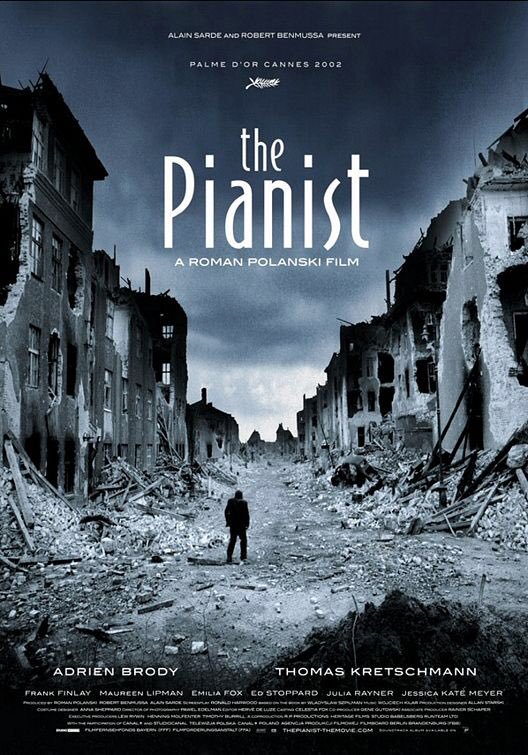
戦場のピアニスト / The Pianist

戦場のピアニスト / The Pianist

In Warsaw during World War II, under the oppression of Nazi Germany, a pianist survives under harsh conditions. He is separated from his family and forced to work with other Jews. The persecution and labor continues, with no guarantee of life today. Will there ever be a peaceful tomorrow for the pianist and the Jews, who live in hope of an end to the war and peace?
Released in 2002, the film won the Palme d'Or, the highest award at the Cannes International Film Festival, and was nominated for seven Academy Awards, winning three.

Reviews, Ratings and Comments on 戦場のピアニスト / The Pianist

戦場のピアニスト / The Pianist
9

The Pianist of the Battlefield," a masterpiece about the tumultuous life of Spielmann, a musician who survived the genocide of the Jews in Poland.

The Pianist on the Battlefield is a 2002 biographical war drama film produced and directed by Roman Polanski, written by Ronald Harwood, and starring Adrien Brody. The film is based on the autobiographical work "The Pianist" (1946), a genocidal memoir by Vladislaw Spielman, a Polish Jew, pianist and composer who survived the Holocaust. The film is a co-production by Britain, Germany, France, and Poland.
In September 1939, Spielmann, a Polish Jew, was playing the piano. At the same time, German troops invading Poland bomb the train station. Hearing that Britain and France have declared war on Germany, Spielmann rejoices alone, imagining that the war with Germany will end in a short time. However, the German and Soviet armies invade Polish territory at the same time, but the promised reinforcements do not arrive. Warsaw becomes part of the German-controlled Governorate. By November 1940, Spielmann and his family were forced to move to the Warsaw Ghetto. The ghetto was isolated from the surrounding Warsaw city center, filled with Jewish residents, and living conditions were terrible. People were starving, the SS were brutal, starving children were left behind, and piles of corpses were everywhere.

戦場のピアニスト / The Pianist
9

A heartbreaking but very thought-provoking story.

The movie "The Pianist on the Battlefield" is the story of a Jewish pianist who manages to survive the persecution and genocide of Jews by Nazi Germany during World War II, despite being separated from his family, his piano, and facing irrational murder and violence.
The persecution of Jews in Nazi Germany is a well-known negative legacy. Therefore, there are many scenes that are painful to watch and make you want to close your eyes. The film realistically depicts unreasonable murders and violence, so it may be difficult for those who do not like to watch such scenes.

There are two recommendations.
The first is Adrien Brody's performance as the main character, Shpilman.
His performance is overwhelmingly realistic, conveying the misery of the situation Jews are in as the scenes go by. His facial expressions, the way he walks, and even his gestures seem as if he is really living in that time period, and it is almost as if he is Spielmann himself.
Brody's performance, especially in the scene when Spielmann becomes ill, was heart-wrenching. The image of him so emaciated and so weak that he cannot even speak is seared in my eyes. It made me wonder if he was really acting or not. I was so suspicious that I wondered if he was really acting.
Brody won the Academy Award for Best Actor for this film.

The second scene is when Hosenfeldt, a German army officer, saves Spillmann.
The Germans were the very people who were persecuting the Jews. The German army was the very party that was persecuting the Jews, and yet they saved the Jews at the very end of the war.
The two meet in a building where Spillman, isolated after the destruction of the city, has taken refuge. There, Hosenfeld learns that Spielmann is a pianist and encourages him to play the piano. Hosenfeldt listens to the piano and promises to hide him.

The Germans help the Jews.

Did Shpilman's piano appeal to Hosenfeldt's heart, or did Hosenfeldt intend from the beginning not to kill him? It is left to the viewer's imagination.

The film "The Pianist on the Battlefield" asks the question in the viewer's mind, "Isn't it a miracle and a precious thing to be alive?" The film "The Pianist on the Battlefield" asks the viewer, "Isn't it a miracle and precious to be alive?

戦場のピアニスト / The Pianist
8

Not exactly the movie I had imagined...

I myself love the piano, so I watched this movie because it is a movie about the piano....
I saw this movie because I like piano myself and it was a movie about piano.
It was a much talked about film, but at the time I wasn't really interested in war movies.
As I got older, my choice of movies changed.

Of course, I knew it was a war movie, and I thought I knew the story, but it was heavier than I had imagined.
But that is not a bad thing.

There were many cruel descriptions that made me want to turn away.
It is hard to believe that such things actually happened during the war, but it is true.
I even think it is a miracle that we are living in this time.

I was also surprised to learn that this Shpilman was a real person, and after watching the film, I did a lot of research on him.
An epic life...
Was it a miracle that he survived this long or was it his mission...

I can't go into details because it would be a spoiler...
I heard that a book from officer Hosenfeldt's point of view has been published, and I would love to read it.

I personally think it was one of the best things about Chopin's piano music, because I love it.
I can't tell you which scene it appears in, but "Ballade No. 1" was very moving.
I will watch it again in a few years.