
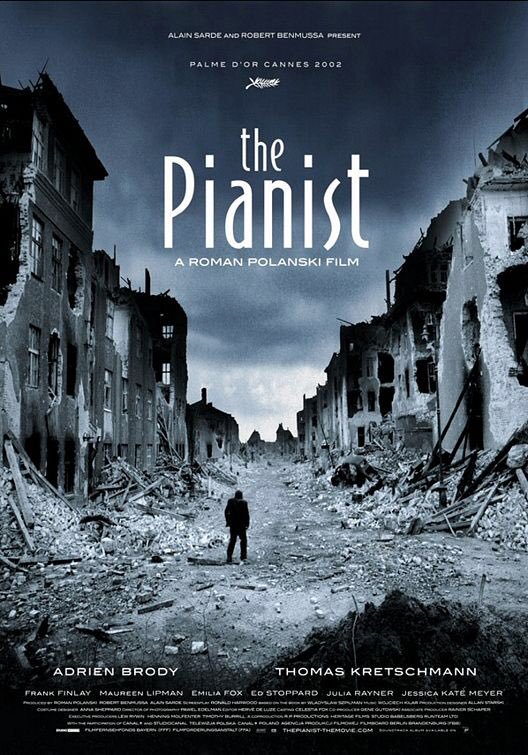

A heartbreaking but very thought-provoking story.
The movie "The Pianist on the Battlefield" is the story of a Jewish pianist who manages to survive the persecution and genocide of Jews by Nazi Germany during World War II, despite being separated from his family, his piano, and facing irrational murder and violence.
The persecution of Jews in Nazi Germany is a well-known negative legacy. Therefore, there are many scenes that are painful to watch and make you want to close your eyes. The film realistically depicts unreasonable murders and violence, so it may be difficult for those who do not like to watch such scenes.
There are two recommendations.
The first is Adrien Brody's performance as the main character, Shpilman.
His performance is overwhelmingly realistic, conveying the misery of the situation Jews are in as the scenes go by. His facial expressions, the way he walks, and even his gestures seem as if he is really living in that time period, and it is almost as if he is Spielmann himself.
Brody's performance, especially in the scene when Spielmann becomes ill, was heart-wrenching. The image of him so emaciated and so weak that he cannot even speak is seared in my eyes. It made me wonder if he was really acting or not. I was so suspicious that I wondered if he was really acting.
Brody won the Academy Award for Best Actor for this film.
The second scene is when Hosenfeldt, a German army officer, saves Spillmann.
The Germans were the very people who were persecuting the Jews. The German army was the very party that was persecuting the Jews, and yet they saved the Jews at the very end of the war.
The two meet in a building where Spillman, isolated after the destruction of the city, has taken refuge. There, Hosenfeld learns that Spielmann is a pianist and encourages him to play the piano. Hosenfeldt listens to the piano and promises to hide him.
The Germans help the Jews.
Did Shpilman's piano appeal to Hosenfeldt's heart, or did Hosenfeldt intend from the beginning not to kill him? It is left to the viewer's imagination.
The film "The Pianist on the Battlefield" asks the question in the viewer's mind, "Isn't it a miracle and a precious thing to be alive?" The film "The Pianist on the Battlefield" asks the viewer, "Isn't it a miracle and precious to be alive?