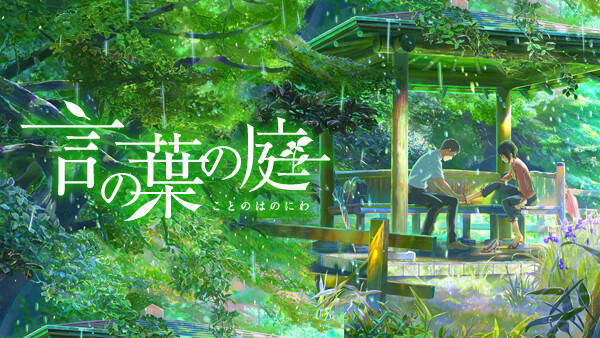
言の葉の庭 / The Garden of Words

言の葉の庭 / The Garden of Words

The Garden of Words is a Japanese animated film directed and written by Makoto Shinkai, known for "5 Centimeters per Second" and "Children Who Chase Stars. It was released in theaters on May 31, 2013. The catch copy of the film is "A story about a solitary sadness that goes back even further than love.
Takao, a high school student who dreams of becoming a shoemaker, skips school when it rains to sketch shoes in a Japanese garden in a park. One day, he meets Yukino, a mysterious older woman who drinks beer cans by herself. They gradually open up to each other, meeting again and again only on rainy days, without any promises. Takao decides to make shoes for Yukino, who says she has lost her place in the world, so that she will want to walk more. Set in present-day Tokyo, this is a story of a faint love between a high school boy and an older woman who is clumsy about life.
A major highlight of the film is the precise and delicate depiction of rain, which is Shinkai's forte, including the depiction of various types of rain according to the emotions of the characters. The film draws on the Manyoshu anthology and Japanese gardens, and the richly emotional images draw the viewer in.
The main male and female characters are voiced by Miyu Irino and Kana Hanazawa, who have voiced the characters in numerous works.

Reviews, Ratings and Comments on 言の葉の庭 / The Garden of Words

言の葉の庭 / The Garden of Words
10

My heart aches for all the descriptions.

I would like to recommend a video work by director Makoto Shinkai, "Garden of Words".
When you think of director Makoto Shinkai, the 2016 release of "What's Your Name?" and "The Weather Child," which will be released in 2019.
First, an overview. The Garden of Words" was released in 2013. The main characters are a high school boy who dreams of becoming a shoemaker and a high school teacher who has lost her ability to live well in society. A rainy day connects them. A movie may have an image of being long, but "Garden of Words" is a short movie of about 40 minutes and can be viewed easily.
Next, I would like to introduce two of my recommendations: First, the overwhelming visual beauty of the film. Makoto Shinkai's works are famous for their beautiful depiction, and "Garden of Words" is no exception, with every cut being filled with delicate and beautiful descriptions. Nature, skyscrapers, and even the withered plants on the balcony are all refined as "works of art.
Second, there are two contrasting characters. The first is a high school student who does not know what it means to be an adult. In the midst of his strenuous life, he has his own worries. He may be anxious about the future and conflicted between his own thoughts and the wishes of others. On the other hand, he is a high school teacher who has been confronted with the reality of society and what it means to be an adult, and he has been caught in the waves of this reality. She has become afraid of everything and has lost sight of what she should take for granted in life, and she also has her own problems. You can't help but feel sorry for yourself for having become so completely weak. We can lean into the thoughts of these two people in such different circumstances from their different perspectives. There is a lot of dialogue from their point of view, so even those who are not good at guessing will be able to fully understand their thoughts. Young viewers, especially those who are close in age, may be able to empathize with the feelings of both high school students and working adults.
We hope that you will be able to witness their decision-making process through to the end of the film. Incidentally, the novel version of the film also contains more detailed descriptions of their feelings and their future, which you may be interested in. We hope you will enjoy the novel version as well.

言の葉の庭 / The Garden of Words
7

A story of a grown-up boy and an adult who forgot how to grow up.

The film is a short film of about 40 minutes, but the scenes and techniques packed into this time are chic.

Makoto Shinkai is famous for his beautiful pictures, which were also talked about in "Weather Child.
What makes him so famous is his uncommonly skillful use of light.
In this work, we can see this in the "reflected light" and "raindrops.
Reflected light" is light that comes from the surrounding scenery. In other words, it is the contour of objects on the opposite side of the light source.
For example, in the scene of a person surrounded by fresh green trees, green is used as the contour on the opposite side of the light source.
This is a method of expression that is faithful to reality, where the green of the surrounding trees is reflected by the cheeks and clothing.
This makes the characters look more natural and realistic.

The other "raindrops" are depicted at a level of reproduction that is not half as good as the original.
Raindrops that shine momentarily in the sunlight and drops of water when they fall on the surface of the water are precisely rendered.
It would be interesting to compare this work with other works such as Weather Child to get a better sense of its realism.

Up to this point, I have written about the expression, but finally I would like to write about the story.
This work depicts the encounter and parting of "Takao," a mature high school boy who dreams of becoming a shoemaker, and "Yukino," a woman who is on leave for a certain reason.
They meet only on rainy days and begin to be conscious of each other, but there is a reason for this.
They were both troubled by each other's problems, and they seemed to have a relationship in which they could help each other.
Takao has a dream of becoming a shoemaker, but he is aware that it is a narrow path, and he is always afraid that people might think he is not capable of it, and he is impatient.
On the other hand, Yukino recognized his dream and supported him, which made Takao open his heart little by little.
Yukino, on the other hand, while supporting Takao, had his hands full with his own problems and was unable to move forward.
For Yukino, talking with Takao, who has no knowledge of her situation, was a comfort to her.
The story will unfold rapidly as Yukino's situation becomes clearer, but I hope you can feel the truth and the sadness of their relationship in the work along with Motohiro Hata's music.

We hope you will enjoy this story that will resonate with those who are struggling with something in their lives.

言の葉の庭 / The Garden of Words
9

This is a movie that makes you love rain.

Kimi no na wa. and "The Weather Child" are among the works of director Makoto Shinkai.
It is a short animation of less than an hour, but I cried a lot.
To give a brief summary, it is about a high school boy who wants to become a shoemaker and a classics teacher who is sick at heart.
Set in Tokyo's Shinjuku Gyoen (a national park in the middle of the city center), the film depicts their struggles and growth.
The film has beautiful visuals and a gorgeous voice cast.
The film is set in Shinjuku Gyoen (a national park in the middle of Tokyo), and depicts the conflict and growth of two people.
But that's not all.
After all, the detailed portrayal is considered one of the best parts of director Fukami's work.
Takao Akizuki (voice: Miyu Irino) is a high school freshman, a boy in a complicated family environment who also handles the household chores.
Momokari Yukino (voice: Kana Hanazawa), a classics teacher who has trouble with students, an affair, and even a taste disorder.
The two bump into each other in the rain at a pavilion in Shinjuku Gyoen.
It was a trivial chance encounter, but it seemed inevitable, and my heart danced with joy.
The boy skips school only on rainy mornings to face his dream of becoming a shoemaker.
Before long, the two become friends, meeting only on rainy days.
Neither of them made any promises...

Others are shocked when their foundation cracks, which is "a thing" among women.
I wondered why Director Fukami knows so much about women's psychology, such as his admiration for the famous shoe brand DIANA! I thought.

When it rains in your heart, this is a very good film that shines through the gaps in the rain clouds and pushes you back a little.

言の葉の庭 / The Garden of Words
7

Loneliness" began with a rain shelter.

Takao, a male student aspiring to become a shoemaker, skips school on rainy mornings to draw sketches of shoes in Shinjuku Gyoen.
There he meets Yukino, a mysterious older woman, by chance on a bench on a rainy day, and they have a heart-to-heart encounter.
Shinkai Makoto's technique of capturing the fleeting moments of everyday life that he felt at that time is brilliantly executed in this work.
The background music of piano and environmental sounds highlight the emotions of the characters, which are beautifully expressed without excess or deficiency in the film's 46-minute length.
The film is 46 minutes long, but it does not overstep its bounds: "I miss him, but I'm still a kid if I just hold on to those feelings.
Takao is a wise and mature man who faces reality while working part-time and sparing no effort to become a shoemaker.
I wonder if I will still be okay.
Yukino is an adult woman who has stumbled in her work and relationships and is stuck in her life.
The contrast between these two very different characters and their reunion at school was well-paced and drew me into the story.
The sad story of Yukino, who is exhausted, and Takao, who is running headlong toward his goal to break free from the harsh reality, is a must-see.
It is rare to find a male student who is not distracted by conversation with an older sister whom he has a crush on, but is instead running headlong toward his own goals.

言の葉の庭 / The Garden of Words
8

A film that reveals our humanity, for better or worse.

The film is sometimes praised for its "beautiful visuals," but I would like to appreciate the human aspects of the film.
The setting is Shinjuku. Takao, a high school student aspiring to become a shoemaker, and Yukino, a mentally and physically exhausted female teacher, meet at the Shinjuku Gyoen garden at the same time. The garden on a rainy day when both skipped school and work. The next time they meet on a rainy day, and the next, and the next, they find themselves drawn to each other.

The setting is very well done.
Shinjuku on a rainy day
Shinjuku Gyoen, a garden that stands alone in the city.
A troubled man and a woman who seek comfort in the garden.

The two are clumsy not only in the way they live, but also in their personalities. Takao, who is pursuing his dreams, is rebelling against adults while struggling to accept his current situation, and Yukino, who has fallen outside of society's boundaries, is trying to get back on his feet but is suffering alone. What they needed was time to be at peace and human beings.

The people who can open their hearts are not always those who are close to them. The Internet society tells us this reality. What Takao sought was an adult who understood him. The ideal is a "mother. However, his mother is a playful and unreliable person. Takao falls in love with an adult woman named Yukino.

What Yukino wants is someone who will accept everything. Torn by loneliness and guilt, Yukino needed time to heal and laugh. That is Takao.

The closer they become, the more they realize the difference. Takao is a high school student, Yukino a female teacher. They are different in age and social status. They live in different places. The only thing they have in common is the need for support. Could they really live together?

After watching this film, you may feel refreshed, as if there is a ray of light in the dreary rain in the city.

言の葉の庭 / The Garden of Words
10

Ultimate Healing

A movie based on Makoto Shinkai's novel "Garden of Words". It is just so beautiful that words cannot describe it.
Although Makoto Shinkai made a big hit with "Kimi no na wa" (What is your name?), I personally prefer "Garden of Words" for its more realistic and poignant feeling. There is nothing to complain about the images and music. For a movie, the amount of dialogue between the characters is very small, but the exquisite descriptions of rain and light are enough to express all the sensitive feelings of the characters. Rain plays an especially important role in the story, and the sounds of rain dripping, bouncing off the ground, and falling hard and forcefully are so wonderful that one could make a whole movie just from the images of rain. Also, the ending song "rain" by Motohiro Hata is a great cover song that fits the movie perfectly.
After watching this movie, I always want to listen to "rain" on rainy days. The film is very short (46 minutes), but the content is so rich and satisfying that you don't feel that it's a short film.
I have personally seen "Garden of Words" six or seven times, so I never get tired of this movie no matter how many times I see it. Although the amount of information is much less than the original, I have no complaints because it is very well put together and the important scenes are excerpted well. It is not uncommon to be disappointed by movies that do not reproduce the original work, but with regard to Garden of Words, even if you already know the original work, the movie has a completely different charm, so I recommend that you watch it.
On the other hand, if you have already seen the movie, you can learn more about Garden of Leaves of Words by reading the original novel, which only touches on Takao's brother, Yukino's ex-lover, his high school classmates, and even the seniors at Takao's part-time job, which were only mentioned briefly in the movie. Both the movie and the novel are excellent, and you should watch and read both.