おおかみこどもの雨と雪 / Wolf Children

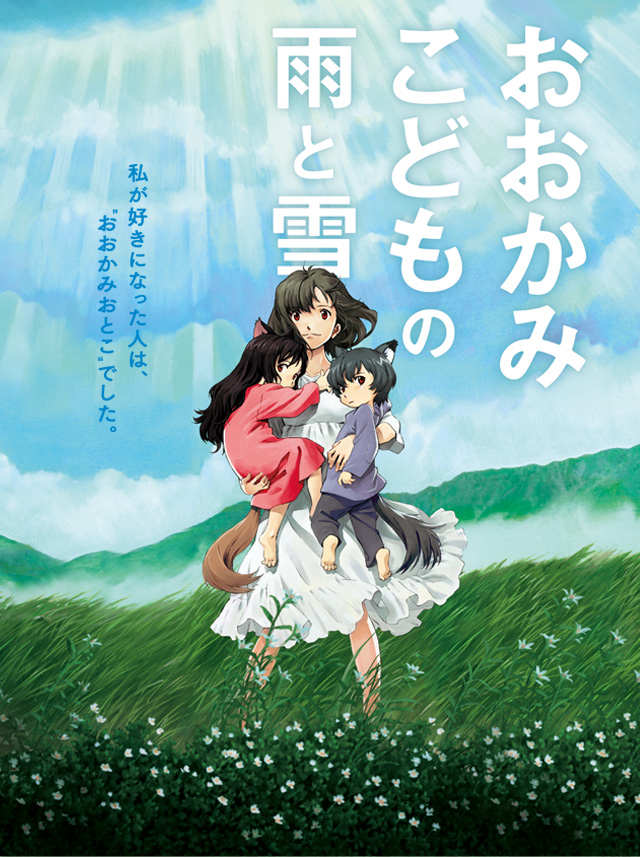
Wolf Children" is an animated film directed by Mamoru Hosoda and released in 2012. The screenplay was written by Sadoko Okudera.
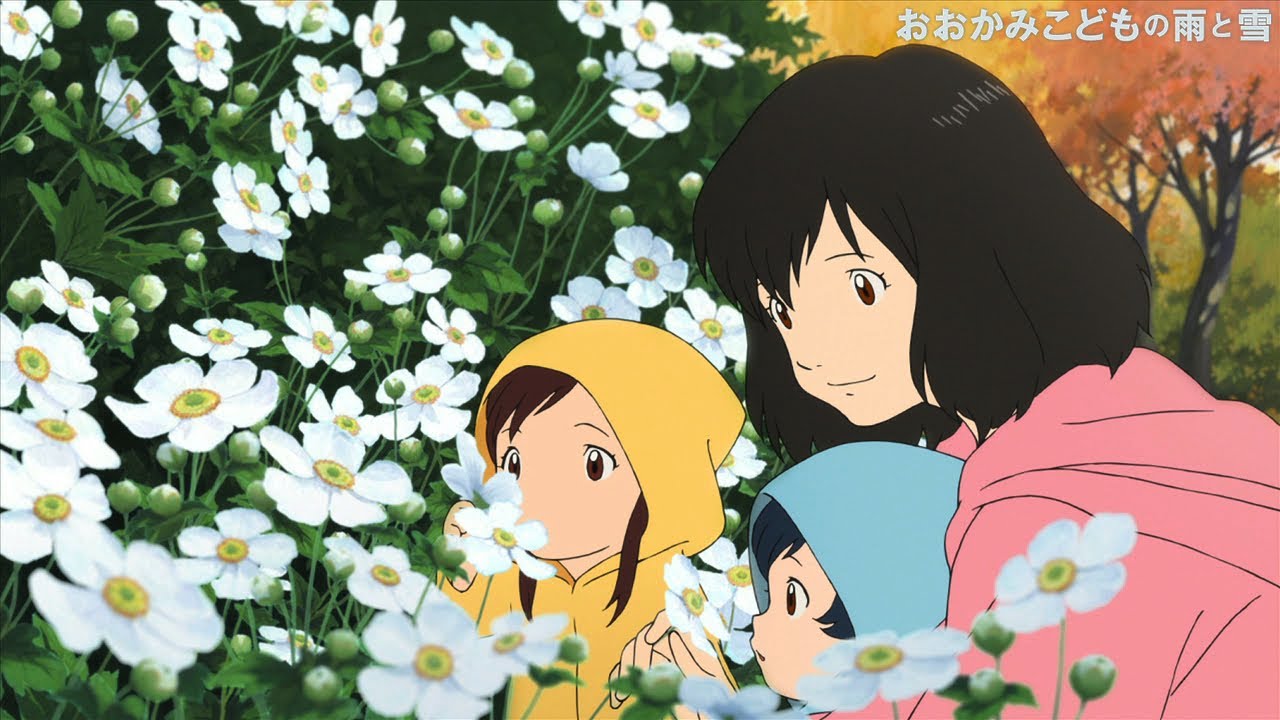
The heroine, a 19-year-old college student named Hana, falls in love with and marries a wolf-kid, which subsequently gives birth to a sister and brother named Ame and Yuki. The siblings are born as werewolf children with both human and werewolf blood, but they hide this fact from the public and live together as a family of four, until a misfortune befalls the family. Saddened, Hana vows to raise them well and moves away from the city to a country town with rich nature so that the children can choose whether to live as "humans" or "wolves" in the future.
Will Snow and Rain choose to be "human" or "wolf"? How does Hana watch over the two wolf children and what does she think about their choice?
This is a story of 13 years of growth and strong bonds between Hana and the three wolf children.
Aoi Miyazaki plays Hana and Takao Osawa plays the wolf boy.
The film won the Best Animated Feature Award at the 36th Japan Academy Awards.

Related Articles on おおかみこどもの雨と雪 / Wolf Children

Howl's Moving Castle (Ghibli Movie) Spoiler Commentary and Discussion Summary

Howl's Moving Castle (Ghibli Movie) Spoiler Commentary and Discussion Summary

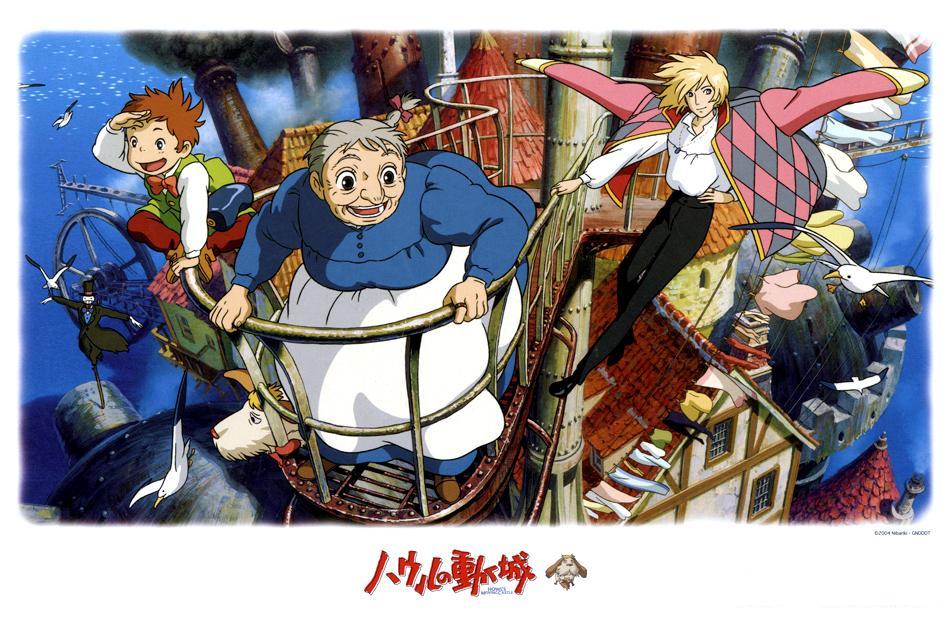
Howl's Moving Castle" is a Japanese animated feature film directed by Hayao Miyazaki and produced by Studio Ghibli, which was released nationwide on November 20, 2004, grossing 19.6 billion yen at the box office. It surpassed "Princess Mononoke" and became the second largest animated film produced by Studio Ghibli after "Spirited Away". The story takes place in a fictional world where magic and machines coexist. It depicts the warlike love between Sophie, a girl who was turned into an old woman by a curse, and Howl, a wizard.

Read Article

Spoiler commentary and discussion of The Girl Who Leapt Through Time (Tokikake)

Spoiler commentary and discussion of The Girl Who Leapt Through Time (Tokikake)

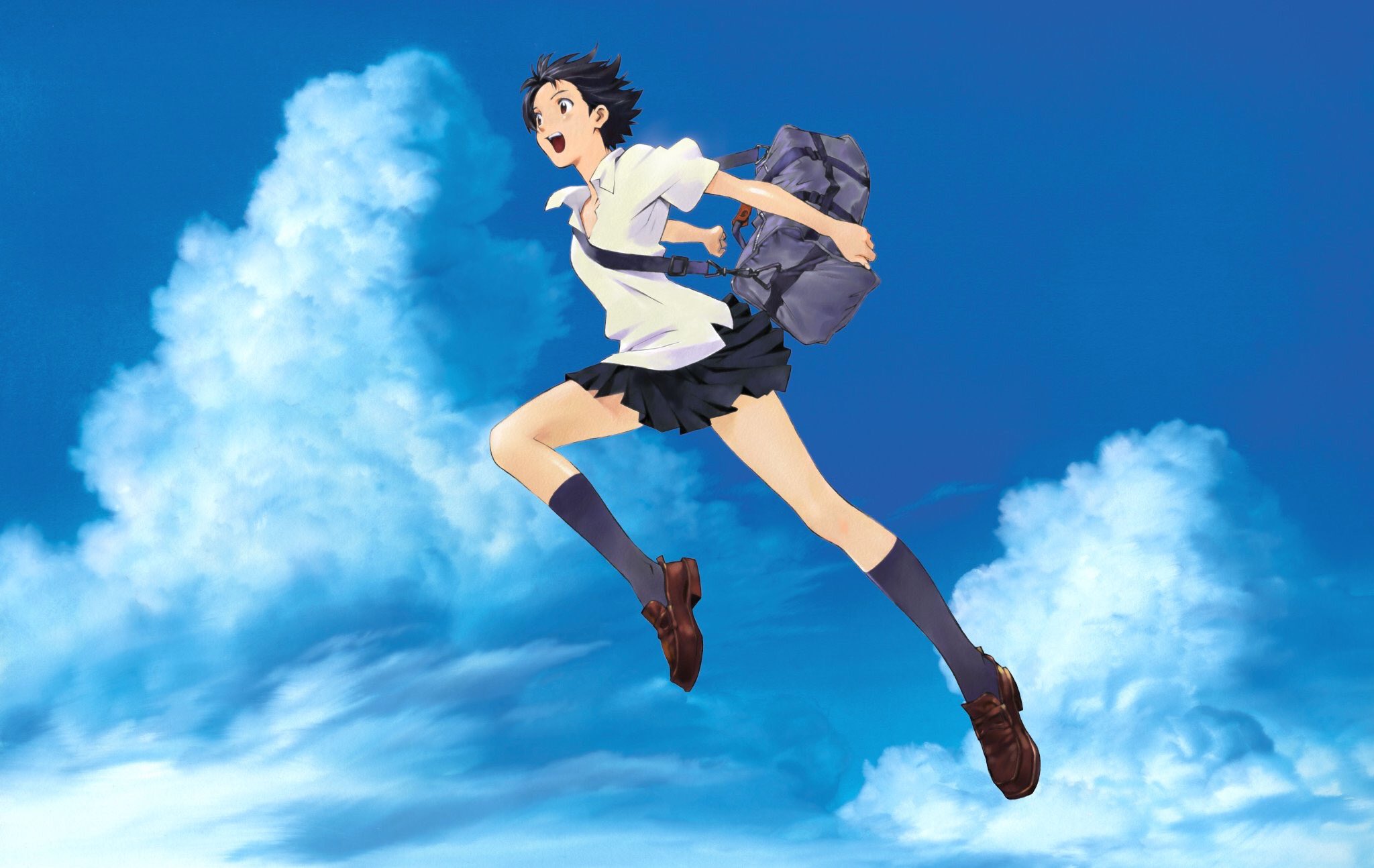
The Girl Who Leapt Through Time" is an animation film released in 2006. The director is Mamoru Hosoda, who also directed "Summer Wars" and "Wolf Children: Rain and Snow. The film is based on the original story by Yasutaka Tsutsui, and is set 20 years after the original story. It is a coming-of-age science fiction film in which the main character gains the power to jump through time, and uses this power to realize what is truly important.

Read Article

Spoiler alerts and discussion of Bakemono no ko (the animated film).

Spoiler alerts and discussion of Bakemono no ko (the animated film).

Bakemono no ko" is an animated film that was released in 2015 and can be considered a blockbuster hit, attracting 4 million viewers. Directed by Mamoru Hosoda, who also directed "The Girl Who Leapt Through Time," "Summer Wars," and "Wolf Children: Rain and Snow. A lonely human child and a loner monster grow up together through a strange teacher-student relationship and form a parent-child bond in this new adventure action film.

Read Article

Summer Wars (animated film) spoiler commentary and discussion summary

Summer Wars (animated film) spoiler commentary and discussion summary

Summer Wars is a Japanese animated film released on August 1, 2009. Directed by Mamoru Hosoda, known for his animated films "The Girl Who Leapt Through Time" and "Wolf Children: Rain and Snow," this is his first original feature-length animated film. Set in a world where the virtual world has developed, the film tells the story of Kenji Koiso, the main character, who confronts a crisis between the virtual world and the real world together with his senior Natsuki Shinohara and her family.

Read Article

Spoiler commentary and discussion of Mirai no Mirai (Mamoru Hosoda)

Spoiler commentary and discussion of Mirai no Mirai (Mamoru Hosoda)

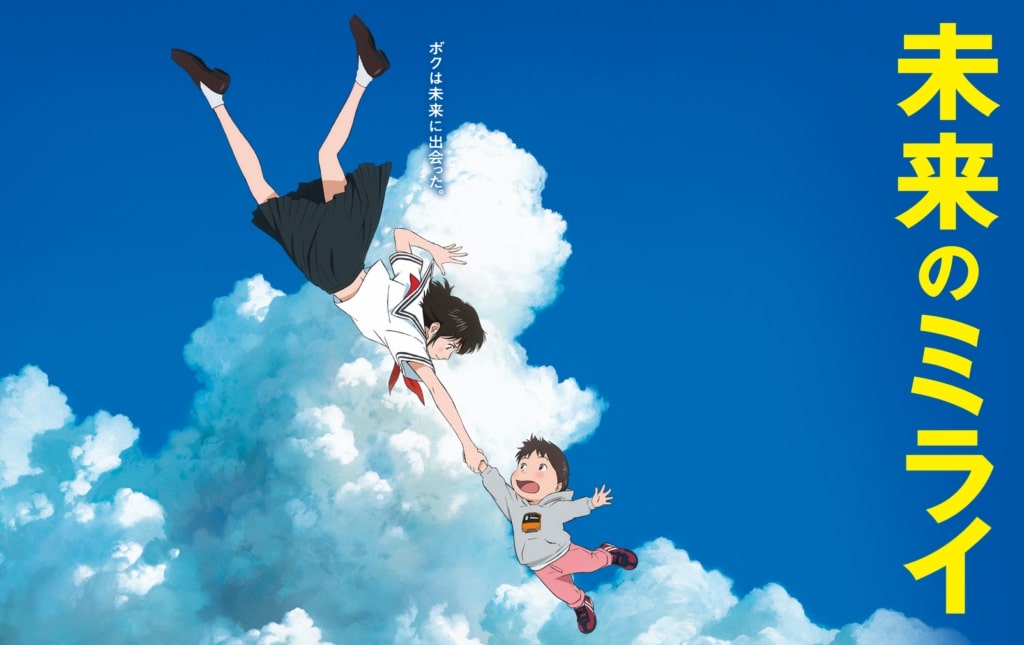
Mirai no Mirai" is an animated feature film produced by Studio Chizu and released in July 2018. The director is Mamoru Hosoda, the creator of "The Girl Who Leapt Through Time" and "Summer Wars. Kun-chan" lives with his parents in a corner of Yokohama, where he has just become a "big brother. After the birth of his younger sister, his parents stop fulfilling his requests, and Kun-chan finally turns into a "baby again. He is always saying, "I don't like babies! He travels through time from the courtyard of their house. There he meets his future sister.

Read Article

ONE PIECE THE MOVIE Baron Omatsuri and the Island of Secrets (One Piece) Spoilers and Discussion Summary

ONE PIECE THE MOVIE Baron Omatsuri and the Island of Secrets (One Piece) Spoilers and Discussion Summary

ONE PIECE THE MOVIE Baron Omatsuri and the Island of Secrets is the sixth animated feature film based on the boys' manga "One Piece". Mamoru Hosoda, famous for "The Girl Who Leapt Through Time" and "Summer Wars," directed this film. It is one of the most unique works in the series, and has caused a stir with its style and drawings that are not typical of "One Piece". The last half of the story is full of storylines and effects that could be mistaken for a horror movie, and some viewers have even said that they were traumatized by the scares.

Read Article

Coo: Coo from a Distant Sea (Animated Film) Spoiler Commentary and Discussion Summary

Coo: Coo from a Distant Sea (Animated Film) Spoiler Commentary and Discussion Summary

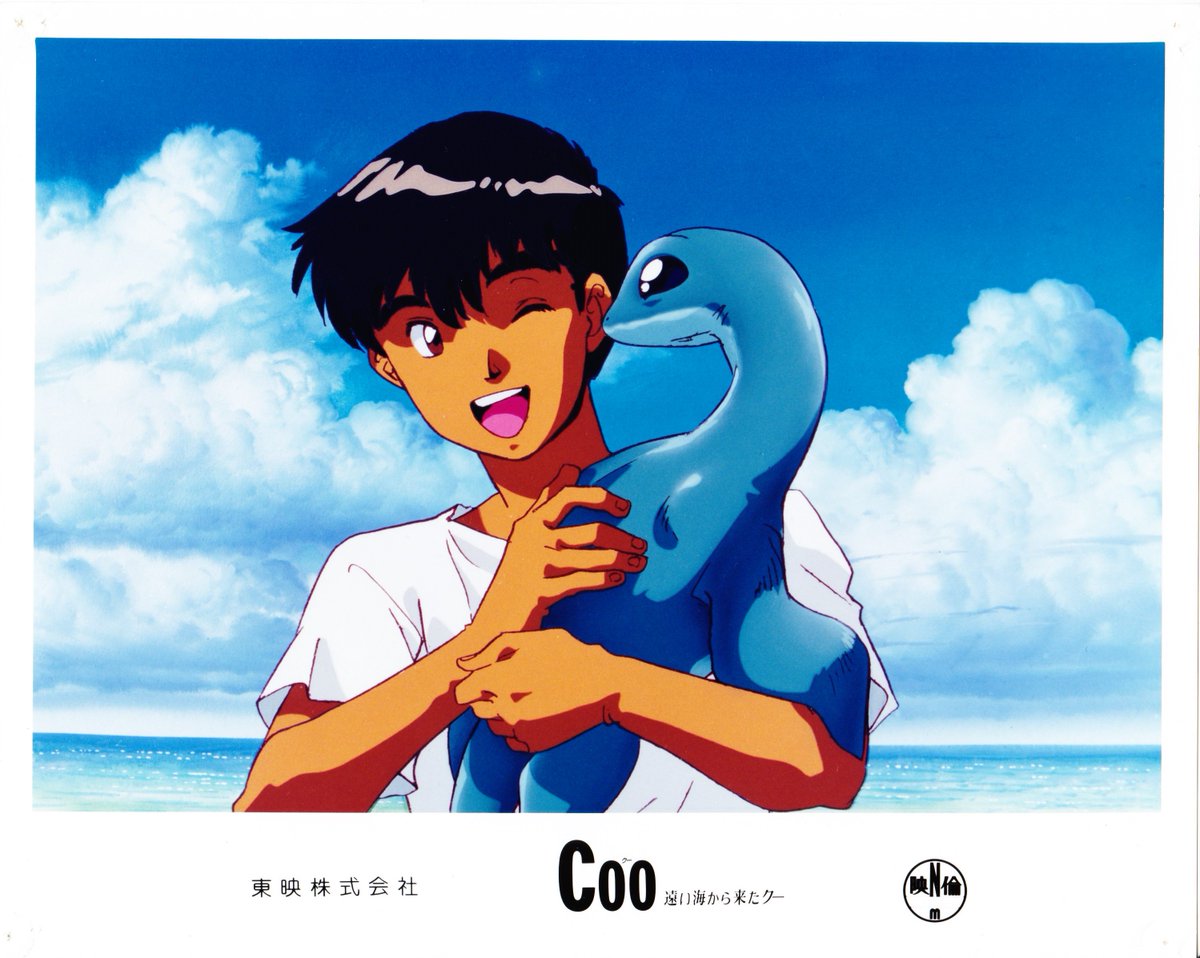
Coo: Coo from the Far Sea" is an animated feature film based on the novel "COO from the Far Sea" by Tamio Kageyama, which was released nationwide in 1993 by Toei Western Pictures. Perhaps due to a string of scandals involving those involved in its production, the film has not been released on DVD or Blu-ray more than 30 years after its release. The main character, Yosuke Obata, is a 12-year-old boy who lives with his father, Tetsuro, on Pago Pago Island in the Fiji Islands. One day, Yosuke picks up a newborn plesiosaur cub in the sea, names it Coo, and raises it. This is the story of the bond between Yosuke and Coo.

Read Article

The Dragon and the Freckled Princess (film) spoiler alert and discussion summary

The Dragon and the Freckled Princess (film) spoiler alert and discussion summary

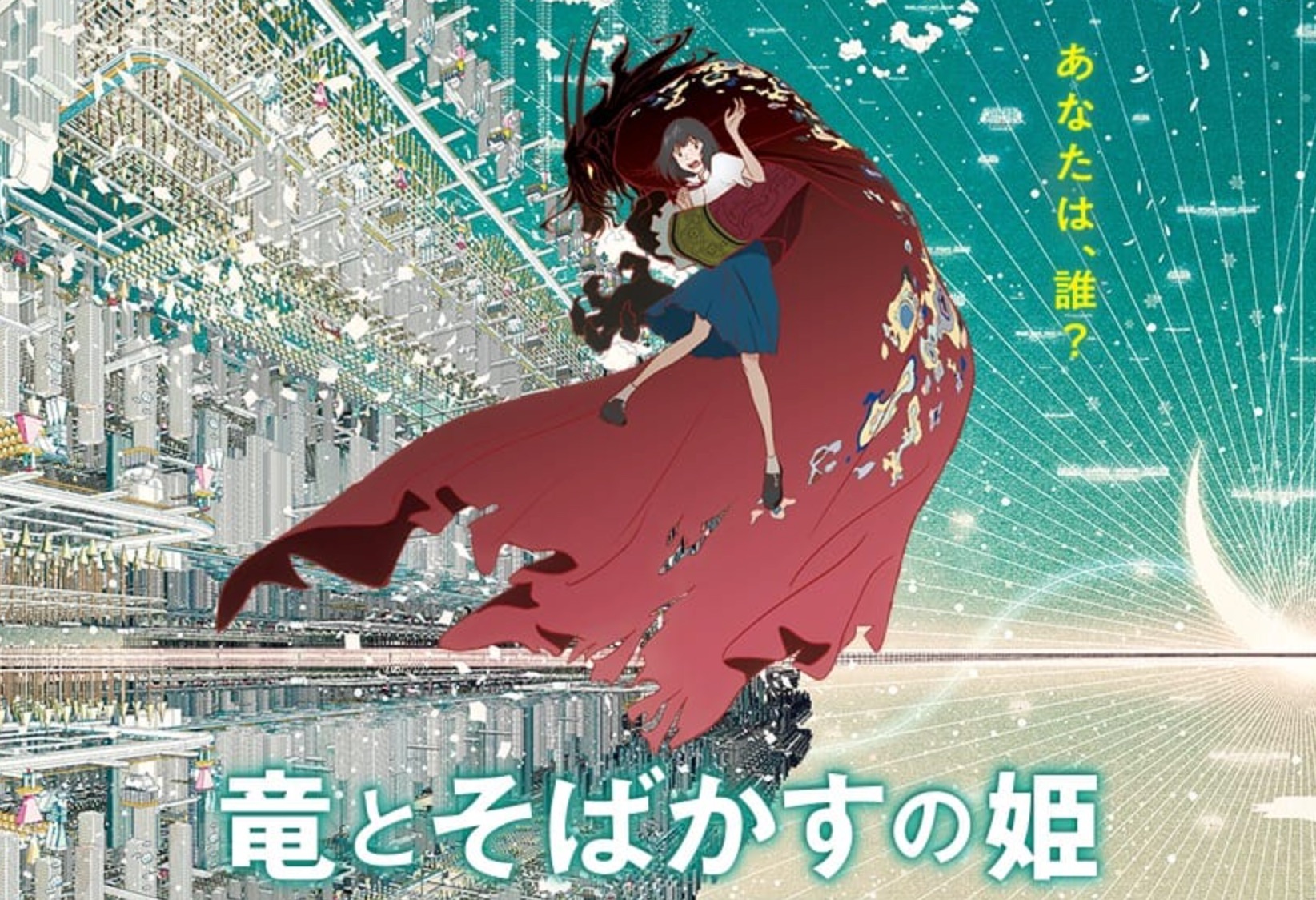
The Dragon and the Freckled Princess" is a Japanese animated film directed by Mamoru Hosoda, produced by Studio Chizu and released in the summer of 2021. The main character, a high school girl with a serious emotional trauma, grows up through encounters in the virtual world and the real world, giving courage to the viewer. The story spun out by the director's unique combination of two worlds, one imaginary and one real, and two animations, is on an overwhelming scale never seen before, and it is a film that appeals to what is important and unchanging in a rapidly changing world where social networking services have become commonplace.

Read Article

A compilation of handsome characters from Ghibli movies! The circumstances they each have are fascinating!

A compilation of handsome characters from Ghibli movies! The circumstances they each have are fascinating!

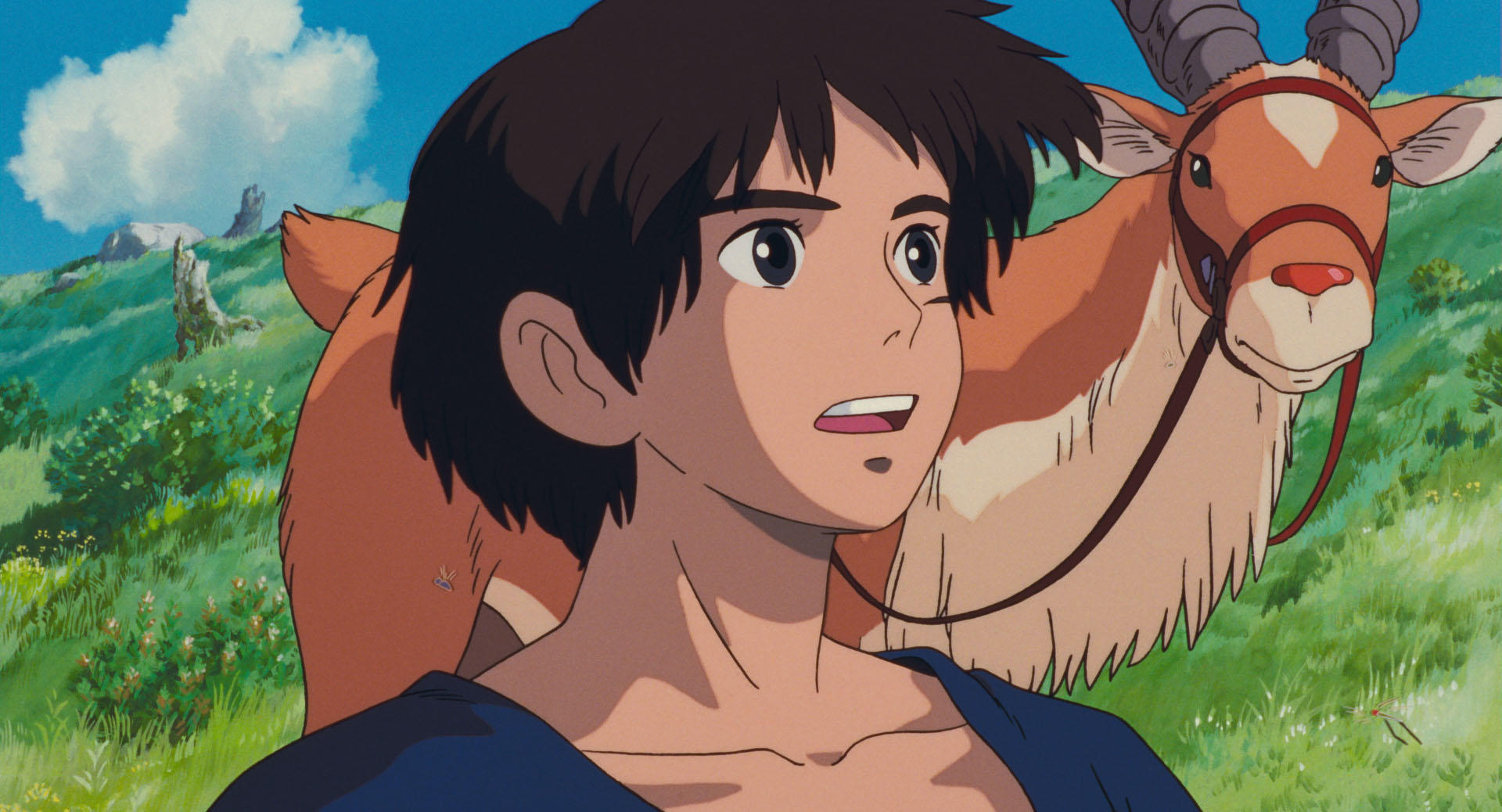
This article introduces a collection of handsome characters that have appeared in films produced by Studio Ghibli. Many attractive characters have appeared in Ghibli films, such as Haku from "Spirited Away," Pazoo from "Castle in the Sky," and Sho from "The Borrower Arrietty. Each of these characters has his or her own story, and this is what makes them so appealing. We hope you will find your favorite character.

Read Article

ハウルの動く城の名言・名セリフ/名シーン・名場面まとめ

ハウルの動く城の名言・名セリフ/名シーン・名場面まとめ

『ハウルの動く城』とは、2004年公開のスタジオジブリ制作の長編アニメーション作品である。脚本・監督は宮崎駿。 帽子屋の少女・ソフィーは兵隊に絡まれていたところを魔法使いのハウルに助けられるが、魔女の呪いによって90歳の老婆に姿を変えられてしまう。店にいられなくなったソフィーは旅に出、その途中でハウルの動く城に出会うのだった。ファンタジックな世界観や美術、個性的なキャラクターが魅力の作品。ハウルとソフィーの戦火の恋がストーリーの軸となっているため、本作にはロマンチックな名言も数多く登場する。

Read Article

Miscellaneous trivia and urban legends to enjoy "Summer Wars," "The Girl Who Leapt Through Time," and "Wolf Children" for the rest of your life! Thorough explanation of Mamoru Hosoda's works.

Miscellaneous trivia and urban legends to enjoy "Summer Wars," "The Girl Who Leapt Through Time," and "Wolf Children" for the rest of your life! Thorough explanation of Mamoru Hosoda's works.

Miscellaneous information and urban legends about Mamoru Hosoda's films "Summer Wars," "The Girl Who Leapt Through Time," and "Wolf Children's Rain and Snow" are compiled. Information related to Mamoru Hosoda's films, including storyboards, catchphrases, and the opinions of those who have seen the films, is thoroughly explained.

Read Article

A compilation of layouts, storyboards, and original drawings by popular animators! Also includes valuable materials showing the greatness of Hayao Miyazaki and Mamoru Hosoda!

A compilation of layouts, storyboards, and original drawings by popular animators! Also includes valuable materials showing the greatness of Hayao Miyazaki and Mamoru Hosoda!

This article compiles images of layouts, storyboards, and original drawings by popular animators. Fans are encouraged to check them out, as they are all valuable materials from such brilliant animators as Hayao Miyazaki, Yoshiyuki Sadamoto, Tatsuyuki Tanaka, Satoshi Kon, Okiura, Yoh Yoshinari, Hiroshi Nagahama, and Mamoru Hosoda.

Read Article

Mamoru Hosoda was supposed to shoot "Howl's Moving Castle"? Introduction of the relationship with Hayao Miyazaki [Studio Ghibli].

Mamoru Hosoda was supposed to shoot "Howl's Moving Castle"? Introduction of the relationship with Hayao Miyazaki [Studio Ghibli].

Howl's Moving Castle" is a popular work by Studio Ghibli. When the project was first conceived, Mamoru Hosoda, a hit maker who is also known as "post-Hayao Miyazaki," was scheduled to take the megaphone. However, the project fell through, and Hayao Miyazaki was to direct the film. Here, we introduce the reasons why the project was not realized and "One Piece the Movie: Baron Omatsuri and the Island of Secrets," a film directed by Mamoru Hosoda that strongly reflects his shocked state of mind. It also includes a comment from a fan who said, "I wanted to see Hosoda's version of Howl.

Read Article

Delicious-looking foods in anime and manga that make you drool just looking at them.

Delicious-looking foods in anime and manga that make you drool just looking at them.

Food scenes often appear in anime and manga. However, in reality, food has different color gradations and different light absorption and reflection rates, making it extremely difficult to depict in pictures. However, there are anime and manga that depict such unique foods in an extremely delicious manner. In this issue, we have compiled a list of many delicious-looking foods, focusing on such scenes.

Read Article

A summary of information on the production costs of Ghibli films! A generous budget is a sign of talent!

A summary of information on the production costs of Ghibli films! A generous budget is a sign of talent!

This article presents a summary of information on the "production cost" of Ghibli films. The production cost per episode of an animated film varies from film to film, but is in the 50 million yen range at the highest. On the other hand, the production cost of a Ghibli film is at least in the hundreds of millions of yen, and the estimated production cost of "The Tale of the Princess Kaguya" is said to be as much as 5 billion yen. Ghibli producer Toshio Suzuki has stated in interviews that "being able to spend money is also a talent.

Read Article

Reviews, Ratings and Comments on おおかみこどもの雨と雪 / Wolf Children

おおかみこどもの雨と雪 / Wolf Children
10

「おおかみこどもの雨と雪」の真実に迫る!深い考察とレビューまとめ

「おおかみこどもの雨と雪」は、細田守監督による感動的なアニメ映画で、多くの視聴者に愛されています。この作品は、シンプルなファンタジーでありながら、家族の絆、母親としての強さ、そして自然との共生という深いテーマが織り込まれており、見る人にさまざまな感情を呼び起こします。
この記事では、この作品の魅力を考察しつつ、レビューと感想を交えて詳しく紹介していきます。

物語は、大学生の花が狼男と恋に落ち、2人の子ども「雨」と「雪」を授かるところから始まります。しかし、夫である狼男が突然の事故で亡くなり、花は人と狼の間で揺れる子どもたちを1人で育てることになります。都会での生活に限界を感じた花は、自然豊かな田舎に移住し、そこでの新しい生活をスタートさせます。

深いテーマ:家族の絆と母親の強さ
「おおかみこどもの雨と雪」は、母としての花の成長と試練が中心となった物語です。彼女は、夫を失った孤独と、不安定な子どもたちの未来に対する責任を一身に背負いながらも、決して弱音を吐かず、前を向いて生きていきます。花の強さは、無償の愛と自己犠牲によって支えられています。

レビューの中で多くの視聴者が感動したポイントは、花が子どもたちに対して決して過保護にならず、彼らの成長を見守る姿勢です。特に雪と雨が、それぞれの道を選び、独立していくプロセスは、母としての花の葛藤と成長を描き出しています。作品を通して、母親が持つ力強さと優しさが感動的に描かれています。

自然との共生
花と子どもたちが都会を離れて田舎に移住するシーンは、自然の力と人間の共生を強調しています。自然の中で育つ雨と雪は、狼としての自分たちの本能と、人間としての生活とのバランスを学んでいきます。このふたつの世界を生きる彼らが、どのように自分たちの生き方を見つけるかが物語の大きな軸となっています。

レビューでは、田舎の美しい風景とそこでの暮らしが多くの視聴者に強い印象を残しました。特に自然の描写や、四季の移ろいが視覚的に美しく表現されており、視覚的にも楽しめる作品です。

キャラクターの成長と選択
この作品のもうひとつの大きなテーマは「選択」です。子どもたちが自分の生きる道を見つける過程で、花は親としての葛藤を感じながらも、彼らの選択を尊重します。雪は人間として生きることを選び、雨は狼として生きることを決断します。この2人の対比的な成長が、視聴者に強い印象を与えます。

視聴者からのレビューでは、雨と雪のそれぞれの成長と選択に共感し、涙したという感想が多く見受けられます。また、花がそれぞれの道を選んだ子どもたちを受け入れ、見守る姿勢は多くの人にとって感動的であり、親子の絆を改めて考えさせられる作品です。

レビューと評価
多くのレビューでは、「おおかみこどもの雨と雪」は、家族の物語としてだけでなく、個人の成長や選択を描いた深い作品として高く評価されています。特に、花というキャラクターの強さや、母親としての無償の愛に感動する視聴者が多く、細田守監督の最高傑作のひとつとして挙げられることもあります。

ただし、一部のレビューでは、ファンタジー要素がもう少し深く掘り下げられても良かったという意見や、物語の展開が若干スローペースに感じられるという批判も見受けられます。それでも、全体的にはその感情的な深みや美しい映像美が高く評価されています。

「おおかみこどもの雨と雪」は、母親としての花の奮闘や、子どもたちの成長を描いた感動的な物語です。家族の絆、自然との共生、そして自分の道を選ぶ勇気がテーマとなっており、見るたびに新しい発見がある作品です。レビューを通じて多くの人がこの作品に共感し、感動を分かち合っています。ファンタジー要素と現実世界の問題が交錯するこの作品を、ぜひ1度観てみてください。

おおかみこどもの雨と雪 / Wolf Children
9

映画「おおかみこどもの雨と雪」

「おとぎ話だって、笑われるかもしれません」「そんな話、あるわけないって」と、このようなセリフから映画はじまります。
この物語は、タイトルのように人間と狼の子供とその子供を育てる親が生きる人生を描いています。物語のはじまりのように、まるで”おとぎ話”のような映画。
人間と狼が交わることは普通では考えられません。そんな映画について少し、ネタばれ有りでレビューを書いています。
もし、気になる方はぜひ最後までお付き合いください。まずは、物語を少し紹介していきます。

ストーリー内容(※ネタばれ有り)
主人公(人間)がある日気になる彼(おおかみおとこ)と大学で出会います。主人公は、他の学生と違いペンとノートで真面目に勉強する彼が何故か気になり声をかけ、2人の関係が始まります。
お互い大学生で図書館に2人で行ったり、スーパーで買い物し一緒にご飯を食べたり、普通の人間のようにデートをし、距離を縮めていきます。
そしてある日、彼が主人公に実はおおかみおとこであると告げます。そこから2人は一緒に過ごすようになり、2人のこどもを授かります。

普通の人間同士の恋愛や生活を送るそんな人生をそれが当たり前だったから、そう思っていた主人公でしたが、まさかおおかみおとこと私がなんて思わざる負えない状況。そんな人生を描く映画となっています。

・おもしろさ…8/10
・感動…10/10
・見やすさ…8/10
・ファンタジー性…10/10

ファンタジー性があり、こんなことがあるんだと希望を持たせてくれるシーンや、親の凄さ・自然について考えさせられる、また感動的な物語です。少しセクシャルなシーンがあるのでお子さんには少し見せにくい部分が一部あります。そこを把握した上で見られるのが良いかもしれません。

気になる方は、ぜひご覧になって見てください。

おおかみこどもの雨と雪 / Wolf Children
10

A very excellent work of fantasy, yet very realistic.

This is a story of two wolf children born to a wolf man and a human woman.
The father, a wolf man, dies early in the story, and the main story is about a single mother, Hana, and her life with her older sister, Yuki, and younger brother, Ame.
The story is depicted from the time of conception, so the difficulties of living with the wolf children are depicted in a very realistic manner.
Even though they are wolf children, they are raised in the same way as human babies, so the scenes of crying at night and the difficulty of breast-feeding are very realistic.
As someone who has experienced childbirth and child-rearing, I found the scenes of the mother's difficulties with the flowers very familiar, and I could not watch the film without crying.
After the difficulties of living in the city, Hana moves to the countryside, where she teaches herself how to live both as a human and as a wolf.
As Snow and Rain grow up, their bodies and minds also change, and the story unfolds.
When they were young, the older sister Snow was more active and had a strong wolf element, taking the form of a wolf and catching insects and animals, but as she grew up, she grew up as a human girl.
On the other hand, Ame, who had said that she hated wolves, but was very whiny, weak-minded, and was often looked down upon as a villain, gradually progressed to live as a wolf.
The title "Wolf Children, Rain and Snow," and the fact that rain came first is connected to the ending, which I thought was very excellent.
The mother Hana's intelligence and generosity of heart, and the story of the two wolf children's growth are very impressive, and I can confidently recommend this work.

おおかみこどもの雨と雪 / Wolf Children
8

The movie "Wolf Children: Rain and Snow," where you can feel a mother's great love, beautiful images and music are also highlights!

This popular film directed by Mamoru Hosoda was released in 2012.
The voice cast includes popular actors and actresses such as Aoi Miyazaki, Takao Osawa, and Hana Kuroki.
The story is about one woman raising two wolf children.
The main character, Hana, falls in love with a werewolf and gives birth to Ame and Yuki, but soon after, her beloved werewolf dies, leaving her to raise the children on her own.
When you have a baby, you are required to have vaccinations and regular checkups, but Hana is unable to go through such regular checkups and procedures because her children are not normal children, but werewolf children.
In fact, Ame and Yuki can turn into wolves at a moment's notice. The problem is when they get sick.
They don't know whether they should go to the vet or to the hospital, and they don't want their true identities to be revealed.
So when Hana Hana mistakenly took some desiccant from Snow, she called both clinics and asked them how to handle the situation, and it turned out to be all right.
An official from the city hall comes and Hana is at a loss for how to handle the situation.
Hana decides to move to the countryside, thinking that she cannot raise her two children in the city while keeping their identities hidden.
She is a single mother with two young children, no job, and very little savings, so she was able to purchase a shabby house in the countryside.
Leaks and missing doors are commonplace.
However, the house is surrounded by nature, and the tomboy Yuki is overjoyed to be there, while Ame wants to go home.
Hana decides to move there so that when they grow up, they can choose to be either human or wolf.
Here, we can feel the mother's great love for them.
From the outside, it may seem like an inconvenient and difficult environment to raise children, but Hana thought about their future and made a big decision.
Time goes by and the two become elementary school students. While Yuki managed to get used to school and her friends, Ame was unable to get used to school at all and stopped attending.
However, Hana does not strongly criticize Ame, but leaves her to her own initiative and lets her go to the mountains if she wants to.
Hana does not leave him to his own devices, but rather warmly watches over him, and her love for him is evident.
One day, the two children are on their way home.
This is a film about family love that cannot be told without emotion.
This movie is recommended when you want to see a heartwarming movie or when you are troubled with child-rearing.

おおかみこどもの雨と雪 / Wolf Children
1

I hate the main character

I didn't really get into the story.
First of all, I don't understand why she would have a child with a man who turns out to be a wolf, and I don't understand why Hana doesn't lose her temper at all. When you raise children, they don't do what you want them to do, they do things you don't understand, and mothers panic, get angry, and lose their temper, don't they? What's with that cool face, I think, and the flowers are too passive. And it's unrealistic to think that Hana would fix up an old house with just her hands, and that she would fuck a wolf. Hana is quite daring and not the demure type, but the fact that she is written in such a mature and demure way that men seem to like is very strange. It's not strange that she is written as the type of person that men would like, but she is not the type of person that men would like. And then one day, the children turn into wolves! One day, the children become wolves!
I think it was good that the children wondered whether they would live as wolves or not. I think it would have been better if the children had been told by their parents not to be exposed as human beings, but they would have thought that running through nature would be better suited for them, or they would have thought that they were human beings, and they would have had their own wills. Well, I think it was a good ending for the rain, although I feel that the mother was too quick to accept it.

おおかみこどもの雨と雪 / Wolf Children
8

A work that should be seen again after the birth of a child.

A Japanese animated film directed by Mamoru Hosoda and created by Studio Chizu.
Synopsis.
Hana, a college girl, falls in love with a man who is a beastman with the blood of a Japanese wolf. Despite knowing this, she gave birth to two children. Snow, the older sister, and Ame, the younger brother. Soon after Ame was born, the "wolf man" died in a car accident, leaving Hana to raise the "wolf children" on her own.
Since it is difficult to live in the city to raise the "wolf children," the three of them start living together in a renovated old house in the middle of nowhere.
Hana tries to minimize her relationships with people so that they will not know that she is a "wolf child," but she is supported by the kindness of the local people.
As Snow and Rain grow up through their relationship with society and nature, Snow chooses to live as a human being and Rain as a werewolf.
Review
I felt that Hana, the mother of the two "wolf children," is an ideal mother in the way she arranges their environment so that they can choose to live either as human beings or as wolves.
When raising children, it is not uncommon for parents to force their wishes and thoughts on their children. However, Hana is always trying to let her children lead their own lives. In this sense, Hana is so idealistic that, as a mother myself, I find it hard to breathe. However, when Rain chooses to "live as a wolf," there is a moment when Hana hesitates. There, we see a glimpse of Hana's humanity, and it is easy to sympathize with her. This is a work that becomes more interesting when seen again after the birth of a child.

おおかみこどもの雨と雪 / Wolf Children
7

A film that shows the struggles of raising a child.

One day, Hana, a female university student in Tokyo, talks to a man who is always alone in class. The man never tried to get involved with anyone and was always alone. She talks to him, and they eventually fall in love through taking classes together.
One day, he tells Hana that he is a werewolf and that he went to college to study the human world.
Hana accepts him and decides to live with him, and a new life is born between them. They name the girl, born on a snowy day, "Snow.
A few years later, they have a second child. This time, a boy is born on a rainy day, so she names him "Rain.
A short time later, however, her husband, the father of her two children, dies.
Hana decides to move from Tokyo to the countryside so that her two children can choose how they want to live, either as wolves or humans.

The film offers a variety of perspectives on the difficulties of raising children and on the life and growth process of Ame and Yuki, who are opposites in character.
Hana moves to the countryside to "let her two children make the choices they want to make," and treats both Snow, who has decided to live in the human world, and Rain, who has decided to live as a wolf, with kindness.
Hana feels relieved that each has found a world in which to live and has begun to walk on her own two feet, and decides to live a carefree life in the countryside.

おおかみこどもの雨と雪 / Wolf Children
9

I just want to say that it's wonderful!

It was so delicately portrayed that I couldn't help but get emotionally involved, even from my perspective as a parent with a child!
Watching the main character suffering from morning sickness reminded me of the time I cooked while enduring sickness myself.
There is a scene in which the mother is upset because she does not know how to handle her child, who has the blood of a wolf, in addition to the groping she has to do.
I was sobbing when I thought about how lonely the main character must have been because her child was so special that she could not talk to anyone about it.
The drama of a mother and her child moving to the countryside made me think.
As a person who lives in the countryside myself, I tend to keep my distance from people from the outside because of the strong unity of the community.
I am sorry for being so cautious. But I was glad to see that the story depicts that once you are in the bosom of the country people, you can reach out to them as if they were your family.
I am surrounded by people who have moved from the city, and it was as if I was watching the months that passed before they became friends enough to share seasonal vegetables with each other. I really can't talk about this work without tears. It is my favorite.
I hope you will all take a look at it.

おおかみこどもの雨と雪 / Wolf Children
10

Not only "Mirai no Mirai"! One of Mamoru Hosoda's masterpieces, "Wolf Children" was also fantastic!

I would like to share with you my impression of "Wolf Children", one of the masterpieces of Mamoru Hosoda, the director of "Mirai no Mirai".
I cried twice with this film.
In this movie, the main characters are a woman named Hana and two children, Ame and Yuki, born to Hana and a wolf man. The first thing that shocked me was that Hana's husband, the wolf man, died in an accident in the first half of the film. Since it was an accident, it happened suddenly and Hana was greatly shocked. However, the children are still very young, not even in kindergarten yet, and Hana is excited to raise them without much time to grieve.
Unlike ordinary humans, the children go back and forth between being human and being a wolf. Therefore, unable to consult doctors or other mothers and friends, Hana decides to raise the children on her own. The children and Hana grow up with all sorts of difficulties.
In this movie, the process of their growth is described in detail, so I was emotionally involved with the children as I watched the movie. The film then develops into the biggest highlight of the film, the children's departure from the nest.
Ame and Yuki are faced with a big decision: to live as human beings or as wolves as they grow into adults. As much as I was emotionally invested in the two children, this scene brought out so many emotions that I couldn't help but cry. I think I learned the preciousness and beauty of growing up and leaving the nest from this film. It is sure to move you. Please take a look.

Parent Tags

Sibling Tags