戦場のメリークリスマス

戦場のメリークリスマス

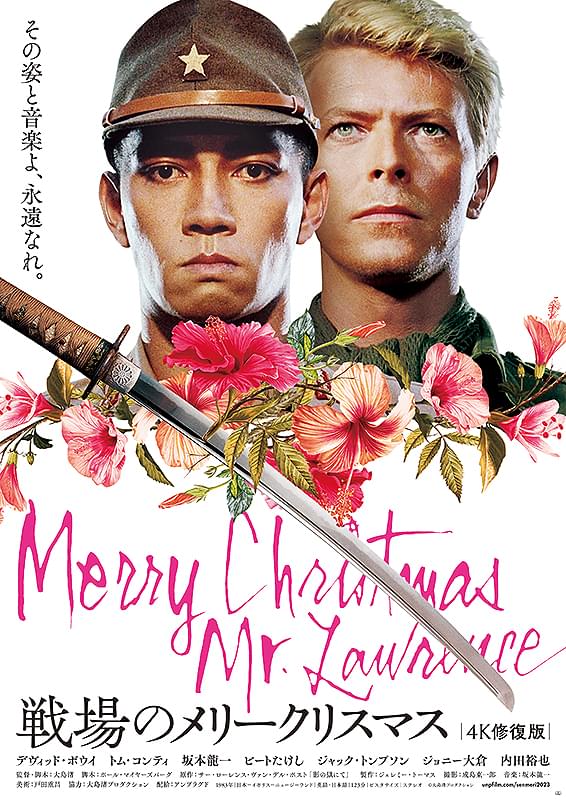
『戦場のメリークリスマス』(英:Merry Christmas, Mr. Lawrence)とは、1983年5月28日に日本で公開された映画作品。大島渚が監督を務め、日本、イギリス、ニュージーランドによる合作として製作された。テレビ朝日が映画製作に初参入した記念すべき第1作目でもある。
原作は、南アフリカ共和国の作家ローレンス・ヴァン・デル・ポストによる短編集『影の獄にて』。著者のジャワ島における日本軍俘虜収容所での実体験をベースにしている。第36回カンヌ国際映画祭のコンペティション部門に出品されて高い注目を集めたほか、英国アカデミー賞で作曲賞を受賞するなど、世界的な評価を獲得した。近年ではデジタル修復版による国内外でのリバイバル上映が行われており、2023年には劇伴を手掛け出演も果たした坂本龍一の逝去に伴う追悼ロードショーも実施された。
物語の舞台は1942年、日本軍政下にあるジャワ島の日本軍俘虜収容所。日本語を解する英国陸軍中佐ジョン・ロレンスと、粗暴ながらもどこか人間味を残す軍曹ハラとの間に芽生える奇妙な友情や、厳格な収容所長である陸軍大尉ヨノイと、彼の心を揺さぶる反抗的で美しい英国陸軍少佐ジャック・セリアズとの言葉を超えた精神的結びつきが描かれる。文化や価値観の対立、戦時下という極限状態における男たちの絆を映し出し、敗戦後の1946年のクリスマス前夜、立場が逆転したロレンスとハラの切ない再会と別れで物語は幕を閉じる。
本作は毎日映画コンクールで日本映画大賞や男優助演賞(ビートたけし)などを受賞したほか、日本アカデミー賞でも多数の優秀賞や話題賞を獲得。デヴィッド・ボウイ、坂本龍一、ビートたけしといった当時の最先端を行く異色のキャスティングと、坂本が手掛けた美しいテーマ曲とともに、日本映画史に残る不朽の名作である。

Reviews, Ratings and Comments on 戦場のメリークリスマス

戦場のメリークリスマス
8

Merry Christmas on the battlefield - Sad men at the mercy of war

Merry Christmas in the Battlefield" is a 1984 film directed by Nagisa Oshima about the strange friendship and love between soldiers in a Japanese POW camp on the island of Java under Japanese rule.
The main cast of this film includes rock singer David Bowie, comedian Beat Takeshi, and the aforementioned Ryuichi Sakamoto, who is not a professional actor. Director Nagisa Oshima's goal was to create a film in which professional actors would not be able to give a realistic representation of the characters, because their skills would be too polished. As he intended, the film delicately depicts the emotional turmoil of soldiers in an extreme state of mind.
The beauty of David Bowie's performance as Army Major Jack Celiaz is something that only a rock singer like Bowie could bring out, and Beat Takeshi's blunt performance as Sergeant Hara is a perfect representation of Hara's unbearable humanity. Although this film is a war movie, there are no battle scenes at all. All that is depicted is the sad past and pride of the soldiers in the camps, their unforgivable love for each other that transcends gender and friendship that transcends national borders.
And yet, after watching this film, a very strong aversion to war is generated. This is a masterpiece by Nagisa Oshima, who did not depict anti-war with cool action scenes, but only with spiritual portrayal.

戦場のメリークリスマス
7

The music and the last.

First and foremost, the music is wonderful. It reminds me of Christmas.
Also, the way it ends is great, and I felt that being able to greet people, which was something that was not allowed at that time, shows that the war is over. I thought that even when they were POWs and Japanese soldiers, they really wanted to celebrate Christmas like friends.
In terms of the story, there were some things I didn't understand. I don't really understand what was going on in that era, and not many big things happened, or maybe they did, but the movie didn't seem to have that much excitement. Ryuichi Sakamoto's music is great, and his face is very tasty, but he is not an actor, and his acting is a bit............................. That's what bothered me.
I originally saw this movie without knowing what the story was about, even though it is well-known. I was surprised that there were more BL elements than I expected. But I think it wasn't about gender or anything like that, it was about the sadness of not being able to do anything or even like someone while there was a war going on. I think it was a sadness of not being able to do anything and not being able to love people in the midst of the war. I felt that those things were sad and war was scary.

戦場のメリークリスマス
10

Must See Before You Die! Comments and review of the 4K restored version of the classic "Merry Christmas at the Battlefield".

Every great film has its masterpieces, but this one has it all, plus the miraculous casting! David Bowie x Ryuichi Sakamoto x Takeshi Kitano.

It's more than cool, it's beautiful! Bowie's aesthetic sense shines through.
I was entranced by Bowie's beautiful blue eyes, shapely style, and elegant behavior from start to finish. This is my guess, but even though it was supposed to be hot in the middle of summer on stage, he wore a thin green scarf around his neck like a scarf. It was so fashionable that I thought it was Bowie's idea. In the boyhood scene, he was wearing a school uniform and a can-can hat at an angle, and it was worn at such an exquisite angle that I wanted to measure it with a protractor. In addition to her aesthetic sense and superficial beauty, she had a strong charm that radiated from within her, as if she could be sucked in just by uttering a line.

Choosing death over shame, the Japanese boys of that era believed in justice and a way of life.
I felt as if I had seen the way of life of Japanese soldiers, or rather Japanese boys, at a time when the spirit of bushido remained strong. The Japanese soldiers had Japanese swords at their waists, while the European prisoners of war had guns on their shoulders, and if they committed any blunder, they would atone for their sins with their own lives by disembowelment. happiness for oneself and one's family, and it was considered right. Whether or not this ideology was correct, I felt that the roots of the Japanese people's emphasis on chic, noble spirit and humility may have come from here. When I think about it, I felt that it was no coincidence that the main captives were British. I believe that there is no small amount of chivalry in England as well, and there was a friendship that was built because there was something that resonated with me and that I could sympathize with. The highlight of the film is that you can feel the friendship and human connection between David Bowie and Ryuichi Sakamoto, and between Takeshi Kitano and Lawrence, through the eyes and facial expressions of these famous actors, and through their conversations, which are not numerous.

★Miracle casting! David Bowie x Ryuichi Sakamoto x Takeshi Kitano (Beat Takeshi)
I believe that this miraculous casting was only possible because of Director Oshima. A masterpiece has great songs and great actors. Even though there are no battlefield scenes, the eyes and facial expressions of the great actors fully convey the horrors of lives ruined by war. The charm they already possess as human beings adds depth and breadth to their roles, and the fact that you can feel the humanity in each character is also a highlight.

Recommended for...
Those who are not good at battle scenes but want to see a masterpiece with a war theme.
People who want to enjoy the charm and beauty of David Bowie.
Those who want to see a film with great composition, color, and use of light.

Not for these people
People who want to see large scale and powerful battle scenes.
Those who want to see films that are easy to understand, easy to watch, and funny.

戦場のメリークリスマス
10

Victims of the Judgmental Era

Hara," played by Beat Takeshi in "Merry Christmas on the Battlefield," was a man who followed what was considered "justice" during the war.
The values of the times created Hara, and Hara was then judged as a war criminal.
Hala was a victim, not a perpetrator.
Once you see the film all the way through and then watch it again from the beginning, "Hala," who at first seemed to be a villain, appears to be just a "cute" person.
Human beings live with conflicts all their lives.
I think that, although there are things that are unforgivable from the victim's point of view, from a bird's eye view, any sinner may be forgiven in the end, as seen in this film.
The lyrics of Hibari Misora's "Ai San San" say, "People are lovely, lovely things, aren't they?" In Merry Christmas at the Battlefield, there are sad war scenes and scenes of physical punishment, but it cannot be helped because that was the justice of the times.
The writer Kafu Nagai knew that Japan would lose the war.
This was because he had studied in France.
So, he lived his life playing in brothels, etc., while being caught and not being caught by the language control.
This movie made me think a lot about who was more intelligent and who was more serious, a person like Hala or a person like Kafu Nagai.