
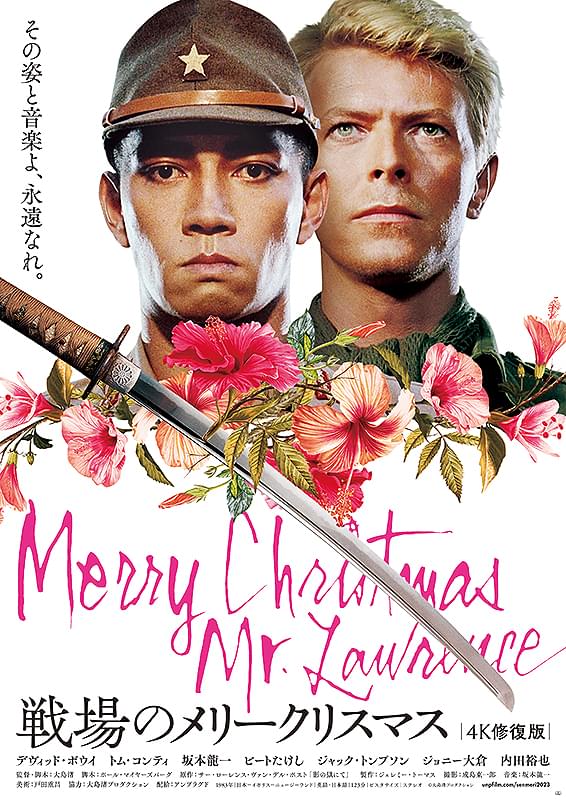

Victims of the Judgmental Era
Hara," played by Beat Takeshi in "Merry Christmas on the Battlefield," was a man who followed what was considered "justice" during the war.
The values of the times created Hara, and Hara was then judged as a war criminal.
Hala was a victim, not a perpetrator.
Once you see the film all the way through and then watch it again from the beginning, "Hala," who at first seemed to be a villain, appears to be just a "cute" person.
Human beings live with conflicts all their lives.
I think that, although there are things that are unforgivable from the victim's point of view, from a bird's eye view, any sinner may be forgiven in the end, as seen in this film.
The lyrics of Hibari Misora's "Ai San San" say, "People are lovely, lovely things, aren't they?" In Merry Christmas at the Battlefield, there are sad war scenes and scenes of physical punishment, but it cannot be helped because that was the justice of the times.
The writer Kafu Nagai knew that Japan would lose the war.
This was because he had studied in France.
So, he lived his life playing in brothels, etc., while being caught and not being caught by the language control.
This movie made me think a lot about who was more intelligent and who was more serious, a person like Hala or a person like Kafu Nagai.