新世紀エヴァンゲリオン劇場版 / 旧劇場版 / 新世紀エヴァンゲリオン劇場版 DEATH(TRUE)2/Air/まごころを、君に / Revival of Evangelion / 新世紀エヴァンゲリオン劇場版 シト新生 / Neon Genesis Evangelion: Death & Rebirth / 新世紀エヴァンゲリオン劇場版 Air/まごころを、君に / The End of Evangelion

新世紀エヴァンゲリオン劇場版 / 旧劇場版 / 新世紀エヴァンゲリオン劇場版 DEATH(TRUE)2/Air/まごころを、君に / Revival of Evangelion / 新世紀エヴァンゲリオン劇場版 シト新生 / Neon Genesis Evangelion: Death & Rebirth / 新世紀エヴァンゲリオン劇場版 Air/まごころを、君に / The End of Evangelion

Neon Genesis Evangelion DEATH (TRUE)2/Air/Magokoro wo Kimi ni" is an anime film directed by Hideaki Anno that combines the contents of "Neon Genesis Evangelion The Movie: SITO Shinsei" and "Neon Genesis Evangelion The Movie: Air/Magokoro wo Kimi ni", which were released successively in 1997. The film, re-edited and reinterpreted from the TV version, visualizes another ending that was never told.
It is called "Natsu Eva" or "EOE," but is also referred to as the "Old Movie" to distinguish it from "Evangelion: The Movie" which was released sequentially starting in 2007.
Neon Genesis Evangelion the Movie" is a must-see for fans of the TV series to gain a deeper understanding of the world of the original work, and for new viewers to fully appreciate the appeal of Evangelion.
One day, Shinji Ikari, a boy in the second year of junior high school, is summoned by his father, Gendo Ikari, commander of the NELF, and ordered to "ride Evangelion, a general-purpose humanoid battle weapon, and fight against the enemy of humanity, the apes. Shinji, who is unaware of the situation, is ordered to continue fighting against the enemy, and while interacting with other boys and girls of the same age, he becomes entangled in a conspiracy over the fate of the world.

Reviews, Ratings and Comments on 新世紀エヴァンゲリオン劇場版 / 旧劇場版 / 新世紀エヴァンゲリオン劇場版 DEATH(TRUE)2/Air/まごころを、君に / Revival of Evangelion / 新世紀エヴァンゲリオン劇場版 シト新生 / Neon Genesis Evangelion: Death & Rebirth / 新世紀エヴァンゲリオン劇場版 Air/まごころを、君に / The End of Evangelion

新世紀エヴァンゲリオン劇場版 / 旧劇場版 / 新世紀エヴァンゲリオン劇場版 DEATH(TRUE)2/Air/まごころを、君に / Revival of Evangelion / 新世紀エヴァンゲリオン劇場版 シト新生 / Neon Genesis Evangelion: Death & Rebirth / 新世紀エヴァンゲリオン劇場版 Air/まごころを、君に / The End of Evangelion
10

Evangelion in the style of director Hideaki Anno

It has been more than 20 years since its release and I have seen this film many times, but this may be the only film that changes my impressions and thoughts every time I see it.
I think this may be the only film in which my thoughts and feelings change every time I watch it. Shinji is surrounded by "congratulations" from his friends, and the film is based on the concept of an Evangelion story that has a different ending from the celebratory mood at the end of the TV series.
In contrast to the warm ending of the TV series, the film starts from the beginning of the film, where things are clearly in a cloud of uncertainty.
Shinji and Asuka are unable to ride the Eva for their own deep reasons, the NERV staff are slaughtered by the Strategic Self-Defense Force, Misato sacrifices herself to save Shinji, and Gendo plots and attempts to do terrible things...
The film is a storm of depressing developments that make you want to say, "Oh no, oh no, oh no, oh no, oh no," just like Shinji in the film.
However, this is also the charm of the old Evangelion movie directed by Hideaki Anno.
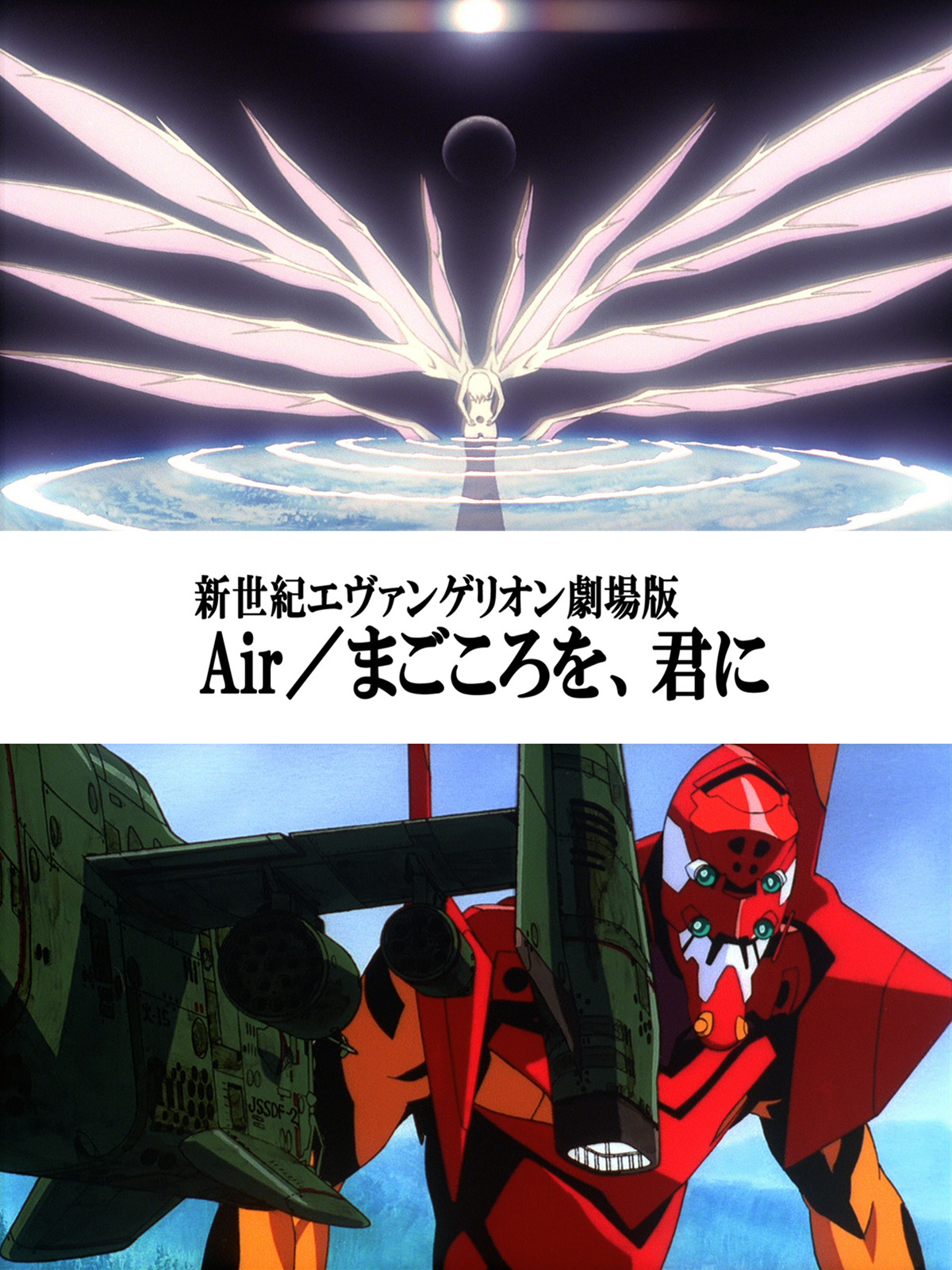
The atmosphere is gloomy from start to finish, but it is Asuka, who awakens aboard Eva Unit 2, who seems to blow away the atmosphere.
The battle scene is a heated battle with a sense of weight between robots, which can be said to be a theory of robot animation, and you can tell that the creators must have been in high spirits when drawing it. The production team must have been in high spirits.
But then again, this is director Hideaki Anno.
The defeat after Asuka's awakening and the plunge into despair were so tremendous that those with a weak mentality would need a tremendous amount of time and energy to crawl up from the bottom. That was the case with me.
Asuka's famous line at the end of the film, "I feel sick," was not originally planned, but was the idea of Yuko Miyamura, the voice actress who voiced Asuka.
It is indeed the last line that convinces me that it is "creepy," so please watch it to the end. Of course, it is a compliment.

新世紀エヴァンゲリオン劇場版 / 旧劇場版 / 新世紀エヴァンゲリオン劇場版 DEATH(TRUE)2/Air/まごころを、君に / Revival of Evangelion / 新世紀エヴァンゲリオン劇場版 シト新生 / Neon Genesis Evangelion: Death & Rebirth / 新世紀エヴァンゲリオン劇場版 Air/まごころを、君に / The End of Evangelion
8

Eventually, I'll be back here again.

The movie "Neon Genesis Evangelion: The Movie Air/Magokoro wo Kimini ni" was released in 1997.
The film depicts a mysterious enemy "Apostles" attacking mankind in the year 2015, and 14-year-old boys and girls piloting the general-purpose humanoid battle weapon "Evangelion," and is the final part of the "Neon Genesis Evangelion" TV series, which became a social phenomenon at the time.
The story is about the battle between Zele (the enemy), who aims to manifest Third Impact in a world after defeating all the "apostles," and NERV, a special agency that tries to stop them.
As NERV facilities are destroyed and occupied one after another, the main character Shinji Ikari is discovered and almost killed, but he manages to get on the Evangelion...
The deaths of most of the popular characters in the TV series, the accompanying grotesque depictions, the controversial final scene, and other aspects of the film have divided fans of the TV series, and the debate still rages among them. However, it is highly rated for its visual beauty and effective music, and there is no doubt that it is a work that deserves to be called the final installment of the series.
It is the kind of film that makes you want to watch it over and over again, even though it is "creepy.

新世紀エヴァンゲリオン劇場版 / 旧劇場版 / 新世紀エヴァンゲリオン劇場版 DEATH(TRUE)2/Air/まごころを、君に / Revival of Evangelion / 新世紀エヴァンゲリオン劇場版 シト新生 / Neon Genesis Evangelion: Death & Rebirth / 新世紀エヴァンゲリオン劇場版 Air/まごころを、君に / The End of Evangelion
8

Immediately after realizing it in words, he makes a mistake in action.

To inspire Shinji, Misato scolds him, persuades him, and encourages him. It is one of the best scenes in the film. Right after that, they kiss. Shinji wants Misato to be like a mother or sister to him, but not sexually. Misato does not understand this until the very end, but she makes the wrong move if there is even a small chance that Shinji will move on. It can be taken as a sad and ugly scene, as is typical in this film, which has depicted relationships between people who have rubbed against each other and hurt each other to no end, but it can also be seen as Misato, who is essentially a stranger, desperately trying to become a real family with Shinji.
In the last scene, Shinji realizes the true nature of human beings: "If I want to be recognized by others, I must also recognize others" and awakens to the "affirmation of others. Shinji realizes the true nature of human beings, that they must accept others for who they are. However, Shinji then begins to strangle Asuka, who is lying next to him. In a kind of reversal, Shinji chooses to "stay with the foreign body," but he cannot bear the pain it inflicts on him, so he decides to eliminate it. In terms of accepting the fact that we are stuck in the process of making wrong choices in life and repeating the repetition of making mistakes and regretting them, I think the story is one step further than the TV version, which ended halfway through the story. It means that there is always the possibility of continued negative attention from the other side. However, in response to this, Kaworu's words, "That possibility (the pain inflicted by the foreign object of others) is the very hope that something different from ourselves exists in this world," are very memorable.
The catharsis of the scene immediately following Asuka's awakening alone is well worth seeing. In this film, where none of the characters are acting according to their own logic, this is the first time Shinji is confronted with the raw emotions of others, and the gap in reality is enormous.