

Unstable Poets
You think you've opened a comic book, but long, long strings of words are swirling across the page.
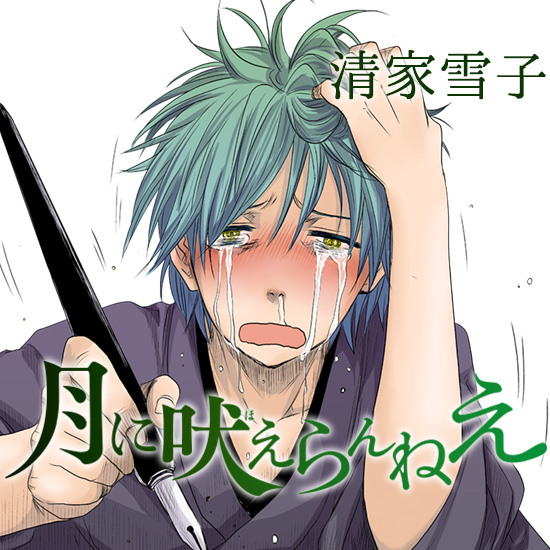
If you start reading "Tsuki ni Barkeranne" (written by Yukiko Seike for Kodansha), you may be surprised at the number of poetic quotations that are packed into the book.
The protagonist of the story is a young man with a boyish or adolescent-like face named "Saku," based on images from poet Sakutaro Hagiwara's poems.
(However, it becomes more and more difficult to identify him as a man with each passing volume of the comics, which leads to the fascinating "instability" of this work!)
) Saku lives in a place called "modern □gai" (詩歌句街) and seems to be getting along well with his admirer, Mr. White (the original image is based on Kitahara Hakushu), and his apprentice, Miyoshi (the original image is based on Miyoshi Tatsuji).
Their way of life seems to pay homage to the relationships that real-life literary giants have developed, but the author, Seike, clearly states in the first panel of the first volume of the comic, "I have nothing to do with any real person or group.
It is rare for the words "no relation" to be used at the beginning of a story, as they are often used in various works.
This is also true of Saku, who literally screams (or faints) when he has a hallucination of being swallowed by "the word," and Mr. Shira, who shows his over-the-top playboyishness, frequently engages in orgies, and they are in the midst of excessive madness.
Indeed, it is impossible to connect their humanity with the real-life writers. Rather, it is indeed scolding.
However, the poetic phrases quoted in the film are nothing but actual works, and one cannot help but feel a disturbing atmosphere in the imbalance between the irrepressible "excessive deformation" and "actual works.
The true nature of this disquieting atmosphere is revealed in the sixth episode, "1945," included in volume 2 of the comic.
In the first volume, Seike mentions the strange inhabitants of the town and Saku's close friend Rhinoceros (originally imagined by Saisei Muroo) who left the town, and finally in the second volume, Seike begins to describe the "war" in which the poets were caught up.
His brushstrokes accelerate and become more severe as the story progresses, revealing the hidden feelings that the poets were unable to bark out.
There is no doubt that the "war poems" bequeathed by these unstable poets are the backbone of this story.
What did they think at the end of creating "war poems"?
The author is facing this question head-on in an attempt to depict it.