
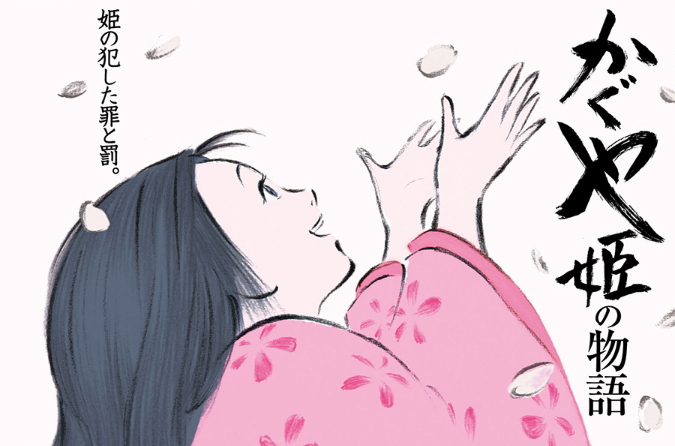

You'd think that no matter how many Ghibli films there are, because it's Princess Kaguyahime, it's all just an old story after all, but when you see it, you'll want to talk about it.
The well-known Japanese folktale "Kaguyahime" has been adapted to film as "The Tale of Princess Kaguya" by the late director Isao Takahata and Studio Ghibli. Here are three highlights.
The first is the light colors used to depict the beautiful Japanese landscapes and characters, and the pencil outlines.
Have you ever seen the lines of an animator's original drawing? Those lines, which the audience cannot see in the finished product, have a certain charm, as if they have a life of their own.
This film was created using an innovative drawing system in order to create an image that makes the most of the charm of the original pencil lines. To the eye accustomed to the digital animation of recent years, this work may seem unsatisfactory at first glance. But like a voice gently reading an old tale, the pale pictures in this film deliver many things.
The temperature when the ogres are in the satoyama. The sense of the seasons. The compassion of the Ou when they call the little princess. The fear of the princess when the emperor approaches her, the anger of the princess when she kicks the floorboards and runs, and many other emotions and textures are delivered through the pictures.
Second, the paintings depict human beings.
In the Heian period (794-1185), the happiness of the princess in marriage was considered to be further enhanced by being chosen by the man, and Kaguyahime's intentions were not reflected in this. On the other hand, O believes that the man who marries the princess should be of high status. This is for his own sake as well as for the happiness of the princess.
Similar values continue to remain in the society in which the audience lives in various forms. Therefore, I believe that there is a part of the story that reaches the audience and does not end up being a folktale. Regardless of gender, people who have seen the film may think something about being chosen and selected, not only for marriage, but also for employment and entrance examinations, and about the standard of happiness.
In the scene where Kaguyahime is reunited with her childhood friend, a young man, in her hometown, her heart soars to the sky. In the movie "Omoide Poroporo," there was a scene depicting Taeko talking with a boy and soaring into the sky. At the time, that movie gave a realistic impression of the emotional turmoil of the main character, Taeko, who was a life-size woman. The late director Takahata's skill was also demonstrated in "The Tale of Princess Kaguyahime". I am sure that there are people who feel as if they are watching this film as if it were their own personal life.
Producer Yoshiaki Nishimura said at the time that women in particular would feel many things. Regardless of gender, if you have not seen this film, please do so.
Third, the humorous design of the supporting characters.
From the O, who looks like that guy from Ghibli, to the handsome emperor, to the courtesan who looks like Ponyo from "Ponyo on the Cliff," they all have their own unique personalities. The messengers from the moon, who appear at the end, are especially a must-see. The lack of sadness and suffering is beautifully expressed. I recommend not watching it with something in your mouth.
There are other points of interest, such as the charm of the princess's voice and figure.
I hope that as many viewers as possible will see this work, so much so that I write such a long introduction.