
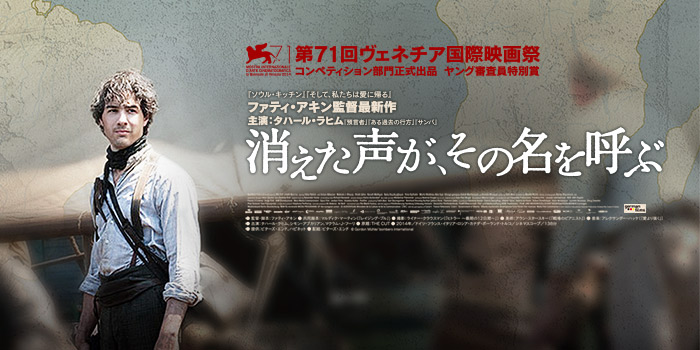
The Ottoman Empire during World War I. One night, Nazaret, an Armenian blacksmith, is suddenly taken away by the military police, forced into forced labor, and executed. His throat is cut and he loses his voice, but he manages to survive, and his only hope is to see his beloved family. In this epic historical drama film, young master filmmaker Fatih Akin portrays a father who walks through the desert, crosses the sea, and travels halfway around the world over a period of eight years.
Overview of "The Missing Voice Calls Its Name"
The Missing Voice Calls Its Name (The Cut) is a German, French, Italian, Russian, Polish, Canadian, Turkish, and Jordanian co-production released in 2014. Directed by Fatih Akin, who has won major awards at all three major film festivals around the world, the film is about the Armenian Genocide by the Ottoman Empire in 1915.
Tahar Rahim, who won numerous awards for his starring role in Jacques Audiard's "The Prophet," gives an impassioned performance as the protagonist who has lost his voice. The film was an official selection in the Competition section of the Venice International Film Festival and won the Young Jury's Special Award.
The story behind "A Missing Voice Calls Its Name"
In 1915, in Mardin in the Ottoman Empire, Nazaret, an Armenian, was living a modest but happy life as a blacksmith, surrounded by his loving wife, Raquel, and twin daughters, Lucine and Arsine.
One day, after finishing work, Nazaret went to church. She had come to repent for having been jealous of a client who was wealthier than she was and had charged him a fee. As a devout Christian, Nazareth tried to be good and discipline herself in this way every day.
After leaving the church, Nazaret went to pick up her twin daughters from school. On their way home, hand in hand, they see a crane flying and Nazaret tells them, "Whoever sees a crane will have a grand journey. He wants them to see the world at large, and that was their father's wish.
The topic of conversation at dinner with the brothers is the situation in World War I. The war was getting serious, and in one town, an Armenian man was reported to have disappeared. Nazareth falls asleep listening to his wife's humming songs with a hint of uneasiness. However, as if to tear apart such a happy night, he is awakened by the sound of someone violently knocking on the door. It was the Kempeitai, the military police. Nazaret and her brothers are taken away with orders to "fight all men over the age of 15. In her hand she holds a scarf given to her by her daughters.
They were taken to an empty, desolate desert. In order to build a road there, Nazareth and his men worked day in and day out under the scorching sun. Armenian elderly men, women, and children wandered past them in a line. The militiamen roughed up the women among them, but the military police on guard made no attempt to stop them. The men prayed that the families that everyone had left behind would be safe.
Forced labor continued as the year went on, and some of the men fell ill and lost their lives. At that time, a man sent by the governor offered to free the men if they converted to Islam. At first, no one moves, but then, little by little, people step forward. Nazareth and the rest of the group shouted at him, "Traitor! and shouted at them.
The next day, they awoke to find men with guns and ropes. Chained by ropes and made to walk to an unpopular place, Nazareth and the others had a premonition of what awaited them ahead. When the military police told them to "get down on their knees," everyone raised their voices and resisted. However, their resistance was in vain as they were decapitated one after another with knives, blood spraying everywhere. The man who held the knife to Nazaretto was unable to cut her head off out of fear, but a soldier held a gun to his head and said, "Do it," and with a shout, as if shaking something off, he slit Nazaretto's throat.
But Nazaret was not dead yet. The man noticed this, and when it was dark, he returned to Nazaret, untied her rope, and gave her water. The man, who called himself Mehmet, said that he had been in jail as a thief, but had been released on condition that he kill them. Mehmet fled with Nazaret, who had lost her voice. He and a group of deserters he met along the way attacked a passing horse-drawn carriage. But on board was the wealthy guest who had been charged by Nazaret in Mardin. When she learns that a woman and her child have been taken to Lars al-Ain, she decides to go alone to Lars al-Ain to look for her family.
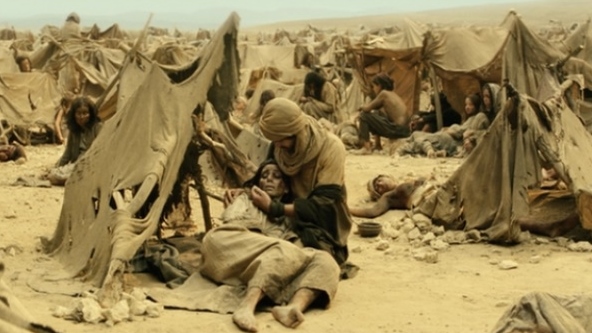
After walking for days, she arrived at a refugee camp in Raas al-Ain to find her sister-in-law lying emaciated and limp. Her sister-in-law told her that her family had all died, and she begged Nazareth repeatedly in a thin voice to "make me comfortable. Nazareth held her sister-in-law to her chest all night, and then quietly strangled her. Is there really a God? If so, why did she do this? She was so angry that she kept throwing stones into the sky.
With nowhere to go, Nazaret was rescued by Omar, an old man she met by chance, and went to live and work in a soap factory run by Omar in Aleppo. The war eventually came to an end. The defeated Ottoman Empire was virtually dismantled, and the soap factory, which had been opened as a lodging facility, was filled with refugees.
One night, Nazaret went to see a movie that had come to town. What was shown on the screen was a silent film by Chaplin. Everyone laughed at its comical movements, and before Nazzaretto knew it, she was smiling too. Then she cried at the reunion between Chaplin and her children and thought of her twin daughters. When the movie ended, something called Nazaretto's name. It was Levon, her apprentice from her artisan days. She was shocked to hear Levon's words. You know that your daughter is safe.
Nazaret began to search for her daughters, but was unable to obtain any information. So Nazaret decided to leave her soap factory and set out on a journey to visit about 100 orphanages in Syria and Lebanon.
In 1922. Nazaret visits an orphanage in Lebanon and finds a photograph of Lucine and Alcine. She learned that Lucine had a limp from a fall during the death march to Lahs al-Ain, but that they were both healthy, and that she had left the orphanage a year earlier to marry a man whom her math teacher had taken care of. The marriage was to Cuba.
While working on a ship, Nazareth traveled to Cuba with the help of her math teacher's relative, Nakasian. However, six months earlier, they had gone to Minneapolis and were working in a factory. In fact, Lucine's marriage partner, whom she had taken care of, had refused to marry her because of her limp, so Alcine had refused to marry her as well. He asked her to send a telegram to the factory, but the reply said that the two had already left the factory and their whereabouts were unknown. Nazareth thought that going to Minneapolis was her only hope, so she started working to earn money for the trip to the U.S. She was not able to save up enough money, but she was able to find a place to live on the same day. One day, she finds a man who has turned down her offer to marry Lucine, so she attacks him and steals his money.
In 1923, Nazaret began working as a railroad worker in North Dakota, where she met Armenian workers and learned that several Armenian families lived in the village of Raso, 30 miles away. She learned that several Armenian families lived in the village of Raso, 30 miles away. Nazaret had no hesitation. He started walking to Raso.
He arrived at the small town of Raso. Nazaret finds a woman walking with a limp. She calls out her name in a lost voice. The woman feels something and turns around. It was Lucine.
Alcine had died a year ago on Christmas Day from a parasite. As she stands in front of Alcine's grave, Lucine murmurs to the despondent Nazaretto: "You found me. You found me. You found me." Thus ended Nazaret's eight-year journey halfway around the world.
Characters from "The Missing Voice Calls Its Name
Nazaret Manugian (played by Tahar Rahim)
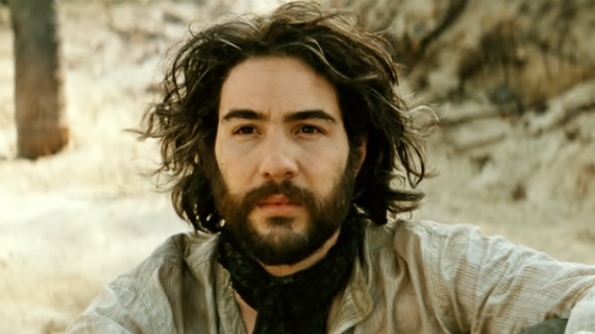
One night in 1915, he and his brothers are suddenly taken away by the military police, forced into forced labor, and beheaded along with their brothers and fellow workers.
However, they are the only survivors because of the hesitation of the beheader, and from there they begin an epic journey to find their family. A devout Christian and a very gentle man, he is sadly strengthened by his terrible experience.
Raquel (played by Hindi Zahra)

Wife of Nazaret and mother of twin daughters, Lucine and Arsine. She was living a happy life surrounded by her loving husband and children, when suddenly her husband was taken away and the town was left with only women and children.
Later, on the way to Lahs al-Ain, where they were forcibly relocated in a death march, she left her two daughters in the care of an Arab nomad. This allowed them to survive, but Raquel herself is believed to have died later, according to her sister-in-law's story.
Lucine (played by Lara Heller)

Daughter of Nazaret. She and Alcine are twin sisters and have been very close since childhood. When Nazaret was taken away, they tearfully handed her a scarf with Nazaret's name embroidered on it.
After being entrusted by her mother Raquel to nomads, she lived in an orphanage in Lebanon. She was then introduced by her mathematics teacher to marry into the Cuban community, but her marriage partner refused her because of her limp. Hearing this, Alcine also quits the marriage, and the two move to Minneapolis. After leaving Minneapolis, they lived in the town of Lasso, but Alcine died about a year before Nazaret found Lucine, and since then she has lived alone.
Omar Nasreddin (played by Makram J. Houli)
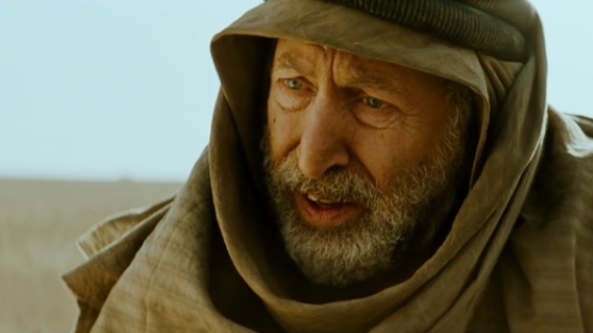
An old man who runs a soap factory in Aleppo. He found Nazareth by chance, who had lost her sister-in-law in Lahs al-Ain and was in despair, and hid her in his soap factory. He is a benevolent man, and after that, he helps those who are wandering around without jobs and puts them to work as live-in laborers.
After the war ended, he opened his factory to refugees as a simple lodging house. Eventually, the factory overflowed with refugees and he lamented that he could not accept any more, but he never gave up on them.
Hagop Nakasian (played by Kevork Malikan)
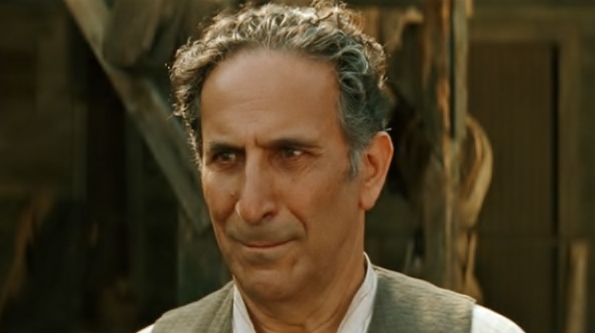
A cousin of the mathematics teacher at the orphanage where Lucine and Alcine grew up, he took care of their marriage proposal, but Lucine turned him down because of his bad leg, and Alcine also turned him down, saying that she could not leave Lucine alone.
When Nazaret visited him at the barbershop he owned, he allowed her to live in his home while he was in Cuba. When Nazaretto told him that she was going to the U.S., he gave his cooperation by negotiating with a customer who was carrying rum.
historical background

Tags
Contents
- Overview of "The Missing Voice Calls Its Name"
- The story behind "A Missing Voice Calls Its Name"
- Characters from "The Missing Voice Calls Its Name
- Nazaret Manugian (played by Tahar Rahim)
- Raquel (played by Hindi Zahra)
- Lucine (played by Lara Heller)
- Omar Nasreddin (played by Makram J. Houli)
- Hagop Nakasian (played by Kevork Malikan)
- historical background
- What is the Armenian Genocide?
- Still Divided Views and Controversy
- Famous quotes, lines, scenes and scenes from "The Missing Voice Calls Its Name
- Illusion of a wife to guide the protagonist
- Chaplin's The Kid
- Episodes and anecdotes from "The Missing Voice Calls Its Name
- Fatih Akin, who challenged a historical taboo.
- The masters who reached out
- trailer (film, TV)