
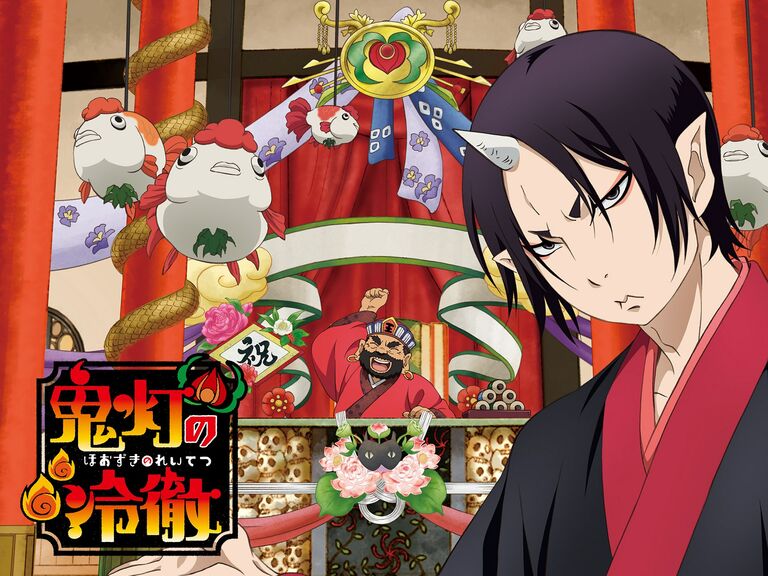
Onikan no Chitetsu" is a manga work by Natsumi Eguchi that was adapted into an anime in 2014, with the second season airing in a two-cour segment in the winter of 2017. The story is set in a Japanese hell and features many characters based on Japanese mythology, fairy tales, and yokai. The main character "Onigami" is a demon god who serves as the first aide to the king of hell, Enma. The story depicts daily life in hell, centering on Onikan, a charismatic, brilliant, but domineering character.
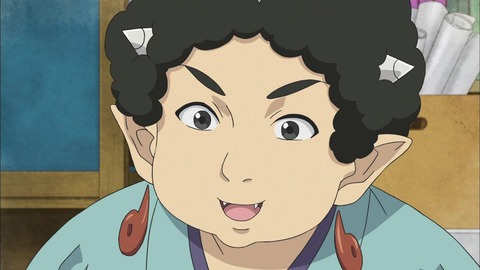
CV: Ohiro Mizushima
A childhood friend of Onikan.
Like Torigashira, he became friends with Onikan when he first arrived in Hades.
In his childhood, Onikan, Torigashira, and Yomogi often worked together.
He has been into collecting clay figurines since he was a child and is now an otaku who loves anime and manga.
He is a fan of a popular work in the afterlife called "Oni Sotsudouji Chinese Angel.
He is usually quiet, but when he starts talking about otaku, he starts talking so much that people around him start to lose interest.
Karasuto plans and develops torture devices and other equipment, and Yomogi makes adjustments so that they can be put to practical use.
While Karigashira is interested in machines and their development, Yomogi is more concerned with body lines and breast size only when it comes to the threat of torturing women.
crow-billed police
Yoshitsune Minamoto / Ushiwakamaru

CV: Kaji Yuki
He is an employee of the Kurama Tengu Police.
Although he is not a tengu, he joined the Tengu Police on the recommendation of Kurama Tengu's "monk Shojo-bo.
He is a small, beautiful boy, but he has a complex about it. He has dreamed of becoming a sumo wrestler since before he was born and longs to be macho like EU Hell Satan.
He is greatly opposed by those around him, who prefer him to remain a beautiful boy.
Because of his appearance, he is often employed as a photo for police posters.
Ten Kings and Aides
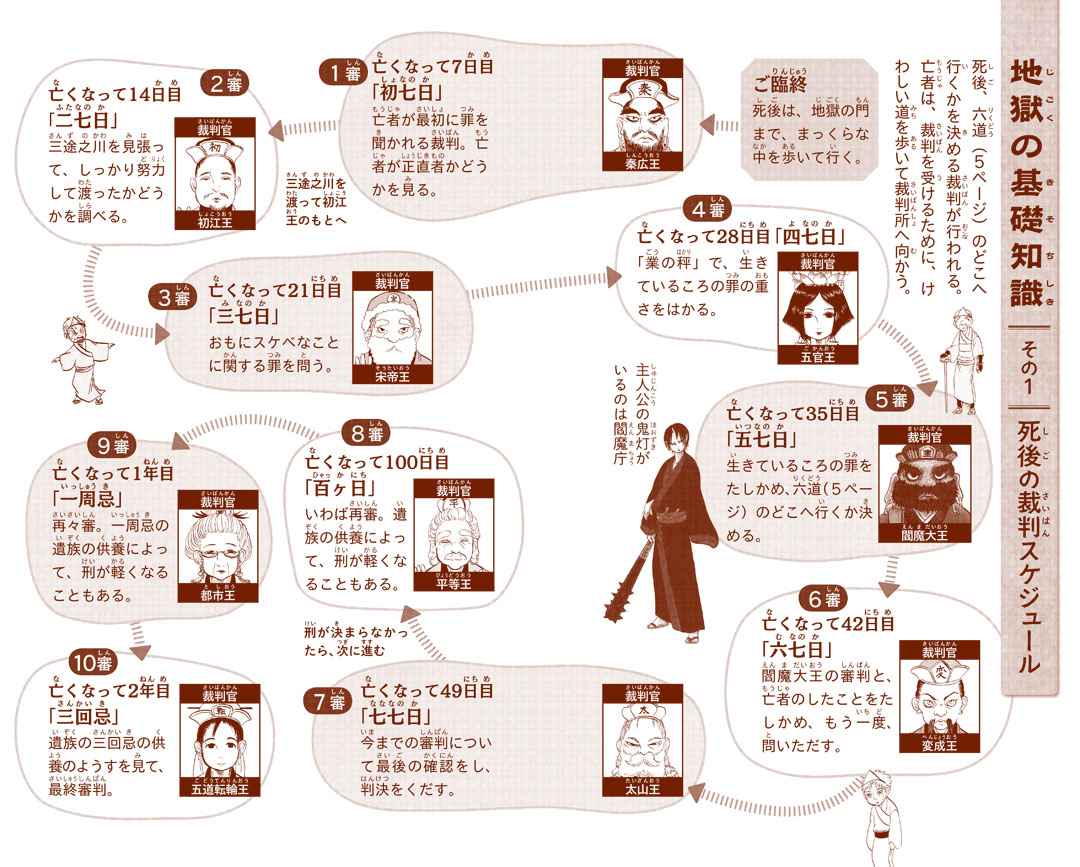
The deceased are tried by ten kings to determine whether they will go to heaven or hell.
On the 7th day after death, the deceased is tried by King Qin Guang; on the 14th day, by King Hatsujiang; on the 21st day, by King Song Tei; on the 28th day, by King Wuguan; on the 35th day, by King Yama; on the 42nd day, by King Hensheng; on the 49th day, by King Taishan; on the 100th day, by King Byodo; on the first year (first anniversary), by King Urban; and on the second year (third anniversary), by King Wu Dao Tianwang.
The content of each trial is different, and sometimes the trial ends with the Taishan King without going through all of the trials.
Therefore, many of the deceased who come to the last five-way tengwang are those who are reluctant to give up and run away.
King Qin Guang Wang
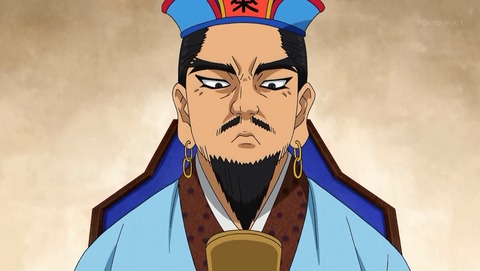
CV: Takashi Matsuyama
The judge of the first seven days (Shonanoka).
He conducts a trial before the deceased crosses the Sanzu River to determine if they are honest or not.
Because of his dignified appearance, he is mistaken for King Enma by the departed.
Ono Takamura
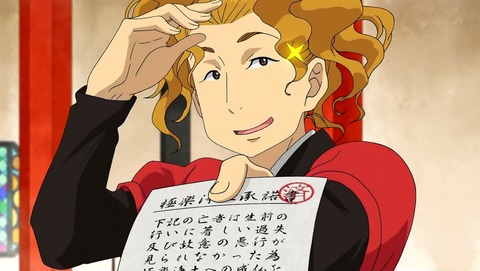
CV: Tsuyoshi Inoue
First aide to King Qin Guang Wang.
He is a historical person who lived in the Heian period.
He has a very strong natural perm.
Before his death, he wandered into hell from a well at Rikudo-Jinnoji Temple, and because of his natural perm, he was thought to be a demon (Gokusoku) whose horns were hidden by his hair, and spent several days in hell.
After that, he was replaced by Onikan, who wanted to go to this world to inspect it. Takamura worked in place of Onikan, and Onikan went to this world pretending to be Takamura.
There is an anecdote about Takamura before his death that he read "ko ko ko ko ko ko ko ko ko" as "kitten of a cat's cub and lion of a lion's cub," but in this work, it was done by the impersonated oni lantern.
Later, when a statue of King Enma was made, it happened to resemble King Qin Guang Wang, and the image of King Enma in this world became King Qin Guang Wang.
King Hatsue (King Shoko)
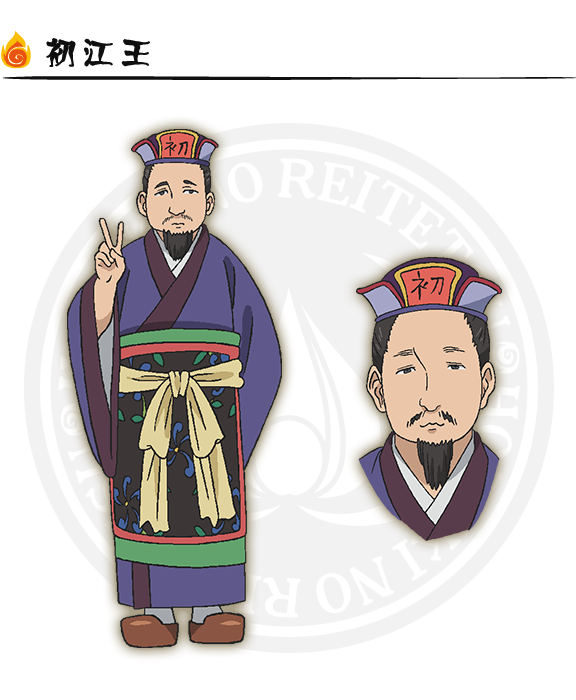
CV: Kenta Sasa
The judge of the 27th (Futananoka) day.
He judges the deceased who have crossed the Sanzu River, and hears testimonies from the deceased's pets and animals with which the deceased had a relationship before his death.
Since animals love him and King Hatsue himself loves animals, most of King Hatsue's prisoners are animals.
Because of the precedent set by King Hatsue, no one could stop Onikoto from increasing the number of animal prisoners.
He does not just love cute animals, but he loves animals themselves, and according to Onikan, he is "more of an animal pervert than an animal lover.
Sung emperor
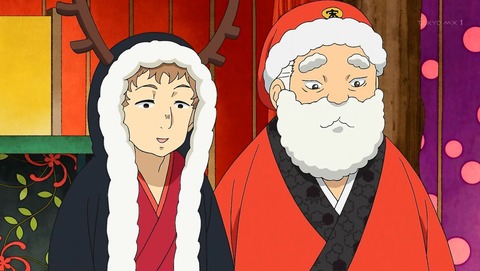
CV: Takuma Suzuki
A judge of the 37th (Minnano) day of the month.
He judges sex crimes, sexual harassment, molestation, and other wicked crimes.
With his white beard, red hat, and kimono, he is often mistaken by the departed for Santa Claus.
Misohagi (bush clover)
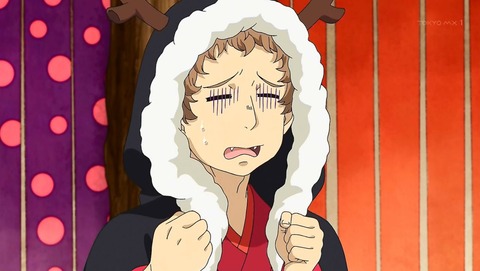
CV: Yoshiaki Hasegawa
First assistant to the Song emperor.
Because of his sensitivity to cold, he always wears a coat with shinroku antlers.
This makes him and the Song Emperor look more Christmas-like, and the demons think he is dressed up as Santa.
His face looks like a mob.

Related Articles
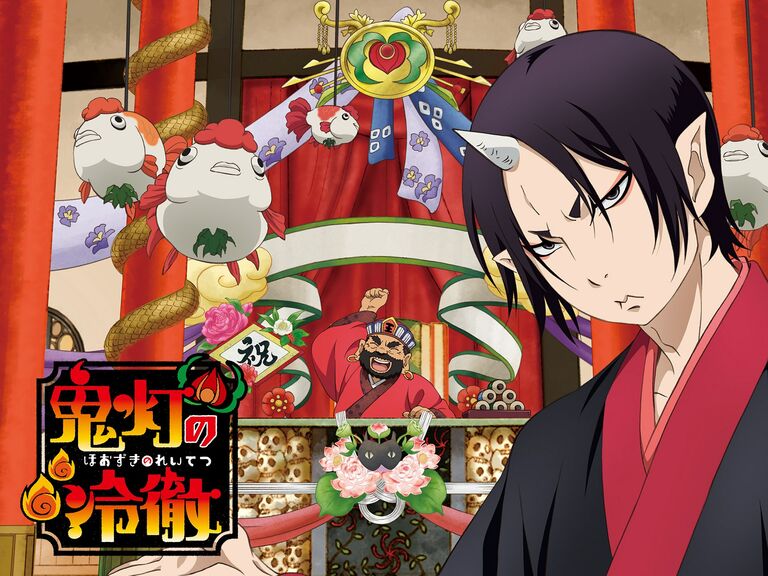
A compilation of famous quotes, lines/scenes, and scenes from Onikan no Raito
Onikan no Chitetsu" is a black comedy manga series by Natsumi Eguchi centered on the inhabitants of a Japanese hell, which was adapted into an anime in 2014 and aired its second season in two separate two-cour installments in the winter of 2017. Set in Japan's hell, the manga features numerous characters based on Japanese mythology, fairy tales, and yokai. The main character Onikan is a demon god who serves as the first assistant to King Enma, the king of hell. The story centers on Onikan, a charismatic, brilliant, but domineering character, and depicts his daily life in Hell. The straightforward statements made by the Dosu Onikan have become the talk of the town, with many quotes that one can empathize with.
Read Article
出禁のモグラ(江口夏実)のネタバレ解説・考察まとめ
『出禁のモグラ』とは江口夏実による漫画。2021年より『モーニング』で連載している。文学部の大学生、真木栗顕と桐原八重子は百暗桃弓木と名乗る仙人に関わり、今まで見えなかったものが見えるようになる。彼は刑罰としてあの世に行くことを禁じられている。あの世に行くためには道標となる“灯”を霊から集めなければならない。その行く先で彼らが不可思議な現象に出会う姿を描いた物語。登場人物の作り込みが細かく、人間の拗れを上手く描いている。地獄の存在が仄めかされているが、前作『鬼灯の冷徹』との関係性は不明。
Read Article
Contents
- Outline of "Onikan no Chitai" (The Lost Light of the Onikan)
- The story of "Onikan no Chitai" (The Cold Light of Onikan)
- Hell's number 2, Onikan
- The Struggle of the Demon Lantern
- The Worldview of "Onikan no Chitai
- What is Hell?
- Hell of equal activity
- Pisspots
- Kuronawa Jigoku
- The Hell of the Masses
- Screaming Hell
- Rain Flame Fireplace
- Separate and bitter place (fumetsu tsuchu-sho)
- Great Screaming Hell
- Scorching Hell
- Ironworks
- Great Incandescent Hell
- Abijigoku (Abijigoku)
- the eight coldest hells in the world
- Hell in a simplified form
- Departments and agencies other than the penitentiary
- records section
- crow-billed police
- welcoming department
- technical section
- Shangri-la
- Hell Abroad
- EU Hell
- British underworld
- Egyptian underworld
- Greek underworld
- life
- marriage
- Main characters in "Onikan no Chitetsu" (The Cold Light of the Demon)
- judgment seat of Yama (judgement)
- Lanterns (Hozuki)
- King Enma/King Enma
- low-ranking prison guard
- Kara-uri (Cucurbita melon)
- eggplant (Solanum melongena)
- hell hath no fury
- white
- Kakisuke
- Lurio.
- the Avici hell, the eighth and most painful of the eight hells in Buddhism
- incense
- Great Molasses Rebellion
- mustard
- the eight coldest hells in the world
- Haruichi
- Alpha Ursae Minoris
- Gates of Hell
- Gozu
- Horse head (Mezu)
- records section
- Leaf Cockscomb
- Kushojin
- technical section
- vortex
- Japanese mugwort (Artemisia princeps, Artemisia indica var. maximowiczii)
- crow-billed police
- Yoshitsune Minamoto / Ushiwakamaru
- Ten Kings and Aides
- King Qin Guang Wang
- Ono Takamura
- King Hatsue (King Shoko)
- Sung emperor
- Misohagi (bush clover)
- Han (people)
- King of the Five Officials
- Japanese star anise (Illicium anisatum)
- King of the Five Dao Tengrins (Five Dao Tengrins)
- Chung (middle)
- hell's dwellers
- Zashiki Warashi (children) / Ichiko and Nikko
- Peach Maki / Makibi
- Miki / Miki
- koban
- Dakki
- Izanami no Mikoto / Izanami
- Goldfish
- Shangri-la
- Shirasawa
- Momotaro
- Neko ko ko (Mao hao hao)
- EU Hell
- Satan
- Beelzebub
- Lady Lilith.
- Egyptian underworld
- Anubis (Greek goddess of strife)
- Yamagami family
- echo
- Princess Ishinagahime / Princess Iwahime
- Princess Kihanasakuyahime / Princess Sakuya
- Other
- Jizo Bodhisattva
- Terminology for "Onikon no chitai" (The cold-heartedness of the devil)
- the dead
- low-ranking prison guard
- ogre
- mirror with a mirror in front of it
- human-headed cane
- Famous Scenes, Scenes, and Places to Watch "Onikan no Chitai" (The Cold Lightning of Onikan)
- Onikan's Past
- Feud between Onikan and Shirasawa
- The real scary Kachikachiyama
- A quick look at the story of Izanagi and Izanami
- Princess Sakuya Showtime
- A wealth of information that you can gain knowledge just by reading.
- Cute animal characters
- parody element
- Backstories, trivia, small stories/episodes, and anecdotes about "Onikan no Chitai" (The Lost Light of Onikan)
- techniques (of expression)
- Influenced by
- My Neighbor Monster-kun" characters make an appearance.
- Changes from the first to the second term
- Great people who are not on the scene but are present.
- Limited Edition with Goods
- Theme song for "Onikan no chiten" (Cold-hearted)
- Opening theme of the 1st season
- Hell's Kitchen All-Stars: "Hell's Kitchen Depends on You"
- Ending theme of the 1st season
- Uesaka Sumire: "Parallax View
- Tokyo Philharmonic Chorus: "Under the Big Goldfish Tree
- Peach Maki (Sumire Uesaka): "120% Caramel Peach Jam
- Shiro, Kakisuke, Lurio: "Oni no ko mita jigokuezu - Rinne wa yasanai" (The hell picture that the demon child saw - reincarnation is nice)
- Uesaka Sumire: "Ask Enma the Great.
- Opening theme of the 2nd season
- Jigoku no Jigoku All Stars "Dai! JIGOKU JIGOKU BUSHI"
- Ending theme of the 2nd season
- Uesaka Sumire: "Riverside Lovers (Love in the Abyss)
- The original comic book of "Onikan no chiten" (The Cold Light of Onikan)
- DVD of "Onikan no chitai" (The cold light of the devil)
- Related links for "Onikan no chitai" (The cold light of the devil)