
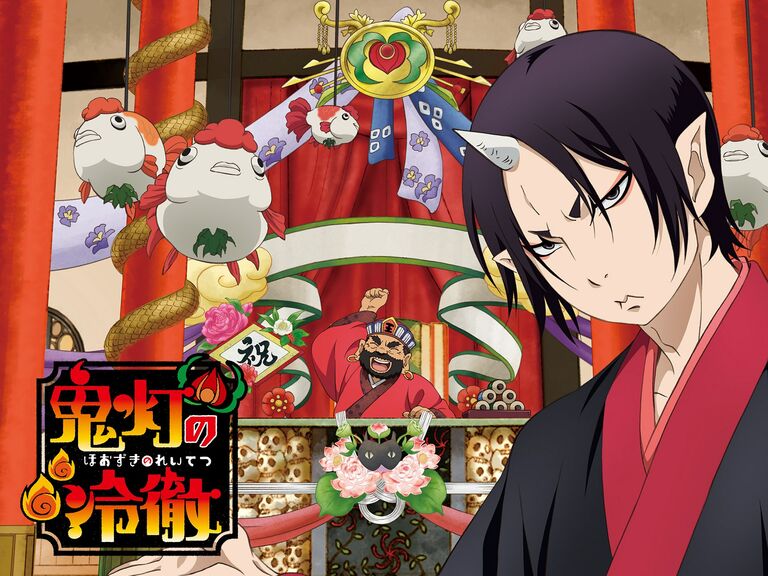
Onikan no Chitetsu" is a manga work by Natsumi Eguchi that was adapted into an anime in 2014, with the second season airing in a two-cour segment in the winter of 2017. The story is set in a Japanese hell and features many characters based on Japanese mythology, fairy tales, and yokai. The main character "Onigami" is a demon god who serves as the first aide to the king of hell, Enma. The story depicts daily life in hell, centering on Onikan, a charismatic, brilliant, but domineering character.
The real scary Kachikachiyama
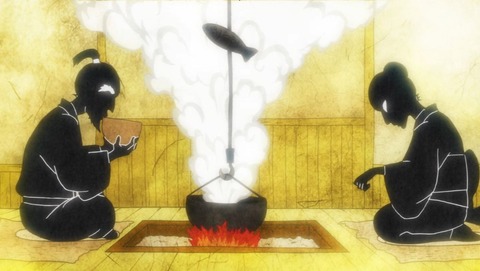
In some fairy tales, the original story is gradually mellowed to make it easier for young children to read.
Kachikachiyama is one such story, and some of the cruel scenes have been cut out.
In the story of Kachikachiyama with the cruel scenes cut out, a raccoon dog misbehaves with a grandfather and an old woman. The raccoon dog injures the old woman, and a rabbit who hears the story goes with the raccoon dog to the mountain, sets fire to the firewood the raccoon dog has and punishes him.
The original Kachikachiyama, however, is even more unforgiving.
The raccoon kills the old woman, makes old-lady soup with her, and transforms into her.
The old woman eats the old woman's soup, and the raccoon scoffs and runs away, saying, "The old man ate the old woman's soup! and the raccoon scoffs and runs away.
Hearing this story, the rabbit goes with the raccoon to the mountain and sets fire to the firewood on the raccoon's back with a flint (the sound of the stones being rubbed together at this time is the origin of the name "Kachi-kachi-yama").
The raccoon dog gets a serious burn on his back, and the rabbit smears spicy miso paste on the burn, claiming that it is medicine.
After that, the rabbit invites the raccoon dog to go fishing, and the rabbit gets on a wooden boat and the raccoon dog gets on a mud boat.
Naturally, the mud boat in which the raccoon dog boarded sank, and the rabbit held the raccoon dog's head down with an oar to save him, causing him to drown.
The original ending of the story is that the rabbit killed the raccoon and avenged his death.
In his work, Onikan says that by cutting out the cruel parts of the story, the villainous character's villainous nature is reduced, and the structure of the story becomes strange.
For example, an uncomfortable feeling occurs in Momotaro, where the ogre has done nothing wrong but is exterminated by Momotaro.
Akuto, the rabbit of Kachikachiyama, is a rabbit who was taken care of by his grandfather and grandmother before his death. The timeline of the story is that after his death, he trained in Momo-gen-kyo and took revenge on the raccoon dogs when he learned of their treachery.
Because of this past, Akuto's personality changes into a violent one at the mere mention of the word "raccoon dog.
A quick look at the story of Izanagi and Izanami
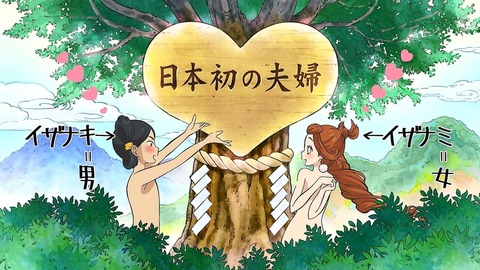
In Japanese mythology, the couple Izanami and Izanagi are said to have created Japan.
Izanagi and Izanami had many children, but one day Izanami gave birth to Kagutsuchi, the god of fire, who was severely burned and died as a result.
Saddened, Izanagi goes to Hades to see Izanami.
Izanami does not want her rotten and disfigured self to be seen, so she tells Izanagi never to look at her.
But Izanagi sees Izanami, and Izanami becomes angry at being humiliated and chases him around.
Izanagi flees to Yomotsuhirasaka, the area between Hades and this world, and blocks the entrance to Hades with a huge rock.
From behind the rock, Izanami told him that she would kill 1,000 people a day in this world if he would do such a terrible thing.
Izanagi replied that he would then make it so that this one would give birth to 1,500 people a day.
This episode was explained in this film in a parody of the educational program "Zakkuri TV.
Princess Sakuya Showtime
In Japanese mythology, the goddess Konohana Sakuyahime is the wife of Ninigi, a descendant of Amaterasu.
Sakuya becomes pregnant, but Ninigi is unsure if the child Sakuya is carrying is really her own and doubts Sakuya.
Sakuya decided that if the child was the true child of Ninigi, the god of Amatsu, she should be able to give birth safely no matter what, so she holed herself up in a maternity house, ignited it, and gave birth in it.
He showed her the child, which was born with flying colors, proving that it was Ninigi's child.
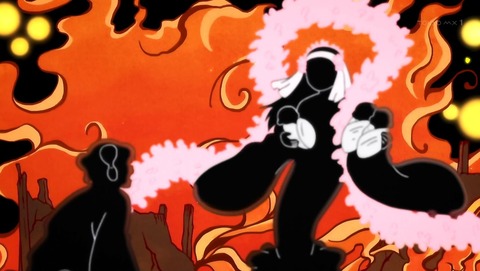
In this work, the young Onigiri appears in this episode of Japanese mythology, advising Sakuya and proposing to give birth in an illusionary manner.
Instead of a birthing house, a perforated Haribote was burned and staged with originally charred walls, smoke screens, and demon fire, and Sakuya gave birth alone in the back of it by degrees.
The onikan made Ninigi stay at arm's length to prevent her from approaching, and because it was nighttime without electric lights and Ninigi was in a hurry and lacked judgment, the trick was not discovered, and the birth was successful and the two were reconciled.
A wealth of information that you can gain knowledge just by reading.
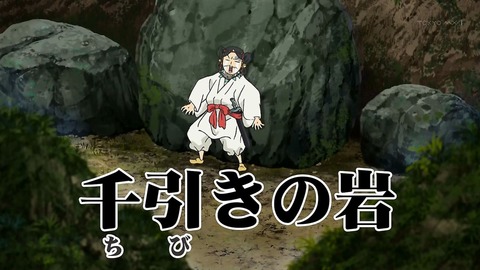
Japanese mythology, which can seem a bit complicated, is easy to understand when viewed in a gag-style animation.
Many of the characters in this work are based on Buddhism, Japanese mythology such as Kojiki and Nihonshoki, and fairy tales known to all Japanese, such as Momotaro and Kachikachiyama.
The stories also provide light commentary on things that may seem familiar but are surprisingly unknown, such as the Kojiki.
There are also details about hell in Japan, myths and stories of hell in Egypt and Europe, historical facts and imaginary creatures.
Watching this work will naturally increase your knowledge of these things.
The manga has a question and answer section, where the author answers detailed settings and original historical facts and myths.
Cute animal characters
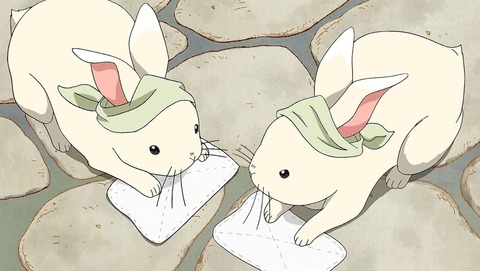
Peachtree employees.
There are as many animal characters in this work as there are humanoid characters.
The most representative examples are "Shiro," "Kakisuke," and "Rurio," the three animals that accompany Momotaro, "Akuto," the rabbit from Kachikachiyama, "Han," the gallant cat, and "Koban," the reporter.
The reason why there are so many animals in hell is because Onikan loves animals, and in recent years, he has been employing animals as prisoners as well.
Outside of hell, the rabbits in Taoyuan-go are apprentices studying Chinese medicine, and although they do not speak, they often appear in the background of the screen.
There are also a number of fictional creatures, such as the "Kirin" and "Phoenix" from Zuiju, and the "Abinus" from Egyptian Hell.
Shirasawa also takes on human form to date a girl, but his true form is that of a white beast.
parody element
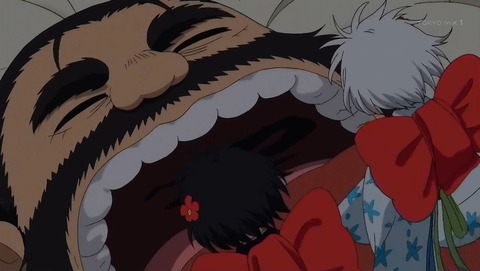
The large, round Enma is often compared to Totoro.
This work has parody material from a wide range of other anime, manga, drama, and variety.
In the first episode of the first season, Onikage is watching "The World's Mysterious Discovery! and the ending of this episode was a parody of the Hitachi commercial song "Hitachi no Ki" played on the same program.
The picture design often leads viewers to mistake it for a serious horror anime, but viewers who had not read the original work learned in the first episode that it was a gag work, and the parody ending became a topic of conversation when it aired.
Onikan seems to be fond of Ghibli's works, and there are many Ghibli references in the series.
In the episode in which Shirasawa appears in the first season, Onikan holds Shirasawa's hand and says "Balsu," and in the episode in which Zashiki-doji appears in the second season, Enma is likened to Totoro.
Backstories, trivia, small stories/episodes, and anecdotes about "Onikan no Chitai" (The Lost Light of Onikan)
techniques (of expression)
The author, Natsumi Eguchi, values the story she first thought of when writing this work and does not reflect what she thinks of later in the story.
She does not favor popular characters and does not force them to appear in the story.
Also, although Onikan, the main character, is a "Dos" character, he is not a sadist who enjoys tormenting others, so he sometimes asks those involved to avoid using such words.
Onikan is popular among women both in the original story and since the anime adaptation, but the author says he was surprised to see Onikan treated as a handsome character because he was aware of the fact that Onikan is a beauty that will never go out of fashion.
He thought it more interesting to create characters with various faces and personalities rather than characters who are perfect both inside and outside, and depicted them as ugly women, such as Princess Iwanagahime, as written in the original texts.
Momotaro, for example, is also depicted only as a beautiful figure of the Heian period, which is an interesting gimmick as it deviates from the modern aesthetic sense.
The characters' actions and settings are based on the author's own experiences. The scene in which Akuto eats his own feces comes from the fact that he used to keep rabbits and knew about their feces-eating habits, and when he told his friends about it, they were taken aback.
The animal characters in this film are not only cute, but also have a unique and terrifying animal quality.
This is to convey the message to people today who selfishly keep pets and then throw them away, that animals can also be frightening.
In addition, the author's strong verbal tsukkomi is what he wanted to say to the upper management of the company he worked for before he became a manga artist.
Maki, who does not tolerate shoplifting because of her part-time job experience, also seems to have come from the author's experience.
Influenced by
The author has been exposed to "Gegege no Kitaro," "Akuma-kun," "Laughs," and "Manga Nihon Mukashi Banashi" under the influence of his parents.
He says that "Gegege no Kitaro" had a particularly large influence on him, especially since he had many opportunities to read yokai manga.
He says he enjoyed the frightening yet cute and unique characters in Kitaro.
On the non-horror side, he was influenced by "Doraemon," with the strong educational elements of the anime version and the crazy elements of the original influencing Onitaro.
The composition and coloring were influenced by Japanese painting, as the artist had prior experience in Japanese painting at art college.
The kimono design is based on a female figure by "Uemura Shoen," while the male warriors and their kimonos are based on the works of "Tsukioka Yoshitoshi.
Among the artist's humorous influences are "These guys are 100% legendary" by Akin Okada and "Nangoku shonen papuwa-kun" by Ami Shibata.
He believes that it is better to go overboard rather than to have small children half-imitate scenes such as the one in which Onikan wields a cudgel.
His choice of words was influenced by the comedy duo "Rahmens.
My Neighbor Monster-kun" characters make an appearance.

Related Articles
A compilation of famous quotes, lines/scenes, and scenes from Onikan no Raito
Onikan no Chitetsu" is a black comedy manga series by Natsumi Eguchi centered on the inhabitants of a Japanese hell, which was adapted into an anime in 2014 and aired its second season in two separate two-cour installments in the winter of 2017. Set in Japan's hell, the manga features numerous characters based on Japanese mythology, fairy tales, and yokai. The main character Onikan is a demon god who serves as the first assistant to King Enma, the king of hell. The story centers on Onikan, a charismatic, brilliant, but domineering character, and depicts his daily life in Hell. The straightforward statements made by the Dosu Onikan have become the talk of the town, with many quotes that one can empathize with.
Read Article
出禁のモグラ(江口夏実)のネタバレ解説・考察まとめ
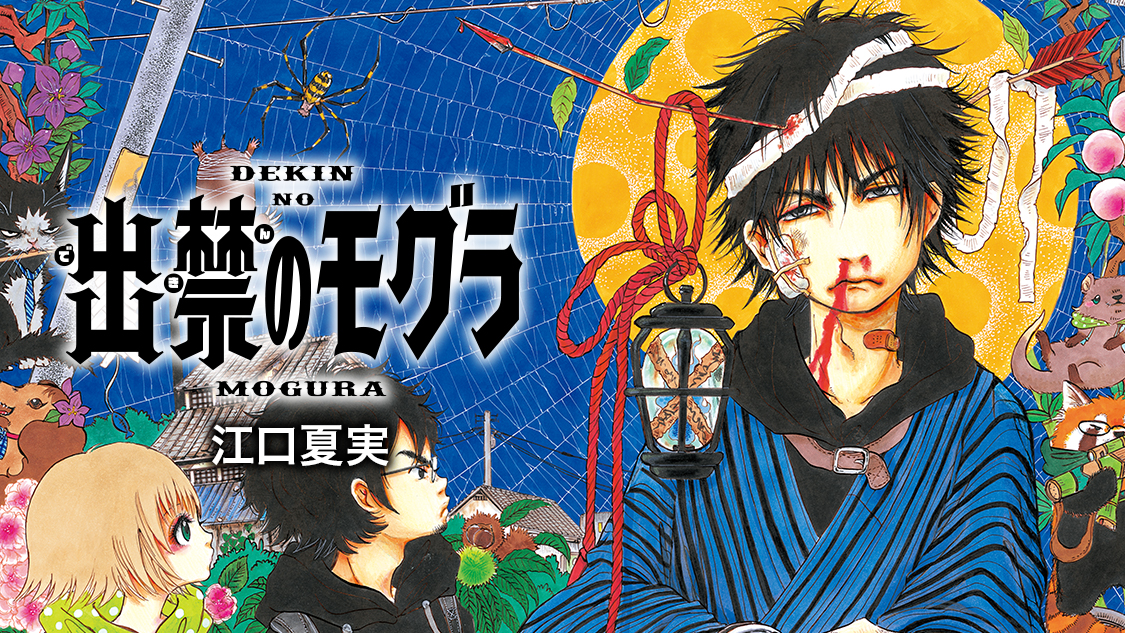
『出禁のモグラ』とは江口夏実による漫画。2021年より『モーニング』で連載している。文学部の大学生、真木栗顕と桐原八重子は百暗桃弓木と名乗る仙人に関わり、今まで見えなかったものが見えるようになる。彼は刑罰としてあの世に行くことを禁じられている。あの世に行くためには道標となる“灯”を霊から集めなければならない。その行く先で彼らが不可思議な現象に出会う姿を描いた物語。登場人物の作り込みが細かく、人間の拗れを上手く描いている。地獄の存在が仄めかされているが、前作『鬼灯の冷徹』との関係性は不明。
Read Article
Contents
- Outline of "Onikan no Chitai" (The Lost Light of the Onikan)
- The story of "Onikan no Chitai" (The Cold Light of Onikan)
- Hell's number 2, Onikan
- The Struggle of the Demon Lantern
- The Worldview of "Onikan no Chitai
- What is Hell?
- Hell of equal activity
- Pisspots
- Kuronawa Jigoku
- The Hell of the Masses
- Screaming Hell
- Rain Flame Fireplace
- Separate and bitter place (fumetsu tsuchu-sho)
- Great Screaming Hell
- Scorching Hell
- Ironworks
- Great Incandescent Hell
- Abijigoku (Abijigoku)
- the eight coldest hells in the world
- Hell in a simplified form
- Departments and agencies other than the penitentiary
- records section
- crow-billed police
- welcoming department
- technical section
- Shangri-la
- Hell Abroad
- EU Hell
- British underworld
- Egyptian underworld
- Greek underworld
- life
- marriage
- Main characters in "Onikan no Chitetsu" (The Cold Light of the Demon)
- judgment seat of Yama (judgement)
- Lanterns (Hozuki)
- King Enma/King Enma
- low-ranking prison guard
- Kara-uri (Cucurbita melon)
- eggplant (Solanum melongena)
- hell hath no fury
- white
- Kakisuke
- Lurio.
- the Avici hell, the eighth and most painful of the eight hells in Buddhism
- incense
- Great Molasses Rebellion
- mustard
- the eight coldest hells in the world
- Haruichi
- Alpha Ursae Minoris
- Gates of Hell
- Gozu
- Horse head (Mezu)
- records section
- Leaf Cockscomb
- Kushojin
- technical section
- vortex
- Japanese mugwort (Artemisia princeps, Artemisia indica var. maximowiczii)
- crow-billed police
- Yoshitsune Minamoto / Ushiwakamaru
- Ten Kings and Aides
- King Qin Guang Wang
- Ono Takamura
- King Hatsue (King Shoko)
- Sung emperor
- Misohagi (bush clover)
- Han (people)
- King of the Five Officials
- Japanese star anise (Illicium anisatum)
- King of the Five Dao Tengrins (Five Dao Tengrins)
- Chung (middle)
- hell's dwellers
- Zashiki Warashi (children) / Ichiko and Nikko
- Peach Maki / Makibi
- Miki / Miki
- koban
- Dakki
- Izanami no Mikoto / Izanami
- Goldfish
- Shangri-la
- Shirasawa
- Momotaro
- Neko ko ko (Mao hao hao)
- EU Hell
- Satan
- Beelzebub
- Lady Lilith.
- Egyptian underworld
- Anubis (Greek goddess of strife)
- Yamagami family
- echo
- Princess Ishinagahime / Princess Iwahime
- Princess Kihanasakuyahime / Princess Sakuya
- Other
- Jizo Bodhisattva
- Terminology for "Onikon no chitai" (The cold-heartedness of the devil)
- the dead
- low-ranking prison guard
- ogre
- mirror with a mirror in front of it
- human-headed cane
- Famous Scenes, Scenes, and Places to Watch "Onikan no Chitai" (The Cold Lightning of Onikan)
- Onikan's Past
- Feud between Onikan and Shirasawa
- The real scary Kachikachiyama
- A quick look at the story of Izanagi and Izanami
- Princess Sakuya Showtime
- A wealth of information that you can gain knowledge just by reading.
- Cute animal characters
- parody element
- Backstories, trivia, small stories/episodes, and anecdotes about "Onikan no Chitai" (The Lost Light of Onikan)
- techniques (of expression)
- Influenced by
- My Neighbor Monster-kun" characters make an appearance.
- Changes from the first to the second term
- Great people who are not on the scene but are present.
- Limited Edition with Goods
- Theme song for "Onikan no chiten" (Cold-hearted)
- Opening theme of the 1st season
- Hell's Kitchen All-Stars: "Hell's Kitchen Depends on You"
- Ending theme of the 1st season
- Uesaka Sumire: "Parallax View
- Tokyo Philharmonic Chorus: "Under the Big Goldfish Tree
- Peach Maki (Sumire Uesaka): "120% Caramel Peach Jam
- Shiro, Kakisuke, Lurio: "Oni no ko mita jigokuezu - Rinne wa yasanai" (The hell picture that the demon child saw - reincarnation is nice)
- Uesaka Sumire: "Ask Enma the Great.
- Opening theme of the 2nd season
- Jigoku no Jigoku All Stars "Dai! JIGOKU JIGOKU BUSHI"
- Ending theme of the 2nd season
- Uesaka Sumire: "Riverside Lovers (Love in the Abyss)
- The original comic book of "Onikan no chiten" (The Cold Light of Onikan)
- DVD of "Onikan no chitai" (The cold light of the devil)
- Related links for "Onikan no chitai" (The cold light of the devil)