
Among the many unique toys created by Gunpei Yokoi, we have compiled a list of two representative examples that dominated the era.
The first work Ultra Hand

Released in 1966. List price: 600 yen.
Mr. Yokoi, whose only job was to inspect equipment, was playing with a "toy stick that expands and contracts" in his spare time. Mr. Yamauchi, the president of the company at that time, saw him doing so and called him into the president's office. Mr. Yokoi thought that he would be scolded, but to his surprise, the president ordered him to "commercialize it as a game. Mr. Yokoi managed to commercialize the game by adding a "ball" to catch and a "stand" to place the ball on to the "stick," which is just a stick that expands and contracts. This simple and easy-to-understand structure was well received by children, and sales reached an astounding 1.4 million units.
The product was named by the president after the word "Ultra C," which was popular at the time due to the 1964 Tokyo Olympics. It was the first in a series of "Ultra Series" toys that would be followed by "Ultra Machine (1968)" and "Ultrascope (1971)".
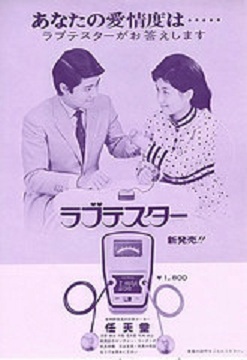
love tester

Launched in 1969. 1,800 yen.
To use the meter, a man and a woman grasp one of the metal balls attached to the end of a pair of cords extending from the main unit and shake hands with their free hand. The meter's needle then swings to indicate the number on the dial. The unit is "love." For example, if it points to 80, it is "80 love. The higher the number, the higher the degree of affection.
The principle is the same as the so-called "lie detector," in that the greater the amount of sweat on the palm of the hand, the easier it is to detect the weak electric current that flows through the human body. However, since you may perspire more when you are in front of someone you are attracted to, the love value may not be a lie.
Yokoi's motivation for developing this product was to "allow men and women to hold hands without hesitation," and his belief in "incorporating communication elements" into toys can be clearly seen in this product. It is a work that clearly expresses Yokoi's philosophy of "incorporating elements of communication" into toys. This is an invention that combines the "old technology" of a galvanometer with the "horizontal thinking" of a handshake.
Related Articles
Inventions of Gunpei Yokoi, "Mr. Nintendo" - RENOTE
renote.net
We will look at the philosophies and ideas of Gunpei Yokoi, who transformed Nintendo from a long-established manufacturer of playing cards and hanafuda (Japanese playing cards) into the world-class company it is today.
