

The second work dealing with dissociative disorders that I would like to introduce is "Golden Time. It is a work in which the protagonist, who has lost his memory and become a different personality, describes his fear that his memory will return and that his present self will disappear. What makes "me" "me" and what is "me" in the first place? It is a work that dared to challenge a theme that might be too heavy for a light novel, and when I read it back now, I feel that it is a little too early for its time.
Considering Dissociative Disorder 1 - "Even If I Don't See You Tomorrow, Today" - RENOTE
renote.net
There is a mental illness called "dissociative disorder." Simply explained, it is a condition in which a person ceases to be himself or herself. The person loses all memories of the past, or a different personality inhabits the same body, and so on. The explanation is a bit complicated, but there are several light novels that depict this kind of mental illness as a motif. The first one I would like to introduce is "Even If I Don't See You Tomorrow," a story about a girl who has several personalities in one body.
The protagonist of "Amnesia."
Banri, the protagonist of "Golden Time" (written by Takemiya Yuko, illustrated by Komatsu Eiji), is considered an "amnesiac" at the start of the story. For some reason, he lost all his memories and entered university as "another persona.
While he is attracted to Kako, the heroine he met there, he also reunites with Linda, another heroine he once had a special feeling for, as a senior and junior at the university.

The hero and heroine lead a conventional, yet enjoyable college life, but...
I want to leave something behind that I've lived."
In fact, Banri's illness is not simply amnesia, but is caused by "dissociative disorder. Eventually, the personality he had before he lost his memory comes to the surface, and even though he lives a mundane, yet joyful life, Banri is haunted by the fear that his "here and now" will disappear someday.
When he realizes that this is inevitable, the protagonist decides to preserve his images.
......I want you to keep it as a proof to yourself. I want to leave this moment in the future to prove to myself that I was alive here. And I want everyone in the future to know that I lived here.
The fear that the existence of "self" might disappear and the protagonist's feelings as he confronts this fear are carefully expressed in this story.
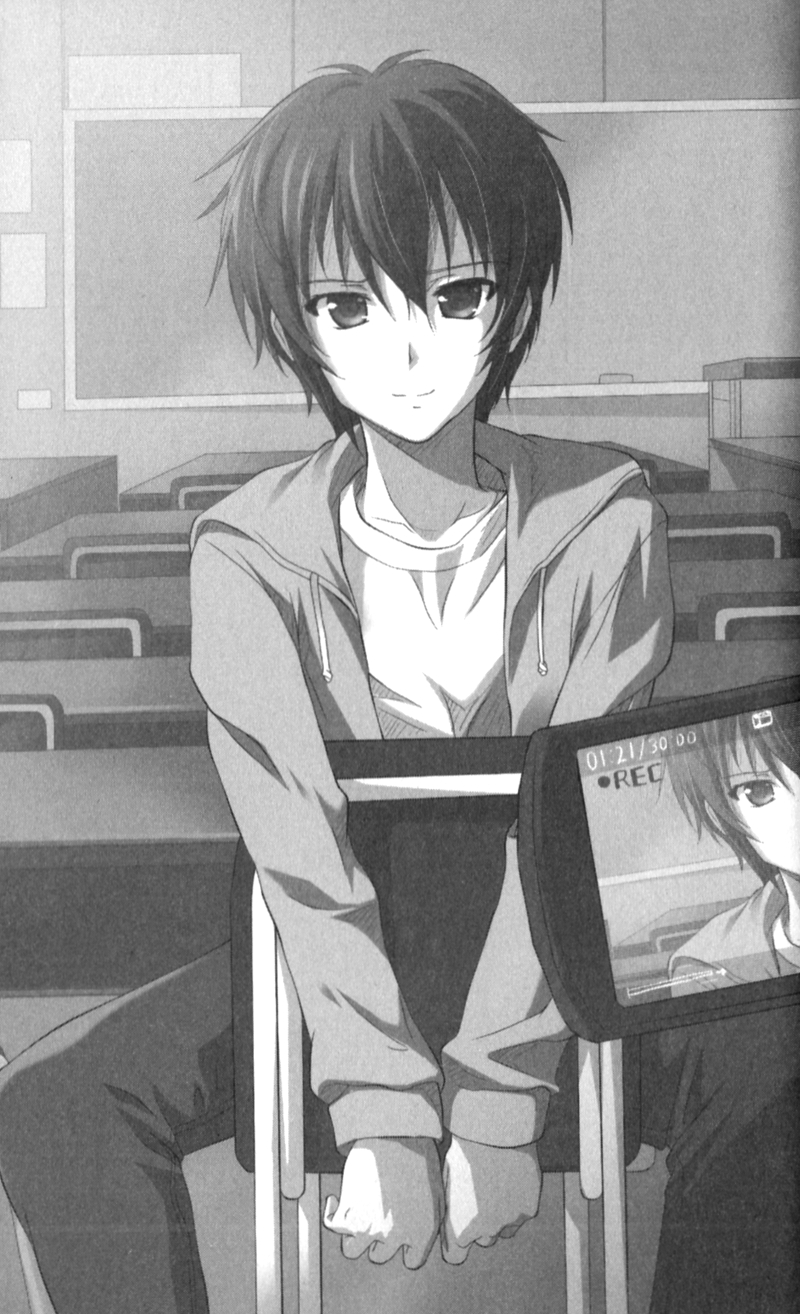
The main character, Banri, turns to the camera in order to "preserve himself.
Sales-wise, we weren't blessed.
Mr. Takemiya is well known for "Toradora," which became a big hit. Although "Golden Time" was also a hit enough to be made into an anime, the simple fact is that it did not reach the sales of "Toradora.
From "Toradora," which was about "where you belong," "Golden Time," which is about "what you are in the first place," is a normal evolution as a story, but perhaps the time was too early for this to be released.
This section continues.

Cover of "Golden Time" vol. 8. Sales did not reach the level of "Toradora".
Considering Dissociative Disorder 3 - "Seishun Butayaku wa Orusuban no Yume ni Mukai" - RENOTE
renote.net
Of all the works dealing with dissociative disorders, I brought this story to the end because it was the least redeeming. It is graceful not to provide easy salvation for the story, not to mention the heaviness of the theme it deals with, but at the same time, it would have the problem of "the inevitability of being entertainment. The writer's attitude of "writing about things that are commonplace" seems to be incompatible with the entertainment aspect.
