
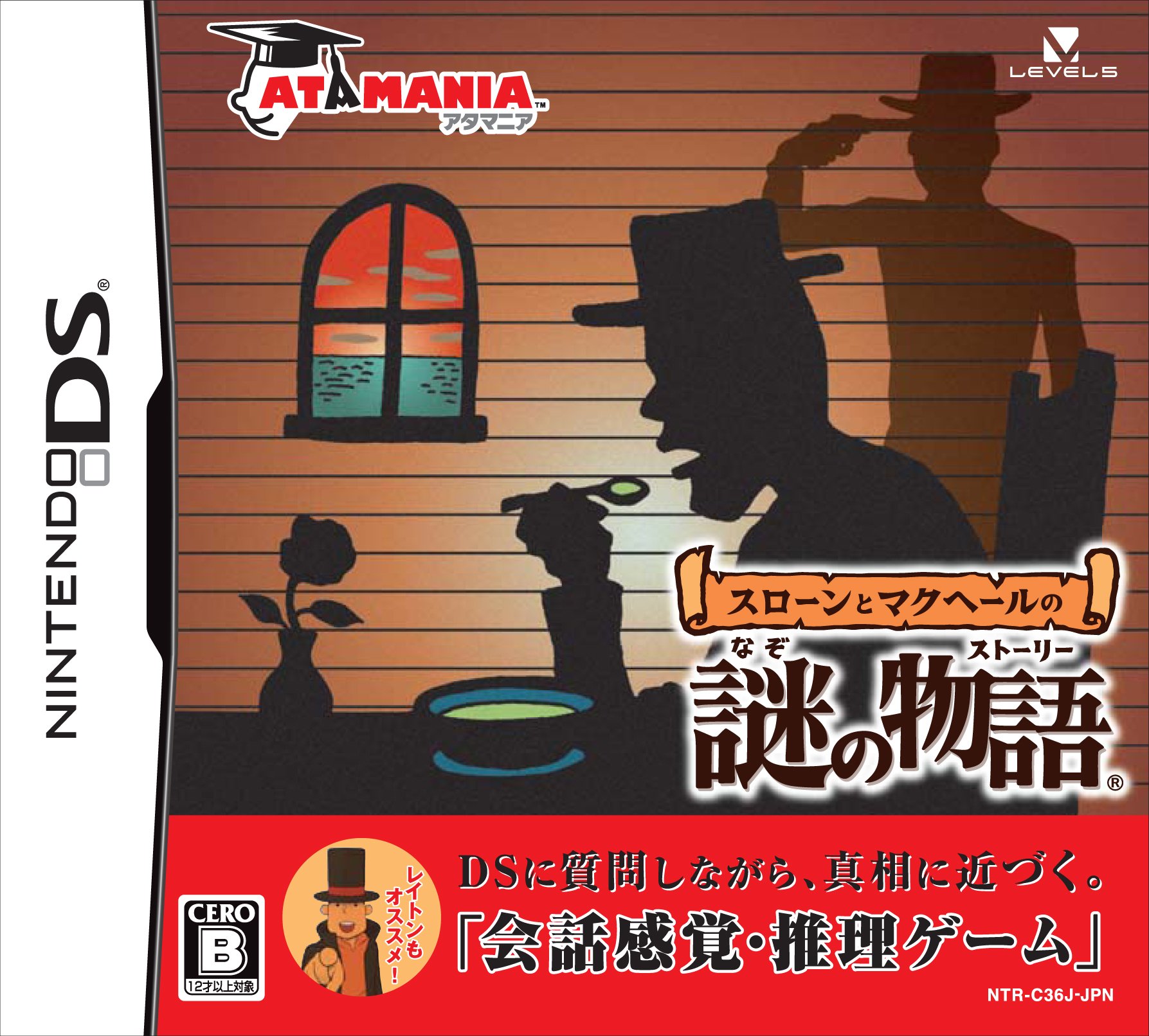
Sloan and McHale's Mystery Story" is a mystery game for the Nintendo DS released by Level-5 in 2009. The game is an adaptation of a "horizontal thinking puzzle," in which the player repeatedly asks and answers questions to advance his or her deductions.
The player reads a story in which only the ending of the story is written, and when the player touches a word in the text to form a question, either "yes," "no," or "not related" is returned, and the player uses these as clues to find the truth. The innovative setting and the highly accomplished mystery are appealing.
An Overview of "The Mysterious Tale of Sloan and McHale"
Sloan and McHale's Mystery Story" is a deduction game for the Nintendo DS released by Level-5 on May 21, 2009. It is a game-playable adaptation of the "horizontal thinking puzzle," in which the player proceeds with deductions by repeating questions and answers. The game is based on the "Sea Turtle Soup" series of books by Paul Sloan and Des McHale, which are representative of horizontal thinking puzzles.
Viewing the story, where only the ending of the story is known, and selecting a word in the sentence with the stylus, other words that may be related are displayed. When you connect these words to form a question, the questioner will answer "yes," "no," or "not related," and you can use these as clues to find out the truth. If you ask a question that gets to the heart of the matter, "Excellent question" will be displayed and the contestant will speak a word that gives a clue. The contestant can also create further questions based on the hints. If you guess from the information you have gathered and proceed to the answer part and answer correctly, you will hear the truth of the story from the contestant.
This is the first in the "Atamania series" of classic puzzle books and intellectual games that the company has developed to enhance thinking skills.
On September 3, 2009, a sequel, "The Mystery of Sloan and McHale 2," was released. The basic controls are the same, but in 2, as you solve the problems, sub-games are unlocked for you to play.
The game gained popularity, especially among puzzle-solving fans, for its innovative setting and high degree of perfection among puzzle-solving games.
The riddles are set in the setting of a story shown in a theater, and are presented in turn by the person who presents the riddles. There are 80 acts in total, ranging in difficulty from simple to complex.
The "Sea Turtle Soup," in which a man ordered sea turtle soup at a restaurant, but as soon as he took a bite, he got up and jumped off a cliff, "The Expensive Book," in which a man with a book worth $40,000 tore the book apart with his own hands and threw it away as garbage, and many other riddles that one cannot forget once one hears them. The fascination of this book is that it is a collection of unforgettable mysteries.
The Story of "The Mystery of Sloan and McHale"
Sea turtle soup
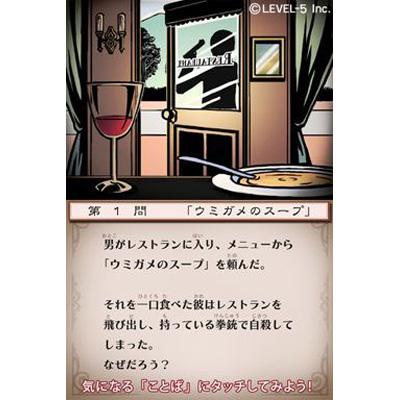
ウミガメのスープのパズル。
The contestant says, "A man's sudden action. A man's sudden action, and the big story behind it. Can you find it?
The story goes, "The man entered a restaurant and ordered 'sea turtle soup' from the menu. After taking a sip of the soup, the man got up from his seat and ran out of the restaurant. He then jumped off a cliff and committed suicide. I wonder why?
The words "sea turtle soup" were connected with words such as "taste" and "memory" to form the question, "Did the man remember the taste of the sea turtle soup?" and make a question sentence, the contestant answers "No." However, if you connect the words "man" to the words "sea turtle soup" and "have eaten" to form the question, "Did the man ever eat sea turtle soup?" and asks, "Yes," the subject replies, "Yes, I have eaten it.
As we repeat the question in this way, we gradually learn more and more about the man. The man had drifted away in the past and nearly starved to death. Furthermore, it turns out that he had eaten sea turtle soup, but could not remember the taste of the sea turtle soup he had eaten at the restaurant.
When the contestant proceeds to answer the questions based on this information, the contestant is asked six questions. Seven choices are displayed, and you choose the word that seems to lead to the answer. Depending on the timing of the answer, some of the words may not have appeared in the guessing part, but in that case, the answer is deduced from the preceding and following sentences.
The answer to the question, "How did you feel about the taste of the man's sea turtle soup?" The answer to the question "I don't remember.
The answer to "What was the man's most painful experience? is drifting.
The answer to "What is the man's worst experience? is the ocean.
What caused the man to nearly die in the past? Starvation.
What has the man lost? Family.
What was in the soup in the man's memory? is a person.
After the above questions and answers are completed, the contestant tells the truth by stating, "The answer you have arrived at... seems to be correct.
The man had been lost at sea some years earlier with his family and a few others, and had drifted until he nearly starved to death. He came to the restaurant because he could not forget the taste of the sea turtle soup he had eaten while drifting. However, the soup he tasted was something he had never tasted before. He realized. He realized that the meat he had eaten while adrift, which he had been told was "sea turtle soup," had belonged to his son, who had died of consumption.
These are the reasons why the man jumped off the cliff. Although it was for his own survival, when the man realized that he had eaten his own son, he could not bear it and killed himself.
The contestant concluded, "Perhaps people are creatures who are not good at forgetting their sorrows. If the man had not visited the seaside restaurant, if the restaurant had not had "sea turtle soup" on the menu... he would not have pulled the curtain back on his own tragedy," he concluded.
Death Party
Parties with people you know well can be fun. But a party without acquaintances who attend out of obligation is boring. You want to leave early, don't you? This is the story of a man who apparently saved his life because of that," the contestant began.
The story goes, "One evening, the man went to a party, drank all his whiskey at once, and decided to leave early. That night, all the guests who attended the party and drank the whiskey died from the poison, but only he survived. Why was he the only one who did not die?" The story was "Why didn't he die?
The word "man" led to the choice of "poison" and "attempted," and the question "Did the man attempt to poison him?" The questioner answered "No. The questioner then asked, "Was the man safe because he was resistant to the poison?" The answer was still "No." But when I asked, "Did you poison the whiskey? But when asked, "Was the whiskey poisoned?" the contestant answered "Yes," and "It seems certain.
The next question was, "Does it have anything to do with the way he drank the whiskey?" When asked, "Excellent question," the questioner indicated "Yes," and the contestant also gave a hint "Yes," and "All the customers who drank the whiskey had a common way of drinking it. From this clue, a further question was created, "Was the common way of drinking whiskey among the customers on the rocks?" which seemed to be the correct answer, and the contestant would tell us that the glasses contained ice, whiskey, and poison.
After compiling this information and proceeding to the answers, the contestant is asked four questions.
The answer to "What action caused the man to survive?" The answer to the first question is, "Leave early.
The answer to "What change in whiskey with time is most associated with poisoning? The answer is "Temperature.
What happened to the poison over time? Spread.
How would the person the killer wanted to kill drink the whiskey? is "on the rocks.
After answering the above questions, the contestant tells the story, "It seems to be correct.
The poison was planted in the ice in the whiskey. At the time the man drank it, the ice had not yet melted, and miraculously, his life was saved. The party continued to go on and most people never left. The more the party went on, the more the poison seeped in, and it became a tragedy that took the lives of many people. Still, who was the culprit behind such a brutal incident?"
Regarding this incident, the contestant said, "If you plant the poison in the center of the ice, it will take time for it to take effect. This would be a trick to delay the discovery of the crime," he explained, explaining the killer's trick. The story ends with a new mystery: who on earth would do such a thing and why?
Expensive books
Books sold in new bookstores have a fixed price determined by the publisher. In antiquarian bookstores, prices fluctuate depending on the popularity and condition of the book. Since antiquarian books are used books, so to speak, they are often cheaper, but when it comes to rare books, the prices can be outrageous," the story begins after a short talk by the contestant.
A man had a book worth as much as $40,000. But the man tore the book to shreds with his own hands and threw it away as garbage. Why in the world?" It was a strange story.
Connecting the word "man" with "act" and "clever," the contestant said, "Yes," "It was a good idea for the man." He then changed the word "clever" to "bet" and asked, "Was the man's act a bet?" When asked, he said that, apparently, the man himself could have lost a lot of money by the act.
He further asked, "Was there only one book in the whole world?" and making a sentence, the contestant gives a hint: "There were two copies of that book in the whole world. Using the "two books" in the clue, the contestant asks, "Of the two books, did you tear out only one?" The contestant asks, "Did you tear out only one of the two books? The contestant then answers "Yes," and then says, "And the value of the one book that remained could increase!" he said. The next question was, "Was the book the man tore up a fake?" to which the subject replied, "No."
From this I deduced and answered the fourth question.
How much was the expensive book worth before the man tore it up? The answer is "$40,000.
What does the man love most? is gold.
Why did the man tear up the book? To make it more valuable.
How many expensive books does the man have left after he tears them up? is "one.
The contestant admitted that these answers "seem to be correct.
In fact, the man had two copies of the book. By taking one of the books apart and throwing it away, he tried to further increase the value of the book. The man's act made the book the only one of its kind in the world, a valuable book. However, it is not certain that it would fetch more than $80,000..."
These were the man's motives.
The contestant said, "The book is the only one in the world...I suppose that he found significance in having it...but it is a barbaric act that is unthinkable for a book lover. There is no doubt that this man does not love books".
Last message
The contestant said, "The term rings true for mystery novel lovers. A message left by a found dead person at the moment of death. Stories in which the protagonist explains the mystery are interesting," he begins to talk about dying messages. He then begins to show a story related to it.
'A man was shot dead. He was lying prone on a desk in his study, a gun in his hand and a tape recorder on the desk. The detective presses the play button and he hears the message, 'I have no more reason to live. I have no reason to live,' was the message heard, and a gunshot rang out. The detective heard this and was convinced he had been murdered. Why?"
Combine "detective," "other murder," "tape," and "gunshot" to create the question, "When the detective heard the gunshot on the tape, did he realize it was another murder?" to create the question, "How did the detective know it was another murder? Anna jumps up and says, "That's a great question!" The questioner affirms and says, "The moment he heard the gunshot, the detective noticed a contradiction. Using the word "contradiction," the contestant asks, "Was the contradiction that the tape was rewinding?" The contestant asks, "Yes. The man was killed by the gun, but the tape was rewound, which implies..."
He then went on to ask, from "the man," "the message," and "his true intentions," "Did the man mean what he said in his message?" I replied, "No. We are told the fact that "all the contents suggesting suicide were said by the murderer.
From these contents, we proceed to the answer.
To "What was the murder weapon that killed the man?" is "A gun.
Where did the man die? is "the study.
"What did the murderer do after he killed the man?" Rewind the recording.
"What was it that made the detective so sure it was another murder?" is "the position of the replay.
When the correct answer is given, the contestant describes the crime.
When the detective pressed the playback button, it suddenly started with a man's voice. Then the tape ended with the sound of a single gunshot. If the man died at the same time as the gunshot, why did playback start with his voice? In fact, there was someone else at the scene who rewound the tape besides the man. The detective immediately realized this and was convinced that the murder was committed by the person who rewound the tape.
This was the truth of the story. The horrifying fact was, "Does this mean that the murderer killed the victim by making it look like a suicide? In a certain mystery novel, there was a case of a suicide made to look like another murder, and another murder made to look like another murder...a complicated case, I heard. It is confusing not only for the detective in the novel, but also for the reader. The contestants were also troubled.
Other mysteries include "The Robber Who Burned a Wad of Stolen Bills," and "The Empty Bottle," in which a girl drained the air out of an empty bottle and filled it with the air of the city.
Basement door
The contestant cut in, "Never open it. Never look at it," he began. You have probably heard such an old tale. The Tamatebako of Urashima Taro. The room of the crane in "The Return of the Crane"? It seems that when people are told what not to do, they are more inclined to try it," he continued.
The film was exactly as he had described in his introduction: "Do not open the door to the basement. If you do, you will see things you should not see. But one day, while her parents were out, she opened the basement door. What was it that she was not supposed to see?
Connecting "door" with "over there," "surprising," and "sight," we get, "Was there a surprising sight behind the door?" Anna jumped up and down and said, "That's a great question! and the contestant denied it, saying, "No." Then she added, "What the girl saw was amazing. The contestant then hinted, "There was nothing surprising in what the girl saw. This unlocked the secret word "what the girl saw. The contestant then connected "what the girl saw" with "living room," and the contestant replied, "Yes. There was a nondescript living room spread out there," the contestant answered. The secret word "large living room" was newly unlocked. Matching the word "window" to "large living room," the questioner nodded "yes" again and said, "There was an ordinary, nondescript window. The final secret word in this mystery, "ordinary window," is then available for selection. Finally, with "ordinary window" and "green garden," he asked, "Did you see a green garden from the ordinary window?" I asked, "Yes. The girl saw the earth for the first time in her life," said the contestant.
From here, we proceed to the answer.
Who else knew about the existence of the cellar besides the girl? The answer was "parents.
Who else had the girl met? Parents.
"Who was inside the cellar?" The girl.
"What was the first thing the girl saw behind the door?" The living room.
What was the first thing the girl was not allowed to see? is the outside world.
To these answers, the contestant states, "It seems to be correct. He then told the truth of this mystery.
The girl had been cherished by her parents in the limited world of the basement, receiving all their excessive love. The girl was happy with her kind parents, but this was clearly a criminal act. Behind the door, the girl saw a wooden living room, a clean kitchen, a garden through the window, and a clear blue sky. These were all ordinary scenes from a home, but for the girl, it was the first time in her life that she had seen the outside world. She has come to know the "outside world" against her parents' wishes. What kind of life will she lead in the future?
The contestant also commented, "It is so important that it must be kept strictly hidden. Such a thing cannot be allowed to happen to a human being. That is totally different from love. People are not things.
Game System for "The Mysterious Tale of Sloan and McHale"
Beginning of the story
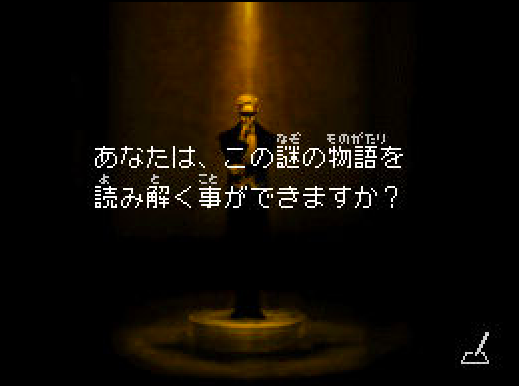
Introduction to the story
The story will always be preceded and followed by a short story by the contestant. Then, after the count of "3, 2, 1," the story begins.
On the Nintendo DS screen, the upper screen shows the illustration and the lower screen shows the text of the story. When the contestant finishes reading the story, the game proceeds to the guessing part.
When the contestant is reading the story, the screen can be touched to fast forward.
Basic operation in the deduction part
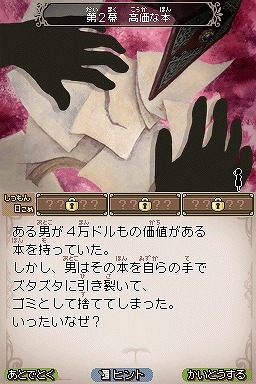
Screen of the deduction part
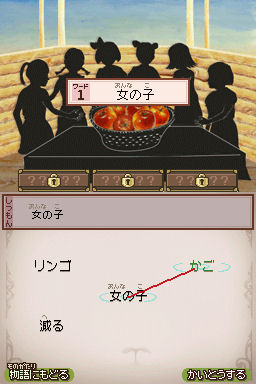
Connect the displayed words to form a question
Some of the words in the story have ripple-like effects. When you select them with a stylus or other tool, related words appear around the word. If you select more related words, the words are connected with each other by lines to form a sentence. The "Ask a question" section will appear, and if you touch it, the questioner will reply with three choices: "Yes," "No," or "Not relevant," and will also give you hints for sharp questions.
There is no limit to the number of questions. You can check how many questions you have asked by looking at the "Shitsumon ○Kome" indicator in the upper left corner of the screen where the story text is located.
secret word
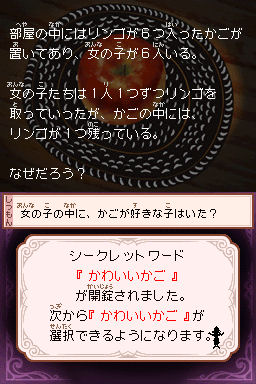
Asking pointed questions unlocks the secret word.

Tags
Contents
- An Overview of "The Mysterious Tale of Sloan and McHale"
- The Story of "The Mystery of Sloan and McHale"
- Sea turtle soup
- Death Party
- Expensive books
- Last message
- Basement door
- Game System for "The Mysterious Tale of Sloan and McHale"
- Beginning of the story
- Basic operation in the deduction part
- secret word
- Answer part
- sub-game
- Characters and characters in The Mysterious Tale of Sloan and McHale
- theatergoer
- questioner (e.g. in a newspaper)
- Anna.
- Mystery Story Characters
- Terms in The Mysterious Tale of Sloan and McHale
- playhouse
- curtain
- tree of imagination
- Novel "Sea Turtle Soup" series
- Horizontal Thinking Puzzle
- Backstories, trivia, subplots/episodes, and anecdotes from "The Mysterious Tale of Sloan and McHale"
- Professor Layton recommended games
- No. 1 in weekly sales ranking immediately after release.
- Children's trauma times