
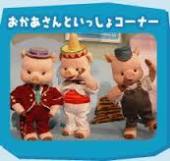
Here is a summary of the beloved "puppet plays" of each era, Okaasan to tosho "Puppet Plays.
1960-1967 "Boo Hoo Woo".
~ Quote~.
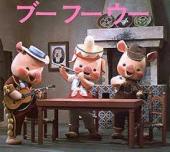
"Set as a sequel to the Western folktale "The Three Little Pigs," this is a comedic story involving three little pigs - Boo, the eldest brother, Hoo, the second brother, and Woo, the youngest - and a wolf that tries to eat them in a Mexican-style setting.
During the course of the broadcast, the wolf and the little pigs became friends.
The show also had supporting characters such as the humorous Yurei and the cute but selfish parrot Pero, who became popular with children."
Quoted in wiki/Boo-Hoo Woo.
sound of heavy breathing
www.geocities.jp
The original stuffed animal puppet show "Boo Hoo Woo" was aired on NHK's popular children's educational program "Okaasan to Itto" on Mondays and Tuesdays during the 15-minute "Puppet Show Corner.
1968-1969 "Mr. Dutt".
~ Quote~.
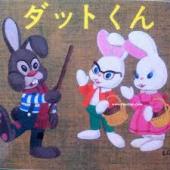
"The MC's sister puts two stuffed bunnies on a small wooden train and proceeds to leave!
When that train goes through the tunnel and comes out of the mountain, oh my, it's a wonder!
The bunnies transform into stuffed animal size and the story of the day begins."
Cited from: http://singsingdo.tea-nifty.com/singsingdo/2008/10/post-bfb4.html
1969-1971 "Tonchinko Bozu"
~ Quote~.
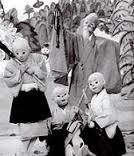
"A delightful folktale about three mischievous little monks and a stubborn monk. From left to right: Tonenbo, the clever one; Chinnenbo, the wimpy, lazy one with c-shaped eyebrows; Kanenbo, the rowdy, fat one; and the monk, who is always scolding the three."
This is the only film in which the main characters are human (as of 2014).
The film depicts a story reminiscent of "Ikkyu-san" in which the monk of a mountain temple and three mischievous little monks, Tonnen, Chinnen, and Kannen (Tonchikan), engage in a "tonchi battle" and the three work together to solve disturbances that occur inside and outside the temple.
Source: wpedia.goo.ne.jp
1971-1974 "Tondeke Butchie" (Tondeke Butchie)
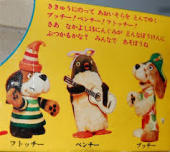
~.
"The slightly slender stuffed dog with a bumchi on the left is the main character, Butchie, and the stuffed penguin girl in the middle is Penchie."
"A balloon vehicle appears from somewhere, and the three dolls board it one after another. The three dolls then board the balloon and float around the room as the theme song plays."
"The balloon goes into one of the pictures and the day's story begins, and no, it was a very fun device that was exciting and very enjoyable, even to a child's mind, to see which picture it would go into today."
Quote from: http://moi-moi.jp/column/zenpan/bucchi.html
"
1974-1976 "Ugoke Boku no E" (The Picture of a Floating Bogeyman)
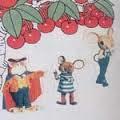
~ Quote~.
The puppet show takes place in a picture sent to me by children watching TV.
Three mice enter the picture.
The story is about joining forces to fight the evil owl.
Maximum use of chroma key technology.
Citation: WIKI/Ugokeboku no e
1977-1979 "Goronta Theatre" (Goronta Theatre)
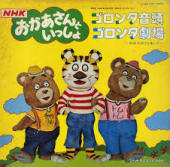
~ Quote~.
"The Goronta Theatre" changed the format of puppet shows that had been used up to that point,
It was the first to adopt the current "puppet show characters interacting directly with children" format.
In those days, the puppet show itself was "performed in a studio with children and filmed while the puppet show was being performed in person,
In the program corner, the puppet show characters and children in the studio would play a game,
In the program's corner, the puppet characters and the children in the studio played a game. "
Cited from: http://dic.pixiv.net/a/ゴロンタ劇場
1979-1982 "Boom Boom Taimu".
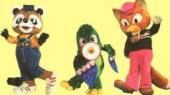
This is a fun story about Bumbun, Tsuneyoshi, and Gojaemon (Oshiodori at the beginning of the broadcast).
Each time, Tuneyoshi tries to make Bunbun and Gojaemon look good by playing along with them, but he always ends up getting hurt in the end.
Reference: WIKI/Bunbun Taimu
1982-1992 "Nikko, Pun" (Nikko, Pun)
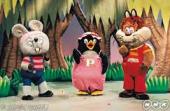
"Jaramaru, Pikkoro, Porori
Actually, these three have... official names, or rather...
Did you know that they have names with last names?"
"・Jajamaru
Real name: Fukurokouji, Jajamaru
Uramote wildcat boy. Estimated age: 5 years old. He is a wildcat with a strong, agile, and parental nature.
Pikkoro
Real name: Furteshimo Pikkoro
She is a "houn" bolt penguin girl. Estimated age: 3.5 years old. She is strong-willed and talkative.
Pororo
Real name: Porori Kaziriacci III
Rat boy. Age: 4 years old. Ancestor is the famous pirate "Neko Irena Kaziriatchi".
嫁さんに「にこにこぷん」すごい懐かしい!と言われたけどは全く知らない
— 玉葱 (@tamanegs_onion) April 6, 2015
その後放送された「ドレミファ・どーなっつ」は知ってるけど「にこにこぷん」はOP聞いても全く知らない
平成生まれは辛いぜ
That's right!
The nostalgia of the puppet show's OP reveals my generation.
1992-2000 "Doremifa Doonutsu!
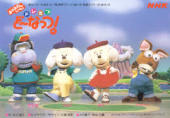
~ Quote~.
"Donut Island" near Nikoniko Island (the setting of "Nikoniko Pun") is the setting for this event.
The number of leading stuffed animals has increased by one from the previous production to four.
The twin poodles, "Mido-Waon" and "Fudo-Waon," the prince character Kinobori kangaroo, "Reonardo-Tobishii," and the gorilla, "Sorao Aoi," who is a nomad and whose name is written in kanji for some reason, are the main characters this time."
Cited from: http://dic.nicovideo.jp/a/ドレミファ, Do Natsu!
Do-Re-Mi-Fa Donuts! (Do-Re-Mi-Fa Donuts) is a puppet show with stuffed animals that was broadcast on NHK's toddler program "OKAASAN TO TO TOSO" from October 5, 1992 to April 1, 2000. It was also broadcast on "Mother and Child TV Time (Sunday Edition)" from April 2000 to March 2001.

Related Articles
![Monoran Monoran] Understanding the Generation! Puppet show of successive generations of "Okaa-san to tosho" [Nikonikopun].](https://renote.net/files/blobs/proxy/eyJfcmFpbHMiOnsiZGF0YSI6NjM2MTM2MiwicHVyIjoiYmxvYl9pZCJ9fQ==--0bd4207944570d8d3039648bcad7921810a48b0d/39e9e4f2118afc6166efa8197eeb9809-1024x681.jpg)
Monoran Monoran] Understanding the Generation! Puppet show of successive generations of "Okaa-san to tosho" [Nikonikopun].
Have you ever heard of the NHK program "Okaasan to tosho"? It is produced for children, and one of its popular sections is a puppet show. In this article, we have compiled a list of puppet plays that have been aired over the years. You can tell which generation you are from by which characters you know! Which one are you familiar with?
Read Article
![With Mom] Surprisingly unknown? A special feature on the "song sisters" and what happened to them afterwards! Takumi Mitani](https://renote.net/files/blobs/proxy/eyJfcmFpbHMiOnsiZGF0YSI6NzY3NjEzNSwicHVyIjoiYmxvYl9pZCJ9fQ==--4151e031a698acd6d7f3902ddf0cf9c4bad5360f/145.jpg)
With Mom] Surprisingly unknown? A special feature on the "song sisters" and what happened to them afterwards! Takumi Mitani
NHK's children's program "OKAASAN ITSYO" is famous for its "Uta no Onee-san" corner where the "Uta no Onee-san" sings with the children. 2016, Takumi Mitani, aka "Takumi Onee-san," regrettably retired as "Uta no Onee-san. In 2016, Takumi Mitani, a.k.a. "Takumi Onee-san," regrettably retired as "Uta no Onee-san. Here we introduce what has happened to the "song ladies" of the past.
Read Article
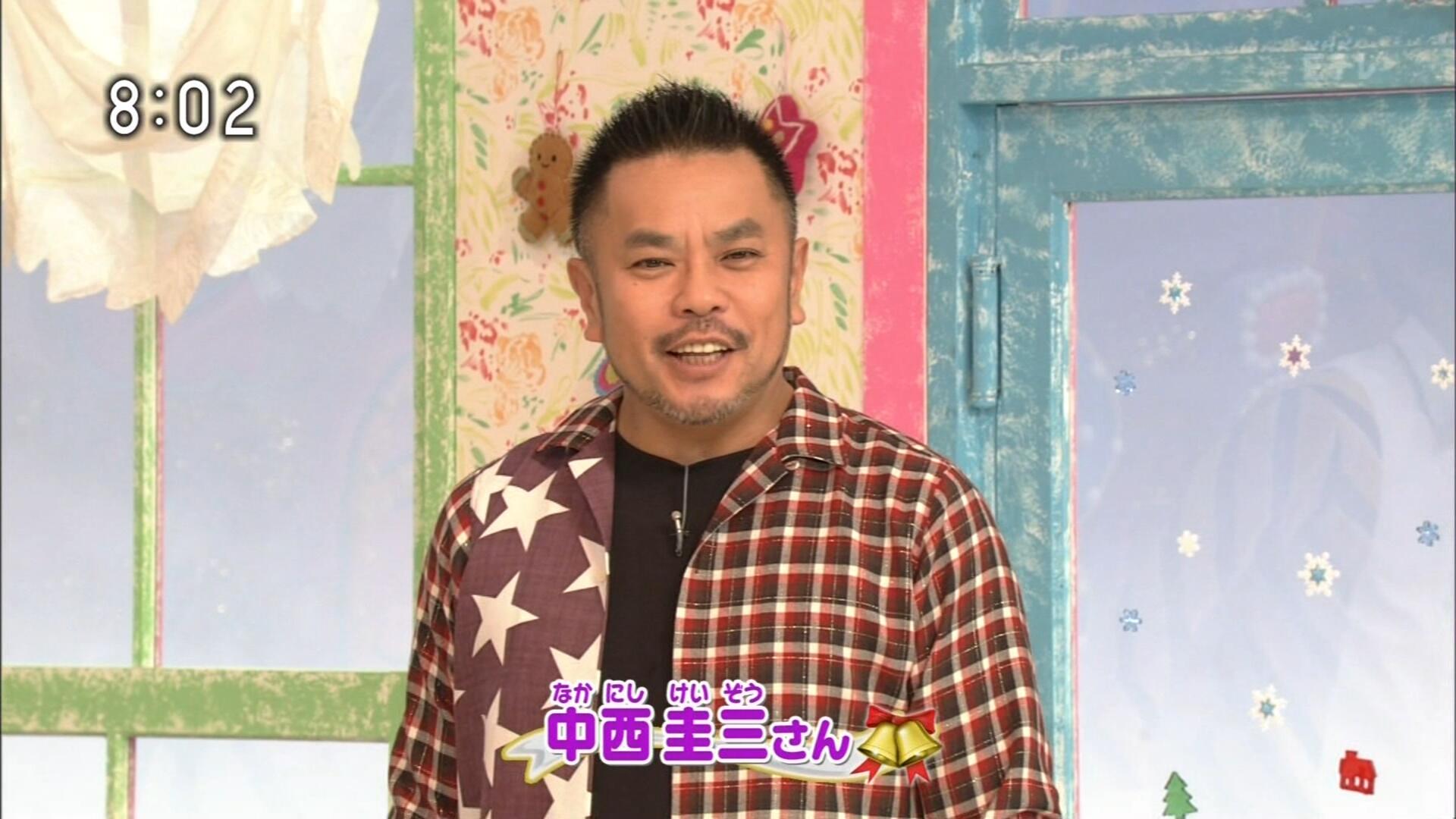
Keizo Nakanishi on "With Mom" Christmas Special! He sang live!
Singer-songwriter Keizo Nakanishi appeared on the Christmas special of "With Mom" broadcast in December 2013. Keizo Nakanishi performed "Pawapu Taiso," a song used in the show's exercises. The children reacted coldly, "Who is this person? while many families said their parents were excited to see him.
Read Article

A summary of the past "Okaasan to tosho" singing brothers! Daisuke Yokoyama finally graduates!
We have compiled a list of the singing brothers who have appeared on NHK's popular program "Okaasan to tosho" since then. Introduced here are a total of seven members, including Seiji Tanaka, the first generation, Osamu Sakata, who has written many famous songs as a lyricist and composer, and Daisuke Yokoyama, who has brought songs and smiles to children for nine years. Their activities in the program are also described.
Read Article
Tags
Contents
- 1960-1967 "Boo Hoo Woo".
- 1968-1969 "Mr. Dutt".
- 1969-1971 "Tonchinko Bozu"
- 1971-1974 "Tondeke Butchie" (Tondeke Butchie)
- 1974-1976 "Ugoke Boku no E" (The Picture of a Floating Bogeyman)
- 1977-1979 "Goronta Theatre" (Goronta Theatre)
- 1979-1982 "Boom Boom Taimu".
- 1982-1992 "Nikko, Pun" (Nikko, Pun)
- 1992-2000 "Doremifa Doonutsu!
- 2000-2009 "Goo - Chocolate Lantern".
- 2009-2011 "Monolan Monolan" (Monolan Monolan)
- 2011-present "Poco Potato"