
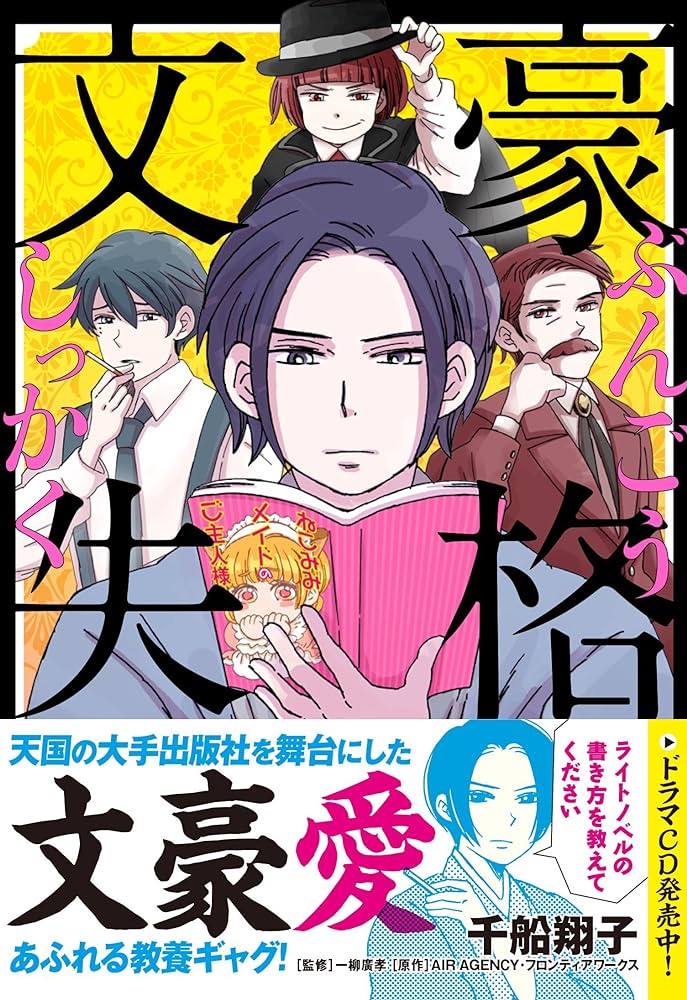
Bungo Shikkaku" is a comicalized version of AIR AGENCY/Frontier Works' drama CD "Bungo Series," serialized by Shoko Chifune in COMIC Ruel starting in 2015. A total of three volumes of the book have been released.
This gag story depicts unique literary giants living in heaven. Soseki Natsume, Ryunosuke Akutagawa, and others try their hand at writing light novels, working as radio personalities, and many other things.
The show is popular as an "educational gag" full of historical facts, as viewers can learn about the masterpieces of the great writers, their personalities, and their relationships with each other through laughter.
Overview of "Bunsho Shikkaku."
Bungo Shikkaku is a gag manga based on the AIR AGENCY/Frontier Works drama CD "Bungo Series," serialized by Shoko Chifune on the website COMIC Ruel starting in 2015. The book has been published in three volumes by AIR AGENCY/Frontier Works. Set in heaven, the story depicts the daily lives of unique literary giants such as Natsume Soseki, Akutagawa Ryunosuke, and Dazai Osamu.
The literary giants are still pressed for time to meet deadlines as they were before their deaths, but they also live quite active lives, fighting and working part-time. The story proceeds to focus not only on the representative works of each of the great writers, but also on their personalities, lives, and relationships, which drew attention as an "educational gag" in that it is both funny and educational at the same time. It has been well received as a "culture gag" that is both funny and informative. It has also been well received as a way to interest people in modern literature, which has an image of being staid and formal.
The original drama CD project was produced by voice actor Keiji Fujiwara, and a total of eight works were released from 2012 to around 2020.
Synopsis and storyline of "Bunsho Shikkaku.
Writer Goes to Akiba
The setting is the heavenly Meiji district. Soseki Natsume was writing in his room when his student Ryunosuke Akutagawa secretly peeked in on him. Natsume noticed and asked him, "What day is it today?" Akutagawa immediately replies, "It's Thursday. Before his death, Natsume's numerous disciples, who adored him, came to visit him every day of the week, making it impossible for him to do his work. When Natsume yelled, "It's Tuesday! Akutagawa blushed when Natsume yelled, "But I came!
Akutagawa told Natsume that he had come to consult with Natsume about a novel. The content of the consultation was, "Please teach me how to write a light novel. When Natsume tilted her head at the unfamiliar words, Akutagawa began to explain, "I heard that it is a novel favored by people today. Apparently, the readership of light novels is growing in Heaven these days, and Akutagawa has been asked by Heaven Publishing to write one. Natsume was puzzled by Akutagawa's puzzlement, saying, "I was born in the Meiji era and I don't know how to write..." Akutagawa then asked Natsume, "Why are you asking me, who was born in the Edo era, to write a novel? When Akutagawa presented a light novel titled "Nekomimi Maid no Goshujin-sama" as a reference and explained that it was "like a satire of a working-class haunted cat wench being exploited by capitalists," Natsume turned pale and tried to distance himself, saying, "Could you try something else? When Akutagawa received such a response from his master, he said, "Oh, my vague anxiety is coming back! he exclaimed, the words he had left in his will before his death, when a new person in a gas mask appeared.
The person in the gas mask said, "Natsume-san, it's been a while. Please give me some money." Without any preamble, the masked person began to speak, which made Natsume and the others wonder, "What's going on? Is this a new kind of debt collector? Natsume and the others were in a panic. The man in the gas mask was none other than Kyoka Izumi. Izumi, who was an extreme germophobe even in historical times, seems to have been further aggravated by recent air pollution, and visited Natsume to ask for money to buy an antiseptic suit. Natsume said, "I came to get money from you even before you died. I have never met him before," she said with a distant look in her eyes.
Then a further visitor appears. The man who entered the room, saying, "A genius has appeared among the three literary geniuses," was Junichiro Tanizaki, who was nominated for the Nobel Prize in Literature in history. He is known for his works depicting uninhibited and seductive women while dealing with intense sexual descriptions.
Chaos reigned at Natsume's house for a while, but eventually Akutagawa asked Natsume to follow him for an interview, which led them to a town called Akiba in the Heisei district, a paradise for light novel readers.
Natsume took the actual light novel in her hands and described the illustration on the cover as "a bunch of yokai with abnormally large eyes, blue and green hair, animal ears and wings, and so on..." Akutagawa was very pleased with the illustration. Akutagawa had a hunch that this was a genre he was good at, and he went to buy a copy as soon as he could. Akutagawa enjoyed reading horror novels, and he himself had produced many works dealing with hell and other such subjects.
Leaving the bookstore, he passes a store selling cosplay costumes. Izumi was transfixed by the rabbit costume on display there. "I was born in the year of the rooster, and my mother told me to take care of the rabbit, which is the Chinese zodiac sign for the year of the rooster," she said before putting on the costume. Tanizaki also donned a nurse's uniform and, after seeing the costume, said, "I want to be examined by a nurse dressed like this," and began to play SM by herself. Akutagawa paled, saying that he felt a darkness in his heart, but the false worldview and the human figures, which could be considered hideous, inspired his new work, and he began to write a note.
When they finally find a maid café, Natsume recalls the setting of the light novel: "A haunted cat lady waitress is being exploited by capitalists..." Akutagawa also entered the store, saying he would cover the scene. Seeing the meticulous attention to detail of the maid dressed as an employee, Natsume was reminded of Kiyo, the maid in "Bo-chan," one of his best-known works. She then shyly ordered, "If possible, I would like you to call me 'bo-chan'..., O-Kiyo. Tanizaki and the others were disillusioned, saying, "What are you talking about?" The maid responded, "Bo-chan...".
When Natsume ordered ice cream, the maid said, "This menu comes with a reward! Please accept Kiyo's feelings!" and slaps Natsume. She then bowed her head and said that slapping was the reward in this restaurant. Natsume and her colleagues finished their interview in Akiba, confused, saying, "I don't understand what that means...".
Back in the Meiji district, Akutagawa recalled how light novels were enthusiastically loved by the people of Akiba. I'm going to keep on writing without losing to the people of today! The work he wrote was about a writer who takes his own life and falls into Akiba Hell, where he is saved by an outcast, and was criticized by Heaven Publishing as "dark as ever.
Embarrassing Letters from the Great Man of Letters
The program-style farce, called "Literary Guru Talk," began with Ango Sakaguchi, popular for his anti-authoritarianism and unrestrained way of life, and Yasunari Kawabata, the first Japanese writer to win the Nobel Prize for Literature, serving as hosts. In addition to Akutagawa and Tanizaki, the invited guests included Naoya Shiga, the god of novels; Kenji Miyazawa, known for his "Night on the Galactic Railroad" and other children's stories; Osamu Dazai, author of the textbook classic "Running Meros"; and Nakaya Nakahara, a poet whose masterpiece is "To My Dirty Sorrow. Nakahara Nakaya is a poet whose most famous work is "To the Dirty Grief. The topic of this year's program is the literary giant Dostoevsky, and it is explained that the participants will seriously discuss his life and his literature. Akutagawa, who had loved reading Dostoevsky before his death, laughed and said, "Sounds interesting," but when it came time for Kawabata to begin his reading, he said, "I feel like we should talk forever and ever, just the two of us. It was a sentence that began with "Then we can KISS. Akutagawa was breaking out in a cold sweat more and more. In contrast, Dazai, who adored him, burst out laughing and said, "What's that? I'm too dost embarrassed! I'm laughing so hard!" and turned the conversation to Akutagawa. Akutagawa cowered in silence, to which Kawabata replied, "I'm sorry. I mistakenly read the letter that Mr. Akutagawa wrote to his wife. Dazai, however, was left to fumigate, "Please tell me it's not true, sir! Dazai was left fuming, and Sakaguchi opened a new piece of letterhead, introducing another letter by Dostoevsky. The content was, "Keep me close to you for the rest of your life. Please treat me like a tea master. If you don't like it, you can bully me however you like. This time Tanizaki was shaking. Sakaguchi gushed and continued, "Mr. Dost also said that he would like to be called master..." Tanizaki finally said in exasperation, "You are doing this on purpose! Tanizaki was outraged. Apparently, the letter was written by Tanizaki to his wife.
At this point, Sakaguchi and Kawabata revealed the real theme of this talk on literary giants. They were going to introduce not Dostoevsky, but a literary giant who had written an embarrassing letter. The winner would receive a one-day trip to Atami as a prize.
While Nakahara, who turned away in disgust, was the next victim, Shiga, who loves Atami, was alone in his excitement and scattered his own letters in hopes of winning. However, since he had many friends, the number of letters was off the charts, and Sakaguchi, who just wants to read out the embarrassing letters and laugh, is about to give up the task of finding them among these. Dazai, who was deeply upset by Shiga's harsh criticism of his work before his death, wanted to make Shiga feel ashamed of his work, so he went through the letters, saying, "I'll definitely find it. Opening them at random, he recounts the contents of his fulfilling days, such as "I took a drinking and haphazard trip to Hokkaido," and "I have not decided on an itinerary in Italy because I want to travel in a drinking and haphazard manner. Dazai, in a fit of jealousy, took out Miyazawa's letter without permission and began to read it without permission, exclaiming, "Eat Miyazawa-kun's grudge letter!" and began to read it out loud without permission. The letter, which was deliberately written in full katakana to express his anger at his best friend's infatuation with a woman, had successfully sent shivers down Tanizaki's and Akutagawa's spine.
Somehow inspired by the friendship between Miyazawa and others, Kawabata took the liberty of pulling out a sentence he had written as a student. The content, which begins, "I was allowed your arms and lips at all times," describes his feelings toward a boy who roomed with him in the student dormitory. Kawabata was 19 years old at the time, and his words caused a stir among Akutagawa and others.
One more to go," Sakaguchi said, setting his sights on Dazai. Kawabata began to read Dazai's letters as well, regardless of Dazai's protests. Dazai takes a deep breath and sits down to escape reality. The letter describes a perfectly normal day in his life, but to his surprise, a small "koishii..." is added in the corner of the letterhead. All the members except Dazai blushed at the direction, and Miyazawa shook Dazai's body, saying, "Hey, how did you come up with this? and shook Dazai's body.
Dazai was about to end the play, when Sakaguchi said, "You are the only one whose letter has not been introduced. Tanizaki began to read Ango's letter, which was addressed to a woman he was dating at the time. While everyone was taking the words "I have no regrets if my ephemeral life, which ended in a ragged dream, is made eternal in my works," seriously, Sakaguchi, with tears streaming down his face, said, "Wow! Ango's moving giant story has come!" he exclaimed excitedly. Miyazawa was also crying from emotion. Tanizaki was the only one who said, "This is boring, you guys! You get 25 points for this essay! You should entertain me more!" He was so indignant that he punched Sakaguchi and Miyazawa.
Thus ended the first Bungo Talk. The final winner was decided to be Nakahara, who suddenly started wearing sunglasses to school when he was in junior high school. Nakahara cried out, "None of this has anything to do with the letter. Dazai, who was not on good terms with Nakahara either, stuck up and insisted that he was more deserving for stopping the Tobu Line without moving while standing on the tracks. He said that all great writers who have left their mark on history are full of black history, and in the end, they all headed to Atami for the launch party.
Writers go to the Doujin Market.
One day, Dazai asked Sakaguchi and Nakahara, "Have you heard of the Heavenly Doujin Market?" Dazai asked Sakaguchi and Nakahara, "Have you heard of the Tengoku Doujin Market? Nakahara and the others replied, "I've only heard of it," to which Dazai replied, "I'm a little bit interested in it. Dazai begins to invite them to join him. Kawabata, who happened to be there, joins the conversation, and Dazai lists his reasons, such as "I get lazy in heaven and my skills get dull," and "I can interact directly with the fans. He was picturing himself being cheered up by a flood of fans. As if he had stolen a glimpse of this fantasy, Nakahara asked him, "You just want to use us as a pretext to make us feel pampered, don't you? Kawabata shows Dazai the list of participants in the doujin market. Kawabata showed Doujin Market participants' list to Dazai, who was very upset. When they all looked at the list, they found that the names of great writers who have left their mark on history, such as "Dostoevsky," "Goethe," "Murasaki Shikibu," and "John," were all listed. Sakaguchi said, "We're going to line up our desks with these guys! Let's not do that! but Dazai shouts, "I'm going to fight in the world as a representative of Japan's literary giants! and boasts that his novels are among the best-selling among Japan's literary giants. However, he was immediately refuted by Nakahara and others, who said, "The Bible has sold 5 billion copies worldwide," and he began to get angry on his own, saying, "Hey, can we stop talking about circulation numbers? Nakahara and the others replied, "The Bible has sold 5 billion copies around the world," and he became angry. At any rate, Dazai had announced his participation in the doujin market on SNS, so he had to attend at any cost. On the other hand, Sakaguchi and the others backed down, saying, "We will do our best to decline.
The day of the event arrived. Sakaguchi, Nakahara, and Kawabata visited the doujin market, which was overflowing with people from all over heaven. There was an out-of-the-ordinary line at John's booth, and Nakahara paled, saying, "We Japanese literary giants are only a small part of the world, aren't we? Then Miyazawa showed up in a flash. He, too, seems to be exhibiting at the doujin market. Nakahara was in a cold sweat. "I wonder if he can read the atmosphere here...," Nakahara said to Miyazawa, who was enthusiastic, "I was passive before my death, so I decided to be brave and sell my books actively in heaven. Sakaguchi replied, "There is no way Mr. Miyaken has such advanced skills.
After looking around for a while, the group looked for Dazai's booth. When they finally found it, Dazai was sitting alone with a faint smile on his face. It seemed that people were being attracted to the next booth and not coming to Dazai's booth. Nakahara asked, "Who's sitting next to you? Dazai bit his lip and began to cry, "Shakespeare," he said. Shakespeare is said to be one of the three greatest writers in the world. Dazai began to lose his temper at the arrangement, "Why are modern Japanese literature and Renaissance English literature right next to each other!" and he begins to lose his temper at the arrangement, eventually exclaiming, "There are people who say things I don't understand, like, 'Aren't you coming out with a new Atom work? Sakaguchi was annoyed when he realized that Dazai was being mistaken for the manga artist Tezuka Osamu (テ塚治虫).
While Dazai is making a big mistake, Sakaguchi and Nakahara notice a booth of the same Japanese literature genre is thriving. A closer look reveals that it is the booth of Tanizaki, a familiar face to them.
It too was sold out. Sakaguchi said, "I knew our Japanese representative was Zakitani Paisen! Tanizaki seemed to have noticed them as well. Sakaguchi, taking advantage of this opportunity, asked him about the contents of his new book, which was apparently a book with extreme sexual descriptions. The book was only 10 pages and cost 3,000 yen, but it sold like hotcakes. Even before his death, Tanizaki had a legend that when he published a book titled "The Key," he set the price high because he was concerned that its bold sexual descriptions might become a social problem, but the book sold so well that it became a bestseller.
And so the literary market was coming to an end. Kawabata suddenly remembered Miyazawa. He looked around and saw Miyazawa, who had started giving away books for free because they were selling so poorly. Nakahara, who had been an avid fan of Miyazawa's since before his death, said, "You big fool! You're not good at selling! I'll sell them, give them to me." He took the books and began to push them around. Nakahara continued to sell Miyazawa's books as a vendor until just before the event closed.
At the doujin market, where there was an infinite number of higher-ups, the literary giants felt like they were back to their beginnings.
Characters and Characters in "Bunbougou Shikkaku" (Disqualified)
literary masterpieces
Natsume Soseki
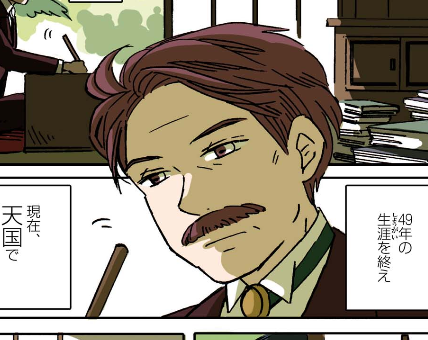
CV: Keiji Fujiwara
Born on February 9, 1867 and died on December 9, 1916, Fujiwara worked as a teacher for more than 10 years before becoming active in the late Meiji and early Taisho periods. He was one of the great writers who created the modern written language of katakana, which is now major. His representative works include "I am a Cat," "Bo-chan," and "Kokoro. Despite his difficult and stubborn personality, many people, including Ryunosuke Akutagawa, Hyakken Uchida, and Miekichi Suzuki, admired him, and his personal connections were known as the "Soseki Mountains. Since his disciples visited him day after day and could not work, he told them to come on Thursdays in batches. This gathering is known as the "Thursday meeting.
Natsume in this work lives in the Meiji district of Heaven and writes as usual at Heaven Publishing. He is a struggling writer who is pushed around by numerous literary giants, especially his pupil Akutagawa, but he also accompanies them in their foolhardy antics with his original caring nature. However, he is prone to anger and often yells at people.
He is a retarded person with a morbid sweet tooth. She loves ice cream, and when she accompanied Akutagawa to a maid café for an interview, she ordered a heaping scoop of ice cream. She also likes rich foods.
Ryunosuke Akutagawa
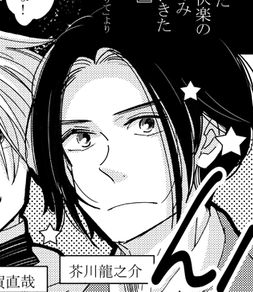
CV: Kosuke Toriumi
Born on March 1, 1892 and died on July 24, 1927. Active from the Taisho period to the early Showa period. He began writing while a student at Tokyo Imperial University, and attracted attention when his short story "Nose" was highly praised by Natsume Soseki. He looked up to Natsume as his teacher and attended the Thursday Club from his student days. His representative works, "Rashomon," "Kappa," and "Tojiharu" were popular. Despite his spectacular career, he was sensitive and timid, and lacked self-confidence. He was a heavy smoker and smoked cigarettes all his life, but when he smoked too much, he could see the cogs along with his headache.
In this work, like Natsume, he is writing a novel for Heaven Publishing. He continues to go to Natsume's house to ask for advice on his novels, as he did before his death. He has a cool personality, but sometimes shows a hint of nobility. He is a relatively sensible person. He has been involved in a lot of commotion caused by Osamu Dazai and other literary giants with strong personalities.
Junichiro Tanizaki
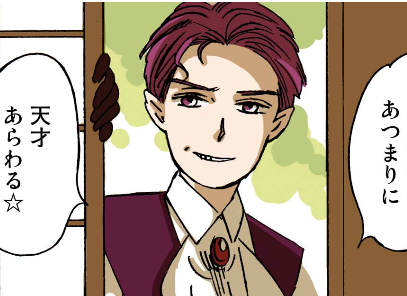
CV: Koji Yusa
Born on July 24, 1886, died on July 30, 1965. He was active from the late Meiji period to the mid-Showa period. His works were highly acclaimed both in Japan and abroad, and he was even nominated for the Nobel Prize in Literature. His representative works include "Lover of a Lover" and "Hosoyuki. His works deal with excessive love for women and masochism, but they also show a high level of artistry through his elegant writing and skillful storytelling that changes with each work.
He is a great aficionado of earthquakes. He was a glutton and a fast eater. He and Ryunosuke Akutagawa had literary disputes, but they did not get along exceptionally well in history.
In this work, he writes for Heavenly Publishing, like other literary giants, but he only thinks about fulfilling his sexual interest by breaking deadlines with various excuses. He is a masochist and a womanizer, and once ran a host club. On the day it opened, it was forced to close by Nakahara Nakaya, Sakaguchi Ango, and others.
Osamu Dazai
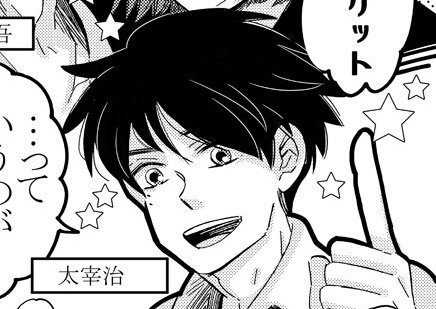
CV: Takahiro Sakurai
Born on June 19, 1909, died on June 13, 1948. He published many works before and after World War II. His representative works include "Running Meros," "Ningen Shikkaku," and "Shayo. He had a highly sensitive and emotionally unstable personality, and was sloppy in his relationships with women and money. On the other hand, he also has a narcissistic temperament, and is a cheerful, energetic, and well-spoken person who seems to be at the center of the conversation at the drinking table.
He has been an admirer of Ryunosuke Akutagawa since his junior high school days, and there is a photo of him posing in imitation of Akutagawa. He was nominated for the Akutagawa Prize, named after the writer he admired, but was not selected because Yasunari Kawabata, a member of the selection committee, said, "There was a shadow of displeasure in his life as a writer, and he regretted that he could not express his talent honestly. Dazai, who wanted the Akutagawa Prize at any cost, sent a long letter to Kawabata begging for it.
In this work, he is happy to be able to talk with Ryunosuke Akutagawa, whom he admires in heaven. On the other hand, Akutagawa seems annoyed by Dazai's noisy behavior. He often causes commotion with his intense emotions of anger, sorrow, and joy. Even before his death, he was often tangled up with a drunken Nakahara Chuya, who grabbed him by the chest and punched him even in heaven.
Nakahara Chuya

Tags
Contents
- Overview of "Bunsho Shikkaku."
- Synopsis and storyline of "Bunsho Shikkaku.
- Writer Goes to Akiba
- Embarrassing Letters from the Great Man of Letters
- Writers go to the Doujin Market.
- Characters and Characters in "Bunbougou Shikkaku" (Disqualified)
- literary masterpieces
- Natsume Soseki
- Ryunosuke Akutagawa
- Junichiro Tanizaki
- Osamu Dazai
- Nakahara Chuya
- Ango Sakaguchi
- Yasunari Kawabata
- Naoya Shiga
- Kenji Miyazawa
- Edogawa Ranpo
- Yakumo Koizumi
- Kan Kikuchi
- Editors of Heavenly Publishing
- editor-in-chief
- new editor
- Terms in "Literary Disqualification.
- Heaven/Meiji District
- Heaven Publishing
- Eat Herb Miyazawa Farm
- Heavenly Doujin Market
- Famous quotes, lines/scenes, and scenes from "Fumi no Shikkaku".
- Letter from Osamu Dazai, who wants the Akutagawa Prize, to Yasunari Kawabata, a member of the jury
- Dazai badly injured in a high jump
- The Monster of Twenty Faces and the Battle of the Bungo
- Soseki Natsume as a Teacher
- Ryunosuke Akutagawa and "Mikan
- Soseki Natsume: "If there is an obsession anywhere, you must go on until you trample it down."
- Back story, trivia, small stories/episodes, anecdotes
- Kyoka Izumi, who is good friends with his wife
- Publisher's basement cell
- Literary commentary tucked into the book