
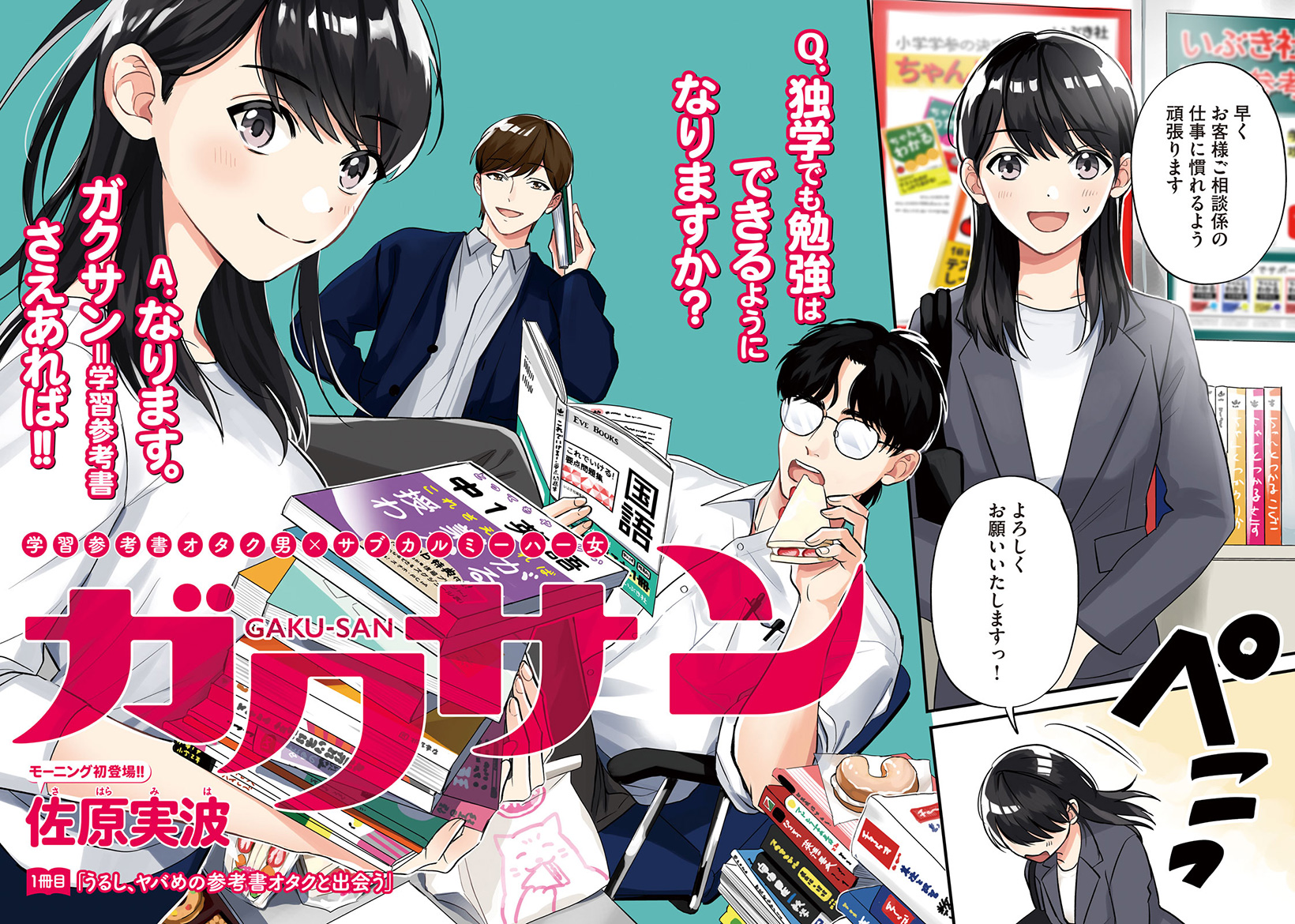
Gakusan" is a study reference book-themed manga work by Minami Sahara that began serialization in "Morning" in December 2021 and has been serialized in "Comic Days" since its transfer. Urushi Chino is a mid-career employee of a reference book publisher. He is assigned to the customer service department and meets Fukuyama, a quirky reference book nerd. Although he has many problems as a member of society, he has a wealth of knowledge about reference books, which inspires Urushi even though she is pushed around by him. Urushi learns about Fukuyama's past. The introduction of real-life reference books has been well received by students, parents, and working people who want to relearn.
A state in which one buys famous or recommended books and piles them up without reading them after all. This term is usually used by Urushi because he does it often. Fukuyama does not understand why Urushi reads a stack of books.
new school (of thought, etc.)
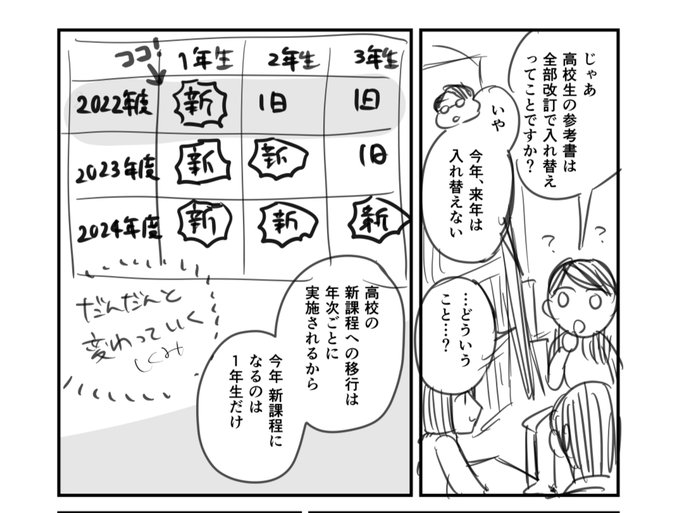
New curriculum refers to classes taught in accordance with the new Courses of Study. The Courses of Study are educational content established by the government, and are revised almost every 10 years in response to changes in the world, such as digitization and globalization. Recent revisions include the establishment of "information science" in high schools in 2002-2003 to cultivate the "ability to live"; the establishment of "foreign language activities" in grades 5 and 6 in 2011-2013; and the introduction of "programming education" in 2020-2022 to promote independent, interactive, and in-depth learning. In volume 3, Fukuyama teaches bookstore clerk Umeyashiki about the new curriculum.
change
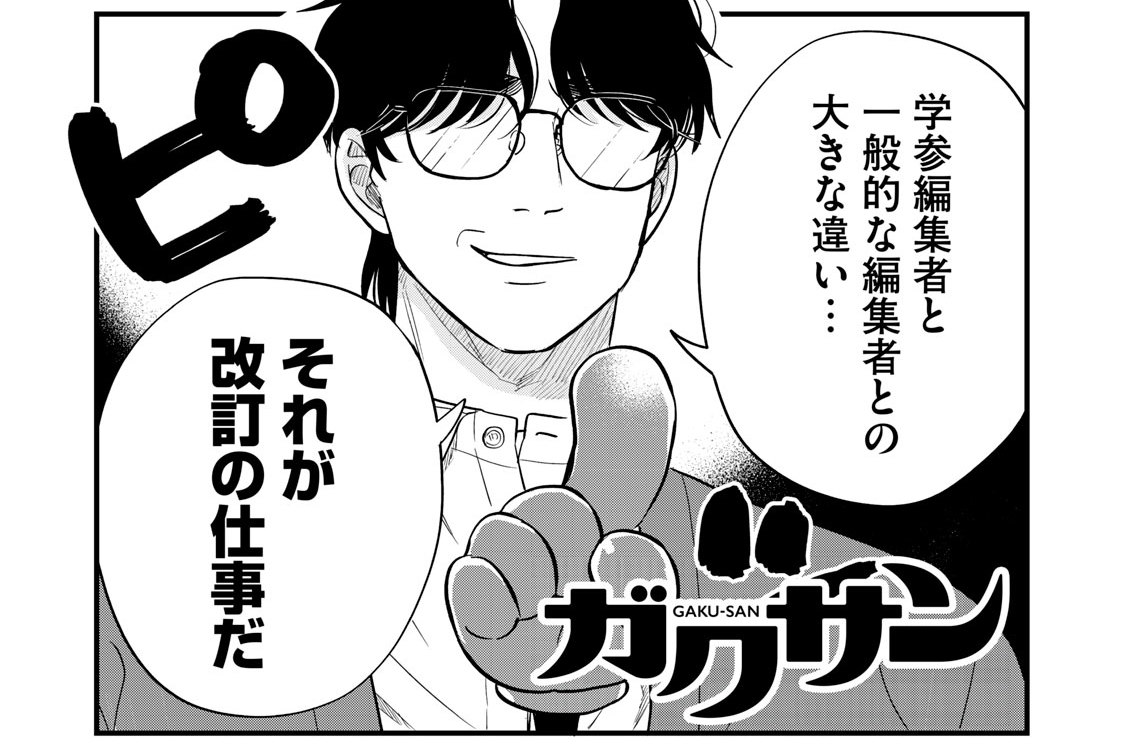
Revision of a study reference book refers to changes in content due to revisions of study guidelines, etc. Ordinary books are not revised very often, but are reprinted in slightly different editions. Textbooks used in schools are revised about once every 10 years, so study reference books are also revised in conjunction with them.
Cognitive Characteristics
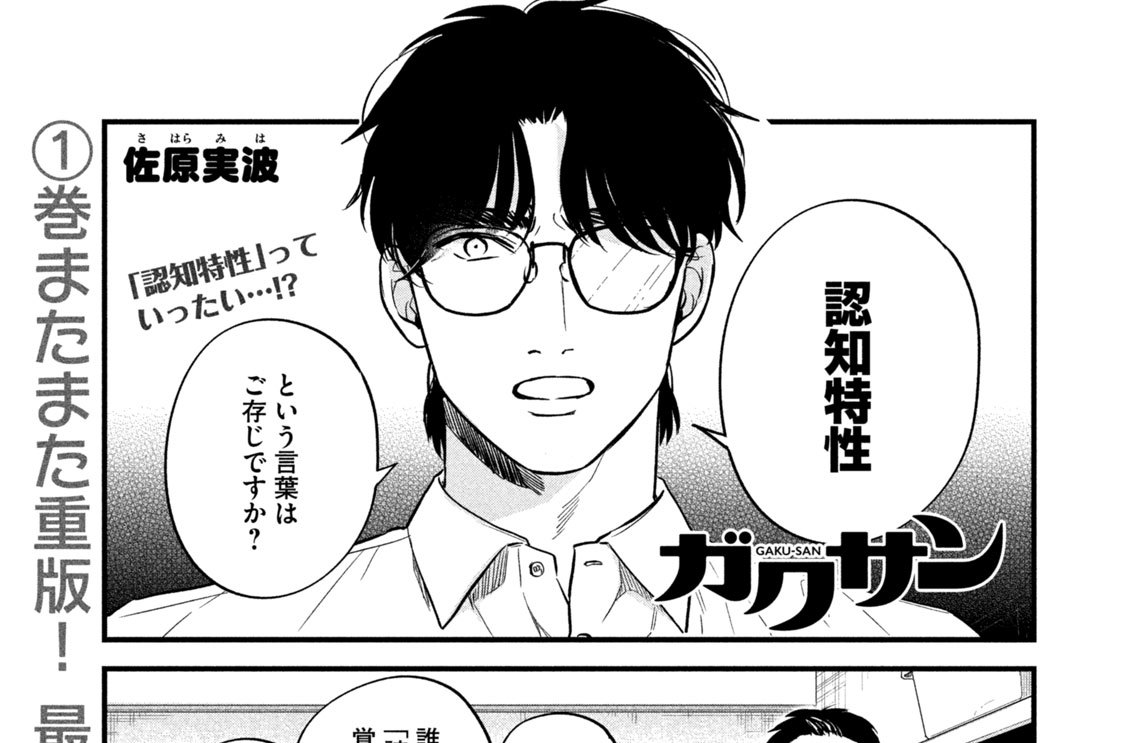
It refers to the tendency of each person's way of thinking and remembering. It refers to one's strengths and weaknesses in the way one understands, organizes, remembers, and expresses information from the outside. There are verbal dominance, in which one reads and understands text, auditory dominance, in which one listens to and understands sounds, and visual dominance, in which one sees pictures. When Yatsuji's daughter, Aoi, consults Fukuyama about studying with videos, he realizes that the study method of visual dominance in "cognitive characteristics" is suitable for her.
learning disability
Learning disabilities, also known as Learning Differences (LD), are specific developmental disabilities. Learning disabilities include reading disabilities (reading difficulties), writing disabilities (writing difficulties), and math disabilities (math and reasoning difficulties). When Urushi recommended drills for a second grader who still could not read hiragana, Fukuyama reprimanded him for his irresponsible response, considering the possibility of a learning disability.
The Three Elements of Academic Achievement
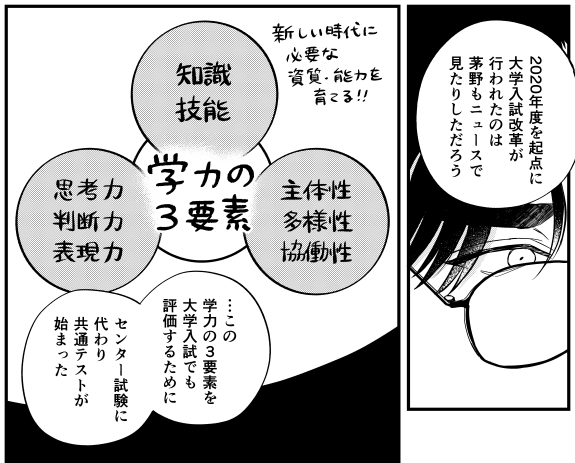
The three elements of academic ability in the modern age are "knowledge and skills," "independence, diversity, and collaboration," and "the ability to think, judge, and express oneself. In the context of fostering the qualities and abilities necessary for the new era, a common test was initiated in place of the Center Test to evaluate them in university entrance examinations as well. Furthermore, additional entrance examination reforms based on the new curriculum guidelines will be implemented starting in FY2024. Fukuyama will explain this to everyone at the "Shiori Kai.
Teaching Study Methods
A study method that explains why the answer is the way it is, rather than only answering what is asked as in a question-and-answer type of output using a question book. It allows a wider range of information to be output. Normally, this study method involves explaining to the person in front of you, but it can be done alone by reading aloud model answers and explanations. This is the study method that Nanami Miyashita used when she studied for the entrance examination at the University of Tokyo.
Cross-company planning office
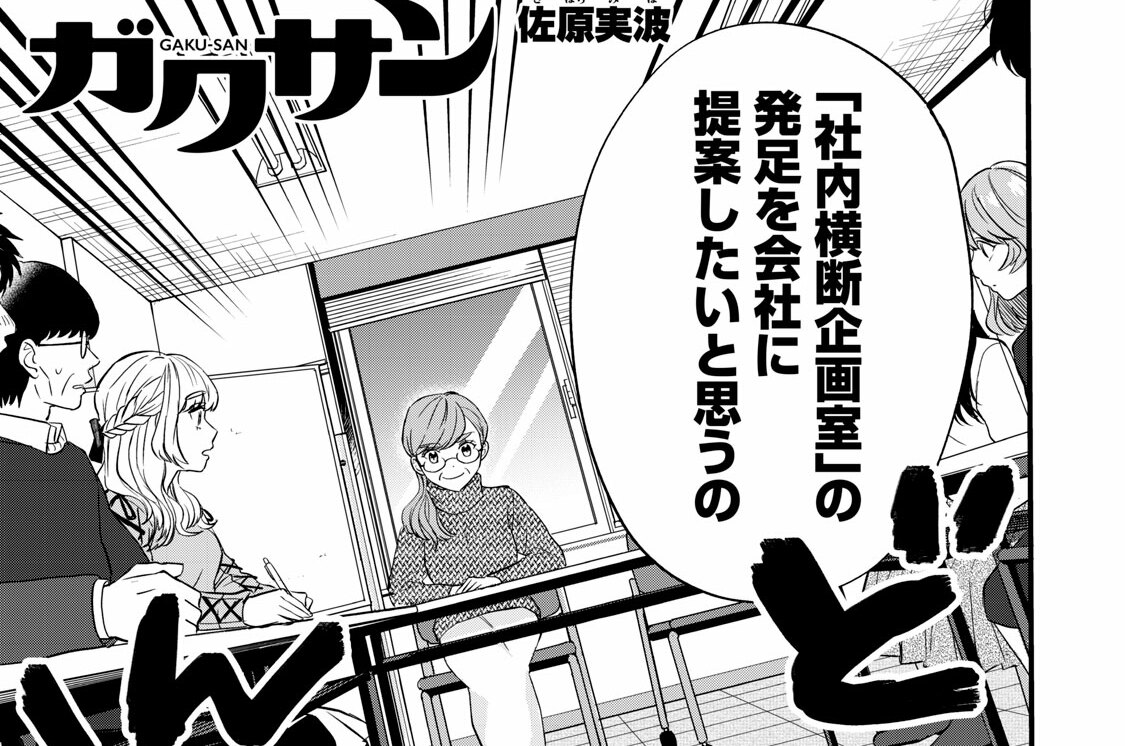
A new department proposed by Shiori Hanayama, leader of the "Shiori Association. Since there is a lack of cooperation between departments within the company, the aim is to establish a department that can create flexible projects without being bound by the customs of the editorial department. Within "shiori kai," the department is envisioned to collaborate with other departments and serve as a hub for each department. Although he submits a proposal, he is unable to get the holly editorial director to approve his vision, and the condition for being able to launch the "Cross-Company Planning Office" is to produce one long-selling book.
Famous quotes, lines/scenes and scenes from "Gaksan
Fukuyama: "In the college entrance exam, you have to compete on the same playing field as children who are given resources like hot water. And yet. There was hope. That's what reference books are for."
A consultation arrives at the Customer Service Section asking if it is possible to take an entrance exam for a difficult-to-enter university with a reference book because he has no money. Urushi tries to answer that indeed it cannot be done, but Fukuyama silently leaves the room. Yamazaki comes into the room at the wrong time and tells Urushi that Fukuyama passed the university entrance examination with only a reference book. Urushi thinks he made a gaffe without knowing it and apologizes to Fukuyama with a sweet in his hand. Then Fukuyama says, "Anyone can take the entrance exam on their own with reference books," and recalling his upbringing and how reference books were his only hope in the educational gap, he says, "In the university entrance exam, you have to fight on the same playing field as children who were given resources like hot water. And yet. There was hope. That's what reference books are for," he said.
Fukuyama: "At first, it's fine if you want to take someone on and off as if you were using a matching app. But in the end, most people choose one person and keep him or her for the rest of their lives. The way to deal with reference books is the same as in love."

Tags
Contents
- Outline of "Gaksan
- Synopsis and story of "Gaksan
- Encounter of Urushi and Fukuyama
- Joined "Shiori Association" of Urushi
- Change in Fukuyama's feelings
- Fukuyama's joining the "Shiori Kai" and the threat of dismissal.
- Characters and characters in "Gaksan
- Key Personnel (IBUKI Corporation Customer Service Section)
- KAYANO URUSHI
- Yuzuru Fukuyama
- Ibuki-sha Shiori-kai Member
- Sho Yamazaki
- Shiori Hanayama
- Tsukasa Yazu
- Mio Akagi
- Goro Kawaguchi
- Nanami Miyashita
- Ibuki Company Directors
- Hiiragi Editorial Director
- Leap relatives
- Akane Mochizuki
- Yukari Mochizuki
- Other Persons
- Aoi Yazu
- Umeyashiki / Ume-chan (Ume-Yashiki)
- Momo Saginuma (Momo Saginuma)
- Wakayama
- Hayase
- ren (ancient Chinese measure of height, depth, etc.; between 1-3 meters)
- Terms of "Gaksan
- hakusan
- Ibuki Corporation
- Customer Service
- gathering for receiving guests or paying their respects
- editorial department
- Production Department
- Introduction.
- thwart
- Reading
- new school (of thought, etc.)
- change
- Cognitive Characteristics
- learning disability
- The Three Elements of Academic Achievement
- Teaching Study Methods
- Cross-company planning office
- Famous quotes, lines/scenes and scenes from "Gaksan
- Fukuyama: "In the college entrance exam, you have to compete on the same playing field as children who are given resources like hot water. And yet. There was hope. That's what reference books are for."
- Fukuyama: "At first, it's fine if you want to take someone on and off as if you were using a matching app. But in the end, most people choose one person and keep him or her for the rest of their lives. The way to deal with reference books is the same as in love."
- Fukuyama: "Basic studies should be accumulated. That's because study is crucial for people to live confidently in this society."
- Urushi: "It's not just where you were born and how you grew up, but surely everything you have accumulated on your own by taking self-study exams with reference books is important."
- Fukuyama: "It means the reference book is on your side until the end."
- Fukuyama: "Beat those who are spoiled by experience with the power of reference books."
- Hiiragi, editorial director: "We want to produce a book that people will yearn to solve this and buy it."
- Backstory, trivia, small stories/episodes, and anecdotes from "Gaksan
- Ibuki-sha's reference books, which are not highly rated by Fukuyama but have a good selection of good books.
- Ibuki-sha, with its Taisho retro appearance so much so that it has been featured in magazines.
- A day in the life of Urushi depicted in the "Omake manga" at the end of the book.
- Setting Fukuyama's sweet tooth
- The playful cover and back of the cover of the book, which is rainbow-colored at the author's request.