
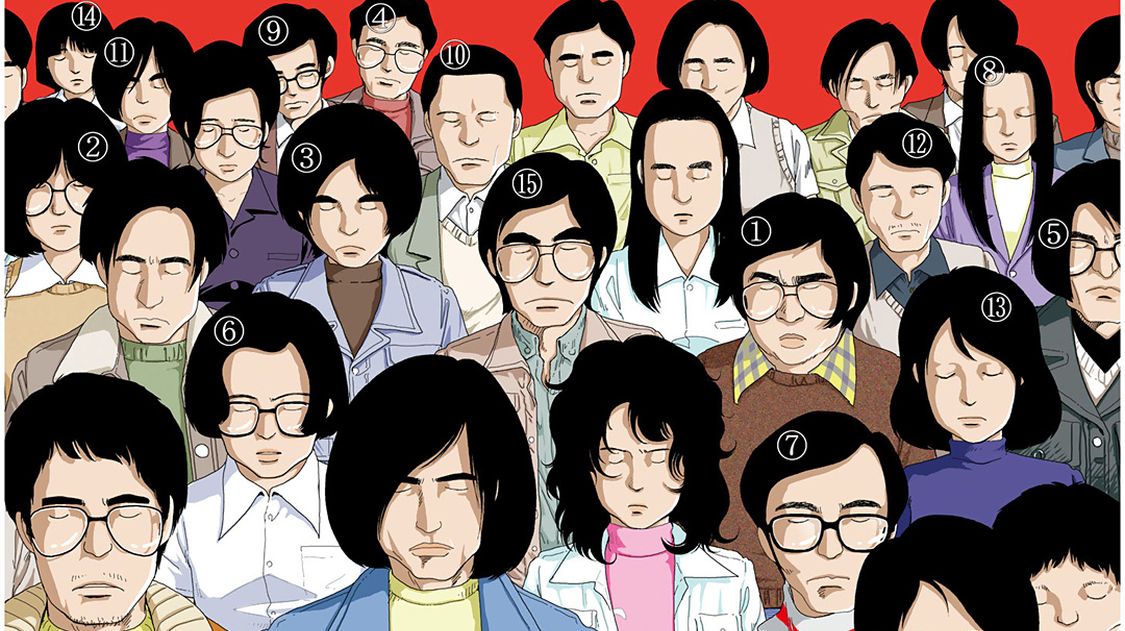
Red" is a manga work by Naoki Yamamoto serialized in Kodansha's manga magazine "Evening" since 2006, a coming-of-age ensemble drama about young people who dreamed of revolution in Japan between 1969 and 1972.From 2006 to 2013, "Red" was serialized, from 2014 to 2016, under the title Red: The Last 60 Days and Asama-Sanso e" and from 2017 to 2018, it was serialized under the title "Red: The Last Chapter: 10 Days in Asama-Sanso."
Red Federation (i.e. communist guerrilla soldiers who fought in the Vietnam War)
A new left-wing faction active mainly in the Kansai region, modeled after the "Communist League Red Army Faction.
The model is the "Communist League Red Army Faction." Although the faction has advocated radical struggles such as the "Osaka War" and the "Tokyo War," it has not been involved in any major activities in the works, and is derided as being "big only in what it says.
The organization was devastated by the mass arrest of its members in 1969, the arrest of its leader Ishizuchi in 1970, and the flight of its main members from the country due to the "International Groundwork Theory," but the Red Army leader Kita came to take control of the "Red League" through an alliance with the Revolutionary League.
firearms store attack
The League of Revolutionaries asked the Red Army to procure guns to recapture their leader Tsukuba, who was in prison, but this did not materialize. They captured 10 shotguns, one blank, and several hundred shotgun shells, but Wakayama and Hiuchi were arrested for choosing an escape route that was not part of the plan.
The Revolutionaries' League was also able to successfully ally itself with the Red Army after acquiring weapons as a result of this incident.
Later, the guns obtained at this time were used in the Asama Sanso siege, resulting in the loss of precious lives.
Operation G is a go!
Operation Gangster, also known as "Operation G." The Red Army used to rob banks and post offices to raise funds for their activities.
In the film, in 1971, Iwaki and three others carried out "Operation G" targeting "Mutual Bank. They robbed approximately 1.12 million yen to fund their activities.
However, during the robbery, they accidentally dropped a memo with the phone number of a financial supporter (a.k.a. "sympathizer") in Aomori at the scene. This blunder forced the cancellation of Operation G in Aomori, which was to be the next target.
Famous quotes and lines from "Red" / Famous scenes and scenes
Amagi: "I just want to live...I don't want to die..."
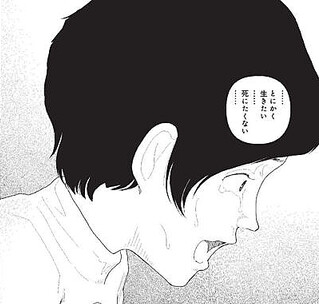
Amagi desperately pleads, "I want to live...I don't want to die..." as he is forced by leader Kita to sum up the situation.
Amagi, a female member of the mountain base, was a beautiful woman with long hair. Her model was Mieko Endo.
However, the bad habit of "summing up" gained momentum in her mountain life, and she was severely criticized and demanded to sum up her hair, rings, and other personal appearance.
Amagi cried and pleaded with the members, "I just want to live...I don't want to die..." because "summing up = death. He was given the condition of "burying with his own hands the corpse of the medicine man who had died that day, so that he could realize his mistake and sum up the situation.
As the people around him watched, he frantically carried the corpse and did as he was told, even punching the corpse in the face and burying it, but he was not accepted because he had not been able to sum up the situation to the satisfaction of leader Kita.
Until then, he had been helping members who could not sum up the situation correctly by themselves by "helping them become communists" as "assistance in summing up" and beating them up.
Amagi was so terrified that he declared, "I will definitely finish the summary by myself! but the order from the north was to "beat yourself up.
Unable to refuse the order, he punched himself in the stomach and face again and again in front of the members, and by the time Kita told him to stop, his face was so swollen that no one could tell who he was.
In order to help him not to worry about his appearance, he had his short hair cut even shorter and was tied to a post.
In addition, she was forced to confess about her past sexual experiences, and was abused, beaten, and told that she was "dirty! and was beaten to death.
The "summary" is self-reflection without "forgiveness. North used this to cling to his power in the organization through fear.
In the end, after his arrest, he committed suicide in prison, which means that he himself could not "sum up" after all.
Backstory, trivia, small stories/episodes, and anecdotes from "Red
The numbers marked on the heads of the characters are the order in which they died
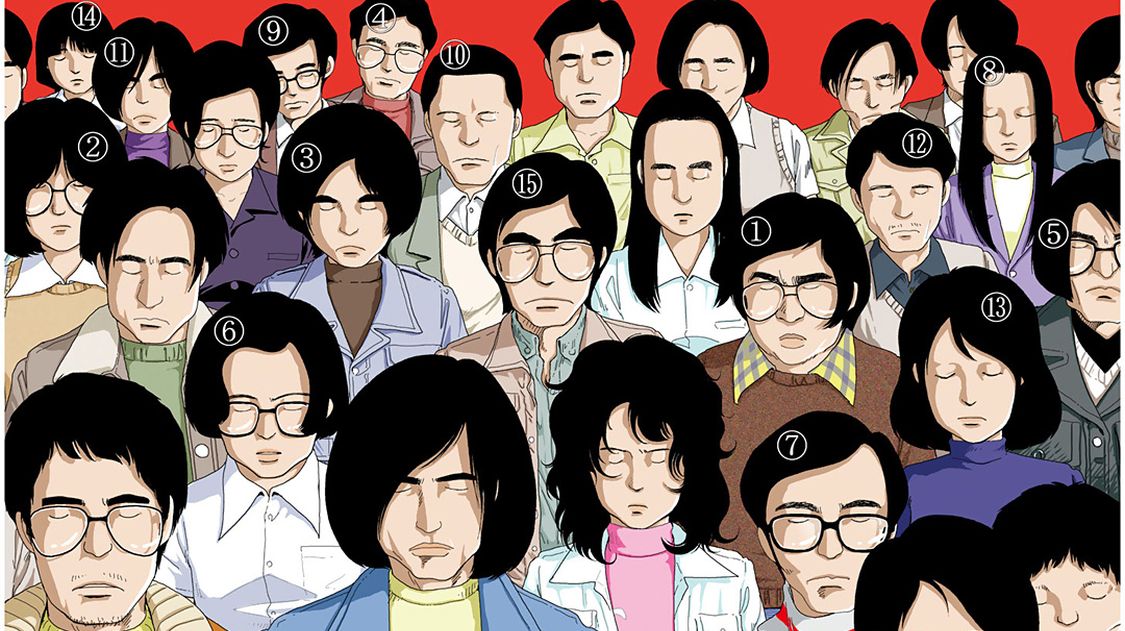
Each of the 15 characters is marked on the head with a number from 1 to 15.
The number of the head often appears on the cover of the first volume of the book and throughout the book. The numbers 1 to 15 are drawn in the exact order in which the characters die in the story, and from the beginning of the story, it is always emphasized that a tragic ending awaits, such as "XX days to arrest," "XX days to be sentenced to death," and "XX days to be shot to death.
Akaishi, marked 1 on the cover of the first volume of the book, was the perpetrator of the attack on the police box in the fourth story, "November-December 1970: The First Dead," but he was shot twice at close range by police officers during the crime and bled somewhat to death.
The second was "Soraki," a woman wearing glasses. Although she had not been active for long, she was accepted by Akagi and allowed to join the mountain base, but she escaped from the base because she could not get used to life in the mountains and wanted to see her boyfriend, who was a doctor.
Although her escape was thwarted by the members and ended in failure, she was later strangled to death by Adachi and others when she was intoxicated, because they feared that her actions would endanger the organization.
The "core" of the series of factual incidents depicted in the film is, after all, "Why have so many aspiring young people gone mad?" The "core" of the series of incidents based on the facts depicted in the film is, above all, "Why have so many aspiring young people gone mad?
These young people, who were supposed to stand for revolution, to hate power, and to stand up against it without regard for their own lives, killed many of their friends at their own hands in the name of "communization.
In order to seize power in a small organization of only about 20 members, they dared to lynch and torture without any relief in the name of "summing up," and all of their comrades who were made to sum up died. The dead members were condemned to "death in defeat because they could not become communists," and they themselves felt no sense of guilt. Others, who were afraid that they themselves would become targets of the crime, felt remorse and continued to take part in the crime, and many others are depicted in the film.
The film depicts a variety of thoughts and feelings, including those of those who continued to be complicit in the crimes even though they feared they themselves would be targeted. Or does power change people?
After the two organizations become the "Red League," the story is essentially about "power struggles" and "the nature of people obsessed with power," and the criminals, who are equally criminals, are numbered in the order in which they die, even in small panels.
This is a technique that can be taken because the story is based on the fact that "people who have this kind of ideology and do this kind of thing will meet this kind of end," but the story is fixed. If this is the case, when thinking about "how to present the story," this method is revolutionary, and of course, it is a method that has never been used before in other works.
Since this film is an ensemble drama without a clear main character, the "end" of the characters is always shown in the film, making the "present" the main character, whereas we would normally be drawn to the "future" or the "continuation" of the story.

Tags
Contents
- Overview of "Red
- Synopsis and story of "Red.
- Alliance of the League of Revolutionaries and the Red Army
- Formation of the Red Federation and Asama Sanso
- Characters and characters in "Red
- Yoko Akagi
- Tanigawa
- Morio Kita
- Amagi
- Terms of "Red
- League of Revolutionaries
- Red Federation (i.e. communist guerrilla soldiers who fought in the Vietnam War)
- firearms store attack
- Operation G is a go!
- Famous quotes and lines from "Red" / Famous scenes and scenes
- Amagi: "I just want to live...I don't want to die..."
- Backstory, trivia, small stories/episodes, and anecdotes from "Red
- The numbers marked on the heads of the characters are the order in which they died