
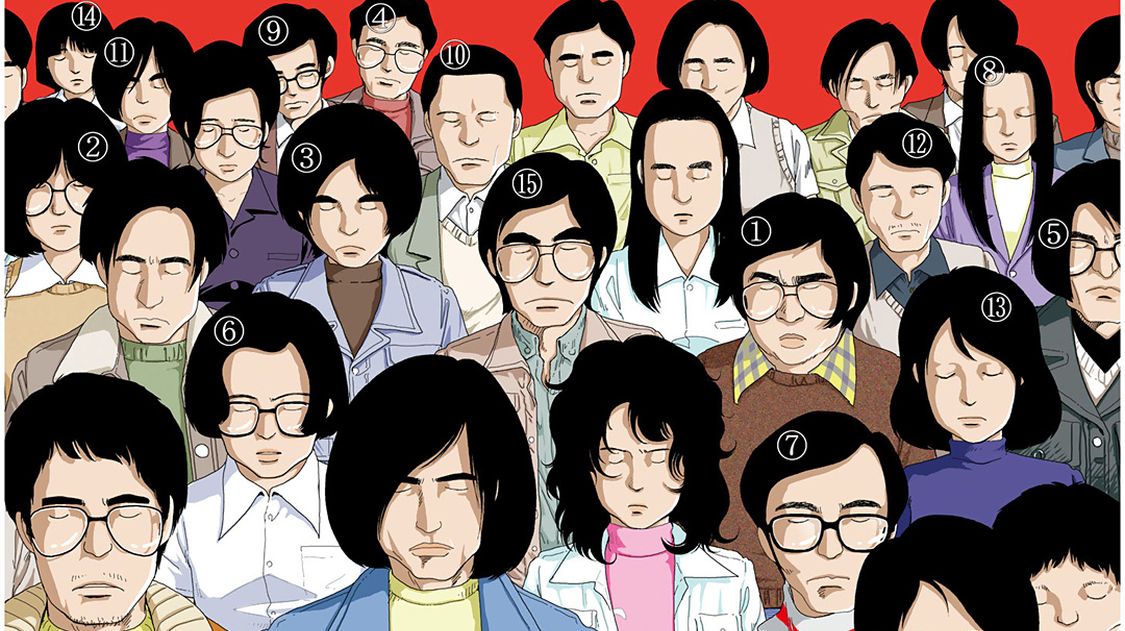
Red" is a manga work by Naoki Yamamoto serialized in Kodansha's manga magazine "Evening" since 2006, a coming-of-age ensemble drama about young people who dreamed of revolution in Japan between 1969 and 1972.From 2006 to 2013, "Red" was serialized, from 2014 to 2016, under the title Red: The Last 60 Days and Asama-Sanso e" and from 2017 to 2018, it was serialized under the title "Red: The Last Chapter: 10 Days in Asama-Sanso."
Overview of "Red
Red" is a manga by Naoki Yamamoto, serialized in Kodansha's manga magazine "Evening" since 2006, which is an ensemble coming-of-age drama about young people who dreamed of revolution in Japan from 1969 to 1972. The work is modeled on the far-left terrorist organization "United Red Army" and its parent organizations, the "Communist League Red Army Faction" and the "Keihin Anpo Kyodo Revolutionary Left Faction." Although the names of organizations and individuals are given in kana, most of the family names are changed to kana, which are associated with mountains, and the names are read the same but only the kanji are changed (examples Yoko Nagata → Yoko Akagi).
Although the serialization and the book include a note that the story is a work of fiction, the author, Naoki Yamamoto, states, "Basically, I try to depict the story as it really happened," and the story is based on interviews with people involved with the United Red Army at the time, and is a fairly faithful depiction of the facts.
The series began in 2006 and was interrupted in 2013 with the 86th episode; a new chapter began in 2014 as "Red: The Last 60 Days, and Then to Asama-Sanso" and ran until 2016; the series ended with "Red: The Last Chapter, 10 Days in Asama-Sanso," which ran from 2017 to 2018.
In 2010, the series won the "Excellence Award" in the manga category at the 14th Japan Media Arts Festival.
From November 29, 2022, a new edition of "Teihon Red 1969 - 1972," which contains a total of 13 volumes of the three titles in four volumes, was published by Ota Publishing Co.
Synopsis and story of "Red.
Alliance of the League of Revolutionaries and the Red Army
Japan was in the midst of its period of rapid economic growth. The world was abuzz with news coverage of the anime "Himitsu no Akko-chan," the opening of the Tomei Expressway to traffic, and the start of the broadcast of "8:00! All hands together!
In the midst of all this, the Zenkyoto movement was losing momentum after the fall of Tokyo University's Yasuda Auditorium in 1969, resulting in 631 arrests, and the barricade blockade at the university in Aomori ended with the retreat of the students who had been holed up in the building without much excitement.
The members of the Revolutionaries' League (model: Revolutionary Left Faction), who had been leaning toward illegal struggles using dynamite to resist the decline of the revolution, were facing the danger of organizational collapse after the arrest of numerous members, including Tsukuba, the leader of the group.
In order to recapture Tsukuba, they planned to raid a steel plate and seize a pistol, but police officers opened fire, leaving two members in critical condition and killing Akaishi, who was hit by two bullets.
This operation led the League of Revolutionaries to form an alliance with another radical far-left group, the Red Army (Akagunha), and to push forward into further struggle.
Formation of the Red Federation and Asama Sanso
After obtaining weapons and funds through raids on gun stores and robberies targeting banks and post offices, known as Operation G, the League of Revolutionaries formed the "Red League" with the Red Army at Haruna Base in 1972.
The experiment was conducted by the leader of the Red Army, Kita, while Akagi, the leader of the League of Revolutionaries, took the number two position. The 20 or so comrades who gathered at the base began joint training to become revolutionary warriors, but violence was rampant there in the name of "summing up" the mistakes they had made. Based on an experience that leader Kita had in the kendo club when he was a student, "I felt as if I was reborn after passing out," they beat him until he passed out, and when he woke up, he was reborn as a revolutionary fighter, a theory that is hard to understand. In this act, which amounted to a "lynching," many of his comrades were killed by the hands of their comrades.
In 1972, the nine remaining members of the group made a desperate attempt to break through the police siege and cross the mountain. They succeeded in their attempt to escape, only to find themselves lost in a mysterious town that does not appear on any maps.
The remaining five men arrive at "Asama Sanso" after a shootout with the police. Taking the caretaker's wife as hostage, they holed up in the villa and fought a fierce siege.
Characters and characters in "Red
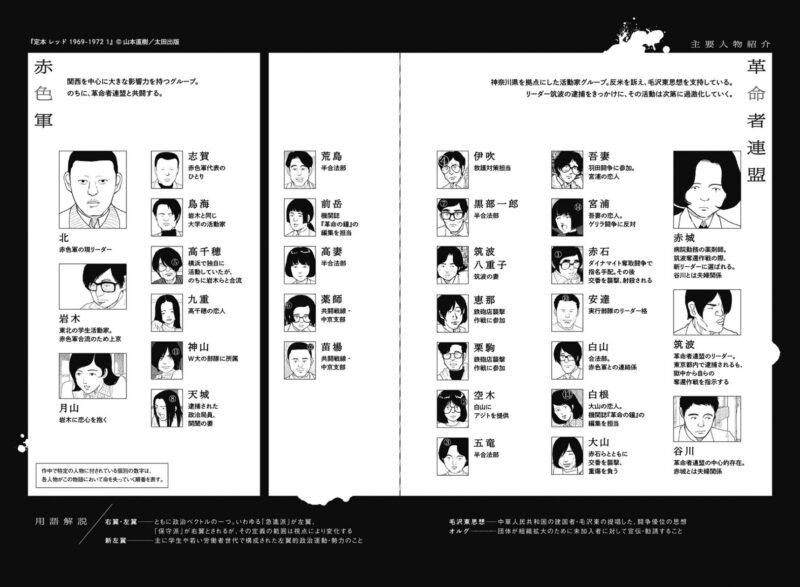
Correlation of "Red" characters
Yoko Akagi
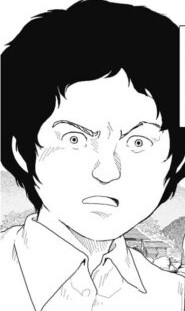
Source: ohtabookstand.com
Yoko Akagi. Former leader of the "League of Revolutionaries" and number 2 of the "Red League
The model is Yoko Nagata. She is a female activist and one of the central characters in this film. She is the wife of Tanigawa, the number three of the Red League.
She used to be a pharmacist working at a hospital, but left her job to pursue her activism. Believing that guerrilla struggle is the only way, she enthusiastically devotes herself to the activities, but often clashes with the members of the federation and reveals her feelings.
In 1970, he became the leader of the organization in recognition of his energetic activities.
After the establishment of the Red League, he took the number two position and led repeated "lynchings" in the name of "helping to sum up.
During an undercover mission to a hideout in Tokyo to collect money, she married the leader Kita and at the same time announced her divorce from her husband Tanigawa. On her way to the Myogei base, she was surrounded by police and arrested without a second thought.
Tanigawa
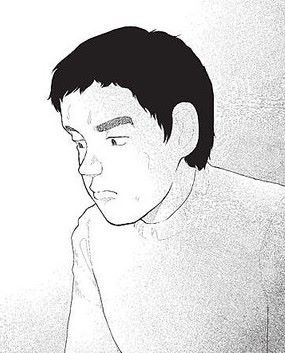
Tanigawa. He is the husband of Yoko Akagi, a former central figure in the League of Revolutionaries. He is the number three of the "Red League.
The model is Hiroshi Sakaguchi. He is a central figure in the League of Revolutionaries and the number three of the Red League.
As his comrades were arrested one after another, he proposed that the organization, exhausted from its life in hiding, move its base of operations to the mountains. After the formation of the Red League, he had doubts about the escalation of the harsh "generalization" of the organization, but he joined it himself, fearing that he would be the one to bear the brunt of it. However, the repeated deaths of his comrades caused him to feel remorse, and his wife, Akagi, demanded a divorce and a summary of the situation because she saw his behavior as problematic.
He was later arrested, and in place of Kita and Akagi, he took command of the group and led them across the mountains. He was one of the survivors of the Asama Sanso holocomes.
Morio Kita
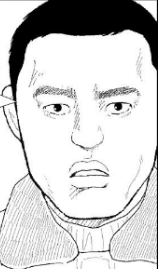
Kita Morio, leader of the "Red League."
The model is Tsuneo Mori. He is the leader of the "Red Army" and the leader of the "Red League" after the reorganization.
He was once a petty thief who was afraid to fight against the "Central Faction," but after the arrests of many members of the upper echelons of the organization, he was able to seize the position of leader as an out-of-jail member.
While fighting for supremacy with Akagi in the "Red League," he was the ringleader of lynching and killing many members in the name of "summing up" those who acted as his rebels in the name of "communization.
In the end, he and his wife Akagi, whom he had just declared his marriage to, were arrested by the police force without a second thought.
Amagi
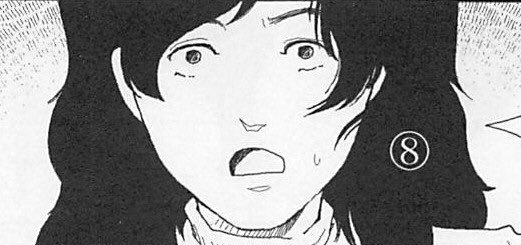
The model is Mieko Toyama. A beautiful woman with long hair, she later joined "Yama.
Terms of "Red
League of Revolutionaries
A new leftist organization based in Kanagawa that takes a guerrilla struggle line based on Maoist ideology. It was modeled after the Kanagawa Committee of the Japanese Communist Party (Revolutionary Left).
At the end of 1969, many of its main members, including its leader Tsukuba, were arrested and suffered a devastating blow.
The radical and peculiar activities of the JCP had been criticized by other factions, who feared that it would be isolated from the masses, but in 1970, the JCP suddenly gained attention and support from within the New Left after it dared to shoot up a police box.
The organization's official name is the "Kanagawa Committee of the League of Revolutionaries," but its main members, Aoaki and Tanigawa, have a base of operations in Ibaraki, and are often ridiculed for this.
The helmets used in the struggle are plain white with the word "leather" written on them, and the organization publishes a journal, "Kakumei no Kane" (modeled after the Liberation Flag).

Tags
Contents
- Overview of "Red
- Synopsis and story of "Red.
- Alliance of the League of Revolutionaries and the Red Army
- Formation of the Red Federation and Asama Sanso
- Characters and characters in "Red
- Yoko Akagi
- Tanigawa
- Morio Kita
- Amagi
- Terms of "Red
- League of Revolutionaries
- Red Federation (i.e. communist guerrilla soldiers who fought in the Vietnam War)
- firearms store attack
- Operation G is a go!
- Famous quotes and lines from "Red" / Famous scenes and scenes
- Amagi: "I just want to live...I don't want to die..."
- Backstory, trivia, small stories/episodes, and anecdotes from "Red
- The numbers marked on the heads of the characters are the order in which they died