
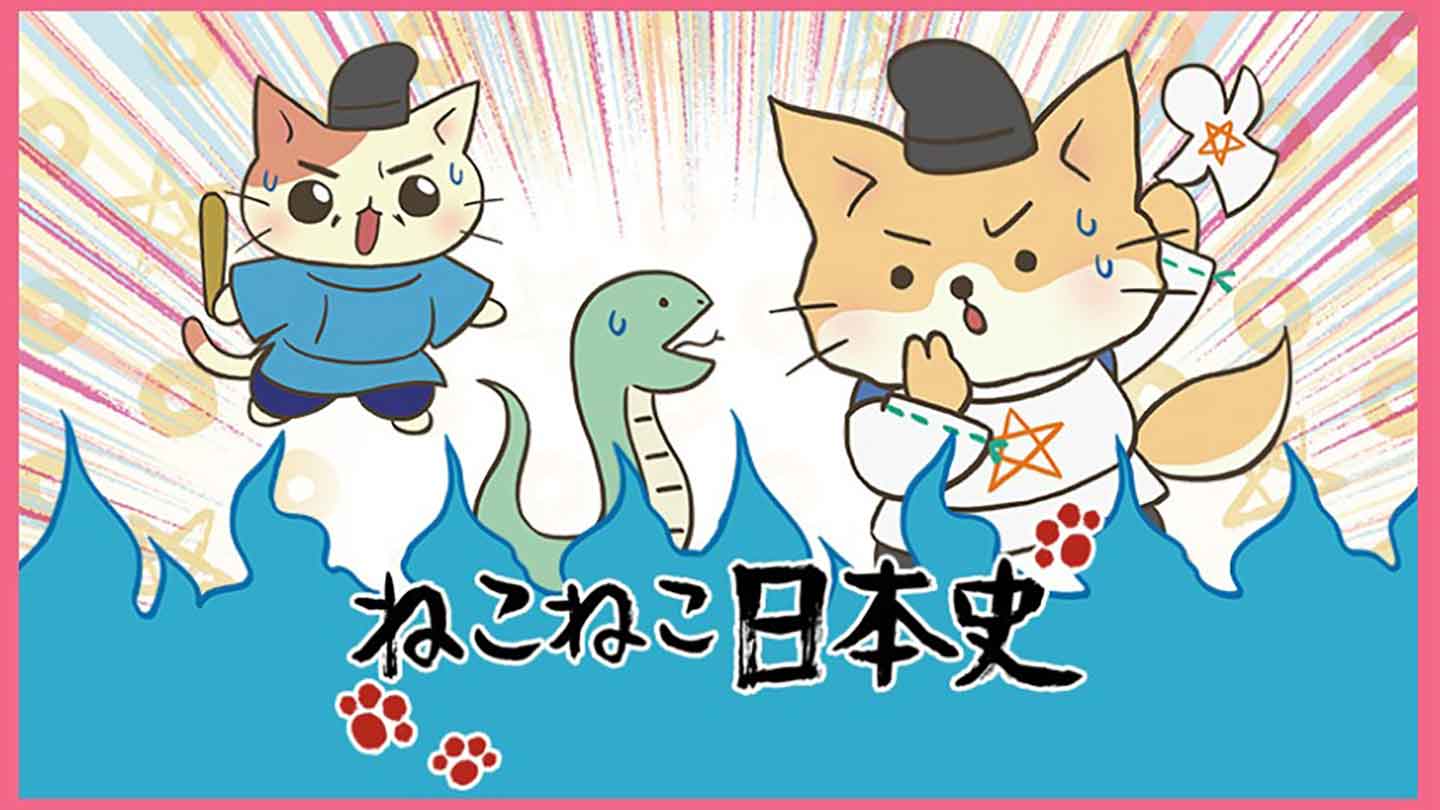
Nekoneko Japanese History" is a four-frame learning manga about Japanese history by manga artist Shigeji Soni, as well as an animated film based on the manga. The creator wanted to create a history learning manga that even small children could enjoy, and drew all the characters in Japanese history as cats. While the content is loose and cute, it is also educational and surprisingly closely follows historical facts. The manga has exploded in popularity, especially among elementary and junior high school students, and has been widely developed through the sale of character goods and related books, as well as through animation and film adaptations.
Outline of "Neko Neko: A History of Japan
Nekoneko Japanese History" is a four-frame manga serialized by manga artist Sonishige on Jitsugyo no Nihonsha's web comic site, "COMIC Ruel. Since his childhood, Sonishige has loved history, and when he was preparing for entrance exams, he studied by reading history study manga. With this experience, he wanted to create a history study manga that even small children could enjoy. He came up with the idea of making all the characters cats, and drew one short story of 6 to 8 pages with Himiko as the main character. The manuscript caught the attention of Jitsugyo no Nihonsha, which decided to publish it in a web magazine. The medium was not limited to manga, but was also adapted into an anime, which was broadcast on NHK E-television from April 2016 to March 2021. The anime is narrated by Koichi Yamadera and the main character is basically played by Yu Kobayashi. It has also been made into a movie, "Nekoneko Nihonshi: Ryoma's Hochamecha Time Travel Zeyo! was released in theaters on February 22, 2020 and became a hot topic. The book has also been published as a picture book, game application, novel, and more. The "Nekoneko Japanese History Official Goods Shop" is also available on the website, where you can choose your favorite character's design and purchase T-shirts, hoodies, mug cups, and other items.
After the manga is finished, Tomohiro Fukuda, a historical researcher, checks the manga to see if there are any differences from the historical facts, and the manga is then revised and completed.
The title "Nekoneko Japanese History" does not mean a history of Japan in terms of cats, but rather a "history of Nekoneko Japan," and since the story takes place in a small country of cats, it is not an actual history of Japan. Each volume of the manga features about 12 great figures and contains about 15 four-frame cartoons related to each of them.
The most attractive point of this work is that, unlike conventional history study manga, it is not "read for study" but "read for fun. By transforming historical figures into cats (and some other animals), the manga makes readers feel attached to the characters, and by making them laugh with gag cartoons, it is a unique history study manga.
The story of "Neko Neko: A History of Japan
Volume 2: Emperor Joto (from the Asuka Period)
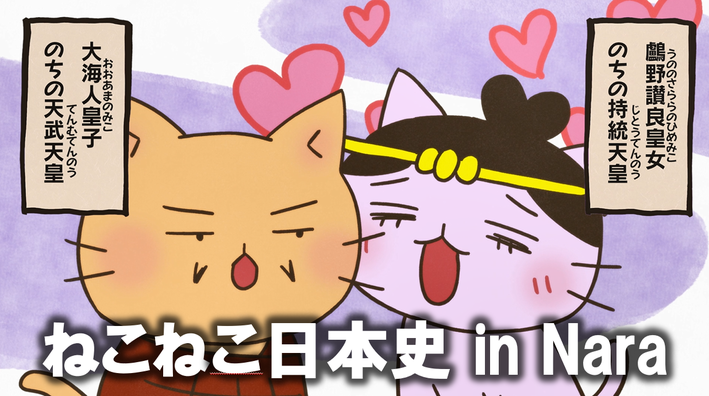
Emperor Ohkaijin (left) and his wife, Princess Chanara Nogino (right), discussing the next emperor.
In 671 A.D., Emperor Tenchi died, and his cat Emperor Ohami no Miko (later Emperor Temmu) and his wife Princess Norno no Sansara no Himeko (later Emperor Jito) discussed the next emperor. Princess No-no-sanrya was "my child! and recommended her son, Kusakabe no Mikoko, who was six months old (nine years old in human terms). However, the next emperor would be either Prince Omijin or his nephew, Prince Otomo, in that order. In the end, the next emperor was decided to be Otomo. Since Princess Nogano Sanra planned to make her own son Kusakabe Emperor in the future, she led a large army to Otomo in order to make her husband Emperor Ohmito the Emperor. This is called the Jinshin Rebellion. Prince Ohkaijin was reluctant to fight, but Princess Chanrya Nogino said, "Wait a minute! There is no need for you to take command! If anything should happen to you... he (Kusakabe) will not be able to become emperor. Prince Ohkaijin retorts, "So that's it! he retorted. The battle was to be led by Prince Takechi, the oldest of the princes, whom Princess Nogino Sansara had appointed to lead the battle. Princess Sorara No-No-Imaterasu was fond of Prince Kusakabe, saying, "Even if he fails, he is not my son! She was very fond of Kusakabe no Miko, saying, "Even if he fails, he is not my son! Prince Koichi won a series of victories, and Prince Otomo committed suicide.
In 673 A.D., Prince Omijin became Emperor Temmu and Princess Sansara Nozano became Empress. In 679 A.D., Emperor Temmu ordered the princes to refrain from fighting, to which they replied cheerfully, "Nakayoshi shimasu! to which the princes replied cheerfully, "Let's be friends! This is called the "Yoshino pact. In 686, Emperor Temmu died. The empress said, "Well, Kusakabe-chan, it's the Emperor's debut! Kusakabe-chan, the Emperor's debut! She exclaimed. However, since Emperor Otsu was superior to Kusakabe in every respect, and everyone thought he was the best choice for Emperor, the Empress planned to have Otsu put to death. Otsu no Miko fell for the ploy and was condemned to death. However, Kusakabe died of illness. The empress said, "Now that it is so, my grandson! She said, "So be it. Her grandson, Karunomiko, was four months old at the time (seven years old in human terms). The Empress (later Emperor Jito) was a woman who would not give up.
Volume 11: Emperor Kouken (from the Nara Period)
In 756 A.D., Emperor Shomu died and a new government was formed with his daughter, Emperor Kōken, and the emperor's wife, Empress Dowager Komyo, assisted by Fujiwara no Nakamaro. Emperor Kouken's successor was Emperor Shomu's last will and testament, and the Crown Prince was to be King Fuu etc. Emperor Kouken and Empress Dowager Komyo stopped this decision, and a new Crown Prince, King Ootaki, was appointed. In 758 A.D., Ootaki changed his name and ascended the throne as Emperor Junnin. Emperor Kouken became the Jounin Emperor. Emperor Kouken said, "Nakamaro! Play with me! but he changed his name to Emi no Oshikatsu (Emi is the name of the Emperor's wife) and went to work taking care of the Emperor, while Empress Dowager Komyo was also busy. In 760 A.D. Empress Dowager Kōmyō died, and Emperor Junin and Emi Oshikatsu took over the real power. In 761 A.D., Emperor Kōhen fell ill and recuperated at the Hōra Palace, where he was cured by the healing effects of the high priest Dōkyō. The following year, the emperor moved to Hokkeji Temple and was ordained. The following year, the emperor moved to Hokkeji Temple and was ordained. The emperor became completely attached to Dokyo and said, "I will follow my master for the rest of my life. The emperor asked Emperor Junnin, who had also benefited from Dos Kagami's healing effect, for his consent, saying, "From now on, I will do all the major work. Then, "That is unforgivable! Emperor Kohken ordered Kibi-no-Makibi to defeat him, and the rebellion was quelled.
In 764 A.D., Emperor Junin was dethroned and Emperor Kohken became emperor again, but this time as an ordained emperor. Emperor Shoutoku began his career as Emperor Shoutoku, but he did not like his job and planned to make Dōkyō an emperor. First, he tries to make Michikagami a pope and force him to do the job, but he is stopped by others. In 769 A.D., a messenger comes from Usa Hachiman Shrine to deliver a divine oracle and tells him to make Michikagami the next emperor, but it is discovered that Emperor Shoutoku had actually had the messenger read a kampeh. He sends Wake-no-Kiyomaro to Usa Hachiman Shrine to confirm whether this oracle is true or not. When he returned, Wake no Kiyomaro said, "Michikagami must not be made emperor. The angry Emperor Shoutoku changed Wake-no-Kiyomaro's name to Wakeshi-no-Kitanamaro and sent him into exile. In the end, Michikagami was not able to take the throne, and Emperor Shoutoku worked until his death.
Volume 10: Sei Shonagon (from Heian Period)
Sadako Fujiwara, Empress of Emperor Ichijo, shows Sei Shonagon (courtesan of Sadako) a piece of paper, saying, "Look at this - my brother Korechika gave me a piece of paper. Emperor Ichijo said he was going to transcribe "Shiji," and Sei Shonagon invites Sadako to join him. "Let's use it as a pillow," she says, and the two begin to doze off with their chins resting on the paper. As they dozed, Sei Shonagon came up with such ideas as "Dawn is the most beautiful in spring," "Night is the most beautiful in summer," "Dusk in autumn," "Early morning in winter," "...but I don't like it when it gradually gets warmer at noon," and when she awoke, she wrote them down on paper. Thus, "The Pillow Book" was born. Sadako and Shonagon continue to doze off on the paper. In a dream, an event of a certain day comes to mind in their minds. Sadako says, "What's it like to see snow on Koromine?" Shonagon raised the noren to show Sadako the snowy scene, based on a poem by Shirakuten, which says, "The snow on Korobo Peak is seen from a blind. Sei Shonagon also wrote about this on a piece of paper. In this way, Sei Shonagon dozes off on a piece of paper and writes down the events of her daily life, thus creating "The Pillow Book. When Minamoto no Tsunefusa, the governor of Ise, caught sight of it, he said to himself, "This is interesting! Let's show it to everyone," and the Pillow Book became widely known.
Volume 4: Ashikaga Yoshimitsu (from the Muromachi Period)
When Ashikaga Takauji, the grandfather of Ashikaga Yoshimitsu, the founder of the Muromachi Shogunate, died, his son, Yoshinori, had a son, Yoshimitsu. Yoshimitsu bore a striking resemblance to Takauji. Yoshinori left Yoshimitsu in the care of his vassal, Yoriyuki Hosokawa, who died. The young Yoshimitsu became the third Shogun. In 1378 A.D., Yoshimitsu built a splendid residence in Muromachi and destroyed Tokiyasuyuki of Mino in 1390 A.D. and Ujikiyo Yamana of San'in in 1391 A.D. Thus, the Muromachi Shogunate was stabilized, and furthermore, Yoshimitsu retrieved the three sacred treasures in the Southern Court and handed them over to the Northern Court, unifying the Northern and Southern Courts. In 1394 A.D., he handed over the shogunate to his son Yoshimochi, who became Grand Minister of State, the highest rank of the court nobility. In 1395 A.D., Yoshimitsu ceased to be Minister of Grand Council of State and became a monk. Yoshimitsu was ordained and built Kinkakuji Temple as his new home. In 1401 A.D., "The shogunate ran out of money!" and decided to trade with Ming Dynasty. The Ming offered the following conditions for trade with Japan: "We must crack down on the pirates, the Japanese pirates," and "Japan must become a retainer of the Ming Dynasty. Yoshimitsu defeated the pirates, and trade between Japan and Ming China began as Ming's retainer. The Muromachi Shogunate was greatly enriched.
Volume 3: Matsuo Basho (from the Edo period)
Edo, 1680 AD. Matsuo Momosei (later Basho) was a haikai master of the Danrin school who scored the haikai of rich cats. He moved to Fukagawa in the countryside and decided, "I'm going to train myself in haikai from scratch here! He decided to do so. One of his pupils, Sanpu, prepared a hut, but the hut was a guard hut for a carp pond, and the cats were too worried about the carp to concentrate on their haikai. So, he planted a Japanese cabbage plant around the koi pond so that the koi would hide in it. Momoqing liked to sleep under the leaves of the banana instead of practicing his haikai. When people saw this, they said, "That's not Matsuo Momoaki, that's Matsuo Basho," and the name Matsuo Basho was born. If I don't do something, nothing will come to mind! Basho decided to set out on a journey. He began his first journey with his pupil Chiri, and completed a new haikai, "The Sound of Water Tipping Into an Old Pond". After that, he wrote "One more step, a trip to Kashima," "Tenpai," and "Kashima Travels! Kashima Travels" and "Tenkomori! Waka no ura, Nara, Osaka, Suma, Akashi, Kyoto, man! A journey of oi no kobun" "How about this? Great Satisfaction! Otsu, Gifu, Nagoya, Narumi, Sarashina & Zenkoji! Sarashina Travels. Basho then embarked on his greatest journey, "Walking with Sora, the Tour Guide, 2,400 km long! He composed a series of famous haiku along the way.
Characters in "Nekoneko Japanese History
the characters (in a play or novel)
Himiko (Himiko)
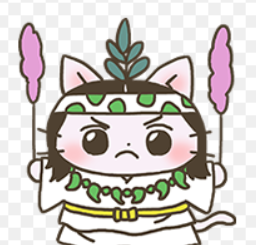
Queen of the Evil Kingdom in the late Yayoi period, around the 3rd century. She was born around 170 and died between 247 and 248. She is depicted as a black-haired cat holding a catnip in each hand, wearing a slender necklace of slender balls, and dressed in a white kimono.
Shotoku Taishi
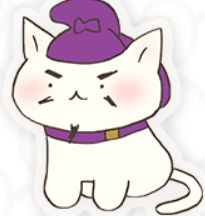
Imperial family member and politician of the Asuka period, born in 574 and died in 622. In recent years, he is often referred to as Emperor Umayado. He is depicted as a wise-looking white cat with a beard.
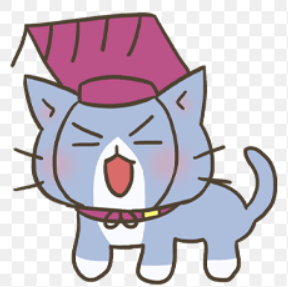
Emperor Shomu

Contents
- Outline of "Neko Neko: A History of Japan
- The story of "Neko Neko: A History of Japan
- Volume 2: Emperor Joto (from the Asuka Period)
- Volume 11: Emperor Kouken (from the Nara Period)
- Volume 10: Sei Shonagon (from Heian Period)
- Volume 4: Ashikaga Yoshimitsu (from the Muromachi Period)
- Volume 3: Matsuo Basho (from the Edo period)
- Characters in "Nekoneko Japanese History
- the characters (in a play or novel)
- Himiko (Himiko)
- Shotoku Taishi
- Emperor Shomu
- Michinaga Fujiwara
- Minamoto no Yoritomo
- Ashikaga Takauji
- Shingen Takeda
- Nobunaga Oda
- Tokugawa Ieyasu
- Tsunayoshi Tokugawa
- Oishi Kuranosuke
- Ryoma Sakamoto
- Emperor Jito
- Ganjin
- Saicho
- Kukai.
- Murasaki Shikibu
- Date Masamune
- Yukimura Sanada
- Musashi Miyamoto
- Yoshimune Tokugawa
- Tadataka Ino
- Heihachiro Oshio
- Isami Kondo
- Toshizo Hijikata
- Soji Okita
- Taira no Masamado
- Kiyomori Taira
- Ii Naotora
- Hideyoshi Toyotomi Hideyoshi
- Mitsunari Ishida
- Oichi.
- Cha-cha-cha.
- Matsuo Basho
- Gennai Hiraga
- Yoshida Shoin
- Atsuhime
- Natsume Soseki
- Nakatomi no Kamatari
- Yoshimitsu Ashikaga
- Dosan Saito
- Motonari Mori
- Sen no Rikyu (Sen Rikyu)
- Hanbei Takenaka
- Hosokawa Galasha
- Kanetsugu Naoe
- Kasuga bureau (Kasuga no Tsubone)
- Katsushika Hokusai
- Kinjiro Ninomiya
- Shinsaku Takasugi
- Michizane Sugawara
- Abe no Seimei / Haruaki / Haruakira / Hareakira
- Shizukagozen
- Soujun Ikkyuu
- Tomiko Hino
- Yoshikage Asakura
- Eitoku Kano
- Toshie Maeda
- wait
- Hattori Hanzo
- Jubei Yagyu
- Shintaro Nakaoka
- Yamato Takel (god of war)
- King Nukata
- Fujiwara no Sadaie/Teika
- Masako Hojo
- Unkei
- Soun Hojo
- Masayuki Sanada
- Chosokabe Motochika
- Yoshihiro Shimazu
- Kiyomasa Kato
- Monzaemon Chikamatsu
- Sakuma Shozan (Sakuma Shozan/Zozan)
- Otomo no Yakamochi
- Tomoe Gozen
- Kaneyoshi Houshi
- Kansuke Yamamoto
- Mitsuhide Akechi
- Yoshiaki Ashikaga
- Sorin Otomo
- Hidenaga Toyotomi (Hideyoshi Toyotomi)
- Issa Kobayashi
- Yoshimune Tokugawa
- Sadanobu Matsudaira
- Tadakuni Mizuno
- Yae Niijima (Yae)
- Kakimoto Hitomaro
- Kamo no Choumei / Kamo no Naga Akira
- Naoyoshi Ashikaga
- Kanami (Kanami/Kannami)
- Zeami
- Sesshu
- Tsukahara Toden
- Hisahide Matsunaga
- Princess Nohime (Princess Nohime/Nohime)
- Princess Kai
- Ihara Saikaku
- Ogata Koan
- Kogoro Katsura
- Fujiwara no Fuhito
- Empress Koumyou
- Hōhō Go-Shirakawa
- Takanobu Ryuzoji
- Katsuie Shibata
- Yodo-dono
- Tadakatsu Honda
- Kojuro Katakura
- Enku
- Kahee Takataya
- Rinzo Mamiya
- Shusaku Chiba
- Sakanoue no Tamuramaro
- Emperor Kammu
- Kusuko Fujiwara
- Sei Shonagon
- Masashige Kusunoki
- Shiro Amakusa
- Xavier.
- Hiroshige Utagawa
- Genpaku Sugita
- John Manjiro
- Eiichi Shibusawa
- Emperor Kouken
- Yoshitomo Minamoto
- Yoshitsune Minamoto
- Yoshitoki Hojo
- Shinran (third highest of the eight hereditary titles)
- Yoshitaka Kuki
- bed-time (for a baby)
- Ujimasa Hojo
- Korin Ogata
- Koshitaro Ito / Kinetaro Ito
- Taisuke Itagaki
- Ryunosuke Akutagawa
- Abeno Nakamaro
- Sadako Fujiwara (Fujiwara no Sadako/Stay)
- Tokimune Hojo
- Honen
- Kenshin Uesugi
- Izumo no Okuni
- Takakazu Seki
- Kaishu Katsu
- Hirobumi Ito
- Rampo Edogawa
- Soga no Umako
- Ono no Komacho
- Tokitaka Tanegashima
- Hidetada Tokugawa
- Senhime (Princess Sen)
- Ii Naomasa
- Hideaki Kobayakawa
- Mune-shige Tachibana
- Yoshinobu/Yoshihisa Tokugawa
- Toshimichi Okubo
- Tsuyoshi Inukai
- Makibi Kibi
- Izumi Shikibu)
- Akiko Fujiwara / Shoshi)
- Yamana Sozen/Yamana Mochitoyo)
- Amago Tsunehisa
- Yoshimoto Imagawa
- first (in a series)
- Araki Mataemon
- Nobunaga Motoori
- Takamori Saigo
- Takashi Hara/Kei Hara
- Akiko Yosano)
- Terms of "Nekoneko Japanese History
- green foxtail (species of annual grass, Setaria viridis)
- canned food
- Lemon Juice Attack
- Unfamiliar
- Famous quotes, lines, scenes, and scenes from "Neko Neko: A History of Japan
- Jomon man (cat) goes inside an earthenware vessel
- Christian missionary
- sound as produced by this alarm
- Ordained by Dozo Saito
- Backstories, trivia, and small stories/episodes/anecdotes of "Neko Neko: A History of Japan
- The film's protagonist is a modern boy cat.
- Spin-off manga of "Neko Neko Nihonshi" is now serialized in Yomiuri KODOMO Newspaper.
- Cats are classified according to the image of the characters
- Theme song and insert song for "Nekoneko Nihonshi
- Animation 1st season
- OP (opening) / ED (ending): "Chérie!" by Team Shachihoko (episodes 1 - 20)
- OP (Opening) : Team Shachihoko "Yume de mo iino" (Episodes 21-32)
- ED (ending): Team Shachihoko "Himitsu no Serenade" (episodes 21-32)
- Animation 2nd season
- OP (Opening): Oshare Track Factory "Kono Oto Connection" (Episodes 33-50)
- ED (Ending): Brian the Sun "Neko no iru fukei" (Episodes 33-50)
- OP (Opening) : Charan Po Lantern "Neko no Te Borrow" (Episodes 51-64)
- ED (Ending) : Takoyaki Rainbow "Nareta nara nara" (Episodes 51-64)
- Animation 3rd season
- OP (Opening) : Brian the Sun "Polaris" (Episodes 65-84)
- ED (Ending): hoval "Cat Balloon" (Episodes 65 - 84)
- OP (Opening): elfin' "Gururuponpon Daisakusen" (Episodes 85-96)
- ED (Ending): Diana Garnett "Thank you for the Music" (Episodes 85-96)
- Animation 4th season
- OP (Opening): elfin' "Funyan Hero" (Episodes 97-117)
- ED (Ending): Diana Garnett "Hello Again" (Episodes 97-117)
- OP (Opening): elfin' "Kimagure☆Nyannyan History! (Episodes 118-128)
- ED (Ending): Mugi (cat) "Nekko Hotte" (episodes 118-128)
- Animation 5th season
- OP (Opening): Girls2 "Guru Guru" (Episodes 129-143)
- ED (Ending): Toshiki Kondo feat. ASOBOiSM "Nekojaraso eru keru mahou himiko" (Episodes 129-143)
- OP (Opening): Girls2 "Japanese STAR" (Episodes 144-160)
- ED (Ending): Girls2 "Nekoneko Nihonshi oboe uta - Zenjidai marukawa♪" (episodes 144-160)